














✅ 2026 Mayoral Candidate Questionnaire The Blue Mountains | The Shulman Report
Background
On 30 August, the three candidates for mayor of The Blue Mountains were each sent the same twenty-two questions. Not a survey — twenty-two questions about the water and wastewater debt, the overrun on the three sewage projects, the two bills every household pays, the Campus of Care, Grey Road 19 and how they would run the Town. Written answers, in their own words, at length.
Here is what happens next, so you know what you are getting and when.
Two questions a day, every day, until they are all out. One post for The Blue Mountains, one for Collingwood, published together. The last one lands on 3 October. In this town there are no paper ballots at all — internet and telephone voting runs from 16 to 26 October — so everything is published well before it opens.
The first fourteen questions are identical in both towns. The four candidates for mayor of Collingwood received a parallel questionnaire the same day, so for the next seven days you can read a Blue Mountains answer here and the Collingwood answer to the same question in the other post. As far as I know, these two councils have never been asked the same questions side by side before. That was the point of writing them in parallel.
Every answer appears in full and unedited. Nothing is summarised, trimmed or characterised. I do not rate the answers, score them, or tell you who won a question. That is your job and you do not need my help with it.
What I add is one short note above each question, headed The issue. It is not about the candidates. It is about why the question is on the list — the report, the number, the decision or the missing document that made it worth asking. Some of these look dry until you know what sits behind them. The note is the reason for the question. The answers are the candidates’ own.
Where I hold a position myself — and on a municipal services corporation, on amalgamation and on regional government I do — it was disclosed on page one of the questionnaire every candidate received, and it is disclosed again here, above the question it touches. You will always be able to tell my words from theirs. Mine are in the note. Theirs are everything below it.
Candidates appear in alphabetical order throughout.
TBM — Question 1: Priorities
1. Priorities
The issue
Every candidate says infrastructure, affordability and accountability matter. That costs nothing to say. The question is what happens when they collide in one budget, and in this town they already have: reserves have fallen from roughly $82 million in 2021 to a projected $6.7 million by the end of this year, about $99 million of projects is committed and under way with more than $150 million further planned, and the asset management reserve stands at roughly $1.8 million. A mayor who will not say which priority gives way is telling you they intend to decide it later, in a budget meeting most residents will never watch. So the question is put plainly: rank them, and name the one that loses.
The question asked: Rank your top three priorities for the 2026–2030 term. For each, outline what you would actually do, and by when. If they compete for the same dollar in the 2027 budget, say which one gives way.
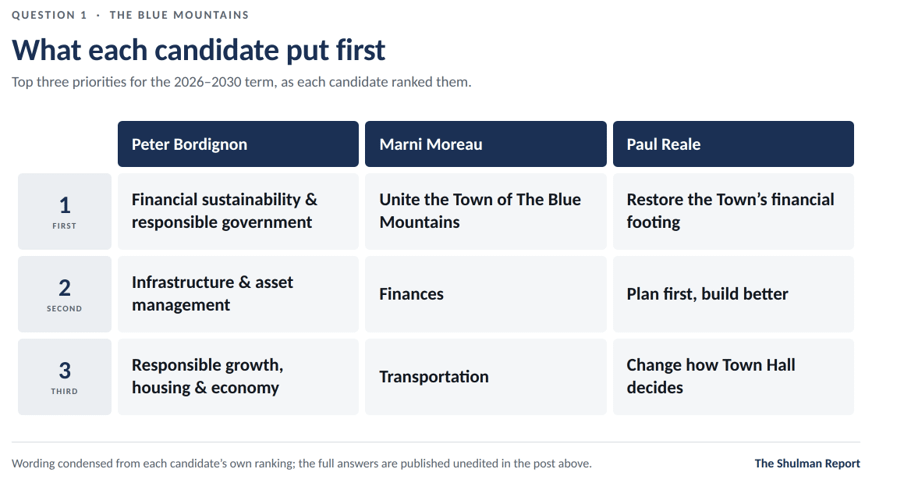
Peter Bordignon
1. Financial Sustainability & Responsible Government
2. Infrastructure & Asset Management
3. Responsible Growth, Housing & Economic Opportunity
1. Financial Sustainability & Responsible Government: Put the Town on a stronger long-term financial footing by rebuilding reserves, improving financial planning and ensuring taxpayers receive value for every dollar. I would also review municipal fees and by-laws to ensure they are fair, understandable and tied to the actual cost of providing services.
2. Infrastructure & Asset Management: Strengthen how we plan, fund and maintain the infrastructure we already own while preparing for the infrastructure needed to support growth. This includes better long-term asset management, clear capital priorities and making sure we understand the full financial impact before taking on major new commitments. I would also explore how a Municipal Services Corporation could create efficiencies, improve service delivery and provide long-term financial value for the Town.
3. Responsible Growth, Housing & Economic Opportunity: Manage growth in a way that respects the character of our communities while ensuring servicing and infrastructure keep pace. We need more housing choices, including rental and attainable housing, and we need to create an environment where local businesses can grow and where new investment and employment opportunities are welcomed.
All are very important and must be addressed through the budget process in both the operational and capital budget processes.
Marni Moreau
1. Unite the Town of The Blue Mountains
2. Finances
3. Transportation
1. Unite the Town of the Blue Mountains: Our Town is at a crucial moment. We need to hire a Director of Operations, Planning, and Corporate and Financial Services. I would look to change the tone in Town Hall to be one of collaboration and innovation under a consensus building leader that brings everyone in. We have many skilled residents in the area that are willing to contribute and we should take advantage of their skills and resources. I grew up here and understand the interconnections of TBM, our integrated tourism driven economy and our agricultural rural communities. Additionally I understand and appreciate the seasonal homeowners who come here, often for decades (sometimes for generations!) and frequently retire here. If elected mayor, I’d get everyone at the same table working together.
2. Finances: Look at the asset management plan and update forecasts. We cannot plan on numbers that are outdated or based on unprecedented times of expansion. Building permits are down and the economy is subject to international trade tensions. There’s no sense in building for what isn’t coming. Establish a budget with clear oversight and communication protocols. We need to look at what we must build, how to finance and manage it. Defining the difference between wants vs needs will clarify budget priorities. And finally fix our project management. The $19 million over budget Bay Street project was due to bundling multiple projects, inadequate regular reporting requirements with budget checks and a lack of sufficient triggers for Council participation and resident communication. We must have staff implement those changes for every project.
3. Transportation: A point-to-point transportation mode must be supported as soon as possible. I would look into innovative solutions such as the app based electric van system like the one presented to Town by ARGO. The lack of options negatively affects everyone in the Town of the Blue Mountains, Including tourists, people trying to get to medical appointments, youth and workers.
The first priority would be an examination of the asset management plan to determine current forecast accuracy in this economic climate and make tough decisions about what moves forward and what is delayed or cancelled. I would prioritize not increasing resident taxes. Consulting extensively with the other six members of Council I would put forward a budget I would hope we could agree on and move forward quickly. Like my father Peter Moreau who persuaded Leonard Shore to champion the LE Shore Library, I would use named gifts and partnerships to tap into additional resources and use the Community Improvement Plan for things that ratepayers want such as supporting healthcare or passion projects like the Georgian Triangle Humane Society.
Another priority would be to look at budget items from an overall perspective, for example creating a Parks and Trails Master Plan for the entire municipality before committing to Moreau Park. My goal is to achieve these things in the first 6 months. Parks are from a specific reserve fund so that wouldn’t pull from anything else. When priorities compete for the same dollar in the 2027 budget, we look at forecast assumptions first, needs second and in tandem with private/public partnerships and other funding possibilities. After that tackle tough decisions on re-sizing, delaying and cancelling other projects.
Paul Reale
1. Restore the Town’s financial footing.
2. Plan first. Build better.
3. Change how Town Hall makes decisions.
My first priority is to get the Town’s financial house in order. In the first 100 days, I would review the operating budget to protect core services and analyze the capital program and 10-year plan to decide what starts, stops, pauses, or continues. If we treat everything as a priority, then nothing is a priority.
Second, “Plan First. Build Better.” In the first year, I would seek council approval for a requirement that major project and growth proposals address infrastructure, costs, timing, environmental constraints and community needs before council commits.
Third, from day one, I would work with council to give staff clear direction and the support and resources needed to deliver, with council accountable to residents for results.
If these compete for the same 2027 dollar, new discretionary spending under #3 waits, but not resources needed for core services. Changing how we work starts immediately.
The three rankings side by side
Question 2: The tax levy, and the commercial base
The Shulman Report · 2026 Mayoral Candidate Questionnaire
Second of twenty-two questions put to the three candidates for mayor of The Blue Mountains on 30 August. All three returned a questionnaire. Every answer below appears in full and unedited. The note headed The issue is mine; everything under a candidate’s name is theirs. The series, and how to read it, is explained in the Question 1 post.
2. The tax levy, and the commercial base
The issue
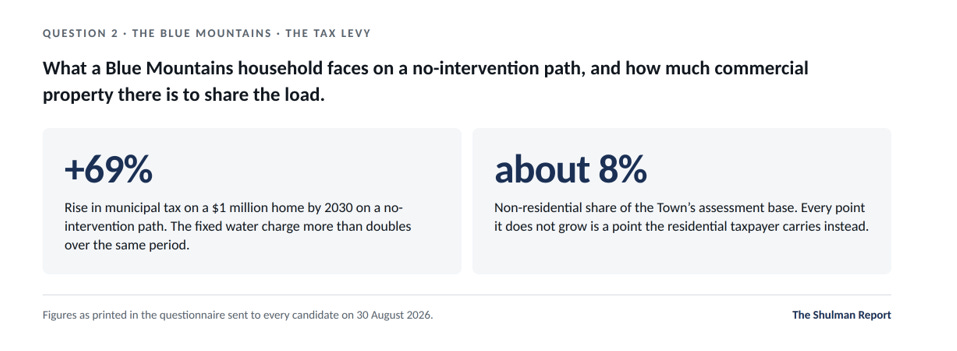
Two numbers sit behind this question. The first is the levy itself, and on a no-intervention path the municipal tax on a $1 million home here rises about 69 per cent by 2030 while the fixed water charge more than doubles. The second is quieter and matters more over a term: non-residential property makes up roughly 8 per cent of this town’s assessment base. That is a very small commercial shoulder for a town carrying this much infrastructure, and every point it does not grow is a point the residential taxpayer carries instead. A candidate who names a commercial target is taking on something measurable. A candidate who will not name a levy number should at least be naming something they would stop doing.
The question asked: Over the 2026–2030 term, the average annual levy increase I will work toward is [below inflation / at inflation / inflation + up to 3% / more than inflation + 3% / I will not commit to a number]. Non-residential property makes up roughly 8 per cent of the Town’s assessment base; over the term I would work toward [a stated numeric target / growth without a target / no change]. Outline your fiscal platform. Name at least one specific service, programme or project you would reduce, defer or eliminate.
Peter Bordignon
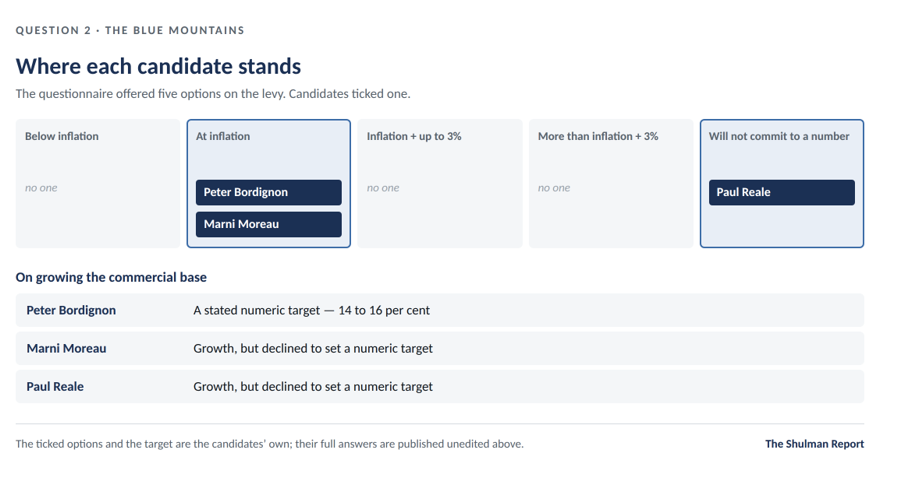
☒ At inflation
Commercial base: ☒ A stated numeric target — 14–16%
My fiscal platform is straightforward: protect essential services, control operating growth, rebuild reserves and prioritize the infrastructure we need.
I won’t promise an arbitrary tax cap without being honest about the consequences. Before the 2027 budget, I would require a review of discretionary spending, service levels, user fees and capital priorities, looking for savings before asking taxpayers for more.
By-law enforcement is one area I would examine closely, particularly whether we can streamline processes, reduce administrative costs and focus enforcement resources on the issues that matter most.
I would also review parking, dog licensing and other fees to ensure they’re fair and reflect the cost of service.
If a levy increase is still necessary after those measures, I’ll be upfront about it. My goal is responsible taxation, not simply the lowest number.
Marni Moreau
☒ At inflation
Commercial base: ☒ Growth without a target
I would reduce the use of consultants. We have too many unused reports sitting on a shelf. I would support the new restructuring of Staff. I would consider the forecasting for our large infrastructure projects and look at how the recent dip in building is affecting our revenue, and our asset plans. There is no sense in overbuilding infrastructure based on previous unprecedented growth numbers. Having seasonal homeowners that do not use many Town services but pay taxes has been an advantage. When the results of the 2026 census come back we must plan Craigleith to transition from a Resort Area to a Settlement Area. The town of Thornbury and Clarksburg is partially protected from sprawl by the Special Agriculture land that surrounds it. This has also limited our ability to find land zoned for light industry. I would look into supporting the many work from home businesses that make it possible for all types of companies to thrive here as well as opportunities for light industry.
Paul Reale
☒ I will not commit to a number
Commercial base: ☒ Growth without a target
I will not promise a levy percentage before we know what the Town must provide and what those obligations will actually cost.
I would build a five-year financial plan showing the cost to complete, finance, operate and maintain our existing commitments, and test what happens if grants or development charges fall short.
That plan would guide which capital projects start, continue, pause or stop. I would review spending, staffing and contracts to set achievable savings targets for 2027, while protecting the services the Town needs to provide and reporting publicly on results.
As one specific deferral, I would defer scheduled replacements in the 2027 IT Continuous Improvements program where existing equipment remains reliable and fit for purpose, while protecting cybersecurity and essential service delivery.
Where each candidate stands
Two Towns, One Failure is a reader-supported publication. To receive new posts and support my work, consider becoming a free or paid subscriber.