
















❗️AI Ransomware and Critical Infrastructure: What the 2028 Warning Means for Canadian Businesses and Municipalities
Last updated: November 3, 2026
Quick Answer
AI ransomware and critical infrastructure risk in Canada is accelerating because attackers now use artificial intelligence to automate phishing, scan networks faster, and target operational technology like water systems and power grids. Canada’s Cyber Centre has flagged ransomware as a top strategic threat through at least 2027, and the pattern of AI-assisted attacks on infrastructure suggests the risk window extends into 2028 and beyond [1]. Canadian businesses and municipalities, including small ones, need to treat this as a near-term planning problem, not a future hypothetical.
Key Takeaways
- Ransomware is officially rated a top strategic threat to Canadian critical infrastructure through 2025 to 2027, with no sign of easing [1].
- AI is acting as a force multiplier, speeding up attacks that once took weeks into days [1][2].
- Attackers are now targeting industrial control systems and programmable logic controllers directly, not just office networks [3].
- Small municipalities, like Saint-Noël, have already been hit by foreign hacking groups, proving size is no protection [4].
- Canadian water systems have experienced cyber compromise, though reported impacts have been limited so far [5][6].
- Recovery costs and downtime are rising, making prevention and insurance planning more urgent.
- The Cyber Centre’s Ransomware Playbook gives concrete, actionable steps organizations can apply right now [7].
What is AI ransomware and how is it different from regular ransomware
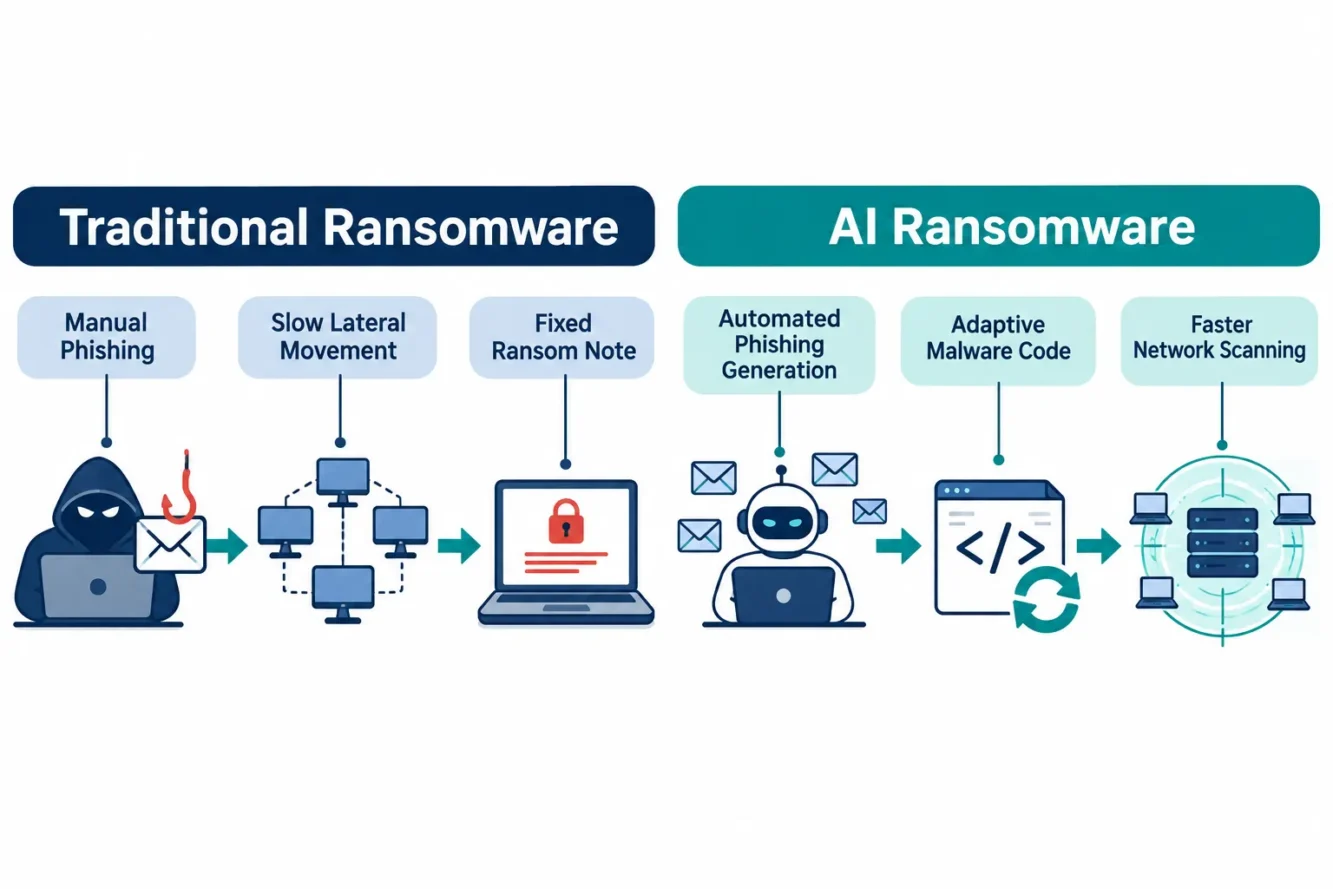
AI ransomware refers to extortion malware built or operated with artificial intelligence tools that automate reconnaissance, phishing, and code generation. Traditional ransomware relies on manual setup and known exploits; AI ransomware adapts faster and scales attacks with far less human effort [1].
Key differences include:
- Speed: AI tools can scan and exploit network weaknesses in hours instead of weeks.
- Personalization: Phishing emails generated by AI mimic writing style and context convincingly.
- Code evolution: Malware variants can be modified automatically to dodge antivirus detection.
- Target selection: AI helps attackers prioritize victims with weak defenses and high ransom potential.
Choose to treat this as urgent if your organization runs any internet-connected operational technology, finance system, or citizen data platform. A common mistake is assuming AI ransomware only threatens large corporations, Canada’s national guidance makes clear smaller, under-resourced organizations are equally exposed [4].
Why is 2028 a warning year for Canadian critical infrastructure
The 2028 warning stems from the trajectory of current threat data: the Cyber Centre’s Ransomware Threat Outlook covering 2025 to 2027 already shows worsening incident volume and ransomware economics, and the trend line points to continued escalation beyond that window [1][2]. This is a forward-looking assessment based on current evidence, not an official government forecast for 2028 specifically.
What’s driving the trend:
- Ransomware-as-a-service makes attacks cheaper to launch.
- AI lowers the skill barrier for criminal groups.
- Infrastructure systems were built before cyber threats were a design priority, leaving legacy gaps.
- National alerts show attackers increasingly targeting internet-exposed programmable logic controllers used in utilities [3].
Edge case: some sectors, like hospitals running heavily regulated legacy software, face slower upgrade cycles, which stretches their exposure window even further.
Which Canadian industries and municipalities are most at risk
Water utilities, small municipalities, hospitals, and nonprofits handling public services face the highest exposure, largely because of limited IT budgets and aging systems. Attackers favor targets where disruption causes public pressure to pay quickly.
High-risk categories include:
- Municipal water and wastewater systems [5][6]
- Small-town municipal governments, as shown in the Saint-Noël case [4]
- Regional hospitals and healthcare networks
- Utilities running SCADA or OT systems
- Nonprofits and SMEs with shared or outdated IT support [4]
Choose heightened monitoring if your organization is a municipality under 50,000 residents with a single IT administrator, this profile matches several recent incident patterns.
How much does it cost to recover from a ransomware attack
Recovery costs vary widely but typically include ransom negotiation, forensic investigation, system rebuilding, legal fees, and lost revenue during downtime. Canadian guidance stresses that even without paying a ransom, recovery expenses from rebuilding systems and restoring trust can be substantial [2][7].
Cost drivers include:
- Whether clean backups exist (reduces cost dramatically)
- Size of the affected network
- Whether personal data was exposed, triggering notification obligations
- Legal and insurance claim processing time
Common mistake: businesses often underestimate the cost of reputational damage and customer churn, which can exceed the technical recovery bill.
What can small Canadian businesses do to prevent AI ransomware
Small businesses should prioritize backups, multi-factor authentication, staff training, and patch management as the first line of defense against AI ransomware. These four controls address the most common entry points attackers exploit [7].
Checklist for small businesses:
- Keep offline, tested backups of critical data.
- Enable multi-factor authentication on all remote access points.
- Train staff to spot AI-generated phishing, which often looks more polished than older scams.
- Patch software and firmware on a fixed schedule, not “when there’s time.”
- Limit administrator access to only those who need it.
Choose a managed security provider if your business has no in-house IT staff, this is often more cost-effective than a breach.
How should municipalities respond if hit with a ransomware attack
Municipalities should isolate affected systems immediately, report the incident to the Canadian Centre for Cyber Security, and activate tested backup and communication plans. Fast, structured response limits both data loss and public confusion [7][8].
Response steps:
- Disconnect infected systems from the network.
- Notify the Cyber Centre and relevant provincial authorities [8].
- Activate backups to restore essential services.
- Decide on ransom payment only after legal and law enforcement consultation.
- Communicate clearly and quickly with residents.
Some municipalities, facing repeated targeting, are now investing in advanced defenses such as quantum-enhanced security for critical systems [9]. That’s an edge case worth watching as a model for larger towns with bigger budgets.
Is ransomware insurance worth it for Canadian companies
Ransomware insurance is worth considering for most Canadian organizations handling sensitive data or critical services, but it should supplement, not replace, strong security controls. Insurers increasingly require proof of backups, MFA, and incident response plans before issuing or renewing policies.
- Choose insurance if your organization cannot absorb weeks of downtime without serious financial harm.
- Skip reliance on insurance alone if you have no documented incident response plan, many insurers now deny claims without one.
- Ask vendors and insurers directly: what security baseline is required for coverage, and does the policy cover ransom negotiation costs separately from recovery costs?
What are common mistakes businesses make before getting attacked
The most common mistake is assuming the organization is “too small to be a target,” which leads to skipped backups, weak passwords, and no incident response plan. This mindset has already proven wrong in Canada, where small municipalities and nonprofits have been directly targeted [4].
Other frequent mistakes:
- Storing backups on the same network as production systems
- Ignoring software update notifications for months
- No written plan for who makes the “pay or not pay” decision
- Failing to test backups, only discovering they’re broken during an actual attack
Can AI ransomware target hospitals power grids and utilities
Yes. AI-enabled campaigns have already been observed targeting internet-exposed industrial control systems, and Canadian water treatment systems have experienced cyber compromise incidents [3][5][6]. Hospitals and power utilities share similar operational technology risks because they run legacy control systems connected to modern networks.
Why this matters: an attack on a hospital’s network can delay patient care, and an attack on a water utility’s control system can threaten public health directly, which is why these sectors sit at the top of national risk assessments [1][2].
How long does it take to recover from ransomware
Recovery timelines range from days to several months, depending on backup quality, system complexity, and whether a ransom is paid. Organizations with tested, offline backups typically recover in days; those without clean backups can face weeks or months of manual rebuilding [7].
Quick example: a municipality with daily offline backups might restore core services within 72 hours, while one relying only on connected cloud backups that were also encrypted could take months to fully rebuild.
What compliance requirements do Canadian businesses have for ransomware
Canadian businesses handling personal information must follow breach notification obligations under federal and provincial privacy laws when ransomware exposes personal data. Beyond legal notification, the Cyber Centre’s guidance documents outline recommended security baselines that regulators and insurers increasingly expect organizations to follow [2][7][8].
Practical steps:
- Document what data was accessed or encrypted.
- Notify affected individuals and relevant privacy commissioners if personal data was compromised.
- Keep records showing security measures were in place before the attack, since this affects liability discussions.
Should we pay the ransom or refuse to pay
Canadian federal guidance does not recommend paying ransoms, since payment does not guarantee data recovery and may fund further criminal activity [7]. The decision should involve legal counsel, law enforcement, and your insurer before any action is taken.
- Choose to refuse payment if backups allow full recovery without it, this is the lowest-risk path.
- Consider that paying may still leave encrypted systems damaged or data leaked regardless of payment.
- Edge case: some organizations face life-safety pressure, such as hospitals, where the decision calculus becomes more urgent and complex.
What are the best security tools to prevent AI ransomware attacks
The most effective tools combine endpoint detection, network segmentation, multi-factor authentication, and automated patch management. No single tool stops AI ransomware; layered defense is what reduces risk meaningfully [7].
Priority tools and practices:
- Endpoint detection and response (EDR) software
- Network segmentation separating OT systems from general IT networks
- Automated patch management platforms
- Email filtering tuned to catch AI-generated phishing patterns
- Regular penetration testing focused on exposed control systems [3]
Do large enterprises face different ransomware threats than small businesses
Yes. Large enterprises typically face more sophisticated, targeted attacks with higher ransom demands, while small businesses face more opportunistic, automated attacks exploiting basic weaknesses. Both face real risk, but the attack style and scale differ.
| Factor | Large Enterprise | Small Business / Municipality |
|---|---|---|
| Attack style | Targeted, researched, multi-stage | Automated, opportunistic, broad scanning |
| Typical defense gap | Complex legacy systems, slow patching | Limited IT staff and budget |
| Recovery resources | Dedicated incident response teams | Often rely on outside contractors |
FAQ
Is AI ransomware already active in Canada?
Yes, national cyber alerts describe AI-enabled campaigns targeting internet-exposed industrial systems, and water utilities have reported cyber compromise incidents [3][5].
Does the 2028 date come from an official government report?
No, it reflects a forward-looking assessment based on the Cyber Centre’s 2025 to 2027 threat outlook and current attack trends, not a specific official forecast for 2028 [1].
Can a small town really be a ransomware target?
Yes, Saint-Noël’s incident shows foreign hacking groups have already targeted very small Canadian municipalities [4].
Should municipalities pay for cybersecurity upgrades now or wait?
Acting now is recommended, since incident volumes and attack sophistication are rising year over year [1][2].
What’s the single most effective prevention step?
Tested, offline backups combined with multi-factor authentication address the majority of ransomware entry and recovery problems [7].
Does cyber insurance guarantee payout after an attack?
No, insurers often require documented security controls beforehand, and claims can be denied without them.
Conclusion
AI ransomware and critical infrastructure risk in Canada is not a distant problem reserved for big cities or Fortune 500 companies. Small municipalities, water utilities, hospitals, and local businesses have already been targeted, and the trend data through 2027 points toward continued escalation as the 2028 warning approaches [1][4][5]. The practical response is straightforward even if the threat feels complex: build tested backups, enforce multi-factor authentication, train staff against AI-generated phishing, and have a written incident response plan before an attack happens, not during one.
Organizations should also ask vendors and insurers direct questions now: What security baseline is required for coverage? How quickly can backups restore full operations? Is there a documented plan for the “pay or not pay” decision? Answering these questions today costs far less than answering them during an active attack.
Related reading from Georgian Bay News on broader AI and technology trends includes coverage on AI’s unfolding risks from an industry insider’s perspective and local governance updates such as the Town of Blue Mountains’ new corporate leadership hire and Collingwood’s online lobbyist registry initiative, both relevant to how municipalities are strengthening institutional accountability. Readers tracking AI’s broader trajectory may also find value in pieces on GPT-5’s expected capabilities and GPT-4o’s practical use cases, which illustrate the same AI advances now being weaponized by ransomware operators.
References
- Cyber Centre Releases Ransomware Threat Outlook 2025 to 2027. canada.ca.
- Ransomware Threat Outlook 2025 2027. cyber.gc.ca.
- Cyber Threat Actors Use Artificial Intelligence Active Global Campaign Disrupt Internet Exposed Programmable Logic Controllers. cyber.gc.ca.
- Cyberattack Saint Noel What IT Means for Smes and Nonprofits. riss.ca.
- Hacking Water Treatment Plants Cyberattack Quebec 9. cbc.ca.
- 9.7294526. cbc.ca.
- Ransomware Playbook Itsm00099. cyber.gc.ca.
- Alerts Advisories. cyber.gc.ca.
- City Explores Quantum Technology Protect 205936847. ca.news.yahoo.com.
Meta Title: AI Ransomware and Critical Infrastructure: 2028 Canada Risks
Meta Description: What the 2028 AI ransomware warning means for Canadian businesses and municipalities, with practical prevention steps, recovery costs, and insurance guidance.
ai ransomware, critical infrastructure, Canadian municipalities, cybersecurity, ransomware prevention, water utility security, cyber insurance, incident response, small business security, OT security, Cyber Centre Canada, data breach compliance