
























🏓 How to Warm Up for Pickleball: Dynamic Routines, Mobility Drills, and Safe Court Prep in 10 Minutes


Last updated: May 22, 2026
Quick Answer
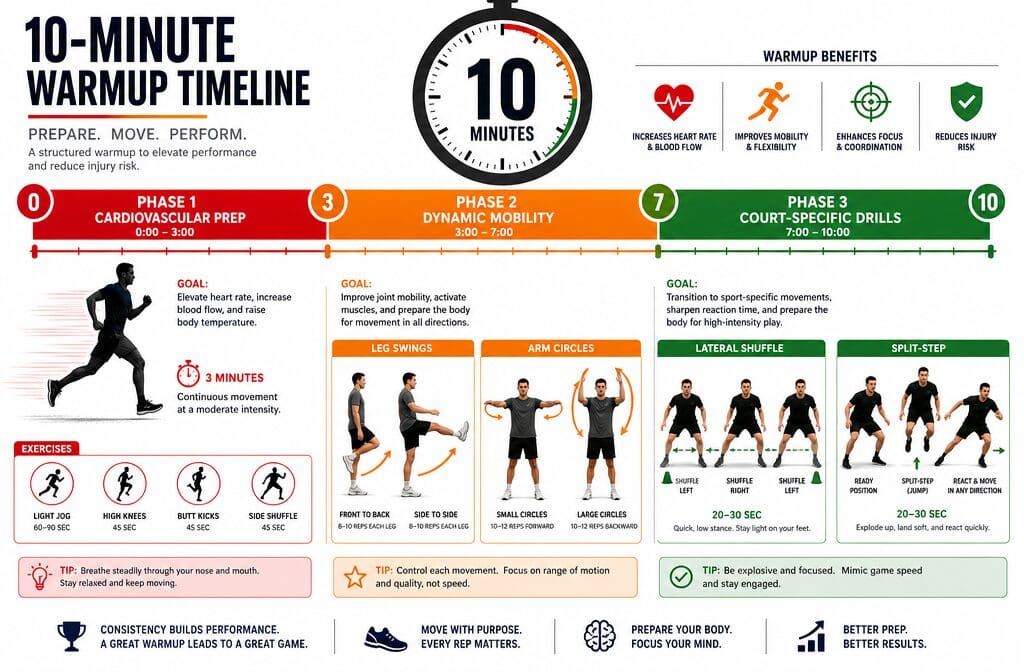
A proper pickleball warmup takes 10 minutes and focuses on dynamic movements that mirror the sport’s rapid lateral shifts, split-steps, and overhead reaches. The routine should progress from light cardiovascular activity (2-3 minutes) through sport-specific mobility drills (4-5 minutes) to court-based movement patterns (3-4 minutes), preparing joints and muscles for the explosive, multi-directional demands unique to pickleball.
Key Takeaways
- Dedicate 10 minutes minimum to warmup before playing to reduce injury risk by preparing muscles, tendons, and joints for pickleball’s stop-and-start movements
- Prioritize dynamic stretches over static holds before play—leg swings, arm circles, and walking lunges activate muscles more effectively than holding stretches
- Include lateral movement drills like side shuffles and crossover steps that replicate pickleball’s side-to-side court coverage patterns
- Tailor intensity to age and fitness—players over 50 should extend warmup time and reduce impact during initial cardiovascular prep
- Never skip warmup even if fit—cold muscles and connective tissue remain vulnerable to strain regardless of baseline conditioning
- Use minimal equipment—a paddle, resistance band, and court space are sufficient for a complete pickleball-specific warmup
- Address existing limitations by modifying high-impact movements and avoiding painful ranges of motion while maintaining warmup benefits
- Focus on shoulders, hips, and ankles—these joints bear the highest stress during pickleball’s overhead shots and quick directional changes

What Stretches Prevent Pickleball Injuries Before Playing
Dynamic stretches that move joints through their full range of motion while warming muscle tissue prevent pickleball injuries more effectively than static stretching. Leg swings (front-to-back and side-to-side), walking lunges with rotation, arm circles (forward and backward), and trunk rotations prepare the specific movement patterns required for court play.
Key injury-prevention stretches include:
- Hip flexor walks: Step forward into lunge, lift back knee toward chest, repeat for 10 steps each leg
- Shoulder external rotations: Hold paddle horizontally, rotate forearm outward 15 times per side
- Ankle circles: Balance on one foot, rotate lifted ankle 10 circles each direction
- Spinal twists: Stand with feet shoulder-width apart, rotate torso side to side while keeping hips stable, 20 total rotations
Common mistake: Holding static stretches (touching toes and holding) before play actually reduces power output and doesn’t warm tissue. Save static stretching for after the game during cooldown.
Choose ballistic stretches (controlled bouncing movements) if you’re an experienced player with good flexibility, but stick with smooth dynamic movements if you’re over 50 or returning from injury.
How Long Should I Warm Up Before a Pickleball Match
Warm up for a minimum of 10 minutes before recreational play and 15-20 minutes before competitive matches or tournaments. Colder weather, morning games, or older players require the longer end of this range to adequately prepare connective tissue and increase joint fluid viscosity.
Time allocation for a 10-minute warmup:
PhaseDurationFocusLight cardio2-3 minutesElevate heart rate, increase blood flowDynamic mobility4-5 minutesJoint preparation, movement patternsCourt-specific drills3-4 minutesSport movements, paddle work
For tournament play, extend warmup to 15-20 minutes and include practice volleys with a partner during the final 5 minutes. This allows you to calibrate paddle feel and court depth perception before competitive points begin.
Edge case: If you arrive late with limited time, prioritize ankle circles, leg swings, and 2 minutes of side-to-side shuffles over skipping warmup entirely. Even 5 minutes provides meaningful injury protection.
Difference Between Pickleball Warmup and Tennis Warmup
Pickleball warmup emphasizes lateral agility and rapid direction changes over the linear, baseline-to-net movements central to tennis preparation. While tennis players focus on shoulder rotation for serves and groundstrokes from the baseline, pickleball warmup prioritizes quick split-steps, kitchen-line positioning, and short-distance explosive movements within a smaller court area.
Key differences:
- Movement patterns: Pickleball requires more side-to-side shuffling and less forward sprinting than tennis
- Joint stress: Pickleball places higher demands on ankles and knees from frequent stopping and pivoting on a hard surface
- Shoulder preparation: Tennis needs greater overhead serving mobility; pickleball focuses on mid-range dinking and quick volleys
- Duration: Tennis warmup often extends 15-20 minutes due to larger court coverage; pickleball can be effective in 10 minutes
Both sports benefit from dynamic stretching, but pickleball players should add extra ankle stability work and lateral lunge variations that tennis warmups may minimize.
Dynamic Warmup Moves for Pickleball Players Over 50
Players over 50 should extend warmup time to 12-15 minutes and reduce impact during initial cardiovascular preparation to accommodate decreased tissue elasticity and longer muscle activation times. Low-impact dynamic movements provide the same benefits without stressing aging joints.
Age-appropriate dynamic warmup sequence:
- Marching in place (2 minutes): Lift knees to hip height, swing opposite arm, gradually increase pace
- Gentle leg swings: Hold court fence for balance, swing leg forward/back 10 times, then side-to-side 10 times per leg
- Wall push-ups with rotation (10 reps): Push away from fence, rotate torso to one side at top of movement
- Step-touches with arm raises (1 minute): Step side to side while raising arms overhead, controlled pace
- Walking lunges (8 per leg): Step forward into lunge, pause, step together, repeat—skip rotation if balance is limited
- Paddle figure-eights (1 minute): Hold paddle, trace large figure-eight pattern in air to warm shoulders
Modification principle: Replace any jumping or plyometric movement with a stepping variation. Instead of jump squats, perform slow bodyweight squats with a 2-second hold at the bottom.
Joint protection note: If you experience sharp pain during any movement, skip that exercise rather than pushing through discomfort. Dull muscle tension is normal during warmup; joint pain is a warning signal.
Best Mobility Drills to Improve Pickleball Performance
Mobility drills that enhance hip internal rotation, thoracic spine rotation, and ankle dorsiflexion directly improve pickleball performance by enabling deeper split-steps, faster lateral movement, and more powerful paddle rotation. These drills should be performed 3-4 times per week, either during warmup or as a separate mobility session.
High-impact mobility drills:
- 90/90 hip switches: Sit with one leg bent 90° in front, other bent 90° behind, switch positions 10 times—improves hip rotation for crosscourt shots
- Thoracic spine windmills: On hands and knees, place one hand behind head, rotate elbow toward ceiling, 8 reps per side—increases paddle reach and power
- Ankle rocks: In split stance, drive front knee forward over toes without lifting heel, 15 reps per side—deepens split-step and improves court coverage
- World’s greatest stretch: Lunge forward, place hand inside front foot, rotate opposite arm toward ceiling, hold 3 seconds, 5 reps per side
Performance benefit: Improved ankle dorsiflexion allows a lower athletic stance at the kitchen line, reducing reaction time to dinks and drops by positioning your center of gravity closer to the ball.
Perform these drills before strength training or as part of your 10-minute court warmup. Consistency matters more than duration—5 minutes daily outperforms 20 minutes once weekly.
Common Warmup Mistakes That Lead to Pickleball Injuries
Skipping warmup entirely, performing only static stretches, and rushing through movements without proper progression are the three most common mistakes that increase pickleball injury risk. These errors leave muscles unprepared for explosive movements and joints vulnerable to strain during rapid direction changes.
Critical warmup mistakes:
- Starting with static stretching: Holding hamstring or quad stretches before play reduces muscle power and doesn’t elevate tissue temperature
- Inadequate ankle preparation: Neglecting ankle circles and dorsiflexion drills leaves this vulnerable joint unprepared for lateral stress
- No sport-specific movement: Jumping jacks and jogging don’t replicate pickleball’s split-steps and side shuffles
- Rushing the progression: Moving from standing still to full-speed lateral drills without gradual intensity buildup shocks cold tissue
- Ignoring shoulders: Failing to warm rotator cuff muscles before overhead smashes increases impingement risk
Choose this approach instead: Begin with 2 minutes of walking or light jogging, progress to dynamic leg swings and arm circles, then finish with court-specific shuffles and split-steps at 50%, 75%, then 100% intensity.
Warning sign: If you feel stiff or restricted during the first game, your warmup was insufficient. Add 3-5 minutes next session and focus on the movement patterns that felt tight.
Quick 10-Minute Warmup Routine for Beginner Pickleball Players
Beginner players should follow a simple three-phase warmup that progresses from general movement to pickleball-specific patterns without requiring advanced athletic skills or equipment beyond a paddle. This routine builds confidence while establishing injury-prevention habits from the start.
Complete 10-minute beginner warmup:
Phase 1: General Warmup (3 minutes)
- Walk around court perimeter twice at comfortable pace (1 minute)
- March in place with high knees, 30 seconds
- Side-step shuffle along baseline, 4 lengths (1 minute)
- Light jog from baseline to kitchen line and back, 6 trips (30 seconds)
Phase 2: Dynamic Mobility (4 minutes)
- Leg swings: 10 forward/back, 10 side-to-side per leg (1 minute)
- Arm circles: 10 forward, 10 backward, gradually increasing size (1 minute)
- Walking lunges: 8 steps per leg across court width (1 minute)
- Torso rotations: Feet planted, rotate shoulders side to side, 20 total (1 minute)
Phase 3: Court-Specific Prep (3 minutes)
- Split-step practice: Hop gently into ready position, 15 reps (1 minute)
- Shadow swings: Forehand and backhand volleys without ball, 20 total (1 minute)
- Lateral shuffle with paddle: Side-to-side across court, 4 lengths (1 minute)
Beginner tip: Perform this routine before every session for the first month until the movements become automatic. Consistency builds the habit and allows you to notice which areas feel tight, helping you customize the routine over time.
Do Professional Pickleball Players Have Specific Warmup Techniques
Professional pickleball players extend standard warmup routines with sport-specific paddle drills, resistance band exercises for rotator cuff activation, and partner-based movement patterns that simulate match intensity. Top players typically warm up for 20-30 minutes before tournament matches, dedicating significant time to mental preparation and tactical visualization alongside physical prep.
Professional warmup additions:
- Resistance band external rotations: 15-20 reps per shoulder to activate rotator cuff before overhead shots
- Medicine ball throws: Chest passes and overhead slams to prime explosive power (not necessary for recreational players)
- Progressive volley exchanges: Start with soft dinks, progress to drives, finish with overhead practice—calibrates timing and depth perception
- Court-position drills: Rapid transitions from baseline to kitchen line and back, simulating point patterns
- Mental rehearsal: Visualization of key shots and tactical situations during final 5 minutes of warmup
Recreational application: You can adopt the progressive volley exchange concept by spending your final 3-4 warmup minutes hitting with a partner, starting with gentle dinks and gradually increasing pace. This bridges physical warmup and match readiness.
Professional players also maintain between-match warmup routines during tournaments, performing abbreviated 5-minute sequences between games to maintain tissue temperature and focus.
What Equipment Do I Need for a Proper Pickleball Warmup
A proper pickleball warmup requires minimal equipment: a paddle, access to court space, and optionally a resistance band for shoulder activation. Unlike other sports that demand foam rollers, massage tools, or specialized gear, pickleball warmup focuses on bodyweight movements and sport-specific patterns that need no additional investment.
Essential equipment:
- Pickleball paddle: Use during shadow swings and court-specific drills to build muscle memory
- Court access: Even half a court or driveway provides adequate space for movement patterns
- Athletic shoes: Proper court shoes with lateral support (same shoes you’ll play in)
Optional but beneficial:
- Light resistance band: Enables rotator cuff activation exercises (15-20 reps per shoulder)
- Water bottle: Hydration during warmup maintains performance
- Small towel: Useful in humid conditions or for grip management
Budget consideration: The entire warmup can be performed with zero additional cost beyond your standard playing equipment. Resistance bands cost $8-15 and last years, making them a worthwhile addition for shoulder health, but they’re not mandatory for injury prevention.
Choose equipment if: You have a history of shoulder issues (add resistance band), play in cold weather (add light jacket to remove after cardio phase), or have balance concerns (use court fence for support during leg swings).
How to Warm Up If I Have Existing Joint or Muscle Limitations
Players with existing joint or muscle limitations should modify warmup intensity and avoid painful ranges of motion while maintaining movement through comfortable arcs to preserve warmup benefits. Focus on the joints and muscles that feel healthy while substituting low-impact alternatives for movements that aggravate existing conditions.
Limitation-specific modifications:
Knee issues:
- Replace lunges with partial-depth squats or wall sits (hold 20 seconds)
- Substitute high-knee marching with regular walking
- Perform leg swings with reduced range of motion
- Avoid deep split-step practice; use shallow ready-position hops
Shoulder restrictions:
- Limit arm circles to pain-free range, even if only 50% of full circle
- Skip overhead movements; focus on mid-range paddle swings
- Add resistance band pull-aparts (15 reps) to activate upper back without overhead stress
- Perform wall slides: back against wall, slide arms up and down within comfortable range
Hip mobility concerns:
- Replace walking lunges with standing hip flexor lifts
- Perform leg swings while holding fence for stability
- Use shorter stride length during lateral shuffles
- Add seated hip circles: sit on bench, lift knee, rotate hip in circles
Lower back sensitivity:
- Avoid torso rotations with feet planted; instead, rotate while walking
- Skip any forward bending; focus on standing movements
- Add cat-cow stretches: on hands and knees, alternate arching and rounding spine gently
General principle: Pain is a stop signal, not a challenge to overcome. If a movement hurts, modify or skip it. Mild discomfort or muscle tension during warmup is normal; sharp or increasing pain indicates the movement isn’t appropriate for your current condition.
Pickleball Warmup Exercises for Improving Lateral Movement
Lateral movement warmup exercises should progress from controlled side-stepping to explosive direction changes that replicate the rapid court coverage required during points. These drills warm the muscles while training the neuromuscular patterns that improve defensive range and offensive positioning.
Progressive lateral warmup sequence:
- Basic side shuffle (1 minute): Shuffle baseline to baseline, stay low, don’t cross feet, 4 lengths
- Crossover steps (1 minute): Step one foot across the other while moving laterally, alternate direction every 3 steps
- Carioca drill (1 minute): Move laterally while alternating front and back crossover steps, 2 lengths each direction
- Split-step to shuffle (1 minute): Perform split-step, shuffle 3 steps right, split-step, shuffle 3 steps left, repeat
- Lateral bounds (advanced, 30 seconds): Push off one foot, land on opposite foot, immediately push back—builds explosive power
Performance benefit: These drills activate the gluteus medius (hip stabilizer) and ankle stabilizers that control lateral movement quality. Weak or cold lateral stabilizers cause knee collapse during direction changes, increasing injury risk and reducing court coverage.
Coaching cue: Keep your chest up and hips low during lateral drills. Leaning forward shifts weight onto toes and reduces stability during rapid direction changes.
Perform these drills after general warmup but before full-speed play to bridge movement preparation and match intensity.
Can I Skip Warmup If I’m Already in Good Physical Shape
You cannot safely skip warmup regardless of fitness level because tissue temperature, joint fluid viscosity, and neuromuscular activation require time to reach optimal function even in well-conditioned athletes. Cardiovascular fitness and muscle strength don’t prevent cold tissue from being vulnerable to strain during explosive movements or rapid direction changes.
Why fit players still need warmup:
- Tissue temperature: Cold muscles and tendons have reduced elasticity and increased stiffness, regardless of strength
- Synovial fluid: Joint fluid thickens when inactive; movement increases viscosity and lubrication
- Neuromuscular activation: Fast-twitch muscle fibers require progressive recruitment signals before explosive activation
- Proprioception: Balance and spatial awareness systems need calibration before precise movements
Research context: Athletic performance studies consistently show that even elite athletes experience reduced power output, slower reaction times, and higher injury rates when skipping warmup protocols.
Choose abbreviated warmup if: Time is severely limited. Perform 5 minutes of dynamic leg swings, arm circles, and lateral shuffles rather than skipping entirely. This minimum provides meaningful tissue preparation even when a full 10-minute routine isn’t possible.
Exception that proves the rule: If you’ve been physically active in the 30 minutes before playing (walking, light housework, other exercise), you may reduce warmup to 5-7 minutes of sport-specific movements since tissue temperature is already elevated.
Conclusion
A science-backed 10-minute warmup routine specifically designed for pickleball’s unique movement demands significantly reduces injury risk while improving court performance. The three-phase approach—light cardiovascular prep, dynamic mobility work, and court-specific movement patterns—prepares joints, muscles, and neuromuscular systems for the explosive lateral movements and rapid direction changes that define the sport.
Take action now:
- Commit to 10 minutes before every session, treating warmup as non-negotiable as bringing your paddle
- Start with the beginner routine outlined above, then customize based on which movements feel most beneficial for your body
- Add resistance band work if you’re over 50 or have shoulder concerns—this $10 investment provides significant rotator cuff protection
- Track your warmup for two weeks and note any correlation between thoroughness and how you feel during play
- Teach partners about proper warmup so your regular playing group adopts injury-prevention habits together
The difference between playing pickleball for years versus being sidelined by preventable injuries often comes down to this simple 10-minute investment before each session. Make warmup automatic, modify it for your specific needs, and prioritize the movements that address pickleball’s unique demands on ankles, hips, and shoulders. Your future self—still playing pain-free years from now—will appreciate the consistency.
FAQ
How long before playing should I start my warmup?
Begin your warmup 10-15 minutes before your scheduled court time so you finish just as play starts. Tissue temperature decreases after 10-15 minutes of inactivity, so timing matters—don’t warm up 30 minutes early then sit waiting.
Should I do static stretching before or after pickleball?
Perform static stretching (holding stretches 20-30 seconds) only after playing, not before. Static stretching before activity reduces power output and doesn’t warm tissue effectively. Save hamstring holds, quad stretches, and calf stretches for your post-game cooldown.
What’s the single most important warmup exercise for pickleball?
Lateral shuffles with split-steps replicate pickleball’s primary movement pattern and prepare ankles, knees, and hips for the sport’s unique demands. If time is severely limited, prioritize 3-4 minutes of progressive lateral movement over other exercises.
Do I need to warm up differently for indoor versus outdoor pickleball?
Indoor play requires the same warmup duration, but outdoor play in cold weather (below 60°F) should extend warmup by 3-5 minutes to compensate for lower ambient temperature affecting tissue preparation. Add layers you can remove as you warm up.
Can I use a foam roller as part of my pickleball warmup?
Foam rolling is better suited for post-play recovery or separate mobility sessions rather than pre-game warmup. The 10 minutes before play should focus on dynamic movement and tissue temperature elevation, not static tissue manipulation.
How do I know if my warmup was adequate?
You should feel loose, slightly elevated heart rate, and ready to move explosively without stiffness. If you feel tight or restricted during your first game, add 3-5 minutes to your next warmup and focus on the movement patterns that felt limited.
Should beginners warm up differently than advanced players?
Beginners should follow the same 10-minute structure but may perform movements at slower speeds and reduced ranges of motion. Advanced players can add intensity and sport-specific drills but shouldn’t skip the progressive warmup phases.
What should I do if I arrive late with only 5 minutes to warm up?
Prioritize ankle circles, leg swings (10 per direction), arm circles, and 2 minutes of lateral shuffles. This abbreviated sequence provides minimum injury protection when time is limited, though 10 minutes remains ideal.
Is warming up more important as you get older?
Yes, tissue elasticity decreases with age, requiring longer warmup times (12-15 minutes for players over 50) and more gradual intensity progression. Older players benefit from extended mobility work and reduced impact during initial cardiovascular prep.
Can I warm up by just playing slowly at first?
Starting play at reduced intensity is better than no warmup but doesn’t adequately prepare tissue or activate stabilizer muscles. Even slow play involves rapid movements that risk injury without proper progressive warmup. Dedicate 10 minutes to structured warmup before any court play.
Do I need to warm up before drilling or only before games?
Warm up before any pickleball activity, including drilling sessions. Drills often involve repetitive movements that stress specific joints and muscles, making proper preparation equally important as game play.
What’s the difference between warmup and cooldown?
Warmup uses dynamic movements to elevate tissue temperature and prepare for activity; cooldown uses static stretching and gentle movement to reduce heart rate and promote recovery. Never substitute one for the other—both serve distinct purposes.
Content, illustrations, and third-party video appearing on GEORGIANBAYNEWS.COM may be generated or curated with AI assistance or reproduced pursuant to the fair dealing provisions of the Copyright Act, R.S.C. 1985, c. C-42. Attribution and hyperlinks to original sources are provided in acknowledgment of applicable intellectual property rights. Such referencing is intended to direct traffic to and support the original rights holders’ platforms.
Much Appreciate You Sharing This Post - It Helps MUCH!!!