

















🇯🇵 Could Japan Bring Down the World Economy? What Every Global Citizen Needs to Know
Last updated: August 20, 2026
Quick Answer
Japan holds more government debt than almost any nation on Earth, owns the largest share of US Treasury bonds among foreign countries, and runs a financial system so deeply woven into global markets that a serious crisis there would not stay contained. Whether Japan could bring down the world economy depends on how severe its fiscal and monetary problems become, how quickly they escalate, and whether major trading partners can coordinate a credible response in time. The risk is real, but not inevitable.
Key Takeaways
- Japan is the world’s third-largest economy, accounting for roughly 4% of global GDP as of recent World Bank estimates.
- Japan holds more US Treasury bonds than any other foreign nation, meaning its financial decisions directly affect American borrowing costs.
- The yen recently hit its lowest level in four decades, raising alarm among economists and policymakers worldwide.
- Japan’s government debt-to-GDP ratio exceeds 260%, the highest among developed nations tracked by the IMF.
- The so-called “yen carry trade” has made Japan a silent engine of global liquidity, and an unwinding of that trade could trigger sharp sell-offs in markets far beyond Tokyo.
- Japan’s 1990s financial collapse, known as the Lost Decade, caused years of domestic stagnation but did not produce a global recession, though global financial integration has deepened significantly since then.
- Economists at institutions including the IMF and the Bank for International Settlements have flagged Japan’s debt trajectory as a systemic risk worth monitoring closely.
- The US has already intervened once to help stabilize the yen, but such interventions offer only temporary relief without structural reform.
- Supply chain exposure means a Japanese economic crisis could disrupt automotive, semiconductor, and electronics production globally.
- Most experts believe a gradual managed adjustment is more likely than a sudden collapse, but the tail risk of a disorderly outcome is not negligible.
What Is Japan’s Economic Impact on the Global Economy?
Japan is the third-largest economy in the world, and its financial reach extends far beyond its own borders. It is simultaneously a top holder of foreign assets, a critical node in global supply chains, and the origin of one of the most widely used funding mechanisms in international finance, the yen carry trade.
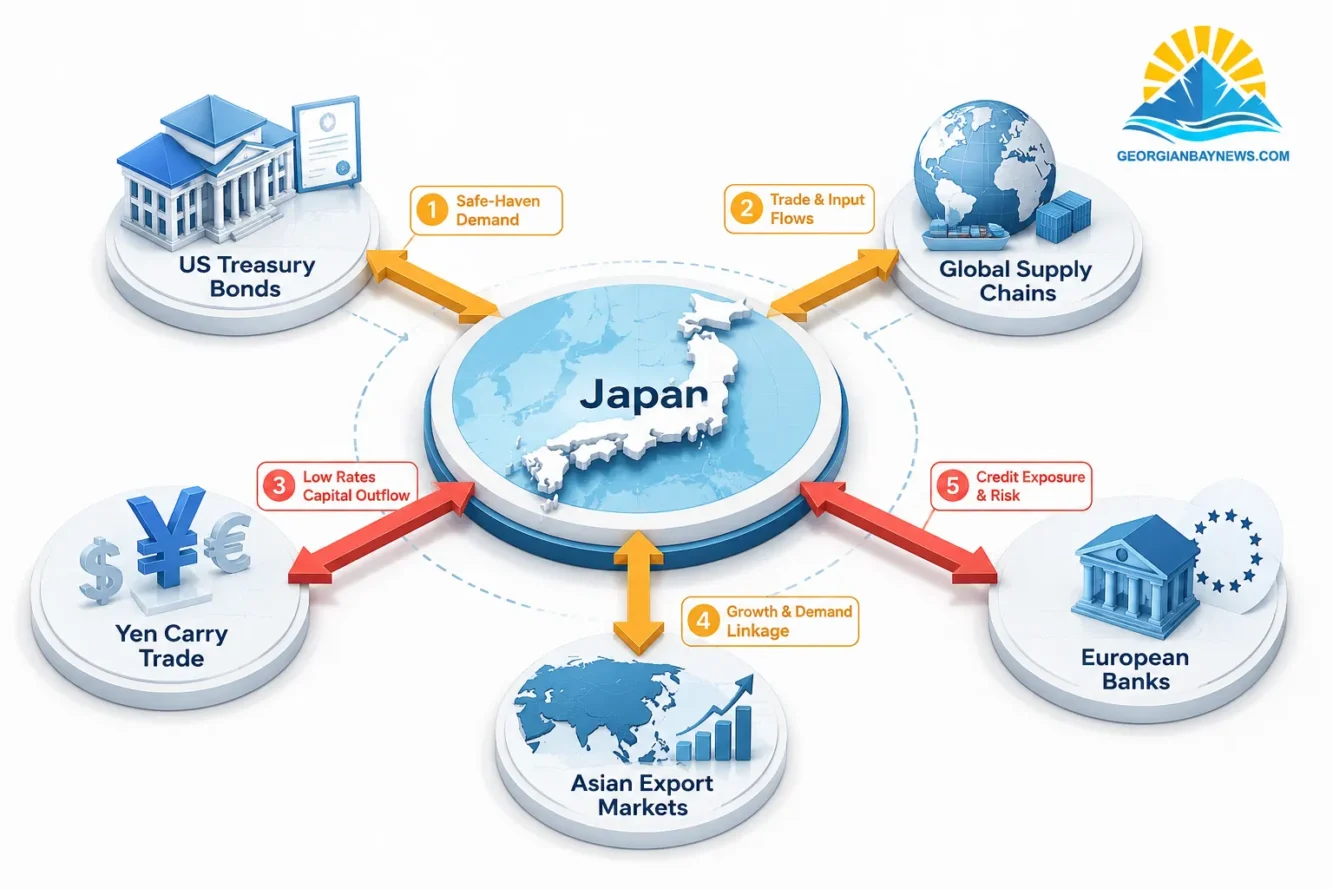
When investors, analysts, and policymakers ask whether Japan could bring down the world economy, they are pointing to several specific transmission channels:
- Foreign bond holdings: Japan is the largest single foreign holder of US Treasury securities, holding approximately $1.1 trillion as of 2024 data from the US Treasury Department. If Japan were forced to liquidate those holdings rapidly, US interest rates could spike.
- The yen carry trade: For decades, investors have borrowed cheaply in yen and invested in higher-yielding assets elsewhere. An abrupt reversal of this trade, triggered by a yen crisis or sudden interest rate changes, can cause rapid sell-offs in equities and bonds across multiple continents.
- Trade and manufacturing: Japan is a top-five trading partner for the United States, China, South Korea, and Australia. Its industrial output feeds into global automotive, robotics, and semiconductor supply chains.
- Financial contagion: Japanese banks and insurers hold large portfolios of international assets. Forced selling to cover domestic losses would ripple outward.
The short version: Japan’s economy is not just large, it is structurally embedded in the global financial system in ways that make its problems everyone’s problems.
How Much Does Japan Contribute to World GDP?
Japan contributes approximately 4% of global GDP, placing it third in the world behind the United States and China. According to World Bank data, Japan’s nominal GDP was approximately $4.2 trillion in 2023, though currency fluctuations caused by the weakening yen have compressed that figure in US dollar terms.
That 4% share understates Japan’s actual influence for several reasons:
- Japan’s per-capita productivity and technological output are disproportionately high relative to its population size.
- Japanese corporations own significant production capacity outside Japan, meaning economic stress at home can affect overseas subsidiaries and their local workforces.
- Japan’s financial assets, including sovereign wealth, pension funds, and insurance company portfolios, total well above its annual GDP, amplifying its market footprint globally.
A useful comparison: The entire eurozone accounts for roughly 15% of world GDP, and a eurozone crisis in 2011-2012 came close to triggering a global financial meltdown. Japan at 4% is smaller, but its specific role as a creditor nation and carry-trade anchor gives it outsized systemic weight.
How Does Japan’s Economy Compare to Other Major Economies?
Japan sits in a unique and uncomfortable position among the world’s major economies. It combines the debt load of a developing nation with the financial sophistication of a G7 member.
| Country | Nominal GDP (approx.) | Debt-to-GDP Ratio | Central Bank Rate (2024) | Key Risk Factor |
|---|---|---|---|---|
| Japan | ~$4.2 trillion | ~261% | 0.1% (rising) | Debt sustainability, aging population |
| United States | ~$27 trillion | ~123% | 5.25-5.5% | Fiscal deficit, political gridlock |
| China | ~$17.7 trillion | ~83% (official) | 3.45% | Property sector, shadow banking |
| Germany | ~$4.5 trillion | ~64% | 4.0% (ECB) | Energy transition, export slowdown |
| United Kingdom | ~$3.1 trillion | ~100% | 5.25% | Inflation persistence, low growth |
Sources: World Bank, IMF Fiscal Monitor 2024, respective central bank publications.
What stands out immediately is Japan’s debt-to-GDP ratio. At over 260%, it dwarfs every other major economy. The counterargument, often made by Japanese officials, is that most of that debt is held domestically by Japanese institutions and households, reducing the risk of a sudden foreign capital flight. That argument has merit, but it is not a complete shield against crisis.
Why Is Japan’s Economy Struggling Right Now?
Japan’s economy is under pressure from several directions at once, and 2026 has not offered much relief. The core problems are structural, not cyclical.
The yen’s historic weakness is the most visible symptom. The yen recently hit its lowest level against the US dollar in four decades. A weak yen raises import costs, squeezes household purchasing power, and erodes the real value of Japan’s foreign asset holdings when measured in domestic terms.
The Bank of Japan’s impossible position sits at the center of the problem. For years, the Bank of Japan held interest rates near zero or below zero to stimulate growth. Raising rates now would help the yen but would also dramatically increase the cost of servicing Japan’s enormous government debt. It would also unwind the yen carry trade, potentially triggering global market turbulence. The Bank of Japan is essentially trapped between two bad outcomes.
Demographic decline compounds everything. Japan has one of the world’s oldest and fastest-shrinking populations. A smaller workforce generates less tax revenue, while a larger retired population demands more in pension and healthcare spending. This structural imbalance makes fiscal consolidation extremely difficult without cutting services that a large portion of the electorate depends on.
Wage growth has been insufficient to offset inflation driven by the weak yen and higher energy import costs. Real wages in Japan fell for an extended period, dampening consumer spending and making domestic demand a weak engine of growth.
For readers interested in how economic forces affect everyday communities, the Business coverage at Georgian Bay News regularly examines how global economic shifts filter down to local and regional levels.
What Happened When Japan’s Economy Crashed in the 1990s?
Japan’s 1990s financial collapse, commonly called the Lost Decade, is the most relevant historical precedent for understanding what a Japanese economic crisis looks like, and how far its effects can travel.
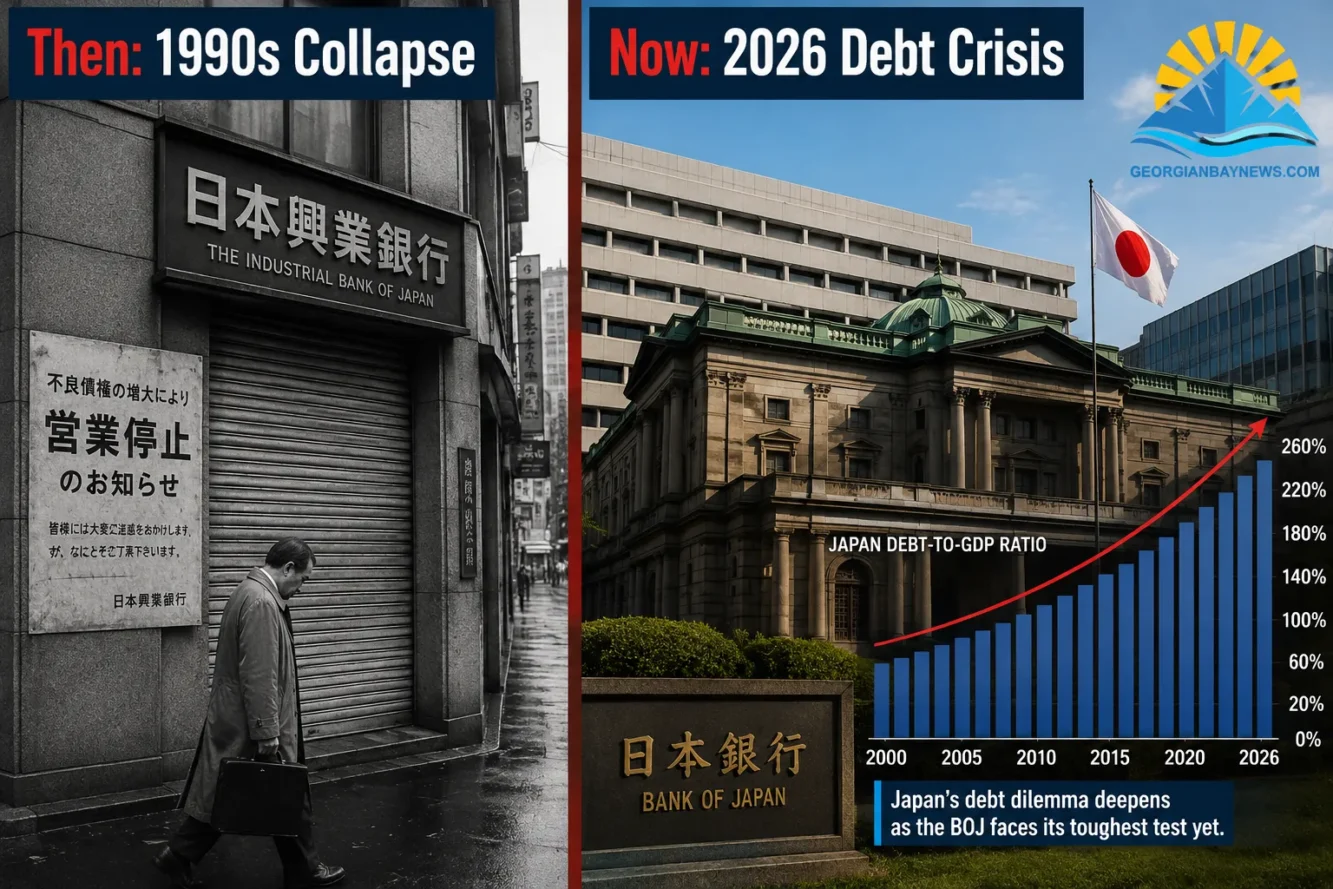
In the late 1980s, Japan experienced a spectacular asset price bubble. Stock prices and real estate values soared to levels that bore no relationship to underlying economic fundamentals. When the bubble burst in 1990 and 1991, the consequences were severe:
- The Nikkei stock index lost roughly 80% of its peak value over the following decade.
- Japanese banks were left holding massive portfolios of non-performing loans.
- Economic growth stagnated for most of the 1990s and into the 2000s.
- Deflation took hold, discouraging investment and spending in a self-reinforcing cycle.
Did Japan’s 1990s crisis cause a global recession? No, not directly. The global economy continued to grow through the 1990s, partly because the US was in the middle of a technology-driven expansion. However, Japan’s weakness did contribute to the 1997 Asian financial crisis by reducing regional demand and creating financial instability across East Asia.
Why the situation today is different and potentially more dangerous:
- Global financial markets are far more interconnected in 2026 than they were in 1991.
- Japan’s debt burden is dramatically larger now than it was at the start of the Lost Decade.
- The yen carry trade is far more embedded in global portfolio strategies today.
- Japan’s foreign asset holdings, including US Treasuries, are much larger, meaning forced selling would hit global bond markets harder.
The 1990s experience shows Japan can absorb enormous internal pain without immediately exporting a global recession. But the structural conditions that made that possible, including a younger population, lower debt, and a less integrated global financial system, are no longer in place.
Is Japan’s Debt Crisis a Threat to Global Markets?
Yes, Japan’s debt trajectory is a credible threat to global financial stability, though the timeline and severity remain genuinely uncertain. The IMF has flagged Japan’s fiscal position as a source of systemic risk in multiple editions of its Fiscal Monitor and Global Financial Stability Report.
The core concern is not that Japan will simply run out of money tomorrow. Japan borrows in its own currency, controls its own central bank, and holds enormous domestic savings that have historically absorbed government bond issuance. The concern is about what happens at the margin, specifically what happens if domestic investors lose confidence, if the Bank of Japan is forced to raise rates sharply, or if a currency crisis forces a disorderly adjustment.
Three specific global market risks stand out:
- US Treasury market disruption. If Japan is forced to sell its approximately $1.1 trillion in US Treasury holdings to defend the yen or cover domestic funding gaps, US interest rates could rise sharply and quickly. That would increase borrowing costs for American consumers, businesses, and the federal government simultaneously.
- Carry trade unwinding. A sudden, sharp rise in Japanese interest rates would make yen-denominated borrowing more expensive, forcing investors to sell the assets they bought with borrowed yen. Those assets include US equities, emerging market bonds, and European real estate. The result would be a synchronized global sell-off.
- Asian contagion. Japan is deeply integrated with South Korea, China, Taiwan, and Southeast Asian economies through trade and investment. A Japanese recession would reduce demand for exports from those countries, potentially triggering secondary slowdowns across the region.
Could Japan’s Recession Affect the Rest of the World?
A Japanese recession would affect the rest of the world, with the severity depending on how deep the recession is and how disorderly the financial adjustment becomes. A mild, managed recession would cause ripples. A severe, disorderly crisis could cause waves.
Direct channels of impact:
- Reduced Japanese demand for imported goods from trading partners, including Australia, the US, China, and Southeast Asia.
- Reduced Japanese foreign direct investment, which funds factories, technology ventures, and infrastructure projects in dozens of countries.
- Financial market volatility triggered by yen movements and carry trade unwinding.
- Potential disruption to global supply chains for automotive parts, industrial machinery, and electronics components.
Indirect channels:
- Loss of confidence in other heavily indebted developed economies, potentially triggering reassessment of sovereign debt risk in Italy, the UK, and the US.
- Reduced appetite for risk assets globally as investors seek safe havens.
- Pressure on Asian currencies if regional investors follow Japan’s lead and sell foreign assets.
The question of whether Japan could bring down the world economy is not purely academic. It is a live risk that central banks and finance ministries in Washington, Brussels, Beijing, and Canberra are actively monitoring.
What Would Happen If Japan Defaulted on Its Debt?
A formal Japanese sovereign default would be one of the most disruptive financial events in modern history, though most economists consider it a low-probability scenario rather than a baseline forecast.
Japan has never defaulted on its modern sovereign debt. Because it borrows in yen and controls the Bank of Japan, it retains the technical ability to print money to meet obligations, which is the classic argument for why developed-market central bank nations do not formally default. However, that path leads to hyperinflation rather than default, and hyperinflation carries its own catastrophic consequences.
What a Japanese debt crisis could actually look like in practice:
- A loss of confidence among domestic bond investors, causing Japanese Government Bond (JGB) yields to spike.
- The Bank of Japan stepping in to buy bonds aggressively (yield curve control on a massive scale), effectively monetizing the debt.
- Rapid yen depreciation as markets price in inflationary money printing.
- A collapse in real living standards for Japanese households as import prices surge.
- Forced liquidation of foreign assets, including US Treasuries, Japanese-owned real estate abroad, and equity holdings.
The global fallout from that scenario would be severe. US Treasury yields would likely rise sharply. Asian financial markets would face intense pressure. Global growth would slow meaningfully.
Most analysts, including those at the Bank for International Settlements and the Peterson Institute for International Economics, consider a gradual managed adjustment far more probable than a sudden collapse. But “more probable” is not the same as “guaranteed.”
What Role Does Japan Play in Global Trade and Supply Chains?
Japan is a cornerstone of several of the world’s most critical supply chains, and disruption to its industrial output would be felt in factories and showrooms far from Tokyo.
Automotive: Japan is home to Toyota, Honda, Nissan, Subaru, and Mazda. These companies produce vehicles and components across global networks, but Japan remains a critical source of high-precision parts, engineering, and design. A deep Japanese recession would reduce output and investment across those networks.
Semiconductors and electronics: While Taiwan and South Korea dominate chip fabrication, Japan supplies a disproportionate share of the specialty chemicals, photomasks, and equipment used in semiconductor manufacturing. Companies like Tokyo Electron, Shin-Etsu Chemical, and JSR are effectively chokepoints in the global chip supply chain.
Robotics and industrial machinery: Japan is the world’s largest exporter of industrial robots. Factories in Germany, the US, China, and across Southeast Asia depend on Japanese-made automation equipment.
Financial flows: Japanese institutional investors, including the Government Pension Investment Fund (GPIF), the world’s largest pension fund with assets exceeding $1.5 trillion, hold significant positions in global equity and bond markets. Shifts in GPIF’s allocation strategy send ripples through asset prices worldwide.
For those tracking how global conservation and economic policy intersect, Japan’s industrial role in clean energy technology, including hydrogen fuel cells and battery materials, adds another dimension to its global economic footprint.
Has Japan Ever Caused a Worldwide Recession Before?
Japan has not directly caused a worldwide recession, but its economic troubles have contributed to regional crises and global financial instability on more than one occasion.
The most significant example is the 1997 Asian financial crisis. Japan’s prolonged stagnation reduced its demand for exports from Southeast Asian economies, weakened regional financial confidence, and contributed to the conditions that allowed the Thai baht crisis to spread rapidly. The IMF and multiple academic studies have identified Japan’s weakness as a contributing factor, though not the sole cause.
Japan’s banking crisis in the late 1990s also contributed to global financial stress. When Japanese banks began pulling back from international lending to shore up their domestic balance sheets, credit conditions tightened in several emerging markets.
The key distinction between then and now: In the 1990s, Japan was a creditor nation with a relatively contained financial footprint in global derivatives and carry trade markets. Today, the yen carry trade alone is estimated to involve hundreds of billions of dollars in borrowed yen funding global asset purchases. An unwinding of that trade, as briefly glimpsed in August 2024 when the Bank of Japan raised rates unexpectedly, caused a sharp global equity sell-off within days.
That August 2024 episode, where a single modest rate hike in Tokyo sent shockwaves through Wall Street, the Nikkei, and emerging market currencies simultaneously, is the clearest recent evidence that Japan’s financial decisions now have immediate global consequences.
Can the US and EU Help Japan Avoid Economic Collapse?
The US has already demonstrated willingness to intervene. American authorities coordinated with Japanese officials to support the yen when it hit multi-decade lows, though that intervention provided only temporary stabilization. The EU and other G7 partners have the tools and the motivation to act, but the limits of external help are real.
What the US and EU can do:
- Currency market intervention, coordinated or unilateral, to support the yen.
- G7 and G20 coordination to signal collective support and reduce market panic.
- IMF emergency lending facilities, though Japan would need to request assistance, which carries significant political costs domestically.
- Bilateral swap lines between the Federal Reserve and the Bank of Japan, which already exist and can provide dollar liquidity to Japanese financial institutions.
What external partners cannot do:
- Fix Japan’s structural debt problem, which requires domestic fiscal reform, demographic policy, and wage growth.
- Prevent carry trade unwinding if Japanese rates rise significantly, because that is a market-driven process.
- Substitute for domestic political will to implement painful but necessary economic reforms.
The honest assessment is that external help can prevent a panic-driven liquidity crisis but cannot resolve a solvency problem rooted in decades of fiscal imbalance. Japan’s path forward depends primarily on decisions made in Tokyo, not Washington or Brussels.
For readers following geopolitical and economic developments, the Space And Science and Startalk sections at Georgian Bay News offer additional context on how technology and innovation intersect with global economic competitiveness.
How Are Other Countries Preparing for a Japan Economic Crisis?
Central banks and finance ministries in major economies are not sitting idle. While few governments publicly frame their preparations as “Japan crisis contingency planning,” the policy actions underway reflect awareness of the risk.
United States: The Federal Reserve maintains active currency swap lines with the Bank of Japan. The US Treasury monitors Japan’s Treasury holdings closely. American financial regulators have conducted stress tests that include scenarios involving sharp rises in global interest rates, which a Japanese crisis would likely trigger.
China: Beijing has reduced its own US Treasury holdings over recent years, partly to reduce exposure to any scenario where Japan’s forced selling drives down Treasury prices. China has also been diversifying its foreign exchange reserves into gold and other assets.
Australia and South Korea: Both countries, deeply integrated with Japan through trade and investment, have strengthened their own foreign exchange reserve positions and bilateral currency arrangements with Japan and the US.
European Central Bank: The ECB has flagged carry trade risks in its financial stability reviews and has encouraged European banks to stress-test their exposure to sudden yen appreciation.
IMF: The Fund has increased the frequency and depth of its Article IV consultations with Japan, pushing for fiscal consolidation measures and structural reforms. The IMF’s 2024 Article IV consultation with Japan explicitly warned that the current fiscal trajectory is unsustainable without corrective action.
None of these preparations guarantee a smooth outcome. They reduce the probability of a chaotic surprise but do not eliminate the underlying vulnerabilities.
What Experts Say About Japan’s Future Economic Stability
Economists and market analysts hold a range of views, but the consensus leans toward “managed difficulty” rather than “imminent collapse,” with a meaningful tail risk of something worse.
The cautious optimists point to Japan’s track record of absorbing enormous stress without triggering global contagion. They note that Japan’s debt, while large, is largely domestically held, that the Bank of Japan retains significant policy tools, and that Japanese institutions have shown resilience in past crises.
The more concerned voices include economists at the IMF, the Bank for International Settlements, and independent researchers who argue that Japan’s debt trajectory is mathematically unsustainable over a multi-decade horizon. They point to the August 2024 carry trade shock as a preview of what a more serious unwinding could look like.
Henry Curr, Josh Roberts, and Ethan Wu, economics and markets experts at The Economist, have framed the central question as one of timing and trigger rather than whether stress will eventually arrive. Their analysis suggests that Japan’s vast hoard of financial assets means its problems can reverberate across the globe in ways that earlier episodes of Japanese economic difficulty did not.
Key expert positions in brief:
- IMF (2024 Fiscal Monitor): Japan’s debt is the highest among advanced economies and requires a credible medium-term consolidation plan.
- Bank for International Settlements: The yen carry trade represents a significant source of global financial vulnerability.
- Peterson Institute for International Economics: A disorderly Japanese adjustment would likely push the global economy into recession.
- Goldman Sachs (2024 research): Japan’s structural reforms under Abenomics and its successors have improved corporate governance but have not resolved the fiscal trajectory problem.
The connection between Japan’s domestic economic health and global financial stability is not theoretical. It is a live, evolving risk that deserves serious attention from policymakers, investors, and informed citizens alike.
FAQ: Japan and the Global Economy
Q: Is Japan’s economy currently in recession?
Japan has experienced brief technical recessions in recent years, including a contraction in late 2023. As of 2026, growth remains weak and uneven, with structural headwinds from demographics and debt continuing to weigh on the outlook.
Q: Why does the yen’s value matter to other countries?
A weak yen makes Japanese exports cheaper, putting competitive pressure on manufacturers in South Korea, Germany, and the US. It also signals stress in Japan’s financial system, which can trigger broader market anxiety. When the yen moves sharply, carry trade positions unwind, affecting asset prices globally.
Q: What is the yen carry trade and why is it risky?
The yen carry trade involves borrowing money in Japan at low interest rates and investing it in higher-yielding assets elsewhere, such as US stocks or emerging market bonds. When Japanese rates rise or the yen strengthens suddenly, investors rush to repay their yen loans by selling those assets, causing rapid price drops across multiple markets simultaneously.
Q: Could Japan be forced to sell its US Treasury bonds?
Yes, under certain stress scenarios, Japan could be forced to sell US Treasuries to defend the yen or fund domestic obligations. This would push US Treasury yields higher, raising borrowing costs across the American economy. It is not the base case, but it is a scenario that US policymakers take seriously.
Q: Has the IMF warned about Japan’s debt?
Yes. The IMF has repeatedly flagged Japan’s debt-to-GDP ratio, which exceeds 260%, as the highest among advanced economies and has called for a credible medium-term fiscal consolidation plan in multiple Article IV consultations.
Q: How does Japan’s aging population affect global markets?
An aging population means Japan’s domestic savings pool, which has historically absorbed government bond issuance, will shrink as retirees draw down assets. This could force Japan to rely more on foreign buyers for its debt, increasing vulnerability to shifts in global investor sentiment.
Q: What is the Bank of Japan’s yield curve control policy?
Yield curve control (YCC) is a policy where the Bank of Japan sets a target range for long-term government bond yields and buys whatever bonds are necessary to keep yields within that range. It has kept borrowing costs low but has also suppressed the yen and created distortions in Japan’s bond market. The Bank of Japan has been gradually loosening YCC, which contributes to yen volatility.
Q: Could Japan’s problems spread to Canada?
Canada is exposed through financial markets, trade with Japan, and its own reliance on US economic stability. If a Japanese crisis pushed US interest rates sharply higher or triggered a global equity sell-off, Canadian households, businesses, and the federal government would feel the effects through higher borrowing costs and reduced export demand.
Q: Is there any scenario where Japan’s crisis helps other economies?
A weaker yen can benefit countries that compete with Japan for export markets, at least temporarily. Lower commodity prices, if a Japanese recession reduces global demand for oil and metals, could also provide short-term relief to import-dependent economies. But these benefits would almost certainly be outweighed by the financial market disruption and reduced global demand that a serious Japanese crisis would generate.
Q: What reforms would actually fix Japan’s economic problems?
Economists broadly agree on the direction: raise the consumption tax gradually, reform the pension system to reflect demographic realities, increase labor force participation (especially among women and older workers), attract skilled immigration, and encourage corporate restructuring to improve productivity. The challenge is political will, not a lack of diagnosis.
Q: How quickly could a Japanese financial crisis spread globally?
The August 2024 carry trade shock showed that market contagion can travel in hours, not weeks. A more serious crisis involving forced Treasury selling, sharp yen appreciation, and JGB yield spikes could produce significant global market moves within days. The speed of modern financial markets means there would be very little warning time for policymakers.
Q: Where can I follow ongoing developments in Japan’s economy?
Reputable sources include the IMF’s Japan page, the Bank of Japan’s official communications, The Economist’s economics coverage, and the Financial Times. Georgian Bay News also covers global economic stories as they affect communities across Southern Georgian Bay and beyond.
Conclusion
The question of whether Japan could bring down the world economy is not alarmism. It is a serious question being asked by serious people at the IMF, the Bank for International Settlements, and in finance ministries across the G7. Japan’s combination of record debt, a weakening currency, an aging population, and deep integration into global financial markets creates a set of vulnerabilities that, under the wrong conditions, could produce consequences well beyond its own borders.
The most likely outcome remains a difficult but managed adjustment, one involving gradual fiscal reform, slow normalization of monetary policy, and continued reliance on Japan’s domestic savings base to absorb its debt. But the tail risk of a disorderly scenario, triggered by a loss of confidence, a sharp carry trade unwinding, or a forced sell-off of foreign assets, is real enough to warrant serious preparation.
What readers and investors can do:
- Stay informed about Bank of Japan policy decisions, particularly any changes to interest rates or yield curve control, as these are the most likely triggers for near-term global market volatility.
- Understand your own portfolio’s exposure to carry trade dynamics, particularly if you hold emerging market assets or high-yield bonds that have historically been funded by yen borrowing.
- Pay attention to IMF and BIS communications on Japan, as these institutions provide the most credible public assessments of systemic risk.
- Recognize that global economic stability is interconnected, and that events in Tokyo can affect mortgage rates in Ontario, pension fund returns in Alberta, and export revenues for Canadian manufacturers.
Japan’s story is not just a Japanese story. It is a preview of the fiscal and demographic challenges that many developed economies, including Canada, the US, and much of Europe, will face in the decades ahead. How Japan navigates its predicament, and how the world responds, will offer lessons that extend far beyond the Pacific.
For ongoing coverage of global economic developments and their local impact, visit Georgian Bay News.
References
- International Monetary Fund. Japan: 2024 Article IV Consultation. IMF, 2024. https://www.imf.org/en/Publications/CR/Issues/2024/07/01/Japan-2024-Article-IV-Consultation
- International Monetary Fund. Fiscal Monitor: Fiscal Policy in the Great Election Year. IMF, 2024. https://www.imf.org/en/Publications/FM/Issues/2024/04/17/fiscal-monitor-april-2024
- Bank for International Settlements. BIS Quarterly Review, September 2024. BIS, 2024. https://www.bis.org/publ/qtrpdf/r_qt2409.htm
- World Bank. World Development Indicators: GDP Data. World Bank, 2024. https://data.worldbank.org/indicator/NY.GDP.MKTP.CD
- US Treasury Department. Major Foreign Holders of Treasury Securities. US Treasury, 2024. https://ticdata.treasury.gov/resource-center/data-chart-center/tic/Documents/mfh.txt
- Curr, Henry; Roberts, Josh; Wu, Ethan. “Could Japan trigger a global financial crisis?” The Economist, 2024.
- Peterson Institute for International Economics. Japan’s Fiscal Challenges and Global Implications. PIIE, 2023. https://www.piie.com
- Government Pension Investment Fund (GPIF). Annual Report 2023. GPIF, 2023. https://www.gpif.go.jp/en/
Content, illustrations, and third-party video appearing on GEORGIANBAYNEWS.COM may be generated or curated with AI assistance or reproduced pursuant to the fair dealing provisions of the Copyright Act, R.S.C. 1985, c. C-42. Attribution and hyperlinks to original sources are provided in acknowledgment of applicable intellectual property rights. Such referencing is intended to direct traffic to and support the original rights holders’ platforms.