
















🎰 Online Gambling Has Increased for Ontario Teenagers: What Parents and Communities Need to Know
Last updated: August 24, 2026
Quick Answer
Online gambling has increased for Ontario teenagers at an alarming rate, driven by easy smartphone access, aggressive app marketing, and the blurring line between video gaming and real-money wagering. Research from the Centre for Addiction and Mental Health (CAMH) and the Responsible Gambling Council has consistently flagged Canadian youth as a high-risk group, with Ontario teens among the most exposed due to the province’s regulated online gambling market that launched in April 2022. While legal gambling requires users to be 19 or older in Ontario, enforcement gaps and offshore platforms mean many minors are participating anyway.
Key Takeaways
- Online gambling has increased for Ontario teenagers, with surveys suggesting roughly 1 in 5 Canadian youth aged 13 to 17 has gambled online in some form.
- Ontario’s regulated iGaming market, launched in 2022, was designed for adults only, but teens access unregulated offshore sites with minimal age verification.
- Sports betting apps, online casinos, and social casino games are the most common entry points for teen gamblers in Ontario and across Canada.
- Problem gambling among teens carries serious mental health risks, including anxiety, depression, and academic decline.
- Parents can take concrete steps: monitor device usage, use parental controls, and have direct conversations about gambling risks.
- Schools in Ontario are beginning to incorporate gambling literacy into health education, though coverage remains inconsistent.
- Free, confidential help is available through ConnexOntario (1-866-531-2600) and the Problem Gambling Helpline.
- The United States faces a parallel crisis, with teen sports betting surging following the 2018 Supreme Court ruling that opened the door to state-by-state legalization.
Why Has Online Gambling Increased Among Ontario Teenagers
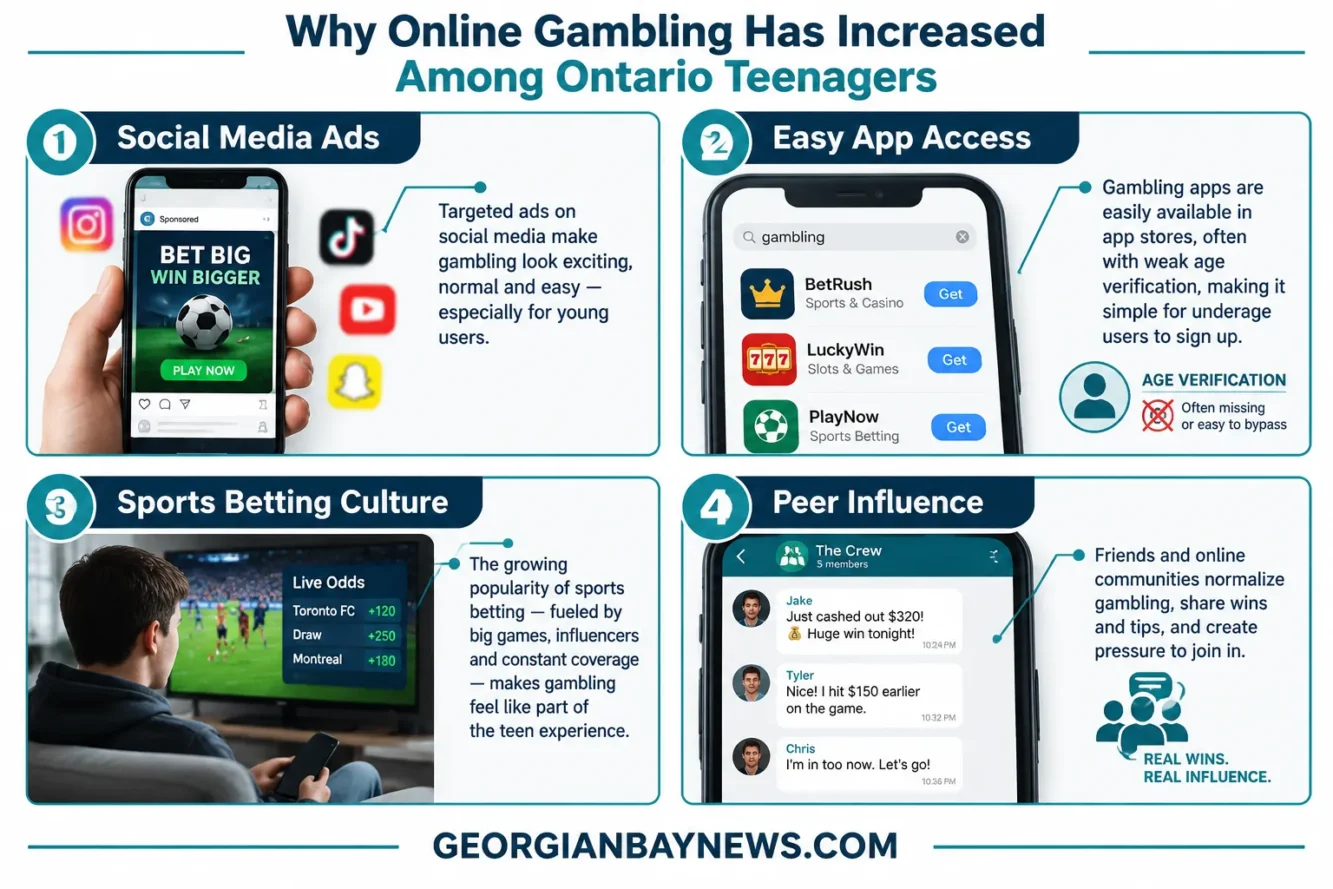
Online gambling has increased among Ontario teenagers for several interconnected reasons, most of which come down to access, culture, and marketing. The 2022 launch of Ontario’s regulated iGaming market brought gambling advertising into mainstream spaces, including sports broadcasts, social media platforms, and YouTube pre-rolls, all heavily consumed by teens.
Key drivers include:
- Smartphone penetration: Nearly all Ontario teens own a smartphone, making gambling apps available 24 hours a day.
- Weak age verification: Many offshore gambling sites require only a self-declared birthdate to create an account.
- Normalization through sports betting: The legalization of single-event sports betting in Canada in 2021 made wagering feel routine and low-risk to young audiences.
- Loot boxes and social casino games: These bridge the gap between gaming and gambling, conditioning teens to accept chance-based spending as normal.
- Peer influence: Group chats and social media posts celebrating wins create social pressure to participate.
According to the Responsible Gambling Council’s 2023 report on youth gambling in Canada, approximately 35 percent of youth who gamble online say they first tried it because a friend recommended it.
Is Online Gambling Legal for Minors in Ontario
No. Online gambling is strictly illegal for anyone under 19 in Ontario. The Alcohol and Gaming Commission of Ontario (AGCO) licenses and regulates the province’s iGaming market, and all licensed operators are required to verify user age before allowing real-money play.
The problem is that the legal framework only governs licensed Ontario operators. Hundreds of offshore sites operating outside AGCO jurisdiction accept players with little to no verification. Teens can and do access these platforms freely.
Bottom line for parents: If your teenager is gambling online, they are almost certainly using an unlicensed offshore site or exploiting a verification gap. This also means they have zero consumer protections if something goes wrong.
What Are the Risks of Online Gambling for Teens
The risks of online gambling for teens are significantly higher than for adults, because the adolescent brain is still developing the impulse control and risk-assessment functions that govern addictive behaviour.
Documented risks include:
- Addiction: Teens develop gambling disorders at two to four times the rate of adults, according to CAMH research.
- Financial harm: Teens may spend savings, steal money, or take on informal debt to fund gambling.
- Mental health decline: Problem gambling in youth is strongly linked to anxiety, depression, and suicidal ideation.
- Academic impact: Preoccupation with gambling leads to missed assignments, poor concentration, and absenteeism.
- Exposure to predatory platforms: Unlicensed offshore sites have no responsible gambling tools, no deposit limits, and no self-exclusion options.
A 2022 study published in the Journal of Gambling Studies found that youth who gambled online were significantly more likely to report co-occurring substance use compared to non-gamblers of the same age group.
How Much Are Ontario Teens Spending on Online Gambling
Precise spending figures for Ontario teens specifically are difficult to pin down because much of the activity happens on unregulated platforms that do not report data. However, available research offers a concerning picture.
The Responsible Gambling Council’s national youth surveys have found that among Canadian teens who gamble, average monthly spending ranges from an estimated $20 to over $200, with a small but significant subset reporting losses exceeding $500 in a single month. Teens often fund gambling through part-time job earnings, allowances, or, in problem cases, money taken from family members without permission.
What the numbers suggest:
- Most teen gamblers start with small amounts and escalate over time.
- Teens are more likely than adults to chase losses, a key marker of problem gambling.
- Sports betting and online slots are the highest-spend categories among youth gamblers.
What Gambling Sites and Apps Are Teens Using in Ontario
Ontario teens most commonly access gambling through offshore online casinos, sports betting apps, and social casino games that use virtual currency. Because licensed Ontario operators are required to enforce age verification, teens typically end up on unregulated platforms.
Popular categories include:
- Offshore sports betting sites that accept Canadian users without strict ID checks.
- Social casino apps (available on the App Store and Google Play) that use virtual coins but normalize gambling mechanics.
- Skin gambling sites linked to video games like CS2 and Roblox, where in-game items are wagered for real or virtual value.
- Crypto gambling platforms that use cryptocurrency to bypass traditional payment and identity checks.
The social media regulation and content moderation landscape in 2026 is increasingly relevant here, as platforms like TikTok and Instagram continue to serve gambling advertisements to users who have not verified their age.
What Is the Difference Between Gaming and Gambling for Teens
The line between gaming and gambling has become genuinely blurry for today’s teenagers. Traditional gambling involves wagering real money on an uncertain outcome. Traditional gaming involves skill-based play with no financial stake. The problem is that modern video games increasingly incorporate gambling mechanics.
Key distinction: If real money can be spent or won, it is gambling. If the only currency is virtual and cannot be cashed out, it sits in a legal grey area, but the psychological conditioning is nearly identical.
Examples of the grey zone:
- Loot boxes: Random in-game rewards purchased with real money. Banned as gambling in Belgium and the Netherlands; still legal in Canada.
- Skin betting: Wagering game cosmetics (which have real-world resale value) on match outcomes.
- Play-money casino apps: No real money, but identical mechanics to slot machines and poker.
Research from the University of Waterloo has noted that teens who engage heavily with loot box mechanics show measurably higher rates of problem gambling behaviour later.
How Does Online Gambling Affect Teen Mental Health
Online gambling affects teen mental health in ways that compound quickly. Adolescents are neurologically more vulnerable to addiction than adults, and the dopamine cycle triggered by gambling closely mirrors that of substance use disorders.
Documented mental health effects include:
- Elevated rates of anxiety and depression among teen problem gamblers.
- Increased risk of self-harm and suicidal thoughts in severe cases.
- Social withdrawal and damaged family relationships.
- Sleep disruption from late-night gambling sessions.
- Shame and secrecy that prevent teens from seeking help.
CAMH research has consistently identified gambling disorder as an underdiagnosed condition in youth, partly because teens hide it and partly because clinicians are less likely to screen for it than for substance use.
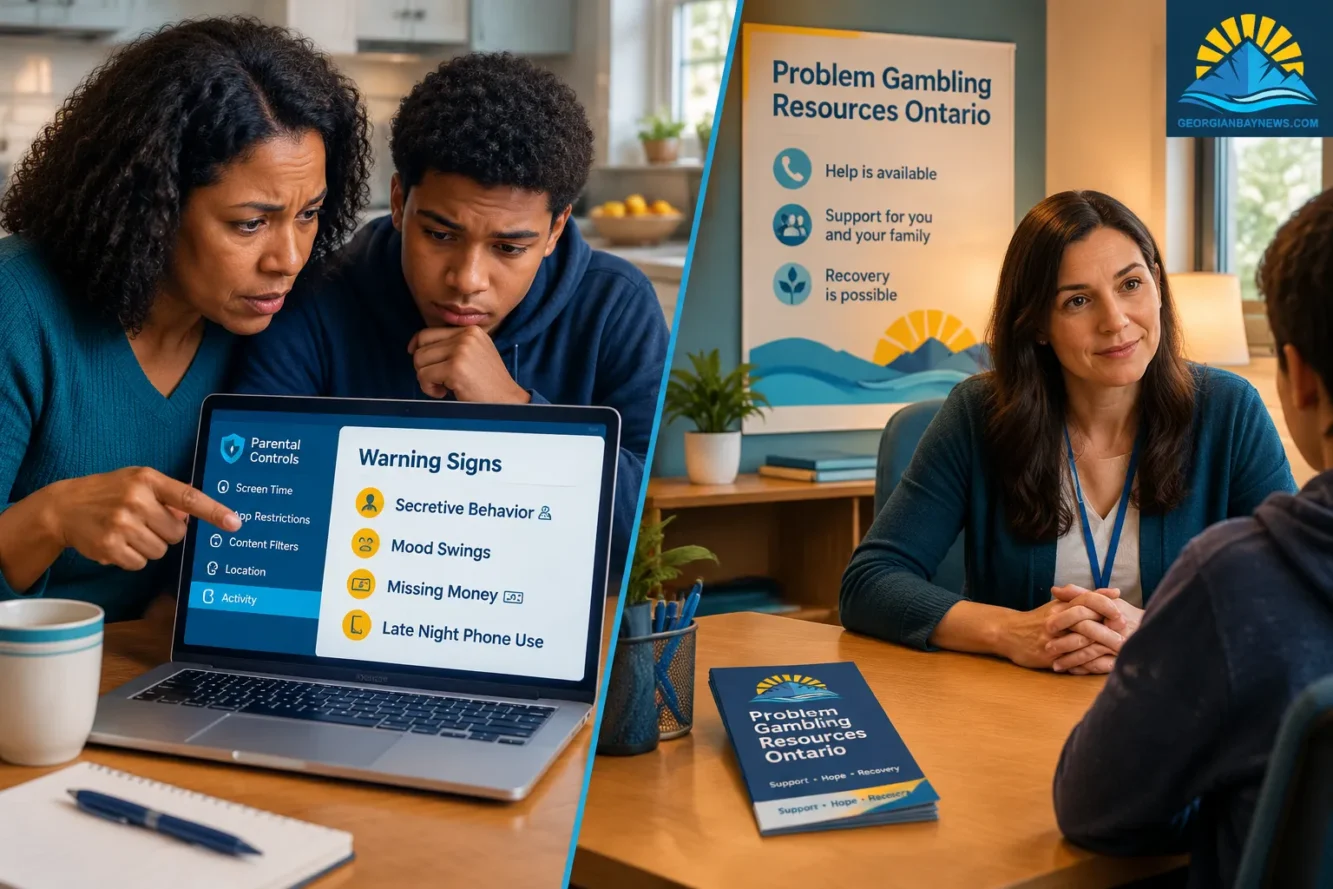
What Are the Signs My Teen Is Gambling Online Too Much
Parents should watch for behavioural changes that suggest a teen may be gambling online excessively. No single sign is definitive, but a cluster of these behaviours warrants a direct conversation.
Warning signs to watch for:
- Unexplained loss of money or requests for extra cash with vague explanations.
- Increased secrecy around phone or computer use, especially at night.
- Mood swings tied to device use, including unusual excitement or deep frustration.
- Withdrawal from friends, family, and hobbies.
- Declining grades or missed school.
- References to gambling wins or losses in casual conversation.
- New, unexplained purchases or gift cards.
If several of these signs appear together, treat it as a serious concern rather than a phase.
How Can Parents Stop Their Teens from Gambling Online
Parents can take practical steps to reduce their teen’s exposure to online gambling. The most effective approach combines open communication with technical safeguards.
Step-by-step actions:
- Have a direct, non-judgmental conversation. Ask your teen what they know about online gambling and whether they have tried it. Shame-based approaches push the behaviour underground.
- Set up parental controls. Most routers, iOS devices, and Android phones allow content filtering. Block gambling-category websites at the network level.
- Monitor financial accounts. If your teen has a debit card or access to family payment methods, review transactions regularly.
- Limit unsupervised screen time, particularly late at night, when online gambling activity among teens peaks.
- Talk about advertising. Help teens recognize that sports betting ads are designed to make gambling feel normal and low-risk.
- Contact the school. Ask whether gambling literacy is part of the health curriculum and advocate for it if not.
The South Georgian Bay online community and similar regional networks are increasingly sharing resources for parents navigating this issue locally.
Are There Gambling Addiction Resources for Ontario Teenagers
Yes. Ontario has several free, confidential resources specifically available for youth dealing with gambling problems, and teens do not need a parent’s permission to access most of them.
Key resources:
- ConnexOntario: 1-866-531-2600 (24/7 mental health, addictions, and crisis support)
- Problem Gambling Helpline: 1-888-230-3505
- CAMH Youth Gambling Awareness Program: School-based prevention and counselling referrals
- Responsible Gambling Council (RGC): Online self-assessment tools and educator resources at responsiblegambling.org
- Ontario211: Connects callers to local addiction services by postal code
Teens can also speak with a school counsellor, family doctor, or walk-in mental health clinic without needing a formal referral.
What Are Schools Doing About Teen Gambling in Ontario
Ontario schools are beginning to address teen gambling, but the response is uneven. The Ontario Health and Physical Education curriculum includes problem gambling as a topic at the secondary level, but depth of coverage depends heavily on individual teachers and school boards.
Some school boards, particularly in urban centres, have partnered with the Responsible Gambling Council to deliver dedicated gambling literacy workshops. These programs teach students to recognize gambling mechanics in video games, understand odds, and identify problem behaviour in themselves and peers.
What is still missing:
- Consistent province-wide mandatory gambling education at the middle school level.
- Training for teachers to recognize early warning signs.
- Clear protocols for referring students to addiction support.
Advocates, including those connected to Southern Georgian Bay communities, have called for stronger provincial standards to ensure all students receive meaningful gambling literacy education before they reach high school.
How the Rest of Canada and the USA Compare
Online gambling has increased for Ontario teenagers, but the trend is not unique to this province. Across Canada and the United States, youth gambling rates have climbed in parallel with the expansion of legal online betting.
Canada-wide picture:
- British Columbia, Alberta, and Quebec have each reported rising youth gambling rates in provincial health surveys.
- The Canadian Centre on Substance Use and Addiction (CCSA) estimates that between 2 and 4 percent of Canadian youth meet the criteria for problem gambling.
- Provinces without regulated iGaming markets have not seen lower youth gambling rates, because offshore sites fill the gap regardless of local law.
United States:
- Following the 2018 Supreme Court decision in Murphy v. NCAA, individual U.S. states were permitted to legalize sports betting. By 2026, more than 35 states have done so.
- The National Council on Problem Gambling (NCPG) has reported a measurable increase in youth helpline contacts since 2020.
- A 2023 study from the Journal of Adolescent Health found that teens in states with legal sports betting were more likely to report gambling activity than those in states where it remained illegal.
- States including Massachusetts, New Jersey, and Illinois have launched youth gambling prevention campaigns in response.
The common thread across all jurisdictions is that legal frameworks designed for adults are not preventing minors from participating.
Conclusion
Online gambling has increased for Ontario teenagers, and the evidence points to a public health issue that is growing faster than the policy response. Easy smartphone access, aggressive marketing, weak age verification on offshore platforms, and the normalization of gambling through sports culture have combined to put a generation of young people at serious risk.
Actionable next steps for different audiences:
- Parents: Start the conversation today. Use parental controls, monitor finances, and contact ConnexOntario (1-866-531-2600) if you are concerned about your teen.
- Educators: Advocate for gambling literacy in your school’s health curriculum and connect with the Responsible Gambling Council for free classroom resources.
- Community leaders: Push for consistent provincial standards on gambling education and stronger enforcement of age verification requirements on all platforms operating in Ontario.
- Teens: If gambling feels out of control, help is available confidentially. You do not need a parent or doctor’s referral to call the Problem Gambling Helpline at 1-888-230-3505.
The window to act is now. The longer this issue goes unaddressed at the community and policy level, the deeper the consequences for Ontario’s young people.
Frequently Asked Questions
Q: At what age can you legally gamble online in Ontario?
A: The legal age for all gambling in Ontario, including online gambling, is 19. Any minor who gambles online is doing so illegally, and the platforms they use are almost certainly unlicensed.
Q: Can a teenager get addicted to online gambling?
A: Yes. Teens develop gambling disorders at two to four times the rate of adults, according to CAMH. The adolescent brain is more susceptible to addiction because the impulse-control regions are still developing.
Q: What should I do if I find out my teen has been gambling online?
A: Stay calm and open a non-judgmental conversation first. Assess how serious the behaviour is, then contact ConnexOntario at 1-866-531-2600 for guidance on next steps.
Q: Are loot boxes considered gambling in Canada?
A: Not legally, as of 2026. Loot boxes remain in a regulatory grey area in Canada. However, research consistently links heavy loot box use to problem gambling behaviours in youth.
Q: Do Ontario’s licensed gambling sites allow minors to play?
A: No. Licensed operators under the AGCO are required to verify age. The problem is that most teens access unregulated offshore sites where verification is minimal or non-existent.
Q: Is teen gambling worse in Ontario than in other provinces?
A: Ontario’s regulated iGaming market and high population density mean more exposure to gambling advertising, but youth gambling rates are elevated across all provinces. The issue is national, not unique to Ontario.
Q: What is the most common type of online gambling among teens?
A: Sports betting and social casino games are the most common entry points, followed by online poker and skin gambling tied to video games.
Q: Are there free resources for teens who think they have a gambling problem?
A: Yes. The Problem Gambling Helpline (1-888-230-3505) and ConnexOntario (1-866-531-2600) are both free, confidential, and available 24/7. Teens do not need parental consent to call.
Q: How do I block gambling websites on my child’s phone?
A: On iOS, use Screen Time under Settings to block adult content categories. On Android, use Google Family Link. At the router level, DNS filtering services like OpenDNS can block gambling-category domains across your entire home network.
Q: Is the U.S. teen gambling problem similar to Canada’s?
A: Yes. The rapid expansion of legal sports betting across U.S. states since 2018 has produced a measurable rise in youth gambling, with the National Council on Problem Gambling reporting increased helpline contacts from minors.
References
- Centre for Addiction and Mental Health (CAMH). Youth Gambling Research and Resources. camh.ca, 2023.
- Responsible Gambling Council. Youth and Gambling: A National Survey. responsiblegambling.org, 2023.
- Canadian Centre on Substance Use and Addiction (CCSA). Youth Gambling in Canada. ccsa.ca, 2022.
- Alcohol and Gaming Commission of Ontario (AGCO). iGaming Ontario Regulations and Compliance. agco.ca, 2022.
- Journal of Gambling Studies. Online Gambling and Co-occurring Substance Use Among Youth. Springer, 2022.
- Journal of Adolescent Health. Sports Betting Legalization and Youth Gambling Behaviour. Elsevier, 2023.
- National Council on Problem Gambling (NCPG). Youth Gambling Awareness Program Data. ncpgambling.org, 2023.
- University of Waterloo. Loot Boxes and Problem Gambling in Adolescents. uwaterloo.ca, 2021.
Content, illustrations, and third-party video appearing on GEORGIANBAYNEWS.COM may be generated or curated with AI assistance or reproduced pursuant to the fair dealing provisions of the Copyright Act, R.S.C. 1985, c. C-42. Attribution and hyperlinks to original sources are provided in acknowledgment of applicable intellectual property rights. Such referencing is intended to direct traffic to and support the original rights holders’ platforms.