






















📱 Calming Your Nervous System: Daily Neurowellness Habits for Stress Relief in a Constant-Scroll World

Canadians now spend more than 38 full days per year on social media alone, and that number keeps climbing [7]. For millions of people juggling work notifications, breaking news alerts, and late-night scrolling, the nervous system never truly gets a chance to rest. The good news is that calming your nervous system through daily neurowellness habits for stress relief in a constant-scroll world does not require a retreat, a prescription, or a dramatic lifestyle overhaul. It requires small, science-backed routines practiced consistently.
Key Takeaways
- Doomscrolling and constant news feeds keep the body locked in a stress response, contributing to anxiety, depression, and poor sleep [1][2]
- Adolescents spending more than six hours daily on screens face a 49% higher prevalence of stress symptoms compared to those staying within two hours
- Extended-exhale breathing, sensory grounding, and rhythmic movement are practical tools for shifting the nervous system out of threat mode
- Setting fixed “news windows,” removing phones from the bedroom, and using digital curfews are clinically recommended daily habits [4][5]
- Short, structured breaks from devices, even 48-hour weekends offline, can meaningfully reduce baseline arousal and improve perceived calm [7]
Why Your Nervous System Is Stuck in Overdrive
The human brain was built to scan for danger. That ancient threat-detection system works brilliantly when a real threat appears, and very poorly when the “threat” is a continuous stream of distressing headlines and social media conflict. Doomscrolling and constant negative news activate the sympathetic “fight-or-flight” response and keep it switched on for extended periods [6][10]. Clinicians now describe this state as chronic digital hyper-vigilance, a low-grade but persistent alarm that drains energy, disrupts sleep, and erodes mood [5][7].
The data behind this is striking. A scoping review of 14 studies found significant links between doomscrolling and depression in 11 studies, anxiety in 12, and sleep disturbance in 8 [1][2]. A 2026 analysis reported that 82.4% of heavy doomscrollers experienced feelings of hopelessness and elevated depressive symptoms [3]. Meanwhile, teens with high daily screen time showed depression symptoms at nearly triple the rate of low-screen-time peers.
This is no longer simply a “too much screen time” conversation. Researchers and clinicians now treat doomscrolling as an independent predictor of mental-health deterioration [1][7].

Calming Your Nervous System: Daily Neurowellness Habits for Stress Relief in a Constant-Scroll World, The Morning Routine
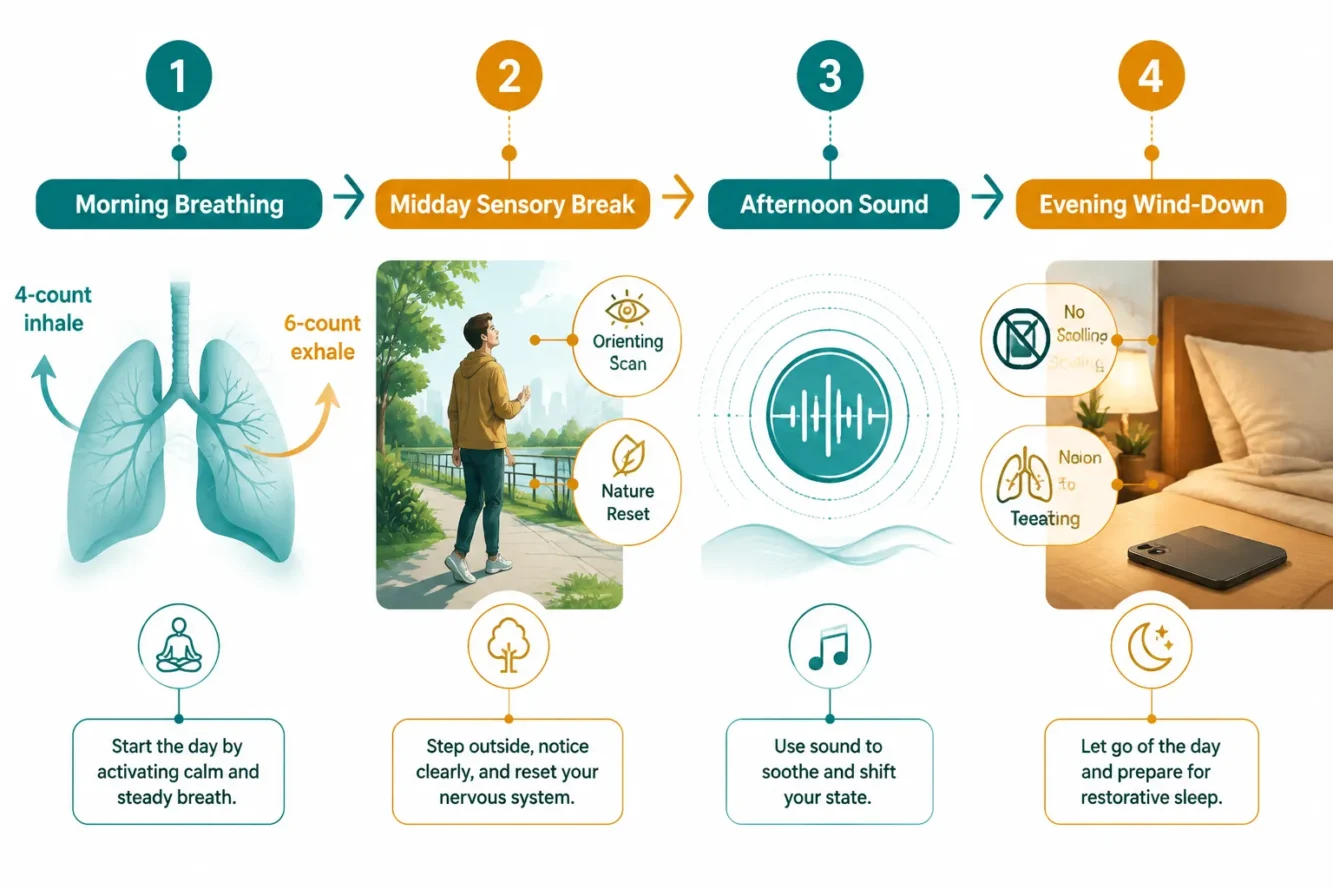
How the day starts shapes the nervous system’s baseline for hours. One of the most evidence-aligned morning habits is extended-exhale breathing before reaching for the phone. A polyvagal-informed routine suggests 10 rounds of breathing with a 4-count inhale and a 6-to-8-count exhale immediately upon waking [30]. The longer exhale activates the parasympathetic branch of the nervous system, the “rest and digest” system, helping to counteract the cortisol spike that naturally occurs in the first 30 minutes of the day.
Morning habits worth building:
- Complete breathing rounds before checking any notifications
- Spend 60 seconds “orienting”, slowly scanning the room, noticing textures, sounds, and light, to signal safety to the brain
- Eat breakfast away from screens to allow the nervous system to settle before the day’s demands begin
A hospital wellness blog published in 2026 also recommends tracking daily scroll time and reducing it by roughly 15 minutes per week, starting with the morning [4]. Avoiding early-morning doomscrolling is one of the most accessible and impactful changes a person can make.
For those interested in community wellness resources in the region, the South Georgian Bay Community Health Clinic offers local support for mental and physical health.
Midday and Afternoon: Micro-Breaks That Reset the Stress Response
The workday is filled with notification triggers, each one nudging the nervous system back toward alertness. Building structured micro-breaks into the afternoon interrupts this cycle before it compounds.
| Micro-Break Type | Duration | What It Does |
|---|---|---|
| Sensory grounding walk | 5-10 minutes | Activates the parasympathetic system through movement and nature |
| Humming or singing | 2-3 minutes | Stimulates the vagus nerve via the vocal cords |
| Warm conversation | 3-5 minutes | Engages the social engagement system, reducing threat arousal |
| Device-free lunch | 20-30 minutes | Lowers baseline cortisol and improves afternoon focus |
Polyvagal theory, the framework behind many of these practices, emphasizes that gentle, rhythmic activities like humming, rocking, and slow walking are among the most direct ways to shift the autonomic nervous system from a threat state toward safety [23]. These are not luxuries. They are functional tools.
Mental-health experts also recommend setting fixed news windows, checking news once or twice daily at set times rather than continuously, and turning off all breaking-news push alerts [5][13]. This single habit meaningfully reduces the number of times the nervous system is activated by alarming information throughout the day.
The Stonetree Clinic is one local provider exploring integrative approaches to nervous system health in the Georgian Bay area.
Evening Digital Curfews and Sleep as Nervous System Medicine
Sleep is not just rest, it is the nervous system’s primary repair window. Yet 75-80% of adults use social media before bed, and up to 93% of young adults aged 18-25 report that social media causes them to lose sleep [21][22]. Teens who use platforms after 10 p.m. are several times more likely to report poor sleep quality than those who log off earlier.
Problematic social media use has been shown to predict subsequent depressive and anxiety symptoms, with poor sleep quality acting as a key pathway between the two [25]. Protecting sleep is therefore not just good hygiene, it is a direct nervous-system intervention.
Evening habits recommended by clinicians and professional bodies [4][5][24]:
- Keep phones out of the bedroom entirely
- Establish a digital curfew 60-90 minutes before bed
- Replace nighttime scrolling with 5-10 minutes of slow breathing or gentle movement
- Prefer summarized news explainers over live feeds if checking in the evening
The Spiritual Space community in Georgian Bay has highlighted similar themes around intentional rest and disconnection as part of broader well-being practices.
Building a Weekly Reset: The Case for Digital Detox Weekends
Beyond daily habits, short intensive breaks from devices are gaining traction as a way to “rewire” the stress response. A 2026 neurowellness article describes 48-hour screen-free weekends as a meaningful reset, with participants reporting improvements in perceived calm, sleep quality, and focus [11]. While these findings are largely based on self-report rather than large randomized trials, expert commentary broadly supports structured device breaks as a way to interrupt automatic checking behavior and lower baseline arousal [4][5].
A practical weekend reset might look like this:
- Friday evening: Notifications off, phone on airplane mode by 8 p.m.
- Saturday: Outdoor activity, in-person connection, music, cooking, all offline
- Sunday: Gradual re-entry with intentional, time-limited news checking
For those looking for restorative weekend destinations, Southern Ontario winter getaway options near Georgian Bay offer natural environments that are inherently supportive of nervous system recovery.
The South Georgian Bay Music Foundation also offers community music programs, and rhythmic, musical engagement is one of the most well-supported tools for vagal activation and stress relief.
Conclusion
Calming your nervous system through daily neurowellness habits for stress relief in a constant-scroll world is not about perfection, it is about consistency. The research is clear: chronic digital hyper-vigilance is a real and measurable health concern, and the nervous system responds to small, repeated signals of safety [1][6][7].
Actionable next steps for this week:
- Start tomorrow morning with 10 rounds of extended-exhale breathing before touching the phone
- Set one fixed news window per day and delete breaking-news push alerts
- Move the phone charger out of the bedroom tonight
- Schedule one 20-minute device-free outdoor break each afternoon
- Plan one screen-free evening this weekend
The nervous system is not broken, it is responding exactly as designed. The goal is to give it more accurate information: that right now, in this moment, there is safety, stillness, and space to recover.
References
[1] labs.sciety – https://labs.sciety.org/articles/by?article_doi=10.21203/rs.3.rs-9743646/v1
[2] eprints.chi.ac.uk – https://eprints.chi.ac.uk/id/eprint/8522/
[3] Doomscrolling – https://icceph.com/wp-content/uploads/2026/02/DOOMSCROLLING.pdf
[4] The Hidden Health Effects Of Doomscrolling And How To Break The Habit – https://www.trinityhealthma.org/newsroom/blog-articles/the-hidden-health-effects-of-doomscrolling-and-how-to-break-the-habit
[5] News Anxiety Doomscrolling Mental Health 2026 – https://expert-zoom.com/gb/news/news-anxiety-doomscrolling-mental-health-2026
[6] goodtherapy – https://www.goodtherapy.org/blog/doomscrolling-news-anxiety-mental-health/amp/
[7] Doomscrolling Mental Health News Fatigue Science Fix Habits 2026 – https://www.medicaldaily.com/doomscrolling-mental-health-news-fatigue-science-fix-habits-2026-475693
[9] Doomscrolling Effects – https://www.reachlink.com/advice/anxiety/doomscrolling-effects/
[10] Doomscrolling And Mental Health – https://www.doctronic.ai/blog/doomscrolling-and-mental-health/
Content, illustrations, and third-party video appearing on GEORGIANBAYNEWS.COM may be generated or curated with AI assistance or reproduced pursuant to the fair dealing provisions of the Copyright Act, R.S.C. 1985, c. C-42. Attribution and hyperlinks to original sources are provided in acknowledgment of applicable intellectual property rights. Such referencing is intended to direct traffic to and support the original rights holders’ platforms.
Much Appreciate You Sharing This Post - It Helps MUCH!!!