



















Ontario Family Calls for Medical Assistance in Dying (MAID) Changes After 26-Year-Old Son’s Death
When a young person’s life ends through Medical Assistance in Dying (MAID), the ripples extend far beyond a single family. In late December 2025, Kiano Vafaeian, just 26 years old, received MAID in British Columbia—a decision that has ignited a fierce debate about eligibility criteria, mental health protections, and the boundaries of compassionate care. His family, devastated and determined, is now calling for significant changes to Canada’s MAID legislation, arguing that their son’s primary struggle was mental health, not his physical conditions of Type 1 diabetes and partial vision loss.[3]
This case has become a flashpoint in the ongoing conversation about end-of-life care in Canada, raising critical questions that affect not just healthcare professionals and policymakers, but families across the country and around the world.
Key Takeaways
- A 26-year-old Ontario man received MAID in BC on December 30, 2025, despite his family’s belief that mental health—not physical illness—was his primary struggle.[3]
- Mental illness as a sole condition remains excluded from MAID eligibility until at least March 17, 2027, following federal legislation delays.[1][6]
- Two independent medical assessors must evaluate all MAID requests, with a mandatory 90-day assessment period when death isn’t reasonably foreseeable.[4]
- An Ontario couple is leading a court battle to change MAID policies in British Columbia, highlighting cross-provincial concerns.[7]
- The case underscores tensions between patient autonomy, mental health support, and family involvement in end-of-life decisions.
Understanding Medical Assistance in Dying (MAID) in Canada
Medical Assistance in Dying represents one of the most significant shifts in Canadian healthcare policy over the past decade. Since its legalization in 2016, MAID has provided Canadians facing unbearable suffering with the option to end their lives with medical assistance—but the framework governing who qualifies and under what circumstances continues to evolve.
The Current Legal Framework
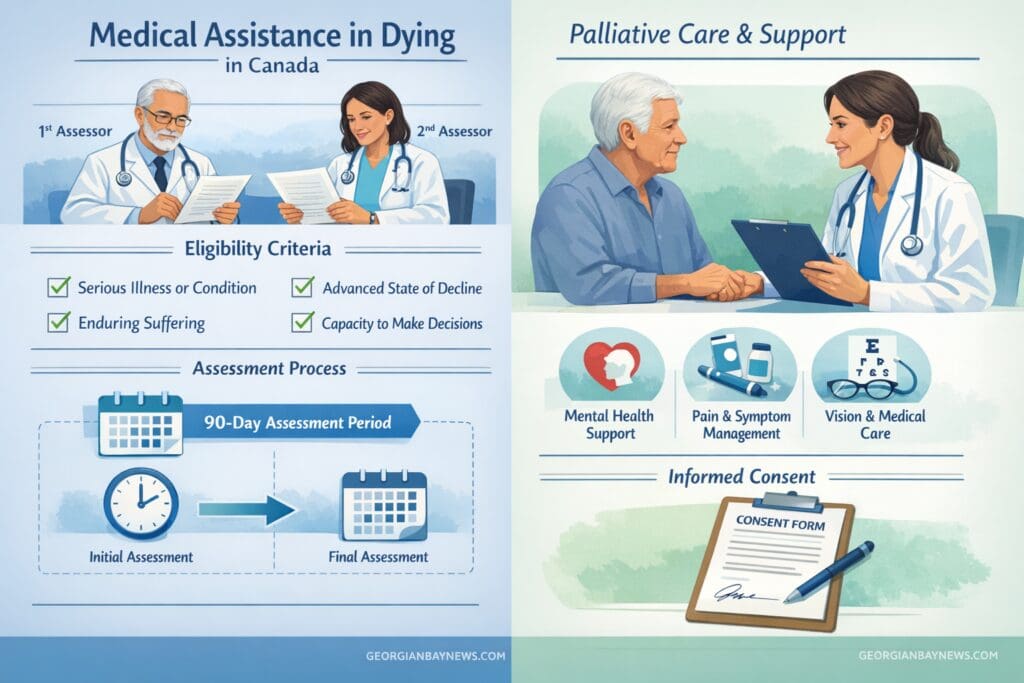
The eligibility criteria for MAID in Canada are specific and designed with safeguards. According to federal regulations, individuals must meet several requirements:[4]
- Be eligible for publicly funded health services in Canada
- Be at least 18 years old and capable of making healthcare decisions
- Have a serious and incurable illness, disease, or disability
- Be in an advanced state of irreversible decline
- Experience unbearable physical or psychological suffering that cannot be relieved under acceptable conditions
- Provide informed consent to receive MAID
Importantly, people whose sole underlying medical condition is a mental disorder are currently excluded from eligibility—a restriction that will remain in place until at least March 17, 2027.[1][6]
The Two-Track System
Since March 2021, when Bill C-7 expanded MAID eligibility, Canada has operated under what’s essentially a two-track system:[1]
Track 1: For individuals whose natural death is reasonably foreseeable
- Shorter assessment timelines
- Streamlined process
- Fewer procedural requirements
Track 2: For individuals whose natural death is NOT reasonably foreseeable
- Mandatory 90-day assessment period (can be shortened if capacity loss is imminent)
- More rigorous evaluation process
- Additional safeguards and consultations
This distinction matters tremendously in cases like Kiano’s, where the presence of chronic conditions doesn’t necessarily mean death is imminent.
The Kiano Vafaeian Case: A Family’s Heartbreak
Kiano Vafaeian’s story has become emblematic of the concerns many families harbor about MAID’s implementation. Living with Type 1 diabetes and partial vision loss, Kiano traveled from Ontario to British Columbia, where he received MAID on December 30, 2025.[3]
What His Family Is Saying
His family’s position is clear and anguished: they believe Kiano’s primary struggle was mental health, not his physical conditions. If mental health was indeed the driving factor, they argue, he should have been ineligible for the procedure under current federal law.[3]
This raises profound questions:
- How do assessors distinguish between physical suffering and mental health struggles when they’re intertwined?
- What role should families play in the decision-making process?
- Are the current safeguards sufficient to protect vulnerable individuals?
The family’s advocacy has joined a growing chorus of voices calling for reforms. Much like families advocating for mental health support in other contexts, they’re channeling grief into action, hoping to prevent similar situations.
The Cross-Provincial Dimension
One complicating factor in Kiano’s case is geography. As an Ontario resident who received MAID in British Columbia, his situation highlights how provincial differences in healthcare delivery can create inconsistencies in how MAID is administered across Canada.
An Ontario couple is currently leading a court battle to change MAID policies specifically in British Columbia,[7] suggesting that BC’s approach may differ from other provinces in ways that concern families and advocates. This legal challenge could have far-reaching implications for how MAID is regulated and standardized across provincial boundaries.
The Assessment Process: Safeguards and Concerns
The MAID assessment process includes multiple layers designed to protect vulnerable individuals while respecting patient autonomy. Understanding these safeguards is crucial to evaluating whether the system is working as intended.
The Dual Assessor Requirement
Two independent medical practitioners—either physicians or nurse practitioners—must assess all MAID requests.[4] These assessors:
- Cannot knowingly benefit from the person’s death
- Must not hold authority over each other
- Cannot have connections that could compromise objectivity
- Must independently confirm eligibility in writing
This dual-assessment requirement aims to prevent hasty decisions and ensure thorough evaluation. However, critics wonder whether two assessments are sufficient when mental health complexities are involved.
The 90-Day Assessment Period
For individuals whose death is not reasonably foreseeable, a minimum 90-day assessment period is mandatory.[1][2] This extended timeline allows:
- Comprehensive evaluation of the person’s condition
- Exploration of alternative treatments and supports
- Time for reflection and reconsideration
- Assessment of whether suffering can be alleviated
The 90-day period can be shortened only if both evaluators agree the person is at imminent risk of losing decision-making capacity—a provision designed to balance protection with practicality.
Informed Consent and Final Affirmation
Immediately before receiving MAID, individuals must:[4]
✅ Be given the opportunity to withdraw consent
✅ Affirm their decision if they choose to proceed
✅ Demonstrate capacity at the moment of administration
An exception exists if the person has previously waived the requirement for final consent—a provision that applies in specific circumstances where capacity loss is anticipated.
Alternative Care Discussions
Healthcare providers are required to inform patients about other options for managing their suffering before proceeding with MAID assessment.[1][2] These alternatives include:
- Palliative care services
- Mental health supports and interventions
- Pain management strategies
- Other end-of-life care options
The question families like Kiano’s are asking: Were these alternatives adequately explored and offered? Was sufficient time given to pursue mental health treatment?
Mental Health and MAID: The Ongoing Debate
The exclusion of mental illness as a sole qualifying condition for MAID remains one of the most contentious aspects of Canadian legislation. This debate directly impacts cases like Kiano’s, where physical and mental health struggles intersect.
The Current Exclusion
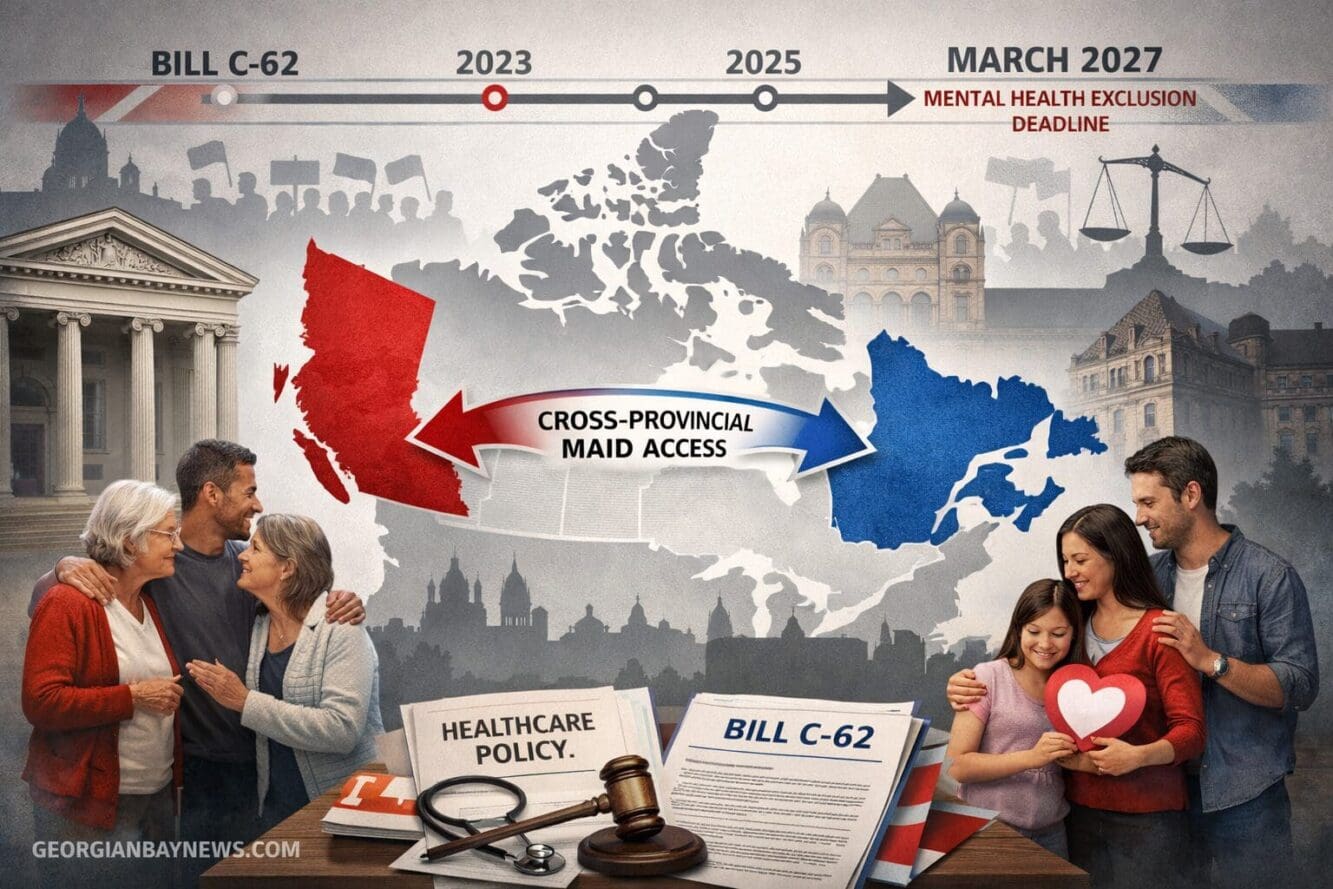
Following federal legislation in Bill C-62 (announced February 29, 2024), individuals whose sole underlying condition is a mental disorder are excluded from MAID eligibility until March 17, 2027.[1] In January 2025, the federal government introduced additional legislation to further postpone implementation for this category.[6]
Why the Delay?
The postponement reflects deep concerns among healthcare professionals, ethicists, and advocates:
🧠 Complexity of Assessment: Mental illness can fluctuate, making capacity and prognosis difficult to determine
🧠 Treatment Potential: Mental health conditions may respond to treatments not yet tried
🧠 Vulnerability: People in mental health crises may not be in a position to make irreversible decisions
🧠 Resource Gaps: Canada’s mental health system has significant access barriers
The Gray Area: Physical Illness with Mental Health Components
Kiano’s case illustrates the gray area that concerns many families. When someone has both physical conditions (diabetes, vision loss) and mental health struggles, how do assessors determine what’s driving the request for MAID?
Supporting families through difficult healthcare decisions requires nuanced understanding and compassion—qualities that may be difficult to ensure in every MAID assessment.
Provincial Variations and Legal Challenges
Canada’s healthcare system is provincially administered, which means MAID implementation can vary across the country despite federal legislation setting the framework.
The British Columbia Situation
The fact that an Ontario couple is pursuing a court battle specifically targeting BC’s MAID policies[7] suggests there may be differences in how the province interprets or applies federal guidelines. While the core eligibility criteria are federally mandated, provinces have some discretion in:
- How assessments are conducted
- What additional supports are offered
- How waiting periods are implemented
- What oversight mechanisms exist
The Sam O’Neill Case
The legal challenge also references Sam O’Neill, age 34, who received MAID approximately one year after being diagnosed with cervical cancer that had metastasized.[7] While this case differs from Kiano’s—involving a terminal cancer diagnosis—it’s part of the broader conversation about assessment thoroughness and family involvement.
Cross-Provincial Access
Kiano’s journey from Ontario to BC to receive MAID raises questions about cross-provincial healthcare access. Should provinces have different thresholds or processes? What happens when families disagree with assessments made in another province?
These questions matter not just for communities across Ontario but for all Canadians navigating complex healthcare decisions.
The Family Perspective: When Loved Ones Disagree
One of the most painful aspects of Kiano’s case is the apparent disconnect between his decision and his family’s understanding of his situation. This raises fundamental questions about the role of families in MAID decisions.
Patient Autonomy vs. Family Input
Canadian MAID legislation prioritizes patient autonomy—the individual’s right to make decisions about their own body and life. However, this can create agonizing situations when:
- Families believe mental illness is clouding judgment
- Loved ones feel they haven’t been adequately consulted
- Family members have information about the person’s history that assessors may not fully appreciate
The Burden of Grief and Advocacy
Families who lose loved ones to MAID often carry complex grief—a mixture of loss, questions, and sometimes regret or anger about the process. When families believe the system failed their loved one, this grief can transform into advocacy, as we’re seeing with Kiano’s family and the Ontario couple pursuing legal action.[7]
Supporting families through loss requires acknowledging their pain while respecting the deceased’s autonomy—a delicate balance that our healthcare and legal systems continue to navigate.
What Families Are Calling For
Based on cases like Kiano’s, families are advocating for:
📢 Greater family involvement in the assessment process
📢 More rigorous mental health screening before MAID approval
📢 Longer mandatory waiting periods for non-terminal conditions
📢 Standardized protocols across all provinces
📢 Enhanced oversight and review mechanisms
Reporting and Oversight: Ensuring Accountability
Canada has established reporting requirements designed to track MAID cases and ensure the system operates within legal boundaries.
Provincial Reporting
In Ontario, physicians and nurse practitioners must notify the Office of the Chief Coroner after providing MAID and report deaths through the Medical Assistance in Dying Death Report.[1] This creates a paper trail for:
- Tracking trends and patterns
- Identifying potential issues
- Ensuring compliance with legal requirements
- Providing data for policy evaluation
Federal Reporting
Federal reporting requirements apply to all providers involved in eligibility assessments across Canada.[1] This national-level data collection helps:
- Monitor how MAID is being implemented across provinces
- Identify disparities or concerning patterns
- Inform future policy decisions
- Provide transparency to the public
The Question of Sufficiency
For families like Kiano’s, the question remains: Are these reporting and oversight mechanisms sufficient? Do they catch cases where mental health may have been the primary driver? Can they identify when alternative supports weren’t adequately explored?
International Perspectives: How Canada Compares
Canada’s MAID legislation exists within a global context. Several countries have legalized some form of assisted dying, each with different approaches and safeguards.
Countries with Legal Assisted Dying
🌍 Netherlands: Pioneered assisted dying; includes mental illness as qualifying condition
🌍 Belgium: Broad eligibility including mental suffering; no age restriction
🌍 Switzerland: Allows assisted suicide; attracts international “suicide tourism”
🌍 Several U.S. states: Medical aid in dying legal in Oregon, Washington, California, and others
🌍 Australia: Recently legalized in several states with strict safeguards
Canada’s Middle Ground
Canada’s approach attempts to balance compassion with caution. The current exclusion of mental illness as a sole condition places Canada in a more conservative position than the Netherlands or Belgium, but more progressive than many U.S. jurisdictions.
The international debate influences Canadian policy discussions, with advocates on both sides pointing to other countries’ experiences as either cautionary tales or models to emulate.
Moving Forward: What Changes Might Come
Kiano’s case and the ongoing legal challenges may catalyze changes to Canada’s MAID framework. Several potential reforms are being discussed:
Possible Policy Changes
Enhanced Mental Health Screening
More comprehensive psychiatric evaluation before MAID approval, particularly for cases involving chronic conditions that don’t necessarily mean imminent death.
Family Consultation Requirements
While respecting patient autonomy, some advocates suggest mandatory family consultation (with exceptions for abuse situations) to provide additional perspective.
Provincial Standardization
Clearer federal guidelines to ensure consistent application across provinces, reducing the kind of cross-provincial concerns that led to legal challenges.
Extended Waiting Periods
Some propose extending the 90-day minimum assessment period for certain categories of cases, particularly those involving younger individuals.
Ongoing Capacity Assessment
More frequent check-ins throughout the assessment period to ensure the person’s decision remains consistent and capacity is maintained.
The March 2027 Decision Point
The March 17, 2027 deadline for the mental illness exclusion looms large.[1][6] As that date approaches, Canada will need to decide:
- Whether to extend the exclusion further
- Whether to implement mental illness eligibility with additional safeguards
- How to address the gray areas where physical and mental health intersect
Cases like Kiano’s will undoubtedly inform this decision.
What This Means for Canadians
For everyday Canadians—whether seniors considering end-of-life options, families supporting loved ones with chronic conditions, or healthcare providers navigating these complex decisions—understanding MAID is increasingly important.
If You’re Considering MAID
✔️ Understand the criteria: Ensure you meet eligibility requirements
✔️ Explore alternatives: Give palliative care and other supports genuine consideration
✔️ Involve loved ones: While the decision is yours, family input can be valuable
✔️ Ask questions: Don’t hesitate to question your assessors about the process
✔️ Take your time: Use the assessment period for thorough reflection
If a Loved One Is Considering MAID
💙 Listen without judgment: Understand their perspective and suffering
💙 Share your concerns: Express worries about mental health or alternative options
💙 Seek support: Professional guidance can help families navigate these conversations
💙 Respect autonomy: Ultimately, capable adults have the right to make their own decisions
💙 Document concerns: If you believe the process isn’t being followed properly, document and report
For Healthcare Providers
Healthcare professionals administering MAID face enormous responsibility. Kiano’s case underscores the importance of:
- Thorough mental health assessment
- Genuine exploration of alternatives
- Clear documentation of decision-making processes
- Sensitivity to family concerns while respecting patient autonomy
- Awareness of the complex interplay between physical and mental health
Conclusion: Balancing Compassion, Autonomy, and Protection
The story of Kiano Vafaeian and his family’s call for MAID changes represents more than one tragic case—it embodies the ongoing tension between respecting individual autonomy and protecting vulnerable people from irreversible decisions made during periods of suffering.
Medical Assistance in Dying serves a genuine need for many Canadians facing unbearable suffering with no hope of relief. For terminal cancer patients, those with degenerative neurological conditions, or individuals experiencing intractable pain, MAID can provide a dignified exit from unbearable circumstances.
But cases like Kiano’s—where a young person with chronic but manageable physical conditions and potential mental health struggles receives MAID—force us to ask whether the current safeguards are sufficient. His family’s advocacy, alongside the legal challenges being pursued by other Ontario families,[7] may lead to meaningful reforms that better protect vulnerable individuals while preserving access for those who genuinely need this option.
Next Steps for Advocacy and Awareness
If Kiano’s story resonates with you, consider these actions:
- Stay informed about MAID legislation and proposed changes
- Support mental health initiatives that provide alternatives to MAID
- Engage with policymakers about your concerns or support for current policies
- Have conversations with loved ones about end-of-life wishes and values
- Advocate for healthcare resources that address both physical and mental health needs
The conversation about Medical Assistance in Dying in Canada is far from over. As we approach the 2027 decision point on mental illness eligibility, and as families like Kiano’s continue to share their stories, the framework will likely continue to evolve.
What remains constant is the need for compassion—for those suffering, for families navigating impossible decisions, and for healthcare providers carrying the weight of these profound choices. Finding the right balance between autonomy and protection may be impossible to perfect, but listening to voices like Kiano’s family ensures we keep trying.
References
[1] Medical Assistance Dying And End Life Decisions Support Medical Professionals – http://www.ontario.ca/page/medical-assistance-dying-and-end-life-decisions-support-medical-professionals
[2] Medical Assistance In Dying – https://www.phsa.ca/health-info/medical-assistance-in-dying
[3] Ontario Family Changes Son Maid Bc – https://globalnews.ca/news/11644100/ontario-family-changes-son-maid-bc/
[4] Medical Assistance Dying – https://www.canada.ca/en/health-canada/services/health-services-benefits/medical-assistance-dying.html
[6] Maid And Mental Illness Faqs – https://www.camh.ca/en/camh-news-and-stories/maid-and-mental-illness-faqs
[7] Why An Ontario Couple Is Leading A Court Battle To Change Maid In B C – https://panow.com/2026/01/13/why-an-ontario-couple-is-leading-a-court-battle-to-change-maid-in-b-c/