











Human Rights Crisis in Iran: Inside the Crackdown on Anti-Government Protests
The streets of Tehran fell silent on January 8, 2026, but not from peace—from fear.
As mobile networks went dark and internet connections severed across Iran, the world lost its window into one of the deadliest government crackdowns on protesters in modern history. What began as merchants protesting economic collapse in Tehran’s historic Grand Bazaar on December 28, 2025, rapidly transformed into a nationwide uprising that has claimed thousands of lives and thrust the Human Rights Crisis in Iran: Inside the Crackdown on Anti-Government Protests into the global spotlight.
The numbers tell a devastating story. While Iran’s government reports just over 3,000 deaths, independent human rights organizations have documented at least 6,221 people killed and more than 42,300 arrested—and experts believe the true toll is far higher.[5][6] Among those imprisoned is Nobel Peace Prize laureate Narges Mohammadi, whose detention symbolizes the regime’s systematic silencing of dissent. As 2026 unfolds, the international community faces urgent questions about accountability, intervention, and the future of human rights in Iran.
Key Takeaways
- 🚨 Protests erupted December 28, 2025 in Tehran’s Grand Bazaar following the Iranian rial’s collapse to 1.4 million per dollar, marking the first time since 1979 that the Bazaar catalyzed nationwide unrest
- 💔 Death toll disputes reveal massive discrepancies: Iran claims 3,117 deaths while human rights groups documented at least 6,221 killed and over 42,300 arrested, with actual numbers likely much higher
- 📵 Nationwide communications blackout imposed January 8, 2026 cut mobile and internet services as security forces escalated lethal force, with restoration delayed until February 17, 2026
- ⚖️ Amnesty International identified January 2026 as the deadliest month of state repression in Iran in decades, documenting coordinated unlawful killings by IRGC, Basij, police, and plain-clothes agents
- 🏆 Nobel laureate Narges Mohammadi remains imprisoned alongside thousands of activists, highlighting the regime’s systematic targeting of human rights defenders
The Spark That Ignited a Nation: Economic Collapse and the Tehran Bazaar
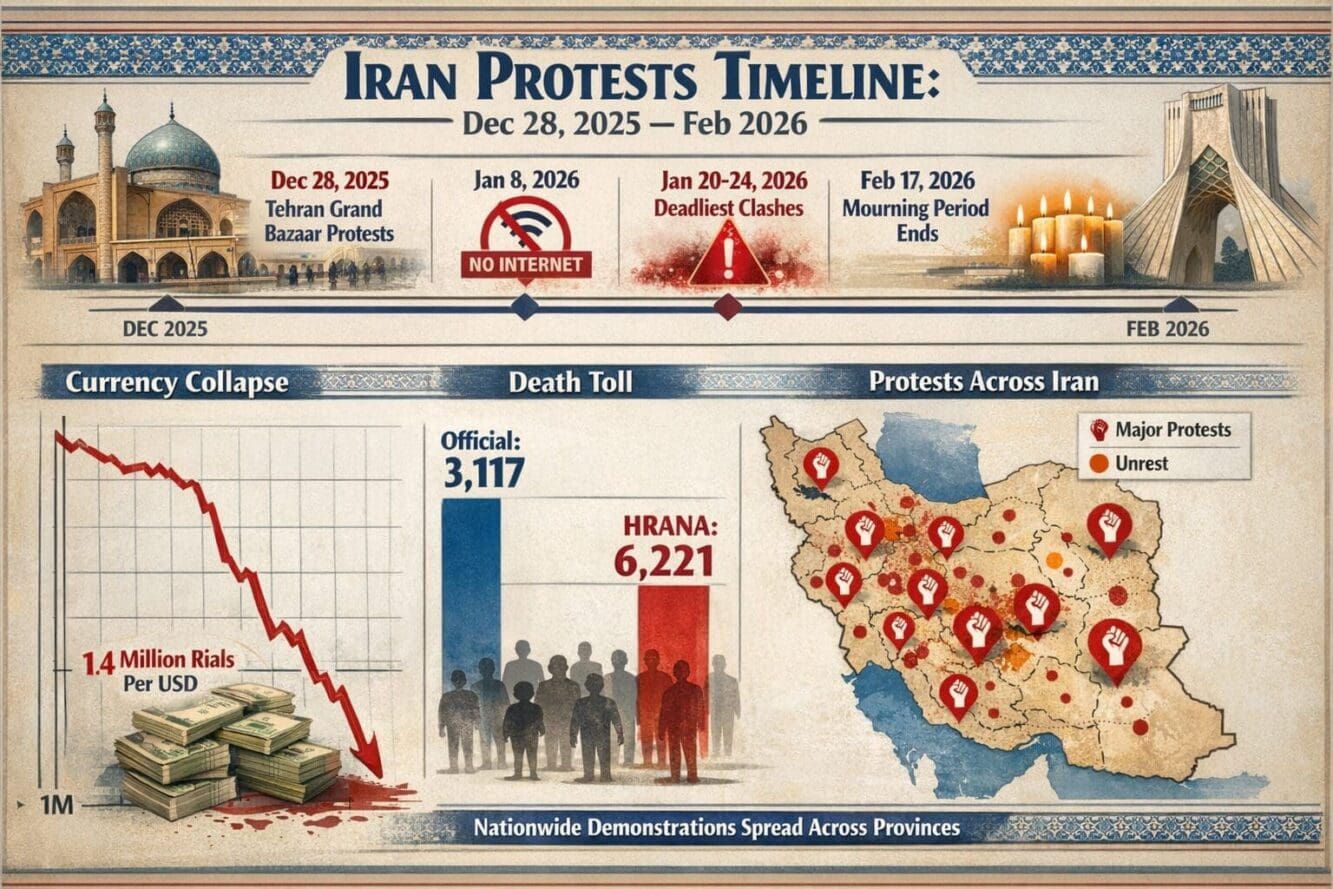
The Human Rights Crisis in Iran: Inside the Crackdown on Anti-Government Protests has deep economic roots that extend far beyond political ideology. When the Iranian rial plummeted to an unprecedented 1.4 million rials per dollar in late December 2025, it wasn’t just numbers on a screen—it was the destruction of livelihoods, savings, and hope for millions of Iranians.[5]
Why the Grand Bazaar Matters
Tehran’s Grand Bazaar isn’t merely a marketplace; it’s a historic institution that has served as Iran’s economic and political heartbeat for centuries. The last time the Bazaar catalyzed widespread protest was during the 1979 revolution that toppled the Shah. When merchants closed their shops on December 28, 2025, it sent an unmistakable signal that even traditionally conservative business communities had reached their breaking point.[5]
Initial protest demands centered on:
- Runaway inflation destroying purchasing power
- Widespread unemployment, especially among youth
- Stagnant wages failing to keep pace with rising costs
- Currency instability making business planning impossible
- Government corruption and mismanagement
The economic grievances were legitimate and initially acknowledged even by Supreme Leader Ayatollah Ali Khamenei, who on January 3 stated that shopkeepers had justified concerns about currency fluctuations.[2] However, this brief moment of acknowledgment quickly gave way to brutal suppression as protests evolved beyond economic complaints.
From Economic Protests to Political Uprising
What distinguishes the 2025-2026 protests from previous demonstrations is the rapid transformation from economic grievances to anti-government demands.[4] Within days, protesters were chanting slogans against the Islamic Republic itself, calling for fundamental political change rather than mere economic reforms.
Students played a prominent role in these early phases, organizing demonstrations at universities across multiple provinces before institutions closed and evacuated dormitories in an attempt to disperse the movement.[5] The regime’s response revealed its greatest fear: not economic criticism, but challenges to its fundamental legitimacy.
The Deadliest Crackdown: Documenting State Violence
January 2026 will be remembered as one of the darkest months in Iran’s human rights history. Amnesty International identified this period as witnessing the deadliest state repression in decades, with coordinated escalation of unlawful lethal force beginning January 8, 2026.[6][7]
The Death Toll Controversy
The massive discrepancy between official government figures and independent documentation reveals the scale of the crisis:
| Source | Deaths Reported | Arrests | Notes |
|---|---|---|---|
| Iran’s Martyrs Foundation | 3,117 | Not disclosed | 2,427 labeled “martyrs” and security personnel; remainder called “terrorists” and “rioters”[5] |
| Human Rights Activists News Agency (HRANA) | 6,221+ | 42,300+ | Documented cases; actual toll believed substantially higher[5][6] |
| Amnesty International | Thousands | Thousands | Coordinated unlawful killings documented across multiple provinces[7] |
The regime’s strategy of categorizing victims reveals its narrative approach: security forces and regime supporters are “martyrs,” while protesters are dismissed as “rioters,” “terrorists,” or foreign agents.[5] This linguistic manipulation attempts to delegitimize the genuine grievances driving the protests.
Security Forces Deployed Against Civilians
Amnesty International identified multiple security apparatuses involved in the lethal crackdown, creating a comprehensive suppression network:[7]
- Islamic Revolutionary Guard Corps (IRGC): Elite military force loyal to the Supreme Leader
- Basij battalions: Paramilitary volunteer militia known for brutal tactics
- FARAJA (police forces): Regular law enforcement units
- Plain-clothes agents: Unidentified operatives conducting arrests and surveillance
Reports from anti-regime sources suggested that nearly 3,000 Iranian-backed Iraqi militia fighters entered Iran to assist in suppression efforts, with European military sources confirming approximately 800 fighters crossed borders under the guise of religious pilgrimages.[1] These foreign militias potentially employ even greater force than Iranian security personnel, operating with less accountability.
The January 8 Communications Blackout
The regime’s decision to impose a nationwide telecommunications blackout on January 8, 2026 marked a critical escalation point.[1][4] By suspending mobile services and blocking local internet access, authorities achieved several objectives:
✅ Prevented protesters from coordinating activities
✅ Stopped documentation of human rights abuses from reaching international audiences
✅ Isolated communities from each other and the outside world
✅ Created information vacuum allowing regime propaganda to dominate
Officials stated they would not restore internet access until the conclusion of the 40-day mourning period for protest victims—February 17, 2026.[1] This extended blackout period prevented families from sharing information about missing loved ones and made independent verification of casualties nearly impossible.
The global implications of such authoritarian tactics extend beyond Iran, setting dangerous precedents for how governments might respond to popular dissent in the digital age.
Iran’s Information Warfare: Controlling the Narrative
Understanding the Human Rights Crisis in Iran: Inside the Crackdown on Anti-Government Protests requires examining how the regime attempts to shape domestic and international perceptions. Iran deployed a sophisticated three-phase information warfare campaign designed to delegitimize protesters and deflect responsibility.[2]
Phase One: Distinguishing “Legitimate” from “Illegitimate” Protest
The regime’s initial strategy acknowledged economic grievances while condemning political demands. Supreme Leader Khamenei’s January 3 statement exemplified this approach: he validated shopkeepers’ concerns about currency fluctuations while simultaneously asserting that “mercenaries” were “chanting slogans against the Islamic Republic.”[2]
This distinction served a critical purpose—it attempted to split the protest movement by:
- Offering symbolic sympathy to economic complaints
- Painting political demands as foreign-influenced
- Creating a “good protester/bad protester” narrative
- Justifying harsh crackdowns against those making political demands
Phase Two: Blaming External Actors
As protests intensified, the regime shifted to blaming foreign powers for orchestrating the unrest. This external scapegoating strategy categorized demonstrators as:[5]
- “Rioters who were deceived” by foreign propaganda
- “Terrorists working for Israel and the U.S.” seeking regime change
- ISIS operatives responsible for deaths and destruction
- Mercenaries paid by hostile nations to destabilize Iran
By January 17, Supreme Leader Khamenei attributed all casualties and damage directly to U.S. President Donald Trump,[2] completely absolving Iranian security forces of responsibility for the violence they perpetrated against civilians.
Phase Three: Framing as Ongoing Conflict with Israel and U.S.
The final phase of Iran’s information warfare positioned the protests within the broader narrative of resistance against Western imperialism and Zionism.[2] This framing serves multiple regime objectives:
- Activates nationalist sentiment among supporters
- Justifies extreme security measures as national defense
- Deflects from domestic policy failures
- Appeals to anti-Western sentiment in the region
The calculated nature of such disruption tactics mirrors strategies employed by authoritarian regimes globally, where domestic failures are consistently blamed on external enemies rather than policy inadequacies.
Imprisoned Voices: Narges Mohammadi and Political Detainees
Among the more than 42,300 people arrested during the crackdown,[5][6] certain cases have captured international attention and symbolize the broader assault on human rights in Iran.
Narges Mohammadi: A Nobel Laureate Behind Bars
Narges Mohammadi, recipient of the 2023 Nobel Peace Prize, remains imprisoned despite international calls for her release. Her detention exemplifies the regime’s systematic targeting of prominent human rights defenders who cannot be silenced through intimidation alone.
Mohammadi’s advocacy work has focused on:
- 📢 Abolition of the death penalty in Iran
- 👥 Women’s rights and gender equality
- ⚖️ Political prisoners’ conditions and treatment
- 🕊️ Peaceful democratic reform
Her continued imprisonment sends a chilling message: even international recognition and acclaim cannot protect activists from the regime’s retribution. The Nobel Committee’s decision to award Mohammadi the Peace Prize while she remained in prison was itself a powerful statement about Iran’s human rights crisis.
The Systematic Targeting of Activists
Beyond high-profile cases, thousands of ordinary Iranians face detention for participating in protests or expressing dissent. Common patterns in arrests include:
- Students and young people organizing or attending demonstrations
- Journalists and citizen reporters documenting government abuses
- Labor organizers advocating for workers’ rights
- Women’s rights activists challenging mandatory hijab laws
- Lawyers defending political prisoners
Many detainees face torture, forced confessions, unfair trials, and lengthy prison sentences. Families often receive no information about their loved ones’ whereabouts or wellbeing for extended periods, particularly during communications blackouts.
The importance of individual voices in creating change cannot be overstated, even when those voices are temporarily silenced by imprisonment.
International Response and the Question of Accountability
The Human Rights Crisis in Iran: Inside the Crackdown on Anti-Government Protests has prompted urgent discussions at the highest levels of international diplomacy about appropriate responses and accountability mechanisms.
United Nations Security Council Deliberations
The UN Security Council convened emergency sessions to address the crisis in Iran, with ambassadors meeting to discuss potential responses.[8] However, geopolitical divisions have complicated unified action:
Challenges to Security Council action:
- Russia and China’s historical protection of Iran from sanctions
- Competing interests among permanent members
- Iran’s strategic importance in regional politics
- Difficulty verifying information during communications blackouts
Despite these obstacles, the international spotlight on Iran’s human rights violations creates diplomatic pressure that the regime cannot entirely ignore.
Amnesty International’s Call for Global Action
Amnesty International issued urgent calls for global diplomatic action to signal an end to impunity for the massacre of protesters.[7] Their recommendations include:
✅ Independent international investigations into unlawful killings
✅ Targeted sanctions against officials responsible for human rights violations
✅ Support for accountability mechanisms including potential referral to International Criminal Court
✅ Protection for Iranian refugees and asylum seekers fleeing persecution
✅ Sustained international pressure through diplomatic channels
The organization documented extensive evidence of coordinated, unlawful use of lethal force across multiple Iranian provinces, providing crucial documentation that could support future accountability efforts.
Economic and Diplomatic Pressure
Beyond formal UN mechanisms, individual nations and regional organizations have options for responding to Iran’s human rights crisis:
- Targeted sanctions against specific officials involved in the crackdown
- Diplomatic isolation through reduced bilateral relations
- Support for civil society and human rights organizations
- Amplification of Iranian voices through international media platforms
- Humanitarian assistance for those affected by violence
The effectiveness of such measures remains debated, particularly given Iran’s experience navigating international sanctions and isolation. However, sustained pressure can create space for internal reform movements and signal to Iranian citizens that the world has not forgotten their struggle.
Understanding broader geopolitical dynamics helps contextualize how international responses to Iran’s crisis fit within larger patterns of global power politics.
The Human Cost: Stories Beyond Statistics
While numbers like 6,221 deaths and 42,300 arrests convey the scale of Iran’s crackdown, they cannot capture the individual tragedies and shattered lives behind each statistic.
Families Searching for Answers
During the communications blackout and in its aftermath, thousands of Iranian families faced agonizing uncertainty about missing loved ones. The regime’s refusal to provide transparent information about casualties and detainees compounds the trauma:
- Parents unable to locate children who attended protests
- Spouses receiving no information about arrested partners
- Children left without parents who “disappeared” after demonstrations
- Extended families bearing economic and emotional burdens
The 40-day mourning period referenced by authorities—ending February 17, 2026—holds deep cultural significance in Iranian tradition.[1] The regime’s decision to extend the communications blackout through this period prevented families from properly grieving and honoring their dead.
Economic Devastation Compounding Political Trauma
The currency collapse that sparked the protests continues to devastate ordinary Iranians’ economic security. With the rial at 1.4 million per dollar,[5] families face:
- 💸 Savings becoming worthless overnight
- 🏪 Basic goods becoming unaffordable
- 💼 Businesses unable to operate profitably
- 🎓 Education and healthcare costs skyrocketing
- 🏠 Housing insecurity and potential homelessness
The combination of political repression and economic collapse creates a humanitarian crisis that extends far beyond those directly involved in protests.
Psychological Impact on a Generation
Young Iranians, particularly students who participated in early protest phases,[5] face profound psychological consequences:
- Trauma from witnessing or experiencing violence
- Fear of continued surveillance and potential arrest
- Hopelessness about prospects for peaceful change
- Anger at systematic injustice and impunity
- Isolation from communications restrictions
This psychological toll will shape Iran’s social fabric for decades, potentially fueling future cycles of protest and repression.
Looking Forward: Paths Toward Justice and Reform
As 2026 progresses, the Human Rights Crisis in Iran: Inside the Crackdown on Anti-Government Protests raises fundamental questions about the future of the Islamic Republic and the Iranian people’s aspirations for dignity, freedom, and justice.
Internal Dynamics and Potential for Change
Despite the brutal crackdown, several factors suggest the regime faces ongoing challenges:
- Economic crisis remains unresolved, with structural problems requiring fundamental reforms
- Youth demographics create a population increasingly disconnected from the 1979 revolution’s ideology
- Information access, despite blackouts, continues through VPNs and satellite communications
- Regional protests demonstrate that grievances extend beyond Tehran to provinces nationwide
- Elite divisions may emerge as economic and political pressures intensify
The fact that Tehran’s Grand Bazaar—traditionally a conservative institution—catalyzed the protests signals that the regime’s support base is eroding even among previously loyal constituencies.[5]
International Community’s Role
The global response to Iran’s human rights crisis will partly determine whether perpetrators face consequences or continue operating with impunity. Key areas for international action include:
Documentation and Evidence Preservation:
- Supporting human rights organizations documenting abuses
- Preserving digital evidence despite communications blackouts
- Protecting witnesses and survivors who can testify
Diplomatic Pressure:
- Maintaining Iran’s human rights record on international agendas
- Coordinating responses among democratic nations
- Using multilateral forums to spotlight abuses
Support for Iranian Civil Society:
- Funding independent media and information sources
- Providing platforms for Iranian voices
- Supporting refugees and asylum seekers
Accountability Mechanisms:
- Pursuing sanctions against specific officials
- Exploring International Criminal Court jurisdiction
- Building cases for future prosecutions
The leadership qualities required to navigate such complex crises demand both moral clarity and strategic sophistication from international actors.
What Ordinary People Can Do
Individuals concerned about the Human Rights Crisis in Iran: Inside the Crackdown on Anti-Government Protests have several avenues for meaningful action:
📢 Amplify Iranian voices on social media and in personal networks
✍️ Contact elected representatives urging action on Iran’s human rights violations
💰 Support human rights organizations working on Iran issues
📚 Educate yourself and others about Iran’s history and current situation
🤝 Connect with Iranian diaspora communities in your area
📰 Share credible information to counter regime propaganda
Individual actions, when multiplied across thousands of people globally, create sustained pressure that regimes cannot entirely suppress.
Conclusion: The Struggle for Human Rights Continues
The Human Rights Crisis in Iran: Inside the Crackdown on Anti-Government Protests represents far more than a series of tragic statistics or diplomatic challenges. It embodies the fundamental human yearning for dignity, justice, and the right to shape one’s own future without fear of state violence.
From the merchants who closed their shops in Tehran’s Grand Bazaar on December 28, 2025, to the students who risked their lives demanding change, to Nobel laureate Narges Mohammadi continuing her advocacy from behind prison walls—the Iranian people have demonstrated extraordinary courage in the face of brutal repression.
The documented deaths of at least 6,221 people and arrests of more than 42,300 individuals demand accountability.[5][6] The coordinated unlawful killings identified by Amnesty International during January 2026 constitute potential crimes against humanity that the international community cannot ignore.[7]
As communications were gradually restored after February 17, 2026, the world gained renewed access to information about Iran’s ongoing crisis. However, the regime’s willingness to impose nationwide blackouts, deploy lethal force against peaceful protesters, and imprison prominent human rights defenders reveals a government willing to use any means necessary to maintain power.
Next Steps for Engaged Global Citizens
Immediate Actions:
- Follow credible human rights organizations reporting on Iran
- Share verified information about the crisis on social media
- Contact government representatives about Iran policy
Ongoing Engagement:
- Support organizations providing legal aid to detained protesters
- Amplify Iranian voices calling for justice and reform
- Educate communities about Iran’s human rights situation
Long-term Commitment:
- Advocate for accountability mechanisms for perpetrators
- Support Iranian civil society and independent media
- Maintain pressure for international action beyond news cycles
The struggle for human rights in Iran continues, and the world’s response—or lack thereof—will shape not only Iran’s future but also set precedents for how the international community addresses mass atrocities against peaceful protesters everywhere.
The merchants of the Grand Bazaar who sparked this uprising understood a fundamental truth: economic justice and human rights are inseparable. As Iran’s crisis unfolds throughout 2026 and beyond, that truth remains as relevant as ever. The question now is whether the international community will match the courage of Iranian protesters with sustained, meaningful action toward accountability and justice.
References
[1] Iran Update January 16 2026 – https://understandingwar.org/research/middle-east/iran-update-january-16-2026/
[2] Irans Information Warfare During The December 2025 January 2026 Protests – https://ict.org.il/irans-information-warfare-during-the-december-2025-january-2026-protests/
[3] Iran At A Crossroads Amid Anti Regime Protests – https://www.wrmea.org/waging-peace/iran-at-a-crossroads-amid-anti-regime-protests.html
[4] Briefing On Protests In Iran – https://www.securitycouncilreport.org/whatsinblue/2026/01/briefing-on-protests-in-iran.php
[5] Why The Latest Iran Protests Started In The Tehran Bazaar – https://www.stimson.org/2026/why-the-latest-iran-protests-started-in-the-tehran-bazaar/
[6] Uprising In Iran A Comprehensive Qa On What Needs To Be Told – https://today.uconn.edu/2026/02/uprising-in-iran-a-comprehensive-qa-on-what-needs-to-be-told/
[7] Iran Massacre Of Protesters Demands Global Diplomatic Action To Signal An End To Impunity – https://www.amnesty.org/en/latest/news/2026/01/iran-massacre-of-protesters-demands-global-diplomatic-action-to-signal-an-end-to-impunity/
[8] Security Council Live Ambassadors Due Meet Emergency Session Iran – https://www.un.org/en/security-council-live-ambassadors-due-meet-emergency-session-iran
Some content and illustrations on GEORGIANBAYNEWS.COM are created with the assistance of AI tools.
GEORGIANBAYNEWS.COM shares video content from YouTube creators under fair use principles. We respect creators’ intellectual property and include direct links to their original videos, channels, and social media platforms whenever we feature their content. This practice supports creators by driving traffic to their platforms.