


















How Small Home Communities Can Shield Families from AI-Driven Job Losses in 2026
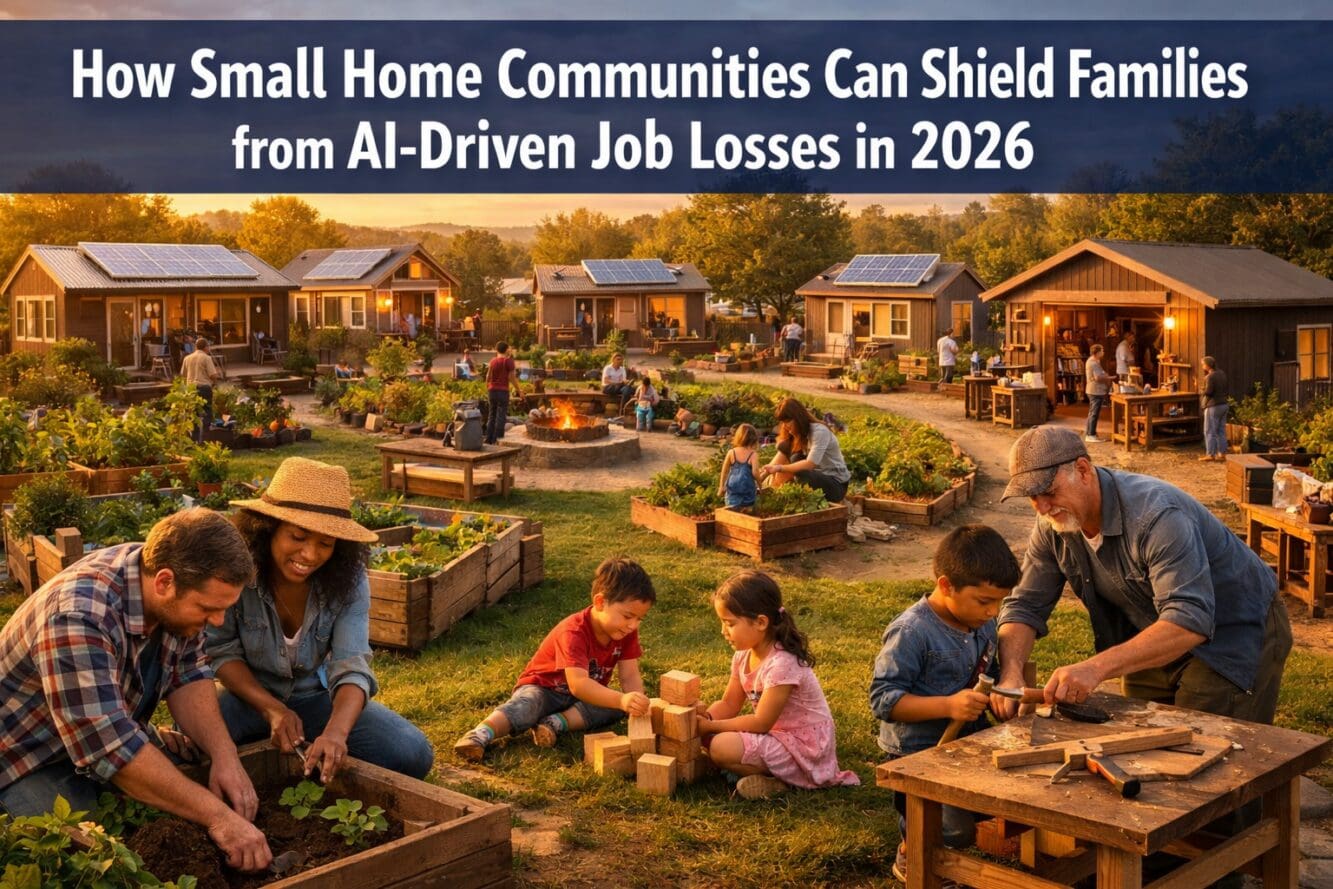
The alarm bells are ringing louder than ever. As artificial intelligence reshapes the employment landscape, 37% of companies expect to have replaced jobs with AI by the end of 2026[2]. For millions of families facing this unprecedented disruption, the question isn’t whether AI will impact their livelihoods—it’s how they’ll survive when it does. But amid this technological upheaval, an unexpected solution is emerging: small home communities that harness shared resources and cooperative economies to build resilience against job displacement.
Understanding how small home communities can shield families from AI-driven job losses in 2026 has become essential for those seeking economic stability in an uncertain future.
These intentional neighborhoods represent more than just affordable living arrangements—they’re reimagining the social contract itself. By pooling resources, sharing skills, and creating micro-economies within their boundaries, small home communities are proving that collective resilience can outpace individual vulnerability when technology threatens traditional employment.
Key Takeaways
- Small home communities reduce living costs by 30-50% through shared resources, providing crucial financial cushioning when AI eliminates jobs
- Cooperative economies within neighborhoods create diverse income streams that don’t depend on traditional employment vulnerable to automation
- Skill-sharing networks transform community members into multi-income earners, reducing dependence on single-employer jobs most at risk from AI
- Shared childcare, food production, and tool libraries free up capital and time for retraining and entrepreneurial ventures
- Building community resilience now prepares families for the 38% reduction in entry-level positions already underway due to AI adoption[1]
The AI Employment Crisis: Understanding the 2026 Landscape
The Scale of AI-Driven Job Displacement
The AI revolution isn’t coming—it’s already here, and the numbers paint a sobering picture. Recent data reveals that 38% of employers have already reduced entry-level roles due to AI[1], with the most significant impact falling on workers aged 22-25 in AI-exposed occupations, who have experienced a 13% employment decline[3].
What makes 2026 particularly critical is the acceleration of this trend. Companies aren’t waiting for AI to prove its worth; they’re laying off workers based on AI’s potential rather than its current performance[4]. This speculative approach to workforce reduction means families have less time to prepare than traditional economic transitions would allow.
Who faces the highest risk?
- Entry-level and early-career workers in administrative roles
- High-salary employees whose compensation makes them targets for cost-cutting
- Workers without AI skills or digital literacy
- Employees in routine cognitive tasks like data entry, basic analysis, and customer service
The employment landscape is fundamentally restructuring, with the International Monetary Fund noting that new skills and AI are reshaping work faster than workers can adapt[7]. Traditional career paths—finish school, get a job, work for decades—no longer provide the security they once did.
Why Traditional Safety Nets Are Failing
Government unemployment programs and corporate severance packages weren’t designed for the speed and scale of AI-driven displacement. These systems assume temporary disruptions followed by reemployment in similar roles. But when entire job categories disappear permanently, workers need fundamentally different support structures.
The Brookings Institution’s research on workers’ capacity to adapt to AI-driven displacement reveals a troubling gap: many workers lack both the financial resources for extended retraining and the social capital to access emerging opportunities[6]. This is where small home communities offer a revolutionary alternative.
How Small Home Communities Can Shield Families from AI-Driven Job Losses: The Economic Foundation
Radical Cost Reduction Through Shared Resources
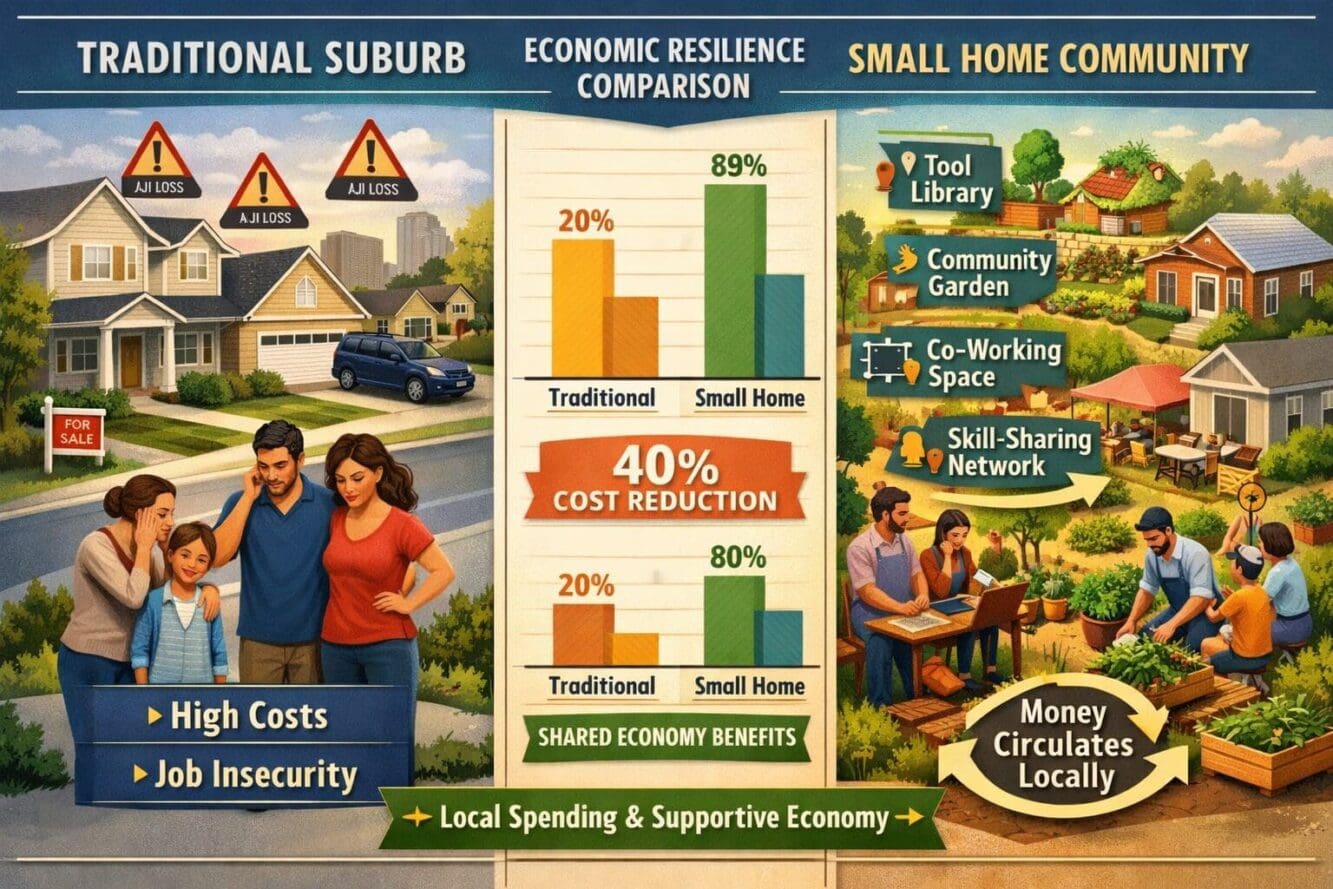
The first line of defense against job loss is reducing the income needed to maintain quality of life. Small home communities achieve this through systematic resource sharing that can cut household expenses by 30-50%.
Core shared resources include:
| Shared Resource | Individual Cost | Community Cost | Savings Per Family |
|---|---|---|---|
| Tool Library | $3,000-5,000 | $500-800 | 85-90% |
| Lawn Equipment | $2,000-4,000 | $300-600 | 85-90% |
| Childcare Co-op | $12,000/year | $2,000-4,000 | 65-85% |
| Community Garden | $800-1,200 | $200-400 | 65-75% |
| Shared Vehicles | $8,000-12,000 | $1,500-3,000 | 75-85% |
These aren’t theoretical savings—they’re documented outcomes from existing communities. When a family reduces their annual expenses by $15,000-25,000 through shared resources, they gain critical breathing room during job transitions or income loss.
Building Cooperative Micro-Economies
Beyond cost reduction, small home communities create internal economies that generate income independently of traditional employment. This diversification is crucial when AI threatens specific job sectors.
Income-generating community structures:
🏡 Community Supported Agriculture (CSA) – Residents grow food collectively and sell surplus to external members, creating revenue streams while reducing food costs
🔧 Skill Exchange Networks – Formalized systems where members trade services (plumbing, electrical work, tutoring, design) using time-banking or community currency
🏪 Cooperative Businesses – Collectively owned enterprises like community bakeries, repair shops, or online services that employ multiple residents
👶 Childcare Cooperatives – Professional-quality childcare operated by community members, serving both residents and external clients
💻 Shared Co-Working Spaces – Community-owned facilities that members use for remote work, freelancing, or small business operations
The power of these structures lies in their redundancy. When one family member loses a traditional job to AI, they can immediately pivot to income-generating activities within the community economy while seeking external opportunities.
Practical Strategies: Building Resilient Small Home Communities
Designing for Economic Resilience
Not all small home communities are equally prepared for AI-driven economic disruption. The most resilient communities intentionally design for economic cooperation from the beginning.
Essential design elements:
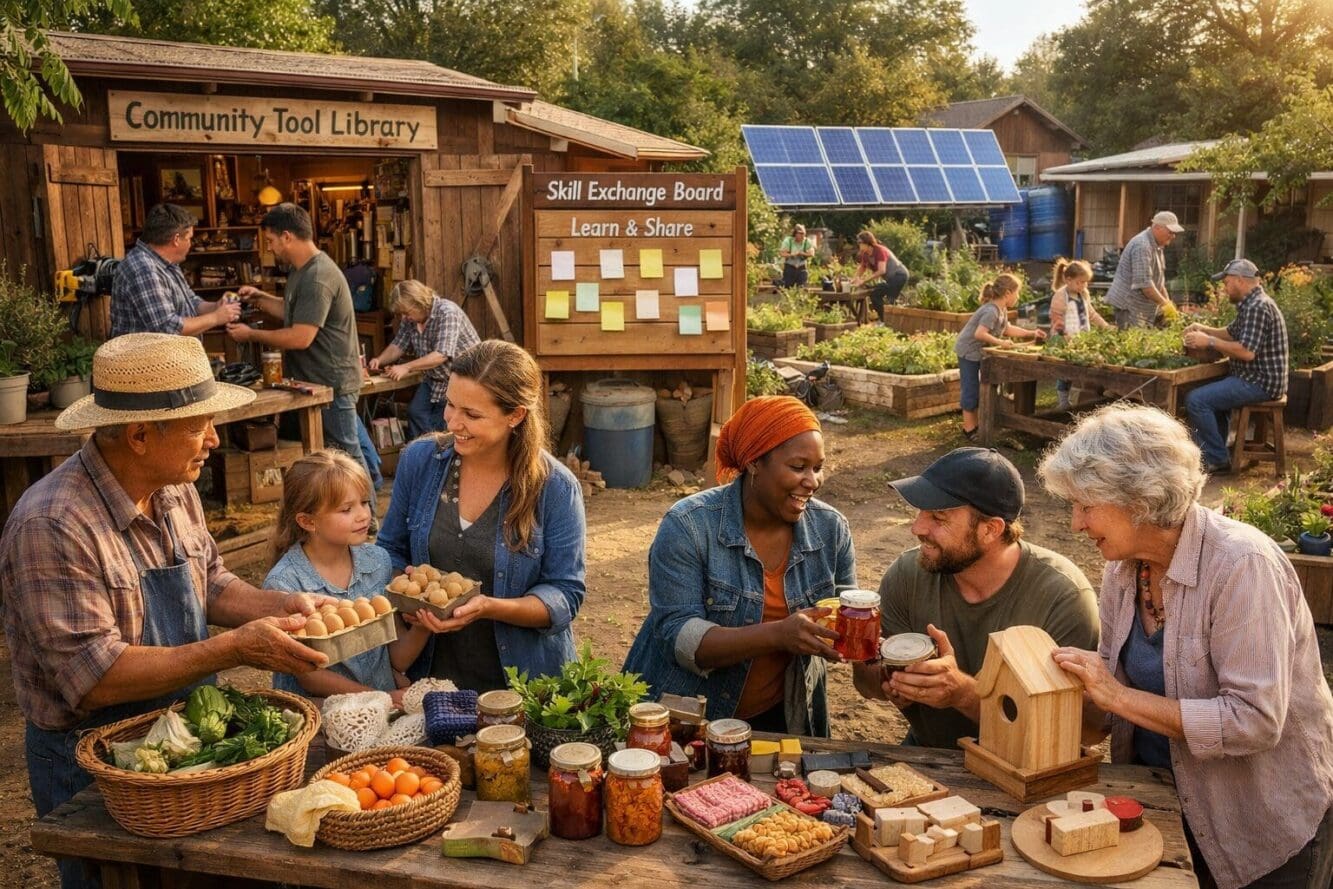
✅ Shared Workshop Spaces – Equipped areas for woodworking, repairs, crafts, and small manufacturing that enable entrepreneurial activities
✅ Community Commercial Kitchen – Licensed facilities where residents can legally prepare food for sale, supporting cottage food businesses
✅ Flexible Common Buildings – Multi-purpose spaces that can serve as classrooms, meeting rooms, co-working areas, or retail spaces
✅ Digital Infrastructure – High-speed internet and shared technology resources supporting remote work and online businesses
✅ Agricultural Space – Gardens, greenhouses, or small-scale farming areas for food production and potential income
✅ Tool and Equipment Libraries – Comprehensive collections of tools, equipment, and resources that eliminate individual purchase needs
These physical elements create the infrastructure for economic self-sufficiency. A community workshop isn’t just about saving money on tools—it’s about enabling residents to start repair businesses, create products for sale, or offer services to external customers.
Governance Structures That Support Economic Cooperation
The legal and organizational framework of a small home community determines how effectively it can respond to economic crises. Communities using cooperative ownership models show greater resilience than traditional homeowner associations.
Effective governance approaches:
Limited Equity Cooperatives – Members own shares in the community rather than individual lots, keeping housing affordable and preventing speculation
Community Land Trusts – The land is owned collectively while homes are owned individually, reducing costs and ensuring long-term affordability
Intentional Income Sharing – Some communities pool a percentage of member income to support those experiencing job loss or reduced earnings
Skill-Based Membership Requirements – Communities actively recruit members with diverse, complementary skills to strengthen the internal economy
Formal Mutual Aid Agreements – Written commitments to support members during hardship, creating predictable safety nets
These structures aren’t merely administrative—they’re the social technology that transforms a collection of small homes into an economically resilient community.
Real-World Examples: Communities Leading the Way
Case Study: East Wind Community, Missouri
East Wind Community demonstrates how cooperative economics can insulate members from external economic shocks. This income-sharing community operates multiple businesses collectively, including a nut butter company and rope-making operation.
Key protective features:
- Members receive housing, food, and healthcare regardless of external employment
- Community businesses provide diverse income streams not dependent on single industries
- Skill-sharing programs ensure members can transition between roles as needed
- Collective decision-making distributes economic risk across the entire community
When AI disrupts specific job sectors, East Wind members can shift to other community enterprises without losing their basic security.
Case Study: Emerald Village, California
Emerald Village takes a different approach, focusing on radical affordability through tiny homes and shared facilities. Residents own their small homes but share common buildings, gardens, and resources.
Economic resilience features:
- Housing costs reduced to $500-800/month including utilities
- Community garden produces 40% of residents’ food needs
- Shared workshop enables multiple resident-run businesses
- Childcare cooperative saves members $15,000+ annually
- Tool library eliminates $5,000+ in individual equipment purchases
This model proves that even without income-sharing, strategic resource pooling can dramatically reduce the income needed for quality of life—crucial protection when AI threatens jobs.
Lessons from Cohousing Communities Nationwide
Hundreds of cohousing communities across North America provide additional evidence. Research shows these communities consistently achieve:
- 30-40% reduction in household expenses through shared resources
- Higher employment diversity among residents compared to conventional neighborhoods
- Faster recovery from job loss due to community support and reduced expenses
- Greater entrepreneurial activity enabled by shared facilities and cooperative purchasing
The pattern is clear: communities designed for cooperation and resource sharing provide measurable protection against economic disruption.
Implementing Community-Based Solutions: A Roadmap
For Families Seeking to Join or Create Communities
Taking action requires understanding both immediate steps and long-term commitments. Families concerned about AI-driven job losses can begin building community resilience today.
Immediate actions (0-6 months):
Research existing communities – Use directories from the Fellowship for Intentional Community or Cohousing Association to find nearby options
Attend community events – Many communities offer tours, workshops, or trial stays to experience cooperative living
Assess financial readiness – Calculate current expenses and identify which could be reduced through sharing
Develop marketable skills – Focus on hands-on skills (repair, building, gardening, cooking) valuable in cooperative economies
Build local connections – Start informal resource sharing with neighbors to practice cooperative living
Medium-term actions (6-18 months):
Join or form a core group – Connect with others interested in creating a new community or join an existing development
Secure land or housing – Explore community land trusts, cooperative housing options, or land suitable for development
Establish governance – Create legal structures, decision-making processes, and membership agreements
Design shared facilities – Plan workshops, gardens, common buildings, and other infrastructure for economic resilience
Develop income strategies – Identify community businesses, skill exchanges, or cooperative enterprises to launch
Long-term sustainability (18+ months):
Launch cooperative businesses – Start community-owned enterprises that employ multiple members
Establish external partnerships – Connect with local businesses, farms, or organizations for mutual benefit
Create educational programs – Offer workshops, apprenticeships, or classes that generate income and build skills
Document and share – Record successes and challenges to help other communities develop similar resilience
Expand the network – Connect with other communities for resource sharing, mutual support, and collective advocacy
For Policymakers and Community Leaders
Government and organizational support can accelerate the development of economically resilient small home communities. Forward-thinking policymakers recognize these communities as infrastructure for economic stability.
Policy recommendations:
💼 Zoning Reform – Update regulations to permit small home communities, accessory dwelling units, and cooperative housing developments
💰 Financial Incentives – Provide grants, low-interest loans, or tax benefits for communities incorporating shared resources and cooperative economics
🏗️ Technical Assistance – Fund programs helping communities with planning, legal structures, and sustainable design
📚 Workforce Development – Support skill-sharing programs and apprenticeships within communities to build adaptive capacity
🤝 Public-Private Partnerships – Connect communities with businesses, educational institutions, and nonprofits for mutual benefit
These policies don’t require massive government spending—they primarily remove barriers and provide modest support for communities building their own resilience.
Challenges and Realistic Expectations
Common Obstacles to Community Formation
Building economically resilient small home communities isn’t without challenges. Families considering this path should understand potential obstacles:
⚠️ Zoning and regulatory barriers – Many jurisdictions prohibit or severely restrict small home communities, cooperative housing, or shared facilities
⚠️ Financing difficulties – Traditional mortgages often don’t accommodate cooperative ownership or unconventional housing arrangements
⚠️ Cultural resistance – American individualism can conflict with the cooperation and compromise required for community living
⚠️ Interpersonal conflicts – Living in close proximity with shared decision-making inevitably creates tensions requiring skilled conflict resolution
⚠️ Economic uncertainty – Community businesses and cooperative enterprises face the same market risks as any small business
⚠️ Time investment – Developing and maintaining cooperative structures requires significant volunteer time from members
Setting Realistic Expectations
Small home communities aren’t utopias, and they won’t eliminate all vulnerability to AI-driven job losses. However, they can provide:
✓ Significantly reduced living costs freeing up resources for adaptation and retraining
✓ Diverse income opportunities through community businesses and skill exchanges
✓ Social support networks providing emotional resilience and practical assistance
✓ Shared risk distributing economic shocks across multiple households
✓ Adaptive capacity through collective problem-solving and resource pooling
The goal isn’t perfect protection—it’s meaningful resilience that gives families better odds of weathering economic disruption than they’d have in conventional housing arrangements.
The Broader Movement: From Individual Communities to Systemic Change
Scaling Community-Based Economic Resilience
Individual communities provide protection for their members, but the broader movement toward cooperative living and shared economies could reshape how society responds to technological unemployment.
Emerging trends:
🌍 Network Effects – Communities connecting with each other to share resources, knowledge, and economic opportunities at larger scales
📱 Technology Enablement – Digital platforms facilitating resource sharing, skill exchanges, and cooperative businesses across distributed communities
🏛️ Policy Recognition – Growing governmental acknowledgment of community-based solutions as legitimate responses to economic disruption
💡 Innovation Acceleration – Rapid experimentation with new governance models, economic structures, and physical designs
🎓 Academic Interest – Increased research documenting outcomes and best practices from existing communities
As more families experience AI-driven job displacement, demand for community-based alternatives will likely accelerate. Communities forming today are pioneering models that could serve millions in coming years.
Integration with Other Economic Resilience Strategies
Small home communities work best as part of a comprehensive approach to economic security, not as isolated solutions. Effective strategies combine:
- Personal skill development – Continuous learning and adaptation to changing job markets
- Multiple income streams – Diversification beyond single employment relationships
- Reduced consumption – Lower expenses through sharing and sustainable practices
- Community cooperation – Mutual support and collective economic activity
- Policy advocacy – Working for systemic changes supporting economic resilience
- Financial preparation – Emergency funds and strategic savings despite reduced income
This integrated approach recognizes that no single strategy provides complete protection, but multiple reinforcing strategies create robust resilience.
Conclusion: Building Resilience Before the Storm
The question of how small home communities can shield families from AI-driven job losses in 2026 isn’t theoretical—it’s urgent. With more than a third of companies already replacing workers with AI[2] and entry-level positions declining by double digits[3], families need alternatives to conventional economic arrangements that assume stable, long-term employment.
Small home communities offer a proven path forward through:
✅ Dramatic cost reduction via shared resources and cooperative purchasing
✅ Diversified income generation through community businesses and skill exchanges
✅ Social safety nets providing support during job transitions
✅ Adaptive capacity enabling rapid response to changing economic conditions
✅ Quality of life maintained even with reduced monetary income
The communities succeeding today share common elements: intentional design for cooperation, robust governance structures, diverse member skills, and commitment to mutual support. These aren’t accidental features—they’re deliberate choices that create economic resilience.
Your Next Steps
For families concerned about AI’s impact on employment security, consider these actionable steps:
Assess your vulnerability – Honestly evaluate how AI might affect your current income sources and timeline for potential displacement
Calculate the community advantage – Determine how much you could reduce expenses through resource sharing and cooperative living
Research options – Explore existing communities in your region or connect with others interested in forming new ones
Start small – Begin informal sharing arrangements with neighbors to experience cooperative benefits and build skills
Develop valuable skills – Focus on hands-on abilities that translate well to community economies and resist automation
Connect with the movement – Join online forums, attend conferences, and learn from communities already implementing these strategies
Advocate for change – Support zoning reforms, financing innovations, and policies enabling community-based economic resilience
The AI revolution will continue reshaping employment regardless of individual preparation. But families who build cooperative relationships, share resources strategically, and create diverse income streams position themselves to weather this disruption far better than those relying solely on traditional employment and individual resources.
Small home communities aren’t a retreat from modern economy—they’re an evolution of how humans organize for mutual prosperity in an age when technology disrupts faster than institutions can adapt. By combining the efficiency of shared resources with the resilience of cooperative economics, these communities demonstrate that collective action can provide security when individual employment cannot.
The storm of AI-driven job displacement is already here. The time to build community resilience isn’t after job loss occurs—it’s now, while families still have resources to invest in creating alternatives. Those who act today will be positioned to help others tomorrow, building networks of mutual support that can weather whatever economic transformations lie ahead.
References
[1] Ai Headcount Statistics – https://programs.com/resources/ai-headcount-statistics/
[2] hrdive – https://www.hrdive.com/news/companies-will-replace-workers-with-ai-by-2026/760729/
[3] Fact Check Has Ai Already Caused Some Job Displacement – https://econofact.org/factbrief/fact-check-has-ai-already-caused-some-job-displacement
[4] Companies Are Laying Off Workers Because Of Ais Potential Not Its Performance – https://hbr.org/2026/01/companies-are-laying-off-workers-because-of-ais-potential-not-its-performance
[6] Measuring Us Workers Capacity To Adapt To Ai Driven Job Displacement – https://www.brookings.edu/articles/measuring-us-workers-capacity-to-adapt-to-ai-driven-job-displacement/
[7] New Skills And Ai Are Reshaping The Future Of Work – https://www.imf.org/en/blogs/articles/2026/01/14/new-skills-and-ai-are-reshaping-the-future-of-work
Some content and illustrations on GEORGIANBAYNEWS.COM are created with the assistance of AI tools.
GEORGIANBAYNEWS.COM shares video content from YouTube creators under fair use principles. We respect creators’ intellectual property and include direct links to their original videos, channels, and social media platforms whenever we feature their content. This practice supports creators by driving traffic to their platforms.