





















Russia’s Massive Drone and Missile Assaults on Ukraine: Escalation in 2026
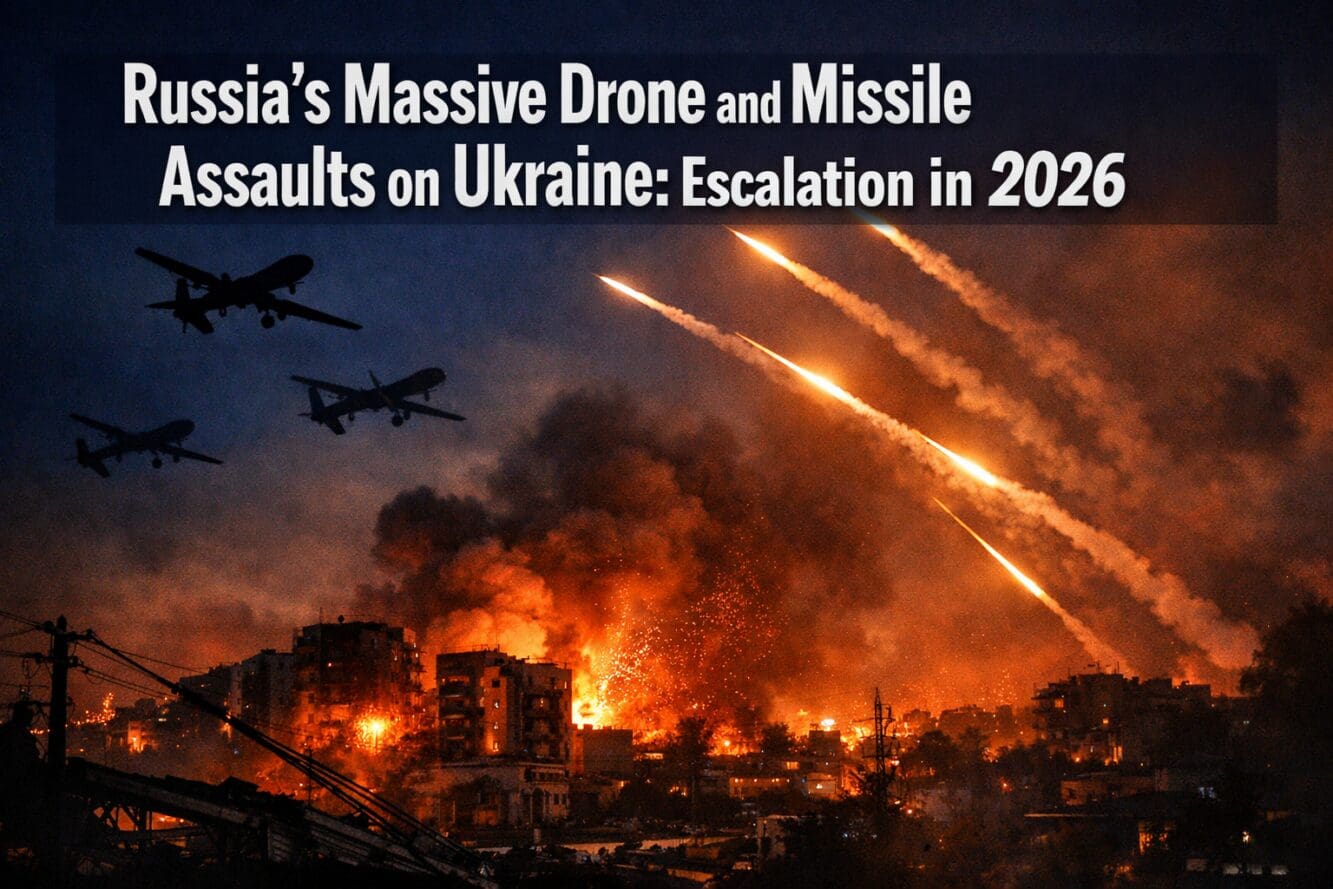
The night sky over Ukraine has become a battlefield of unprecedented intensity. In late January 2026, Russia’s massive drone and missile assaults on Ukraine reached a terrifying new threshold, with over 440 drones and missiles launched in coordinated waves that overwhelmed air defenses and left civilian populations reeling. This escalation in 2026 represents not just a quantitative increase in violence, but a qualitative shift in warfare tactics that signals a prolonged conflict with far-reaching implications for NATO, European security, and the future of modern warfare itself.
As Ukrainian air defense systems worked desperately through the night, shooting down over 100 incoming threats, the strategic calculus behind Russia’s massive drone and missile assaults on Ukraine became clear: systematic degradation of civilian infrastructure, psychological warfare against urban populations, and a calculated test of Western resolve. The attacks coincided with the shocking assassination of a Russian lieutenant general in Moscow, creating a complex narrative of escalation that demands urgent international attention.
Key Takeaways
- Russia launched 146 loitering munitions and drones in a single January 27-28 assault, including approximately 90 Shahed attack drones, with Ukrainian forces intercepting 103 systems but 36 striking 22 locations[1]
- Ukraine’s energy capacity has been reduced to only 60 percent of national electricity demand due to sustained missile and drone strikes on infrastructure[6]
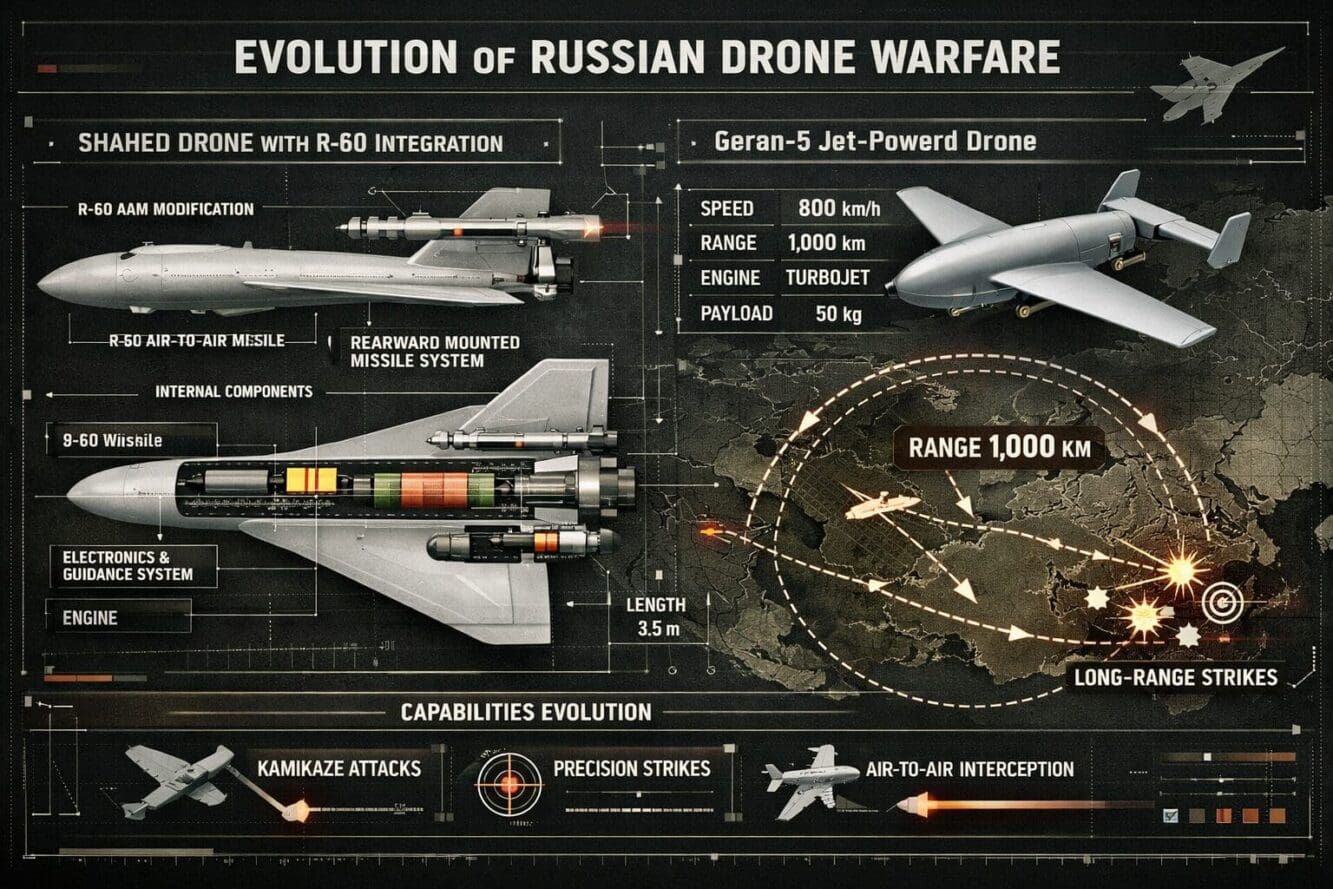
- Russia has integrated air-to-air missile capabilities onto Shahed-type drones with backward-facing R-60 missiles, representing a significant tactical evolution[2]
- Four people were killed and 22 wounded in overnight strikes on Kyiv in January, including an emergency medical worker and five injured rescue personnel[4]
- Russia deployed the new Geran-5 jet-powered drone with a 90 kg warhead and 1,000 km strike range, expanding its arsenal capabilities[3]
The Scale of Russia’s Massive Drone and Missile Assaults on Ukraine in Early 2026
Record-Breaking January 27-28 Attack
The January 27-28 assault exemplified the overwhelming scale of Russia’s current offensive strategy. Russian forces launched an Iskander-M ballistic missile alongside 146 loitering munitions and drones, with approximately 90 being Shahed attack drones[1]. By 09:00 the following morning, Ukrainian air defenses had successfully shot down or jammed 103 of these systems—a remarkable defensive achievement that nonetheless left 36 attack UAVs penetrating to strike 22 separate locations across the country[1].
This single night’s assault demonstrates the mathematical challenge facing Ukrainian defenders: even with a 70% interception rate, the sheer volume of incoming threats guarantees that dozens will reach their targets. For civilians sheltering in Kyiv, Kharkiv, and other major cities, the calculus is simple and terrifying—no air defense system is perfect, and Russia has drones to spare.
Continuous Operations Despite Announced Moratoriums
Perhaps most revealing about Russia’s strategic intentions was the continuation of drone and missile strikes on the night of January 30-31, despite the Kremlin’s announcement just days earlier of a week-long partial moratorium on strikes against certain Ukrainian energy infrastructure on January 29[5]. This pattern of announced ceasefires followed by immediate violations has become a hallmark of Russian information warfare—creating headlines of restraint while maintaining relentless pressure on Ukrainian civilians and infrastructure.
The overnight operations on January 30-31 included Russian drone operators from the 106th Airborne Division and 34th Separate Motorized Rifle Brigade remaining active in the Sumy direction, though Russian forces did not achieve territorial advances despite continuing operations[5]. This suggests a deliberate strategy of maintaining operational tempo regardless of diplomatic messaging.
Tactical Innovation: New Weapons and Capabilities
Air-to-Air Missile Integration on Shahed Drones
One of the most significant developments in Russia’s massive drone and missile assaults on Ukraine during 2026 has been the integration of air-to-air missile functionalities onto Shahed-type drones. Russian forces are now equipping these unmanned systems with backward-facing R-60 air-to-air missiles, representing a tactical shift designed specifically to evade and potentially destroy Ukrainian air defense interceptors[2].
This innovation transforms the Shahed from a simple one-way attack drone into a self-defending weapons platform capable of engaging pursuing aircraft or interceptor drones. The backward-facing configuration suggests Russian engineers have analyzed Ukrainian interception tactics and developed countermeasures specifically targeting the approach vectors used by Ukrainian air defense systems.
The Geran-5: Next-Generation Strike Capability
Russia deployed a new jet-powered drone called the Geran-5 in January 2026, significantly expanding its strike capabilities. This advanced system carries a 90 kg warhead, has a 1,000 km strike range, and can be air-launched by Su-25 aircraft[3]. The jet propulsion system offers several advantages over traditional propeller-driven drones:
- Higher speed making interception more difficult
- Greater range allowing strikes from safer launch positions
- Air-launch capability providing tactical flexibility
- Reduced acoustic signature compared to some propeller systems
The Geran-5 represents Russia’s commitment to technological escalation in unmanned warfare, leveraging AI tools and advanced manufacturing to stay ahead of Ukrainian defensive adaptations.
Infrastructure Degradation: The Strategic Goal
Energy System Collapse
The cumulative effect of Russia’s massive drone and missile assaults on Ukraine has been catastrophic for the national energy grid. Russian strikes from ballistic missiles, cruise missiles, and drones have reduced Ukraine’s energy system capacity to only 60 percent of national electricity demand as of January 2026, creating prolonged blackouts across the country including Kyiv[6].
This systematic degradation represents a deliberate strategy of civilian suffering. By targeting power generation and distribution infrastructure during winter months, Russian forces aim to:
✅ Undermine civilian morale through prolonged blackouts
✅ Complicate military logistics by disrupting power to defense facilities
✅ Strain government resources forcing allocation to infrastructure repair
✅ Create refugee flows as conditions become unbearable
✅ Demonstrate Western inability to protect Ukrainian civilians
Coordinated Targeting of Oil and Military-Industrial Sites
Beyond energy infrastructure, January 2026 attacks systematically targeted oil refineries and military-industrial sites. Strikes included the Oskolneftesnab oil depot in Belgorod Oblast, the Volgograd oil refinery, and the Ilsky oil refinery in Krasnodar Krai[3]. These coordinated strikes demonstrate sophisticated targeting intelligence and the ability to conduct simultaneous operations across vast geographic distances.
The targeting of oil infrastructure serves dual purposes: degrading fuel supplies for Ukrainian military operations while creating economic pressure through reduced refining capacity. The pattern suggests Russian planners are working from comprehensive target lists developed through satellite reconnaissance and intelligence gathering.
Human Cost: Casualties in Kyiv and Beyond
January Kyiv Strike: Four Dead, Twenty-Two Wounded
The human tragedy behind the statistics became painfully clear in January when four people were killed and at least 22 wounded in overnight drone and missile strikes on Ukraine’s capital[4]. Among the casualties was an emergency medical aid worker—one of the first responders who risk their lives to save others. Five additional rescue workers were injured during response operations[4], highlighting the compounding danger of secondary strikes and collapsing structures.
“The targeting of emergency responders represents a particularly cruel dimension of modern warfare, where those who rush toward danger to save lives become casualties themselves.”
Multiple districts in Kyiv sustained damage, including the Desnyanskyi and Dnipro districts, where drones crashed onto residential buildings and fires broke out[4]. The geographic spread of impacts across different districts suggests either saturation tactics designed to overwhelm emergency services or degraded precision in targeting systems—both scenarios offering little comfort to civilians.
The Broader Civilian Impact
Beyond immediate casualties, Russia’s massive drone and missile assaults on Ukraine in 2026 have created a constant state of trauma for millions of civilians. The psychological impact of nightly air raid sirens, hours spent in shelters, and the uncertainty of whether one’s home will survive until morning cannot be quantified in simple statistics. This represents a form of psychological warfare as deliberate as any kinetic strike.
Cognitive Warfare and Northern Diversions
Small-Scale Cross-Border Assaults
Russian military operations continue employing small-scale cross-border assaults in previously inactive northern Ukraine frontline regions to persuade Western nations that Ukrainian defenses are faltering[2]. These operations serve primarily cognitive warfare objectives rather than territorial conquest:
- Creating perception of Ukrainian weakness to undermine Western support
- Forcing defensive resource allocation away from primary fronts
- Generating negative media coverage in Western outlets
- Testing NATO response thresholds to limited border violations
The operations in the Sumy direction on January 30-31, while not achieving territorial gains, succeeded in maintaining operational pressure and forcing Ukrainian commanders to maintain defensive positions that might otherwise be redeployed[5].
Weather Exploitation Tactics
Russian forces have demonstrated tactical adaptability by taking advantage of adverse weather conditions to conduct more frequent, high-casualty assaults northeast of Kharkiv City[5]. Poor visibility and difficult flying conditions that hamper Ukrainian drone reconnaissance and air support create windows of opportunity for Russian ground operations. This weather-dependent tactical flexibility suggests sophisticated operational planning that integrates meteorological forecasting into assault timing.
Meanwhile, Ukrainian forces have responded by expanding operational kill zones into Belgorod Oblast[5], demonstrating their own capacity for cross-border operations that complicate Russian defensive planning and logistics.
Ukrainian Counter-Strikes and Defensive Adaptations
Targeting Russian Launch Infrastructure
Ukrainian forces have not remained passive in the face of escalating assaults. Counter-strikes have targeted Russian military infrastructure, including the Kapustin Yar launch site in January 2026, focusing on facilities associated with intermediate-range ballistic missiles[2]. These strikes serve multiple strategic purposes:
🎯 Degrading launch capabilities to reduce future attack volumes
🎯 Demonstrating strike range to complicate Russian force positioning
🎯 Maintaining offensive initiative despite defensive pressures
🎯 Signaling resolve to domestic and international audiences
The ability to strike deep into Russian territory, targeting launch sites and military infrastructure, represents a critical deterrent capability that may influence Russian operational planning and force dispersal.
Air Defense Evolution
The 70% interception rate achieved during the January 27-28 assault demonstrates remarkable effectiveness given the volume and sophistication of incoming threats. Ukrainian air defense has evolved through:
- Integration of Western systems with Soviet-era platforms
- Distributed sensor networks improving early warning
- Electronic warfare capabilities for drone jamming
- Rapid redeployment tactics to avoid counter-battery fire
- Civilian air defense coordination through mobile apps and alerts
However, the mathematical reality remains stark: against 146 incoming threats, even a 70% success rate means 44 systems reach their targets. Sustaining this defensive effort requires continuous resupply of interceptor missiles—a logistical and financial burden that tests Western commitment.
NATO and Western Response Implications
The Test of Alliance Resolve
Russia’s massive drone and missile assaults on Ukraine in 2026 represent a calculated test of NATO unity and Western staying power. Each wave of attacks poses implicit questions to alliance members:
- How long will you continue supplying air defense systems?
- At what point does the cost exceed your commitment?
- Can you maintain public support as the conflict extends into its third year?
- Will you escalate your own involvement or accept Ukrainian defeat?
The continuation of strikes despite announced moratoriums suggests Russian confidence that Western fatigue will eventually create space for negotiated settlements favorable to Moscow’s territorial ambitions. Understanding this dynamic is crucial for policymakers considering long-term support strategies, much like the strategic planning required in AI adoption initiatives that demand sustained commitment.
Military Aid and Air Defense Priorities
The degradation of Ukraine’s energy infrastructure to 60% capacity highlights the urgent need for enhanced air defense systems capable of handling the volume and variety of threats Russia can deploy. Western nations face difficult allocation decisions:
- Patriot batteries offering sophisticated capabilities but limited quantities
- NASAMS systems providing medium-range coverage
- IRIS-T platforms for short to medium-range defense
- Ammunition resupply for existing systems
- Electronic warfare equipment for drone jamming
Each system comes with training requirements, maintenance logistics, and opportunity costs—resources allocated to Ukraine cannot simultaneously defend NATO territory. This creates political tensions within alliance structures as member nations balance collective security commitments against national defense requirements.
Prolonged Conflict: What the Escalation Signals
Abandonment of Negotiation Pathways
The intensity and systematic nature of Russia’s massive drone and missile assaults on Ukraine in 2026 suggest abandonment of near-term negotiation pathways in favor of military pressure campaigns designed to create facts on the ground. The pattern of announced ceasefires immediately violated indicates Russian leadership views diplomatic gestures as tactical information operations rather than genuine conflict resolution mechanisms.
This strategic orientation points toward prolonged conflict measured in years rather than months, with implications for:
- European energy security as alternative supply chains solidify
- Global food prices as Ukrainian agricultural exports remain disrupted
- Defense industrial capacity as sustained production becomes critical
- Alliance cohesion as economic costs accumulate
- Refugee integration as temporary displacement becomes permanent
Normalization of Civilian Infrastructure Targeting
Perhaps most concerning is the normalization of systematic civilian infrastructure targeting as an accepted warfare methodology. The deliberate degradation of energy systems, water treatment facilities, and emergency services represents a return to total war concepts that international humanitarian law was designed to prevent.
This normalization creates precedents for future conflicts where belligerents may feel empowered to target civilian infrastructure without fear of meaningful international consequences. The erosion of these norms represents a strategic threat extending far beyond Ukraine’s borders.
Future Scenarios and Strategic Trajectories
Escalation Pathways
Several potential escalation pathways emerge from current trends in Russia’s massive drone and missile assaults on Ukraine:
Scenario 1: Sustained Attrition
Russia maintains current operational tempo indefinitely, gradually degrading Ukrainian infrastructure and defensive capabilities while avoiding actions that trigger direct NATO intervention. This represents the most likely near-term trajectory based on current patterns.
Scenario 2: Technological Escalation
Introduction of new weapons systems—potentially including tactical nuclear weapons, hypersonic missiles, or advanced electronic warfare capabilities—creates qualitative shifts in battlefield dynamics. The Geran-5 deployment suggests Russia continues investing in technological advancement despite economic sanctions.
Scenario 3: Geographic Expansion
Operations extend into Moldova, Belarus becomes more directly involved, or strikes against NATO supply lines in Poland create alliance response dilemmas. Northern border operations suggest Russia is testing expansion possibilities[2].
Scenario 4: Negotiated Freeze
Western pressure on Ukraine to accept territorial losses in exchange for ceasefire creates frozen conflict similar to previous post-Soviet disputes. Russian strategy may aim at creating conditions where this becomes the path of least resistance for exhausted Western publics.
Ukrainian Resilience Factors
Despite the intensity of attacks, several factors support continued Ukrainian resistance:
- Distributed energy infrastructure limiting single-point vulnerabilities
- Civil defense networks providing population protection
- Western military aid sustaining defensive capabilities
- Economic adaptation to wartime conditions
- National unity forged through shared adversity
The ability of Ukrainian society to adapt and persist under sustained assault represents a critical variable that Russian planners may have underestimated. Historical examples from 9-1-1 emergency response systems demonstrate how societies can develop remarkable resilience under sustained pressure.
International Law and Accountability Challenges
Documentation of War Crimes
The systematic targeting of civilian infrastructure and emergency responders constitutes potential war crimes under international humanitarian law. Organizations are documenting:
- Strike patterns demonstrating deliberate civilian targeting
- Casualties among protected personnel (medical workers, firefighters)
- Destruction of civilian infrastructure without military necessity
- Use of prohibited weapons or tactics
- Command responsibility for systematic violations
However, accountability mechanisms remain weak when permanent UN Security Council members are perpetrators. The International Criminal Court faces jurisdictional and enforcement limitations that reduce deterrent effects.
Precedent for Future Conflicts
The international community’s response to Russia’s massive drone and missile assaults on Ukraine in 2026 will establish precedents affecting future conflicts. Weak responses signal to potential aggressors that:
- Systematic civilian infrastructure targeting carries acceptable costs
- International law enforcement remains selective and politicized
- Nuclear powers operate under different constraint regimes
- Economic sanctions can be weathered with authoritarian control
Conversely, robust accountability efforts—even if delayed—can reinforce norms and create long-term deterrence through legal, economic, and diplomatic consequences.
Conclusion: Navigating the Escalation
Russia’s massive drone and missile assaults on Ukraine in 2026 represent a dangerous escalation that tests the foundations of European security architecture and international humanitarian law. The deployment of over 440 drones and missiles in coordinated waves, the integration of air-to-air capabilities on attack drones, and the systematic degradation of civilian infrastructure to 60% capacity demonstrate a comprehensive strategy of military pressure designed to break Ukrainian resistance and Western resolve.
The human cost—measured in casualties like the four killed in January’s Kyiv strikes, prolonged blackouts affecting millions, and the psychological trauma of nightly bombardments—demands urgent international response. Yet the continuation of attacks despite announced moratoriums reveals Russian confidence that time favors their strategic objectives.
Actionable Next Steps
For Policymakers:
- Accelerate delivery of advanced air defense systems with sufficient interceptor ammunition
- Develop sustainable funding mechanisms for long-term Ukrainian support
- Strengthen alliance cohesion through burden-sharing frameworks
- Prepare for prolonged conflict scenarios extending beyond 2026
For International Organizations:
- Enhance war crimes documentation with forensic precision
- Develop enforcement mechanisms that transcend Security Council paralysis
- Coordinate humanitarian assistance for energy infrastructure repair
- Support refugee populations with long-term integration planning
For Informed Citizens:
- Maintain awareness of conflict developments despite media fatigue
- Support accountability organizations documenting violations
- Advocate for sustained governmental support to Ukraine
- Recognize that European security architecture affects global stability
The escalation of Russia’s massive drone and missile assaults on Ukraine in 2026 will define the trajectory of European security for decades. The choices made by Western nations, international organizations, and global citizens in response to this crisis will determine whether international law retains meaning in an era of great power competition—or whether might again makes right in the 21st century.
References
[1] pravda.com.ua – https://www.pravda.com.ua/eng/news/2026/01/28/8018225/
[2] Russian Offensive Campaign Assessment February 8 2026 – https://understandingwar.org/research/russia-ukraine/russian-offensive-campaign-assessment-february-8-2026/
[3] Timeline Of The Russo Ukrainian War (1 January 2026 – Present) – https://en.wikipedia.org/wiki/Timeline_of_the_Russo-Ukrainian_war_(1_January_2026_%E2%80%93_present)
[4] Watch – https://www.youtube.com/watch?v=vphwCF2LJ7s
[5] Russian Offensive Campaign Assessment January 31 2026 – https://understandingwar.org/research/russia-ukraine/russian-offensive-campaign-assessment-january-31-2026/
[6] Russias Grinding War Ukraine – https://www.csis.org/analysis/russias-grinding-war-ukraine
Some content and illustrations on GEORGIANBAYNEWS.COM are created with the assistance of AI tools.
GEORGIANBAYNEWS.COM shares video content from YouTube creators under fair use principles. We respect creators’ intellectual property and include direct links to their original videos, channels, and social media platforms whenever we feature their content. This practice supports creators by driving traffic to their platforms.