





















Canada’s Path to Top-Three Medal Placement: Analyzing the 27-Medal Projection and Key Performance Indicators

As the 2026 Milano Cortina Winter Olympics unfold, Canada stands at a critical juncture in its quest to secure a coveted top-three position in the overall medal standings. With 207 athletes competing across multiple disciplines, the nation’s ambitious goal hinges on strategic performance across ice sports, freestyle skiing, and the highly anticipated men’s hockey tournament. Understanding Canada’s path to top-three medal placement: analyzing the 27-medal projection and key performance indicators reveals both the tremendous potential and the challenges that lie ahead for this winter sports powerhouse. 🏅
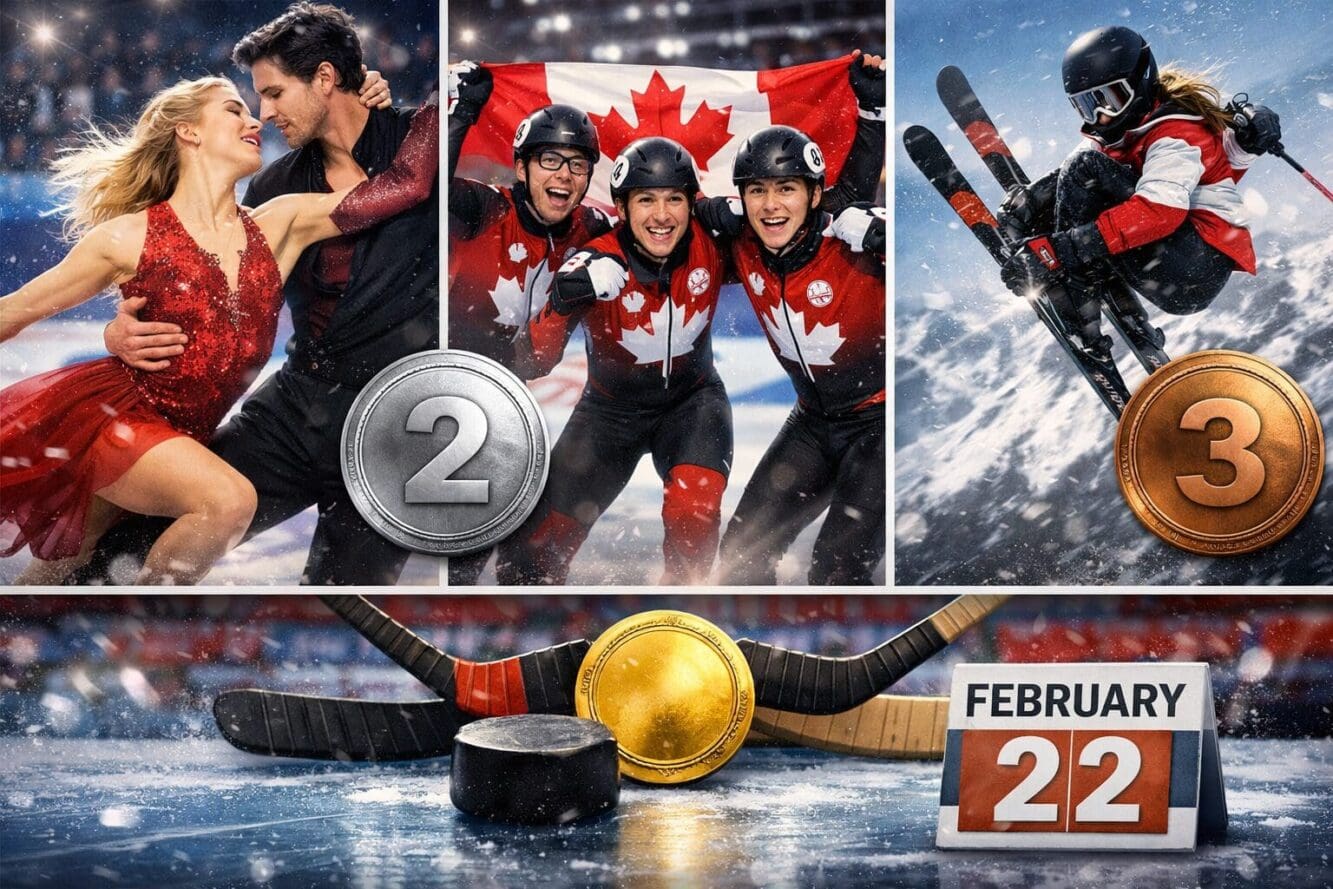
As of February 11, 2026, Canada has already secured four medals—one silver and three bronze—across ice dance, short-track speedskating, and freestyle skiing.[1] This early success provides momentum, but the journey to crack the top three requires sustained excellence across the remaining competition days.
Key Takeaways
- Canada aims to finish third overall with approximately 27 medals, behind Norway and Germany but ahead of the USA in total medal count projections[5]
- Historical benchmark: Canada’s national record stands at 29 medals from the 2018 Pyeongchang Olympics, with a consistent 25-medal target achieved across five consecutive Winter Games[1]
- Early momentum: Four medals already secured through ice dance, short-track speedskating, and freestyle skiing demonstrate strong starts in traditional Canadian strengths[1]
- Men’s hockey represents a critical opportunity, with nine of 19 NHL.com staff members predicting Canada will win gold in this marquee event[4]
- 207 Canadian athletes are competing across multiple disciplines, providing diverse medal opportunities throughout the games[1]
Understanding Canada’s Historical Medal Performance and 2026 Projections
The 25-Medal Benchmark and Pyeongchang Record
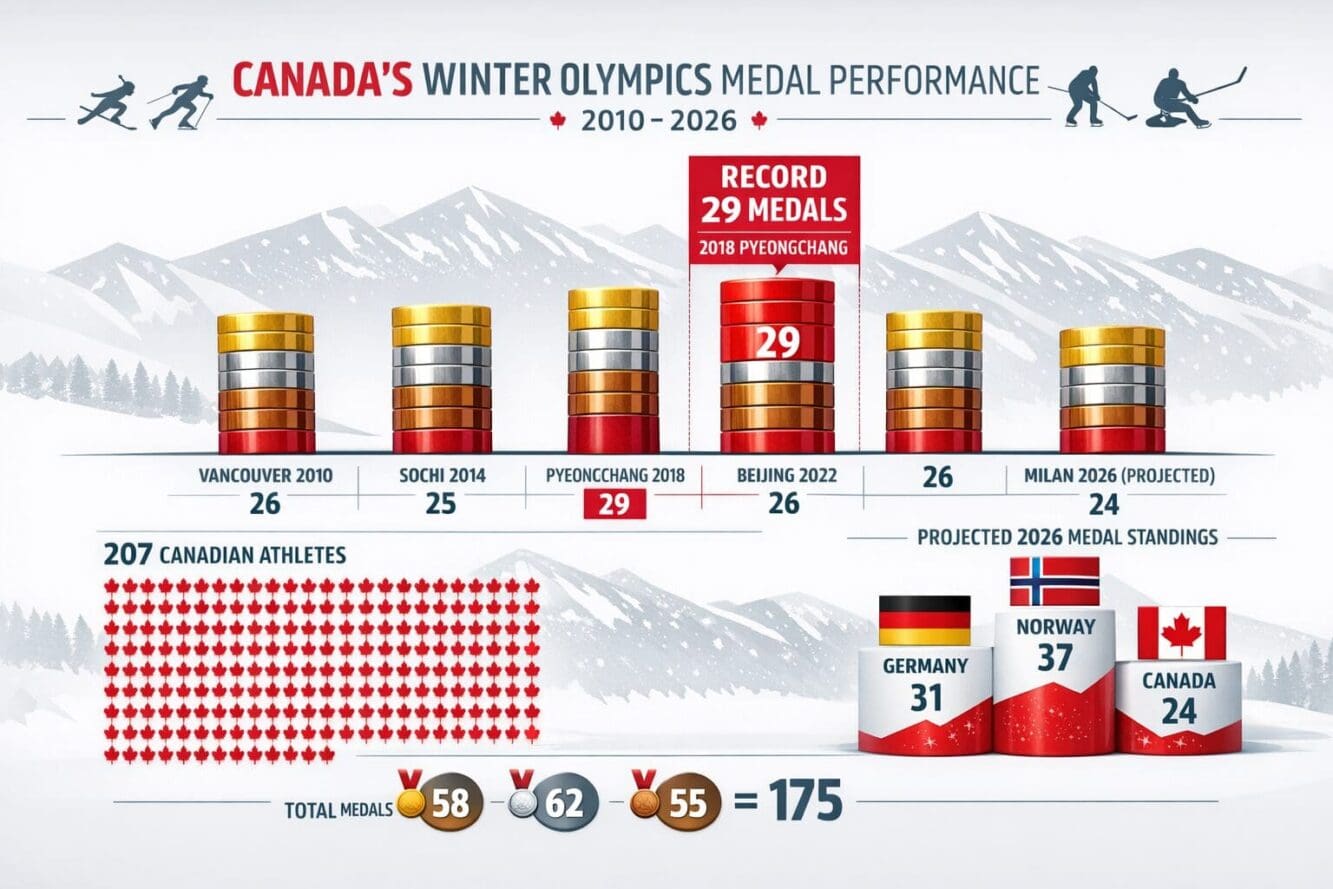
Canada has established itself as a consistent Winter Olympics performer by achieving the 25-medal mark across five consecutive Winter Games.[1] This remarkable consistency demonstrates the strength of Canada’s winter sports development programs and athlete preparation systems.
The national record of 29 medals, set at the 2018 Pyeongchang Olympics, represents the pinnacle of Canadian winter sports achievement.[1] This benchmark serves as both inspiration and a realistic ceiling for what Canadian athletes can accomplish when conditions align perfectly across multiple disciplines.
For Milano Cortina 2026, independent sports analytics predicted Canada would finish third overall with approximately 27 total medals—positioning the nation behind Norway (projected at 69 medals) and Germany (projected at 60 medals), but comfortably ahead of the USA (projected at 50 medals).[5]
Gold Medal Projections and Overall Standings
While total medal count determines overall placement, gold medal performance carries significant prestige and often dominates headlines. Pre-Olympics predictions placed Canada earning between 9 and 15 gold medals, which would position the country fifth in gold medal count behind Norway, Germany, the USA, and potentially Italy.[3][5]
Betting markets reflected this competitive landscape, with Canada listed at +2700 odds for most gold medals overall—indicating the nation faces stiff competition from traditional winter sports powerhouses.[2] Meanwhile, Norway held heavily favored status at -280 odds for most total medals, underscoring the Scandinavian nation’s dominance across winter disciplines.[2]
Canada’s Path to Top-Three Medal Placement: Key Sports and Athletes Delivering Results
Ice Dance: Breaking an Eight-Year Medal Drought
One of the most significant early achievements came when Piper Gilles and Paul Poirier won bronze in ice dance on February 11, marking Canada’s first ice dance medal since Tessa Virtue and Scott Moir won gold in 2018.[1] This eight-year gap in a discipline where Canada has historically excelled made the bronze medal particularly meaningful.
The ice dance result demonstrates that while Canada may not dominate every event as in previous Olympics, the depth of talent across disciplines provides multiple pathways to the medal podium. This diversification strategy proves essential for achieving top-three placement when competing against nations with concentrated strengths.
Short-Track Speedskating: Traditional Strength Continues
Short-track speedskating remains a cornerstone of Canadian Winter Olympics success. The mixed relay team of William Dandjinou, Felix Roussel, Courtney Sarault, and Kim Boutin won silver on February 10, demonstrating continued excellence in this fast-paced, tactical discipline.[1]
Canada’s consistent performance in short-track speedskating provides a reliable medal stream that contributes significantly to overall totals. The technical expertise and competitive experience of Canadian short-track athletes make this discipline a key performance indicator for achieving the 27-medal projection.
Freestyle Skiing: Youth and Experience Combine
Megan Oldham’s bronze medal in women’s freeski slopestyle on February 9 showcased the rising talent in Canadian freestyle skiing.[1] Oldham improved on her fourth-place finish in big air at the 2022 Olympics, demonstrating the growth trajectory of young Canadian athletes.
Having previously won three medals in this event at world championships, Oldham entered Milano Cortina with proven credentials. Her bronze medal represents the type of expected performance that Canada’s medal projection models incorporate—athletes with world championship pedigrees converting that success to Olympic podiums.
Speed Skating: Veteran Excellence
Valérie Maltais earned bronze in the women’s 3,000m speed skating on February 7, capturing her third career Olympic medal while competing in her fifth Olympics.[1] Maltais’s achievement is particularly remarkable given her transition from short-track to long-track speed skating in 2022.
This versatility and longevity exemplify the depth of Canadian winter sports talent. Veterans like Maltais provide stability and predictable medal opportunities that balance the inherent uncertainty of relying solely on emerging athletes.
The Men’s Hockey Factor: A Potential Game-Changer for Medal Standings
NHL Players Return After 12-Year Absence
The 2026 Winter Olympics marks a historic moment: the first time NHL players have competed in the Winter Games in 12 years.[4] This return of professional talent dramatically elevates the competitive level and increases the stakes for traditional hockey powerhouses like Canada.
Among NHL.com staff members, nine of 19 predicted Canada would win the gold medal in men’s hockey, making it a strong favorite in this marquee event.[4] The gold medal game is scheduled for February 22, representing a critical date for Canada’s medal count and national pride.[4]
A gold medal in men’s hockey would not only add to Canada’s total medal count but would also generate tremendous momentum and national enthusiasm that could energize Canadian athletes competing in events scheduled after the hockey final.
Strategic Importance Beyond Medal Count
While one gold medal may seem like a modest contribution to a 27-medal total, the psychological and cultural impact of Olympic hockey success for Canada cannot be overstated. Hockey represents Canada’s national sport and cultural identity in ways that transcend simple medal mathematics.
Success in men’s hockey validates Canada’s winter sports infrastructure and provides a narrative anchor for the entire Olympic campaign. Conversely, failure to medal in hockey—while not mathematically devastating—could overshadow other achievements and dominate post-Olympics analysis.
Competitive Landscape: Norway, Germany, and the Battle for Third
Norway’s Dominance in Winter Sports
Norway’s projected 69 medals represent a commanding lead in the overall medal count.[5] The Scandinavian nation’s success stems from cultural emphasis on winter sports, extensive cross-country skiing programs, and consistent excellence across biathlon, Nordic combined, and alpine events.
For Canada to challenge Norway would require unprecedented success across disciplines where Canadian athletes traditionally compete but don’t dominate. The realistic goal focuses instead on securing third place—a position that still represents elite-level Winter Olympics performance.
Germany’s Balanced Excellence
Germany’s projected 60 medals position it as the likely second-place finisher.[5] German athletes excel across luge, bobsled, biathlon, and alpine skiing, providing a diversified medal portfolio similar to Canada’s strategic approach.
Canada’s competition with Germany for second place remains mathematically possible but would require Canadian athletes to exceed projections while German athletes underperform—an unlikely scenario given both nations’ preparation and talent depth.
USA Competition and Canada’s Third-Place Target
The USA’s projected 50 medals creates a comfortable buffer for Canada’s third-place aspirations.[5] However, the United States possesses strong programs in figure skating, snowboarding, and alpine skiing that could generate unexpected medal surges.
Canada’s path to top-three medal placement requires maintaining the current performance trajectory while capitalizing on remaining opportunities in hockey, curling, and additional speed skating events. The 27-medal projection represents a realistic target that balances optimism with historical performance data.[5]
Key Performance Indicators for Achieving Top-Three Placement
Medal Diversification Across Disciplines
Canada’s success depends on avoiding over-reliance on any single sport. The early medal distribution across ice dance, short-track speedskating, freestyle skiing, and long-track speed skating demonstrates healthy diversification.
Continued medals from curling, additional freestyle skiing events, snowboarding, and potentially figure skating would reinforce this balanced approach. Each discipline represents an independent opportunity, reducing the risk that poor performance in one area derails the entire medal campaign.
Conversion Rate of Medal Favorites
Pre-Olympics predictions identify specific Canadian athletes as medal favorites based on world championship results, World Cup standings, and historical performance. The conversion rate—the percentage of predicted medalists who actually reach the podium—serves as a critical performance indicator.
If Canada’s top-ranked athletes consistently convert expectations into medals, the 27-medal projection becomes highly achievable. Conversely, unexpected failures by favorites would require breakthrough performances from underdogs to maintain the target.
Performance in Team Events
Team events like hockey, curling, and relay races provide concentrated medal opportunities where a single group of athletes can contribute significantly to the overall total. Canada’s silver medal in short-track mixed relay exemplifies this efficiency.[1]
Success in men’s hockey, women’s hockey, and curling competitions could add three to six medals from just these team disciplines, representing more than 20% of the 27-medal projection from a small subset of events.
Momentum and Psychological Factors
Olympic competitions involve significant psychological elements. Early success builds confidence and creates positive momentum that can influence performance in subsequent events. Canada’s four early medals provide this psychological foundation.[1]
Conversely, high-profile failures or controversial judging decisions can create negative momentum. Managing these psychological factors through sports psychology support and team cohesion represents an intangible but important performance indicator.
Challenges and Obstacles to Top-Three Placement
Injury and Illness Risks
The compressed Olympic schedule and high-intensity competition create elevated injury and illness risks. A single injury to a key athlete in a discipline where Canada has limited depth could eliminate multiple medal opportunities.
COVID-19 and other respiratory illnesses remain concerns in 2026, with potential to sideline athletes at critical moments. Canada’s medical and support staff play crucial roles in minimizing these risks through preventive care and rapid response protocols.
Weather and Course Conditions
Outdoor winter sports face variable weather conditions that can dramatically affect results. Unexpected weather changes may favor athletes from certain nations whose training conditions more closely match the competition environment.
Milano Cortina’s specific venue characteristics—including elevation, snow conditions, and course design—may advantage or disadvantage Canadian athletes depending on how closely these conditions match their preparation environments.
Judging Subjectivity in Artistic Events
Events like figure skating, freestyle skiing, and snowboarding involve subjective judging that introduces variability and potential controversy. While judges follow established criteria, interpretation differences can affect medal outcomes.
Canadian athletes in judged events must deliver performances that exceed any reasonable judging variability—essentially performing well enough that results become undeniable regardless of judge preferences or biases.
Conclusion: Canada’s Realistic Path to Podium Success
Canada’s path to top-three medal placement: analyzing the 27-medal projection and key performance indicators reveals a nation well-positioned for Olympic success but facing significant competition from traditional winter sports powerhouses. The early achievement of four medals across diverse disciplines demonstrates the balanced approach necessary for sustained success.[1]
The 27-medal projection represents an ambitious yet achievable target that would maintain Canada’s five-Olympics streak of reaching the 25-medal benchmark while approaching the national record of 29 medals set in 2018.[1][5] Success requires continued excellence in traditional strengths like short-track speedskating and hockey, combined with breakthrough performances in freestyle skiing, snowboarding, and alpine events.
Actionable Next Steps for Fans and Supporters
For Canadian Olympic supporters, the remaining competition days offer numerous opportunities to witness history:
- Watch the men’s hockey gold medal game on February 22 to support Canada’s quest for the sport’s ultimate prize[4]
- Follow speed skating and short-track events where Canadian athletes continue to compete for additional medals
- Support freestyle skiing and snowboarding competitions where young Canadian talent seeks breakthrough performances
- Engage with Olympic coverage through Canadian broadcasters to stay informed about medal opportunities across all disciplines
- Celebrate each medal achievement as a contribution to the collective goal of top-three placement
The 2026 Milano Cortina Winter Olympics represents a defining moment for Canadian winter sports. While Norway’s dominance and Germany’s balanced excellence present formidable challenges, Canada’s diversified talent, strategic preparation, and competitive spirit position the nation for a strong third-place finish. The coming days will determine whether these projections materialize into podium reality. 🇨🇦
References
[1] Canadian Olympic Medal Tracker Podium Performances At Milano Cortina 2026 – https://www.sportsnet.ca/olympics/article/canadian-olympic-medal-tracker-podium-performances-at-milano-cortina-2026/
[2] 2026 Winter Olympics Medals Picks Odds Best Bets Milano Cortina Futures Medals Overall Gold – https://www.cbssports.com/olympics/news/2026-winter-olympics-medals-picks-odds-best-bets-milano-cortina-futures-medals-overall-gold/
[3] 25378590 Olympics Predictions 2026 Medal Odds Usa Canadian Athletes And More – https://bleacherreport.com/articles/25378590-olympics-predictions-2026-medal-odds-usa-canadian-athletes-and-more
[4] 2026 Olympic Hockey Predictions By Nhl Staff – https://www.nhl.com/news/2026-olympic-hockey-predictions-by-nhl-staff
[5] Predicted 2026 – https://www.topendsports.com/events/winter/medal-tally/predicted-2026.htm