


















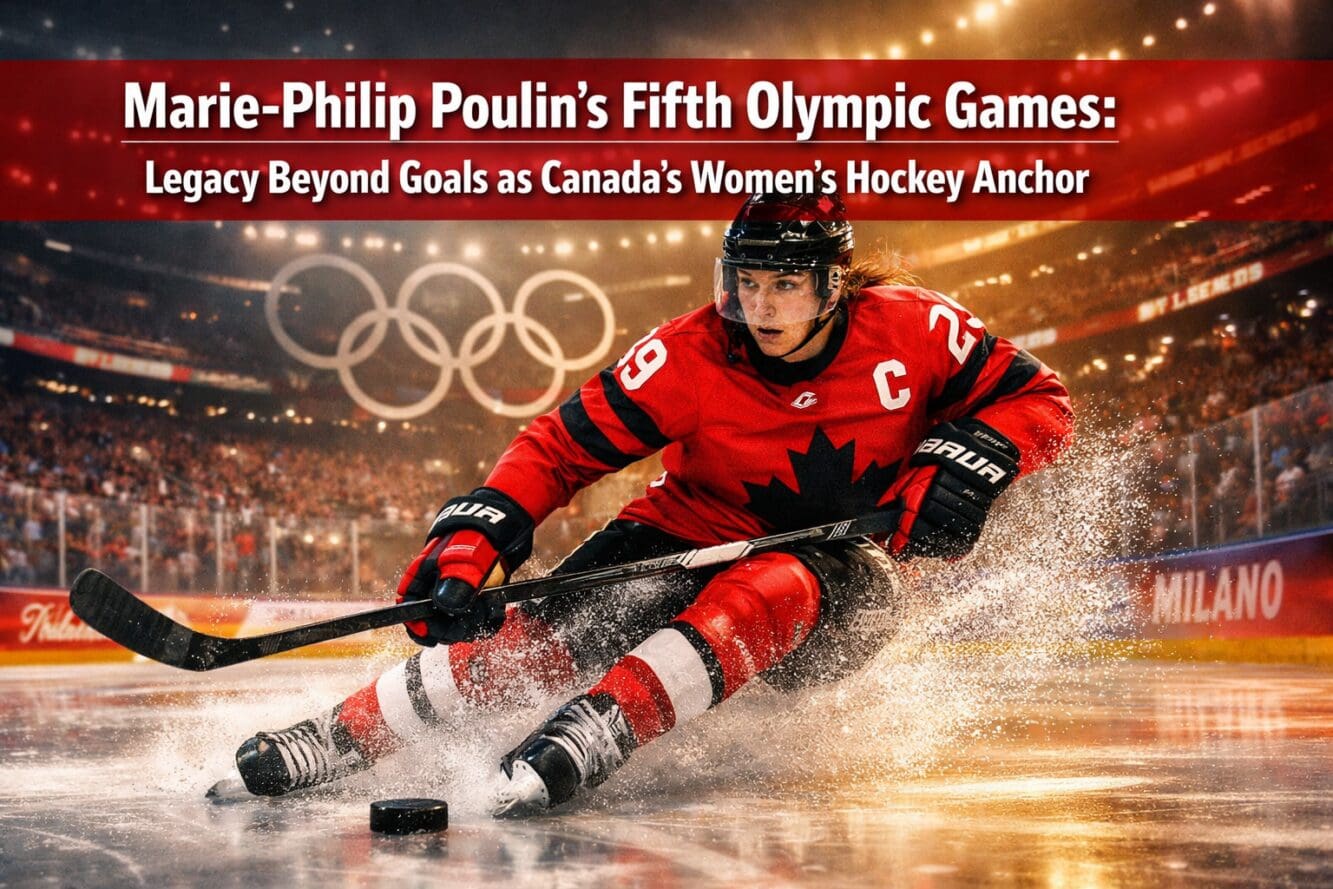
Marie-Philip Poulin’s Fifth Olympic Games: Legacy Beyond Goals as Canada’s Women’s Hockey Anchor
Last updated: February 18, 2026
Marie-Philip Poulin’s fifth Olympic Games has solidified her status as the greatest player in women’s hockey history. The Canadian captain broke the all-time Olympic goal-scoring record while playing through significant injury, carrying her team to the gold medal final against the United States. Her legacy extends far beyond statistics—she embodies the leadership, resilience, and clutch performance that defines championship hockey.
- Marie-Philip Poulin became the all-time leading goal scorer in women’s Olympic hockey history with 20 career goals, surpassing Hayley Wickenheiser’s record of 18[1][2]
- Despite requiring a golf cart to reach the ice due to injury, Poulin scored both goals in Canada’s 2-1 semifinal victory over Switzerland[1][3]
- Canada faces the United States in the gold medal final on February 19, 2026, as underdogs after a 5-0 preliminary round loss[1]
- Poulin’s PWHL experience and Olympic pedigree provide crucial intangibles for Canada’s gold-or-bust mission
- Her leadership as captain represents the anchor point for a team facing offensive depth concerns heading into the final[3]
Quick Answer
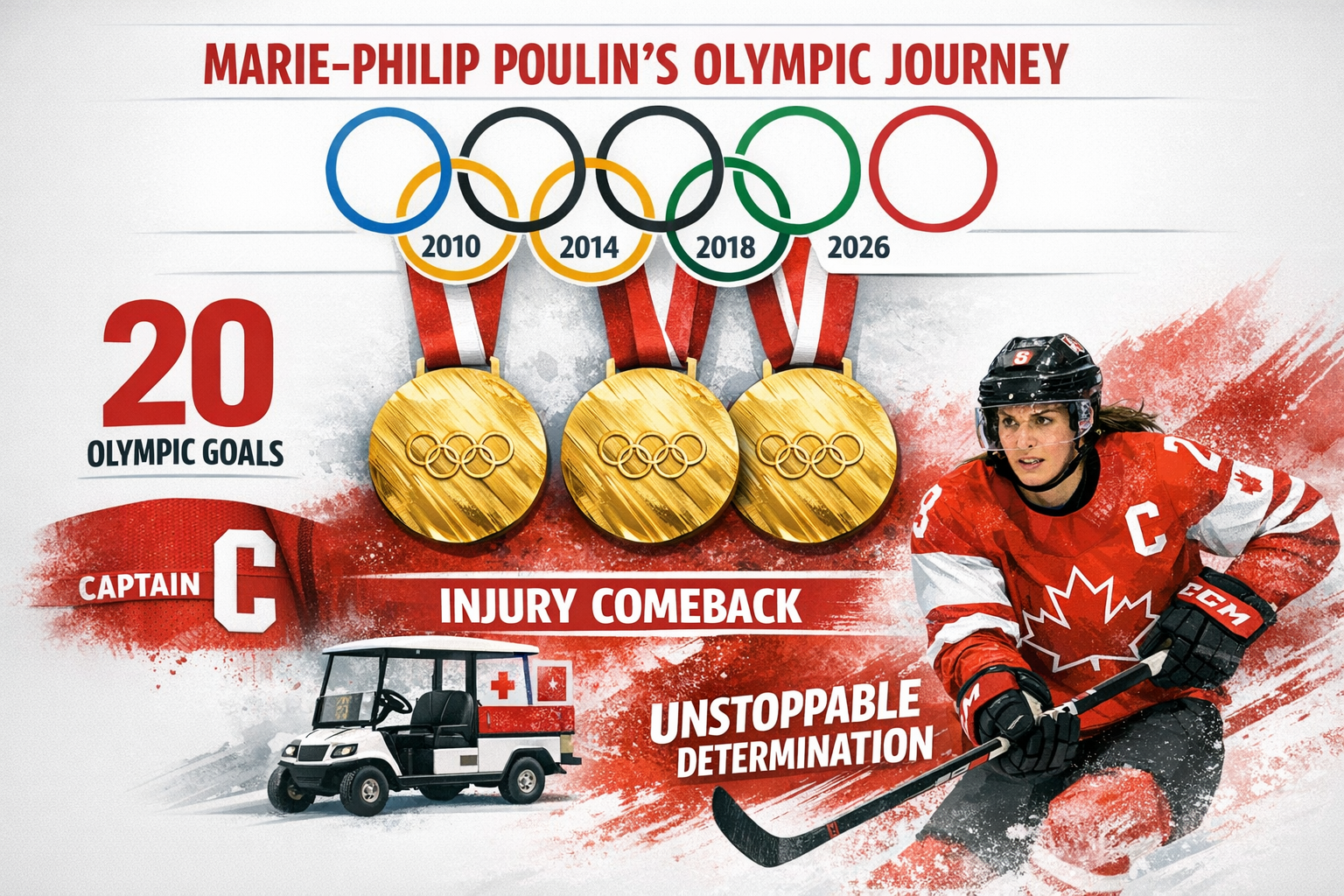
Marie-Philip Poulin’s fifth Olympic Games showcases a legacy built on more than goal-scoring records. The three-time gold medalist and Canadian captain broke Hayley Wickenheiser’s all-time Olympic goals record while playing injured, scoring both goals in a crucial semifinal victory. Her PWHL dominance, unmatched Olympic experience, and ability to deliver in pressure moments make her the essential anchor for Canada’s pursuit of gold against a dominant American team.
What Makes Marie-Philip Poulin’s Fifth Olympic Games Historic?
Poulin achieved the pinnacle of individual Olympic hockey accomplishment on February 16, 2026, when she scored her 19th career Olympic goal to break Hayley Wickenheiser’s long-standing record during Canada’s semifinal against Switzerland.[1][2] She added a second goal just seven minutes later, bringing her career total to 20 Olympic goals.
Key milestones from this Olympic campaign:
- Record-tying goal: February 15 – Poulin scored her 18th career goal to match Wickenheiser’s record[1]
- Record-breaking goal: February 16 – First goal in the Switzerland semifinal established the new benchmark[2]
- Confirmation goal: Seven minutes after breaking the record, Poulin added insurance with her 20th career Olympic goal[2]
- Tournament context: All goals came while playing through a significant injury sustained February 9 against Czechia[3]
The statistical achievement represents only part of the story. Poulin’s ability to perform at the highest level across five Olympic cycles—from Vancouver 2010 through Milano Cortina 2026—demonstrates sustained excellence unmatched in women’s hockey. Her three previous gold medals provide the championship pedigree that transforms individual brilliance into team success.
Common mistake: Focusing solely on goal totals misses the context. Poulin’s record came while playing compromised physically, carrying offensive responsibility for a team struggling to generate scoring depth, and facing elimination pressure in knockout rounds.
How Did Poulin Overcome Injury to Lead Canada’s Semifinal Victory?
Marie-Philip Poulin sustained a serious injury during Canada’s preliminary round game against Czechia on February 9 when she took a hard hit into the boards.[3] The injury was severe enough that she missed the remainder of round-robin play, including Canada’s devastating 5-0 loss to the United States.
Timeline of Poulin’s injury and return:
- February 9: Injured against Czechia, removed from game
- Round-robin finale: Missed Canada’s 5-0 loss to USA
- Quarterfinal vs. Germany: Returned to lineup despite limitations
- February 16 semifinal: Required golf cart transportation from locker room to ice surface[1][3]
- Game performance: Scored both Canadian goals in 2-1 victory despite visible discomfort
The image of Canada’s captain needing a golf cart to reach the ice, then delivering two crucial goals, encapsulates her warrior mentality. Teammates describe her as “everything to this team,” and her semifinal performance reinforced why she’s earned the nickname “Captain Clutch.”[1]
Decision rule: Choose Poulin in critical moments regardless of physical condition. Her track record across five Olympics proves she elevates performance when stakes are highest, making her irreplaceable even when compromised.
Why Is Canada Positioned as the Underdog Against Team USA?
The United States enters the gold medal final on February 19, 2026, with overwhelming momentum and statistical dominance. Team USA compiled a perfect 5-0 record while outscoring opponents 31-1 throughout the tournament.[1]
USA’s tournament dominance indicators:
| Metric | USA Performance | Significance |
|---|---|---|
| Record | 5-0 | Undefeated through five games |
| Goal differential | +30 (31-1) | Averaging 6.2 goals per game |
| Goals allowed | 1 total | Defensive shutdown performance |
| Canada head-to-head | 5-0 victory | Largest Olympic blowout in rivalry history[1] |
Canada’s 5-0 preliminary round loss to the Americans represents the most lopsided defeat in the storied Olympic rivalry between these nations.[1] The margin exposed vulnerabilities in Canadian offensive depth and defensive structure that persist heading into the final.
Edge case: Switzerland, despite losing 2-1 to Canada in the semifinal, managed to score its best-ever Olympic goal total against the Canadians while being outshot 46-8.[1] This defensive struggle against a lower-ranked opponent raises concerns about Canada’s ability to contain elite American forwards.
The underdog positioning actually benefits Canada’s veteran core. Players like 34-year-old forward Brianne Jenner emphasize the team’s championship experience: “We’ve been there before. We know how to do it. It’s just a matter of us showing up.”[1]
What PWHL Experience Does Poulin Bring to This Gold Medal Mission?
Marie-Philip Poulin’s dominance in the Professional Women’s Hockey League provides crucial preparation for Olympic pressure situations. Her professional experience translates directly to the high-stakes environment of Olympic knockout rounds, where technical skill meets mental fortitude.
PWHL-to-Olympics skill transfer:
- Professional pace: PWHL competition maintains game speed and physical intensity during non-Olympic years
- Leadership development: Captaining at the professional level refines communication and tactical decision-making
- Clutch performance repetition: Regular exposure to must-win scenarios builds mental resilience
- Younger player mentorship: Professional league experience allows veterans to develop chemistry with emerging talent
Poulin’s ability to score both goals in the semifinal while playing injured demonstrates the mental toughness cultivated through professional hockey. The PWHL has provided a competitive platform that keeps Olympic veterans sharp between quadrennial tournaments, directly contributing to sustained excellence across multiple Olympic cycles.
Choose PWHL experience if: Your team faces adversity, needs leadership under pressure, or requires veteran presence to stabilize younger players. Poulin’s professional pedigree provides exactly these intangibles.
How Does Poulin’s Leadership Define Canada’s Team Identity?
As Canada’s team captain, Marie-Philip Poulin represents more than on-ice production. Her leadership style combines vocal communication, lead-by-example work ethic, and an uncanny ability to deliver in moments that define tournaments.
Poulin’s leadership dimensions:
- Clutch gene: Known as “Captain Clutch” for scoring in critical Olympic moments across multiple Games[1]
- Physical sacrifice: Playing through injury in elimination rounds demonstrates commitment that inspires teammates[3]
- Offensive responsibility: Willingness to carry scoring burden when team depth falters
- Championship pedigree: Three gold medals provide credibility and calm during pressure situations
- Generational bridge: Connects veteran players with younger roster members through professional and Olympic experience
The semifinal against Switzerland illustrated both Poulin’s value and Canada’s vulnerability. She was the only goal scorer for Canada in that match, accounting for 100% of offensive production in a game where the team was outshot 46-8.[3] This raises legitimate questions about offensive depth, but also confirms Poulin’s irreplaceable role.
Common mistake: Assuming leadership means distributing responsibility equally. Elite captains like Poulin recognize when to shoulder disproportionate burden, particularly when teammates struggle or injuries limit roster options.
“We’ve been there before. We know how to do it. It’s just a matter of us showing up.” – Brianne Jenner, Canadian forward[1]
This veteran confidence stems directly from Poulin’s leadership establishing a championship culture across multiple Olympic cycles.
What Offensive Depth Concerns Does Canada Face in the Final?
Canada’s reliance on Marie-Philip Poulin for goal-scoring in the semifinal exposes a critical vulnerability heading into the gold medal game. Against Switzerland, Poulin scored both Canadian goals while no other forward found the net, despite Canada generating 46 shots.[1][3]
Offensive production analysis:
- Semifinal scoring: Poulin 2 goals, rest of team 0 goals
- Shot efficiency: 2 goals on 46 shots (4.3% conversion rate)
- Depth scoring: Lack of secondary scoring options creates predictability
- USA defensive focus: American scouts can key on Poulin, knowing other threats are limited
- Injury impact: Poulin’s physical limitations may reduce effectiveness over 60 minutes
The contrast with Team USA’s balanced attack is stark. The Americans have scored 31 goals across five games with contributions throughout their lineup, making them difficult to defend with a single game plan.[1]
Decision criteria for Canada’s coaching staff:
- If Poulin is contained: Need secondary scorers to step up (Jenner, Spooner, Fillier must contribute)
- If USA focuses defense on Poulin: Create space for other forwards through tactical adjustments
- If depth scoring continues to falter: Increase Poulin’s ice time despite injury concerns
The gold-or-bust nature of Thursday’s final means Canada cannot afford another game where one player carries the entire offensive load, particularly against the tournament’s most dominant defensive team.
How Does Marie-Philip Poulin’s Fifth Olympic Games Compare to Her Previous Campaigns?
Poulin’s Olympic career spans 16 years, from her debut as a 19-year-old in Vancouver 2010 to her fifth appearance in Milano Cortina 2026. Each Olympic cycle has added chapters to her legacy as “the greatest player in the history of her sport.”[4]
Olympic campaign comparison:
| Olympics | Age | Role | Goals | Medals | Defining Moment |
|---|---|---|---|---|---|
| Vancouver 2010 | 19 | Forward | 2 | Gold | Breakthrough performance |
| Sochi 2014 | 22 | Forward | 3 | Gold | Game-winning goal in final |
| PyeongChang 2018 | 26 | Alternate Captain | 3 | Gold | Overtime heroics |
| Beijing 2022 | 30 | Captain | 10 | Gold | Tournament scoring leader |
| Milano Cortina 2026 | 34 | Captain | 2+ | TBD | All-time goals record |
The progression shows consistent excellence with peak scoring output in Beijing 2022. The Milano Cortina campaign represents a different challenge—maintaining elite performance while injured, carrying a team with depth concerns, and facing the most dominant American squad in recent Olympic history.
Edge case: Poulin’s 2026 goal total appears lower than Beijing 2022, but context matters. She missed games due to injury and is playing compromised physically, making her semifinal performance even more impressive.
What Makes the Canada vs USA Gold Medal Final a Legacy-Defining Match?
The February 19, 2026 gold medal final at Milano Santigiulia Arena (3:10 p.m. ET) represents the ultimate test for Marie-Philip Poulin’s fifth Olympic Games and Canada’s championship aspirations.[2] The matchup carries historical weight beyond a single game.
Stakes for this final:
- Revenge opportunity: Canada seeks redemption for the 5-0 preliminary round humiliation[1]
- Poulin’s legacy: A fourth gold medal would cement her status as the most decorated player in Olympic hockey history
- Underdog narrative: Canada enters as the defending champion facing a superior opponent on paper
- Rivalry renewal: The latest chapter in women’s hockey’s greatest international rivalry
- Injured warrior story: Poulin’s ability to perform while compromised adds dramatic tension
Team USA’s 31-1 goal differential and perfect record make them overwhelming favorites.[1] Canada’s path to gold requires Poulin to deliver another clutch performance, secondary scorers to emerge, and the defensive structure to contain American firepower.
For Canada to win, they need:
- Poulin’s clutch gene: Captain Clutch must deliver in the biggest moment
- Depth scoring breakthrough: Other forwards must contribute goals
- Defensive discipline: Limit USA’s high-powered offense to 2 goals or fewer
- Goaltending excellence: Stellar performance in net to offset shot differential
- Veteran composure: Championship experience must overcome statistical disadvantage
The final represents a winner-take-all showdown where experience and intangibles face overwhelming statistical dominance. Poulin’s career has been defined by exactly these moments.
FAQ: Marie-Philip Poulin’s Fifth Olympic Games
How many Olympic goals has Marie-Philip Poulin scored?
Marie-Philip Poulin has scored 20 career Olympic goals as of the semifinal against Switzerland on February 16, 2026, breaking Hayley Wickenheiser’s previous record of 18 goals.[1][2]
What injury is Poulin playing through at the 2026 Olympics?
Poulin sustained a significant injury from a hard hit into the boards during Canada’s preliminary round game against Czechia on February 9, 2026. The injury was severe enough to require a golf cart to transport her from the locker room to the ice for the semifinal.[1][3]
When is the Canada vs USA gold medal final?
The gold medal final between Canada and the United States is scheduled for Thursday, February 19, 2026, at 3:10 p.m. ET at Milano Santigiulia Arena.[2]
How many Olympic gold medals does Marie-Philip Poulin have?
Poulin has won three Olympic gold medals (2010, 2014, 2018, 2022) entering the 2026 final. A victory on February 19 would give her a fourth gold medal.[4]
Why is Poulin called “Captain Clutch”?
Poulin earned the nickname “Captain Clutch” for her ability to score crucial goals in high-pressure Olympic moments across multiple Games, including game-winning and game-tying goals in Olympic finals.[1]
What was the score when Canada beat Switzerland in the semifinal?
Canada defeated Switzerland 2-1 in the semifinal on February 16, 2026, with both Canadian goals scored by Marie-Philip Poulin despite being outshot 46-8.[1][3]
How badly did USA beat Canada in the preliminary round?
The United States defeated Canada 5-0 in the preliminary round, marking the largest Olympic blowout in the history of the rivalry between these two nations.[1]
Is Marie-Philip Poulin the greatest women’s hockey player ever?
Poulin is widely considered “the greatest player in the history of her sport” based on her Olympic achievements, goal-scoring records, and clutch performances across five Olympic Games.[4]
How old is Marie-Philip Poulin at the 2026 Olympics?
Poulin is 34 years old at the Milano Cortina 2026 Olympics, competing in her fifth Olympic Games since debuting at age 19 in Vancouver 2010.
What is Team USA’s record at the 2026 Olympics?
Team USA entered the gold medal final with a perfect 5-0 record, having outscored opponents 31-1 throughout the tournament.[1]
Did Poulin play in the PWHL?
Yes, Poulin’s PWHL experience has been crucial for maintaining elite-level competition between Olympic cycles, contributing to her sustained excellence across five Olympic Games.
How many times has Canada won Olympic gold in women’s hockey?
Canada has won multiple Olympic gold medals in women’s hockey, with Poulin contributing to three of those championships (2010, 2014, 2018, 2022) and competing for a fourth in 2026.
Key Takeaways
Record-breaking achievement: Marie-Philip Poulin became the all-time leading goal scorer in women’s Olympic hockey history with 20 career goals, surpassing Hayley Wickenheiser’s mark of 18[1][2]
Injured warrior performance: Despite requiring a golf cart to reach the ice due to injury, Poulin scored both goals in Canada’s 2-1 semifinal victory over Switzerland[1][3]
Underdog final positioning: Canada faces a dominant USA team that went 5-0 while outscoring opponents 31-1, including a 5-0 preliminary round victory over Canada[1]
Offensive depth concerns: Poulin was the only Canadian goal scorer in the semifinal, raising questions about secondary scoring heading into the gold medal game[3]
PWHL experience advantage: Poulin’s professional hockey background provides crucial intangibles including clutch performance ability, leadership under pressure, and sustained excellence across five Olympic cycles
Captain Clutch legacy: Known for delivering in critical moments, Poulin’s leadership as team captain represents the anchor point for Canada’s gold-or-bust mission[1]
Championship pedigree: Three previous Olympic gold medals give Poulin and veteran teammates the experience and composure needed to compete as underdogs against statistical favorites
Gold medal final stakes: The February 19, 2026 showdown at 3:10 p.m. ET represents a legacy-defining opportunity for Poulin to cement her status as the greatest player in women’s hockey history[2]
Conclusion: Legacy Beyond the Scoresheet
Marie-Philip Poulin’s fifth Olympic Games transcends individual statistics and record-breaking achievements. Her 20 career Olympic goals establish numerical supremacy, but her true legacy lies in the intangibles that transform talented teams into champions. Playing through injury, carrying offensive responsibility when teammates struggle, and delivering clutch performances across 16 years of Olympic competition—these qualities define greatness in ways no statistic can capture.
The gold medal final on February 19, 2026 presents the ultimate test of Poulin’s legacy. Canada enters as underdogs against a statistically superior American team, making the challenge even more fitting for a player who has built her reputation on rising to impossible moments. Whether Canada claims gold or silver, Poulin’s place as the greatest player in women’s hockey history is secure.
For fans watching the final, pay attention to more than goals and assists. Notice how Poulin positions teammates for success, communicates during pressure moments, and demonstrates the physical courage to compete while injured. These leadership qualities, refined through PWHL competition and five Olympic campaigns, represent the true measure of her legacy beyond goals as Canada’s women’s hockey anchor.
Next steps for hockey fans:
- Watch the gold medal final on February 19, 2026 at 3:10 p.m. ET to witness history
- Follow PWHL action to see how professional women’s hockey continues developing elite talent
- Study Poulin’s leadership approach for insights on performing under pressure in any competitive field
- Support women’s hockey at all levels to ensure the sport’s continued growth and excellence
The final chapter of Marie-Philip Poulin’s fifth Olympic Games will be written on Thursday. Regardless of the outcome, her legacy as Captain Clutch and the anchor of Canadian women’s hockey excellence remains unshakeable.
References
[1] Canadas Poulin Makes History Sets Up Gold Medal Showdown Vs U S – https://www.sportsnet.ca/olympic-women-hockey/article/canadas-poulin-makes-history-sets-up-gold-medal-showdown-vs-u-s/
[2] Marie Philip Poulin Canada Breaks Olympic Goals Record – https://www.nbcolympics.com/news/marie-philip-poulin-canada-breaks-olympic-goals-record
[3] Canada Needs Marie Philip Poulin To Bail Them Out One More Time – https://defector.com/canada-needs-marie-philip-poulin-to-bail-them-out-one-more-time
[4] Watch – https://www.youtube.com/watch?v=TVdAEXEEScc
Some content and illustrations on GEORGIANBAYNEWS.COM are created with the assistance of AI tools.
GEORGIANBAYNEWS.COM shares video content from YouTube creators under fair use principles. We respect creators’ intellectual property and include direct links to their original videos, channels, and social media platforms whenever we feature their content. This practice supports creators by driving traffic to their platforms.