


















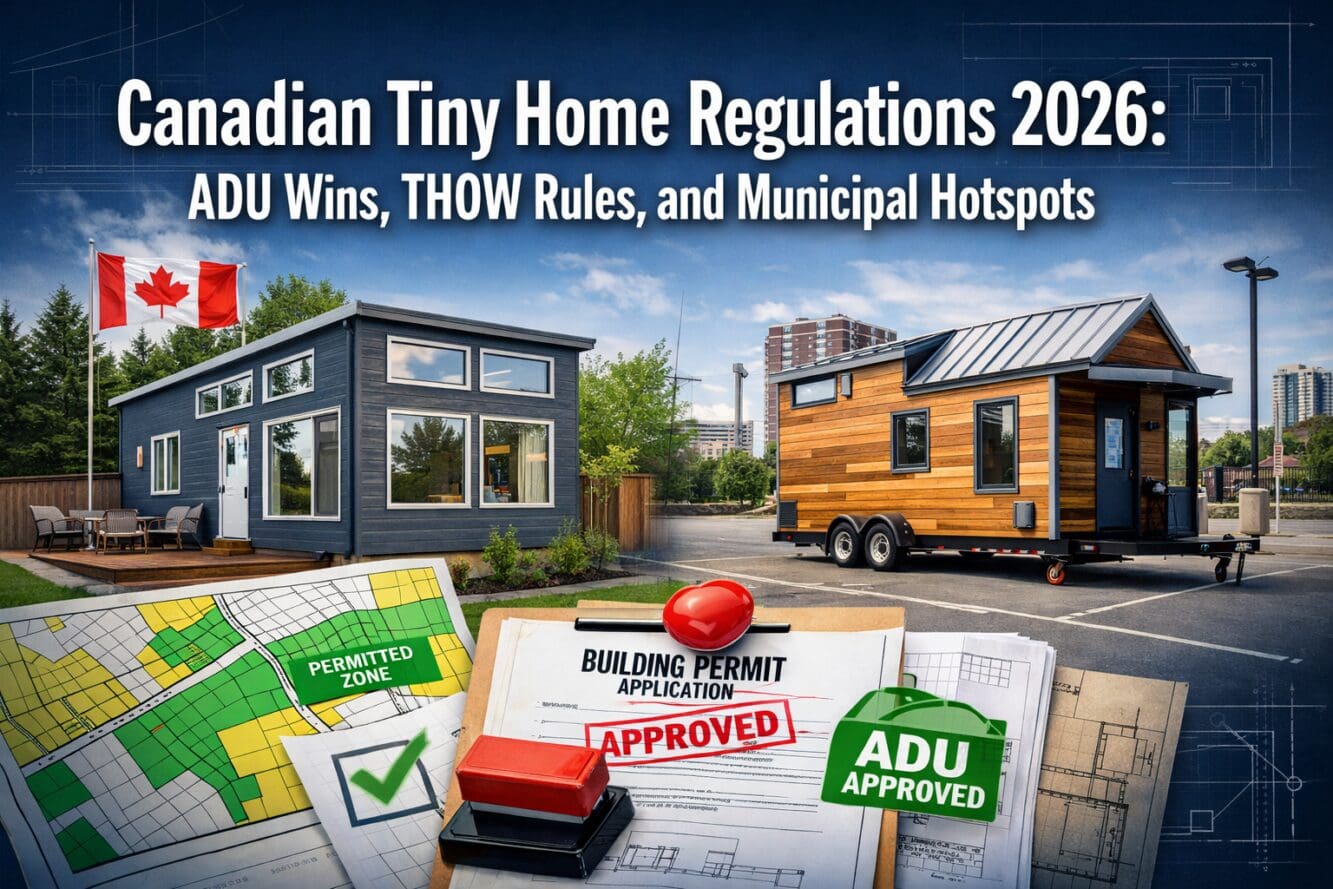
Canadian Tiny Home Regulations 2026: ADU Wins, THOW Rules, and Municipal Hotspots
Last updated: February 20, 2026
Key Takeaways
- ADUs (Accessory Dwelling Units) on fixed foundations are now permitted on most residential lots across Ontario, with Ottawa and Oakville leading the charge by allowing up to four units per property
- Tiny Homes on Wheels (THOWs) face stricter regulations in most provinces, with BC municipalities gaining new authority to permit Z241-certified units while mobile homes remain prohibited in many zones
- Building permits, engineering drawings, and electrical inspections typically cost $3,500 to $8,000 combined, representing the most underestimated expense in tiny home projects
- Federal Build Canada Homes initiatives are accelerating modular and prefabricated construction methods, creating new pathways for factory-built tiny homes
- Municipal zoning varies dramatically across Canada, making location selection critical for legal tiny home placement
Quick Answer
Canadian tiny home regulations in 2026 split into two distinct pathways: foundation-built ADUs (additional dwelling units) enjoy broad legalization across Ontario and growing acceptance in BC, while Tiny Homes on Wheels (THOWs) remain restricted in most municipalities despite new Z241 certification standards. Ottawa recently passed sweeping reforms allowing four units per lot, and Oakville permits garden suites as-of-right now, but mobile tiny homes face outright bans in communities like Squamish, BC. Success depends on choosing permissive municipalities, understanding provincial building codes, and budgeting $3,500-$8,000 for permits and inspections.
What Are the Main Types of Tiny Homes Under Canadian Tiny Home Regulations 2026?
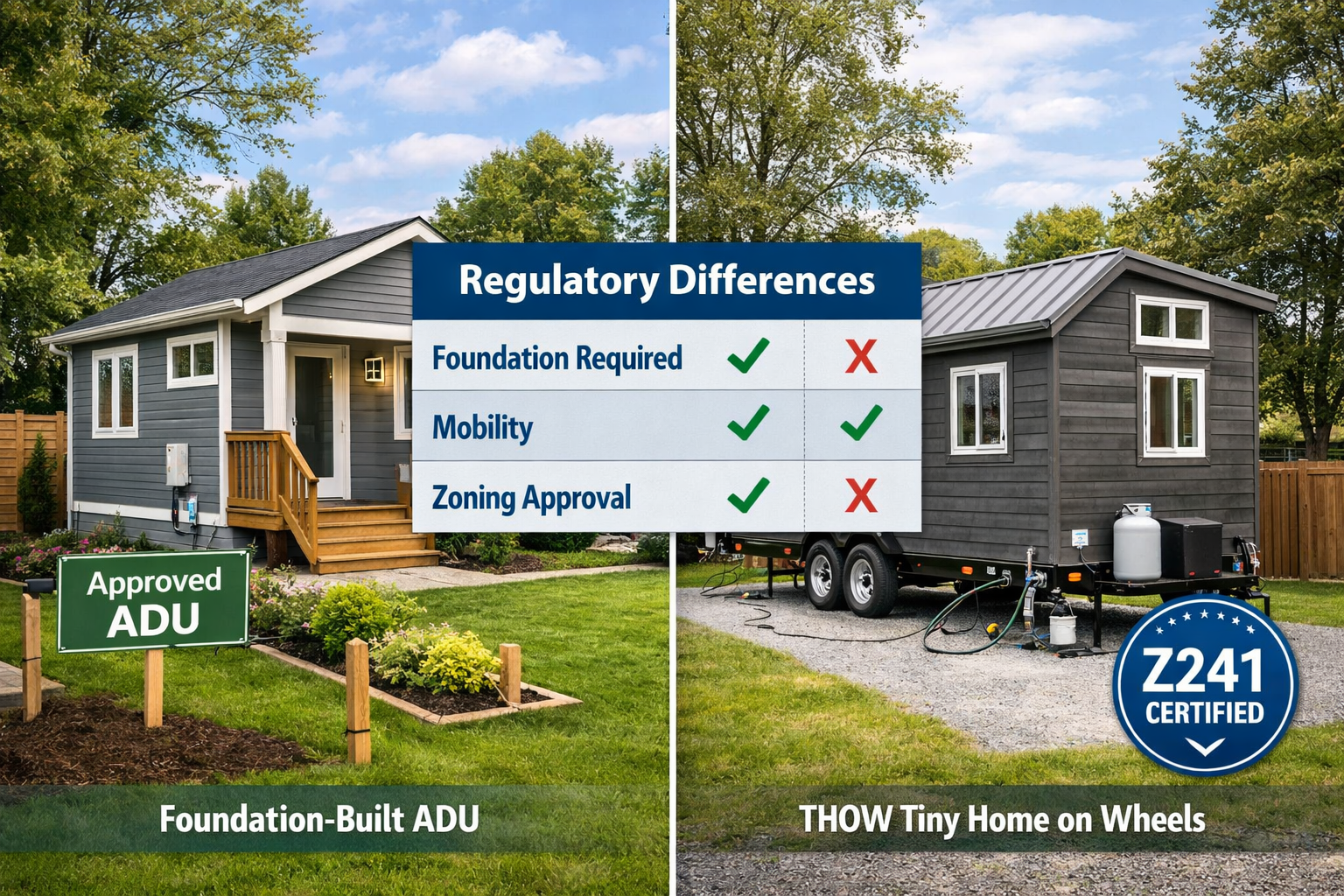
Canadian regulations recognize two fundamentally different tiny home categories in 2026: foundation-built units treated as permanent ADUs and mobile units on wheels or trailers.
Foundation-built tiny homes include garden suites, laneway houses, and detached accessory dwelling units constructed on permanent foundations. These structures must comply with provincial building codes, require full building permits, and connect to municipal services (water, sewer, electrical). Ontario’s Building Code specifically addresses tiny homes under 37 m² in Section 1.11, establishing clear construction standards for both site-built and factory-built units [ontario.ca].
Tiny Homes on Wheels (THOWs) are built on trailer chassis and designed for potential mobility. In British Columbia, municipalities can now permit THOWs that meet the CSA Z241 standard for recreational vehicles, but the BC Building Code does not regulate mobile tiny homes that fall outside standard size categories [5]. This creates a regulatory gap where many mobile units become non-compliant by default.
Key differences:
- Foundation requirement: ADUs must have permanent foundations meeting frost protection depths; THOWs sit on trailer frames
- Permit pathway: ADUs follow standard residential building permits; THOWs require specific zoning amendments in most jurisdictions
- Mobility: ADUs are permanent structures; THOWs can theoretically relocate but face significant legal barriers
- Code compliance: ADUs must meet full Building Code; THOWs often fall into regulatory gray zones
Choose foundation-built ADUs if you want straightforward permitting and long-term property value. Consider THOWs only in municipalities with explicit THOW-permitting bylaws, and verify Z241 certification before purchase [8].
How Do ADU Regulations Create Wins for Tiny Home Builders in 2026?
ADU regulations represent the biggest regulatory win for tiny home advocates in 2026, with Ontario leading the charge through Bill 23 reforms that permit up to three residential units on most lots [2].
Ottawa’s landmark zoning overhaul (passed January 28, 2026) allows four units on every serviced residential lot and raises height limits to three storeys across nearly all residential zones. This unanimous city council decision caps years of modernization efforts aimed at addressing housing shortages through increased density in existing neighborhoods.
Oakville’s updated Livable Plan permits up to four units per lot as-of-right, with detached garden suites legally treated as ADUs provided they meet Ontario Building Code standards and sit on fixed foundations [1]. In mature neighborhoods like Bronte and South East Oakville, lot coverage ratios typically range from 30-40%, strictly constraining where garden suites can be placed but still creating viable opportunities on larger lots [1].
British Columbia updated its small-scale multi-unit housing requirements on January 20, 2026, clarifying that any zone containing parcels restricted to duplexes or single detached homes qualifies as a Restricted Zone requiring minimum unit density. Local governments must update bylaws by June 30, 2026, with the definition now including lots permitting single detached homes with secondary suites and detached accessory dwelling units.
Common ADU approval requirements:
- Lot size minimums: Typically 450-550 m² (4,800-5,900 sq ft) depending on municipality
- Setback distances: Usually 0.6-1.2 m (2-4 ft) from rear/side property lines
- Height restrictions: Maximum 4-6 m (13-20 ft) for single-storey garden suites
- Lot coverage limits: Combined coverage of all structures typically capped at 40-50%
- Parking requirements: Often waived for ADUs or require one additional space
The ADU pathway works best for homeowners with existing properties who want to add rental income or multigenerational housing. It provides clear regulatory frameworks, established inspection processes, and long-term property value appreciation.
What Are the THOW Rules and Restrictions Across Canadian Provinces?
Tiny Homes on Wheels face a patchwork of regulations in 2026, with most provinces maintaining restrictive stances despite growing demand.
British Columbia’s evolving framework: New provincial directives allow municipalities to amend zoning bylaws to permit THOWs built to the Z241 standard [8], providing clearer regulatory pathways than previously available. However, the BC Building Code does not regulate mobile tiny homes or units that don’t meet standard sizes, making them non-compliant and subject to fines [5].
The District of Squamish explicitly states it has no zoning that allows mobile tiny homes, preventing temporary use permits despite building inspector discretion [5]. Mobile homes cannot legally operate in Flood Hazard Areas regardless of local exemptions, creating additional placement barriers in coastal and river communities [5].
Ontario’s mobile home restrictions: While Ontario’s Building Code addresses factory-built tiny homes under Section 1.11, these provisions apply only to units intended for permanent installation on fixed foundations [ontario.ca]. Truly mobile units on wheels fall outside Building Code regulation, leaving them in legal limbo in most municipalities.
Key THOW barriers:
- Zoning prohibitions: Most residential zones explicitly prohibit recreational vehicles and mobile structures as primary dwellings
- Building Code gaps: Mobile units often don’t qualify for building permits because they’re not “buildings” under provincial definitions
- Foundation requirements: Many municipalities require permanent foundations for any year-round dwelling
- Utility connections: Temporary hookups for water/sewer/electrical often violate municipal bylaws
- Property tax classification: Mobile units may be taxed as vehicles rather than real property
Where THOWs might work in 2026:
Choose municipalities that have passed specific THOW-enabling bylaws. Verify Z241 certification from manufacturers. Budget for potential legal challenges and be prepared to convert to permanent foundation if required. Some rural townships with less restrictive zoning may offer more flexibility, but always confirm in writing before purchasing.
For those interested in alternative housing solutions, exploring cohousing communities may provide additional options for sustainable living arrangements.
Which Canadian Cities Are Municipal Hotspots for Tiny Homes in 2026?
Several Canadian municipalities have emerged as tiny home hotspots in 2026, offering permissive zoning and clear regulatory pathways.
Ottawa (Ontario) – Four Units Per Lot: Ottawa’s January 2026 zoning reforms represent the most progressive urban tiny home policy in Canada. The unanimous council decision allows four units on every serviced residential lot with three-storey height limits, creating thousands of potential ADU sites across the city. Garden suites and laneway houses now qualify as-of-right in most neighborhoods, eliminating discretionary approval processes.
Oakville (Ontario) – Garden Suite Leader: Oakville’s updated Livable Plan permits up to four units per lot with detached garden suites treated as legal ADUs [1]. The town provides clear guidelines for lot coverage ratios, setbacks, and design standards. Mature neighborhoods like Bronte and South East Oakville have seen increasing garden suite applications, though lot coverage limits (30-40%) constrain placement on smaller properties [1].
Toronto (Ontario) – Laneway Housing Pioneer: Toronto continues expanding its laneway housing program, with hundreds of units approved annually. The city’s as-of-right permissions for laneway suites (introduced in previous years) have created a proven pathway for tiny home builders. Proximity to transit and urban amenities makes Toronto ADUs particularly valuable.
Blind River (Ontario) – Emerging Rural Market: Smaller Ontario communities like Blind River are exploring tiny home pilots to address affordable housing needs. Rural townships often offer larger lots, lower land costs, and more flexible zoning than urban centers, though municipal services may be limited.
Vancouver/Victoria Region (BC) – Cautious Progress: While BC’s major cities haven’t matched Ontario’s ADU liberalization, recent provincial directives on small-scale multi-unit housing are forcing municipalities to update restrictive bylaws by June 30, 2026. Expect gradual expansion of ADU permissions in Metro Vancouver and Capital Regional District.
Municipal comparison factors:
| City | Units Per Lot | Garden Suites | THOW Permitted | Avg. Lot Size | Permit Timeline |
|---|---|---|---|---|---|
| Ottawa | 4 | Yes (as-of-right) | No | 450-600 m² | 8-12 weeks |
| Oakville | 4 | Yes (as-of-right) | No | 550-800 m² | 10-14 weeks |
| Toronto | 3 | Yes (laneway) | No | 350-500 m² | 12-16 weeks |
| Squamish | 2 | Limited | No | 600-900 m² | 14-20 weeks |
Choose Ottawa or Oakville for the clearest ADU pathways. Consider rural Ontario townships if you prioritize affordability over urban amenities. Avoid municipalities without explicit tiny home or ADU provisions in zoning bylaws.
How Do You Navigate Zoning to Park or Build Your Tiny Home Legally?
Successfully navigating Canadian tiny home zoning in 2026 requires a systematic approach starting with municipal research before any purchase or construction decisions.
Step 1: Verify zoning permissions (before buying land or a tiny home)
Contact your municipal planning department and request:
- Current zoning designation for your specific property
- Permitted uses list (confirm “accessory dwelling unit,” “garden suite,” or “secondary dwelling” appears)
- Lot size, coverage, and setback requirements
- Height and floor area restrictions
- Parking requirements
Step 2: Determine foundation vs. mobile pathway
Foundation-built ADUs follow standard residential permit processes. Mobile THOWs require explicit zoning amendments in most jurisdictions. If your municipality doesn’t permit THOWs, converting to permanent foundation may be your only legal option.
Step 3: Gather required documentation
Building permit applications typically require:
- Site plan showing existing structures, proposed tiny home location, setbacks, and lot coverage calculations
- Stamped engineering drawings for foundations ($1,500-$3,000) [3]
- Architectural plans meeting Building Code requirements (walls R-18 to R-20, attic R-49 insulation) [2]
- Electrical plans with ESA notification filed before work begins [2]
- Plumbing and septic approvals if not connecting to municipal sewer
Step 4: Submit building permit application
Permit fees typically range $2,000-$5,000 depending on township [3]. Processing timelines vary from 8-20 weeks based on municipal workload and application completeness. Incomplete applications face significant delays.
Step 5: Schedule mandatory inspections
Ontario requires:
- Foundation inspection before pouring concrete
- Framing inspection before closing walls
- Electrical inspection (ESA) before connection [2]
- Plumbing inspection before covering
- Final inspection before occupancy
British Columbia requires Technical Safety BC permits for electrical work including solar and heat pumps, with competency assessments for homeowner permits [2].
Common zoning mistakes to avoid:
- Assuming rural properties have no restrictions: Many rural townships have minimum building sizes or prohibit mobile structures
- Skipping pre-application consultations: Most planning departments offer free pre-consultation meetings that identify issues early
- Ignoring lot coverage calculations: Existing house + garage + proposed tiny home often exceed maximum coverage
- Overlooking easements and setbacks: Utility easements, drainage swales, and septic field setbacks reduce usable lot area
Edge case – Factory-built tiny homes crossing municipal boundaries:
Ontario’s Building Code Section 1.11.1 addresses tiny homes partially constructed in one municipality and moved to another [ontario.ca]. Applicants can obtain permits from the construction municipality, with inspections transferring to the receiving municipality upon installation. This creates opportunities for factory-built units but requires coordination between two building departments.
If you’re planning to build in a specific region, understanding local development initiatives can provide valuable context for zoning changes and community priorities.
What Are the Building Code Requirements for Tiny Homes in 2026?
Canadian tiny homes must comply with provincial building codes regardless of size, with specific requirements varying by province and construction method.
National Building Code (NBC) baseline standards:
The NBC 9.36 establishes minimum insulation values, with prescriptive paths typically requiring RSI 3.1-3.5 (R-18 to R-20) for walls and RSI ~8.6 (R-49) for attics, with exact values determined by local climate tables [2]. Roof designs must be engineered for local design snow loads referenced in NBC Appendix C climatic data [2].
Ontario Building Code – Tiny House Section 1.11:
Ontario’s Building Code Part 1 Division C includes Section 1.11 specifically addressing tiny houses. This section applies to houses with:
- Not more than one dwelling unit
- 37 m² or less in building area
- Partial construction off-site and movement to installation location [ontario.ca]
Section 1.11.1.2 provides permit exemptions for tiny homes constructed in one municipality and moved to another, provided specific conditions are met and coordination occurs between building officials [ontario.ca].
British Columbia Building Code 2024:
BC adopted its updated Building Code effective March 8, 2024 for new permits [2]. The code includes provisions for off-grid buildings where electrical service is unavailable, allowing solar panels and geothermal systems with appropriate engineering.
Key structural and safety requirements:
- Foundation frost protection: Minimum depths vary by climate zone (typically 1.2-1.8 m in Ontario)
- Egress windows: Minimum 0.35 m² opening area with minimum 380 mm width and height
- Ceiling heights: Minimum 2.1 m for habitable rooms (some jurisdictions allow 1.95 m for tiny homes)
- Stair dimensions: Minimum 860 mm width, maximum 200 mm rise, minimum 210 mm run
- Fire separation: Between dwelling units requires minimum 1-hour fire rating
- Ventilation: Mechanical ventilation required (typically HRV/ERV systems)
Electrical and plumbing code compliance:
Ontario requires filing a Notification of Work with the Electrical Safety Authority before starting electrical work [2]. DIY is permitted for property owners but inspections are mandatory. British Columbia requires Technical Safety BC permits for most electrical work, with competency assessments for homeowner permits [2].
On-site sewage systems require provincial environmental/health approvals before final building sign-off [2]. Municipal water connections require backflow prevention devices and inspection.
Factory-built vs. site-built code paths:
Factory-built tiny homes may qualify for partial inspections at the manufacturing facility, with final inspections occurring after site installation. This can reduce on-site inspection visits but requires coordination between factory inspectors and municipal building departments. Site-built tiny homes follow standard residential inspection sequences.
Choose factory-built units from manufacturers with established Building Code compliance records. Verify that engineering stamps and code compliance documentation transfer with the unit. Budget for potential modifications if factory-built units don’t meet local amendments to provincial codes.
What Does It Cost to Build or Buy a Compliant Tiny Home in Canada?
Building or buying a code-compliant tiny home in Canada involves significant upfront costs beyond the structure itself, with regulatory compliance representing the most underestimated expense category.
Regulatory and permit costs (2026 estimates):
- Building permits: $2,000-$5,000 depending on township [3]
- Stamped engineering drawings for foundations: $1,500-$3,000 [3]
- Electrical inspections and ESA fees: $500-$800 [2]
- Plumbing and septic approvals: $800-$1,500
- Site plan preparation: $1,000-$2,500
- Zoning variance applications (if required): $2,000-$5,000
Total regulatory costs typically range $3,500-$8,000 for straightforward projects, with variance applications and complex sites pushing costs to $10,000+ [3].
Foundation and site preparation:
- Permanent foundation (frost-protected, engineered): $8,000-$15,000
- Site grading and drainage: $2,000-$5,000
- Utility connections (water, sewer, electrical): $5,000-$12,000
- Driveway/access improvements: $3,000-$8,000
Tiny home construction/purchase costs:
- Site-built tiny home (200-400 sq ft): $40,000-$80,000 materials and labor
- Factory-built tiny home (delivered): $50,000-$100,000+ depending on finishes
- THOW from manufacturer: $60,000-$120,000 for Z241-certified units
Ongoing costs:
- Property tax increase: ADUs typically add $800-$2,000 annually to property tax
- Insurance: Additional $300-$600 annually for separate dwelling coverage
- Utilities: $80-$150 monthly for separate metering
Cost-saving strategies:
- Owner-builder permits reduce labor costs but require demonstrated competency
- Modular/prefab units from Build Canada Homes partners may offer economies of scale as the program expands [4]
- Shared services (water, sewer) with main house reduce connection costs
- Standard designs avoid custom engineering fees
Hidden cost factors:
Soil testing for septic systems ($500-$1,200), tree removal for placement ($1,000-$3,000 per large tree), and heritage/conservation area approvals (timeline delays and additional fees) frequently surprise first-time builders.
Budget 15-20% contingency for unexpected regulatory requirements, inspection failures requiring rework, and material price fluctuations. Municipalities with established ADU programs typically have more predictable cost structures than jurisdictions processing their first tiny home applications.
For those considering tiny homes as part of broader housing solutions, understanding affordable housing initiatives in your region can provide additional context and potential funding opportunities.
How Is Build Canada Homes Affecting Tiny Home Construction in 2026?
The Build Canada Homes Act, enacted February 5, 2026, establishes Build Canada Homes as a Crown corporation dedicated to affordable housing, with significant implications for factory-built and modular tiny home construction.
Since its September 2025 launch, the program has advanced six Direct Build projects across Dartmouth, Longueuil, Ottawa, Toronto, Winnipeg, and Edmonton, representing more than 7,500 new homes combined with four major partnerships [4]. The Act equips the corporation with tools to build homes faster using modern construction methods including modular, factory-built, and prefabricated systems [4].
Build Canada Homes Modern Methods of Construction RFI (February 4, 2026):
The federal housing program launched a Request for Information targeting Canadian firms specializing in modular, panelized, and prefabricated systems. The RFI aims to gather insights on capabilities and delivery approaches, with responses informing prequalification processes and identifying high-potential firms for future projects.
Implications for tiny home builders:
- Standardization potential: Federal involvement may drive standardized tiny home designs that streamline Building Code approvals across provinces
- Factory capacity expansion: RFI responses will identify manufacturers capable of scaling production, potentially reducing wait times and costs
- Regulatory harmonization: Build Canada Homes projects must navigate multiple provincial codes, creating pressure for interprovincial regulatory alignment
- Financing access: Crown corporation backing may improve financing options for factory-built tiny home purchases
Current limitations:
Build Canada Homes focuses primarily on larger multi-unit residential projects rather than individual tiny homes. The program’s impact on tiny home construction will likely be indirect, through expanded factory capacity and improved regulatory frameworks rather than direct tiny home production.
Tiny home advocates should monitor Build Canada Homes prequalification lists for factory-built housing manufacturers. Approved manufacturers will have demonstrated Building Code compliance expertise and production capacity, making them lower-risk suppliers for custom tiny home orders.
The program’s emphasis on modern construction methods aligns with Ontario Building Code Section 1.11 provisions for factory-built tiny homes, potentially creating clearer pathways for off-site construction and interprovincial movement of completed units.
What Are the Common Mistakes When Building Tiny Homes in Canada?
Canadian tiny home builders frequently encounter preventable regulatory and construction errors that delay projects and increase costs.
Mistake 1: Buying land or a tiny home before confirming zoning
Many buyers purchase rural properties assuming tiny homes are automatically permitted, only to discover minimum building size requirements (often 600-1,000 sq ft) or outright mobile home prohibitions. Always obtain written confirmation from municipal planning departments before committing funds.
Mistake 2: Assuming THOW certification equals legal placement
Z241 certification from manufacturers confirms recreational vehicle standards but doesn’t override municipal zoning prohibitions [8]. A certified THOW remains illegal in most residential zones without explicit zoning amendments.
Mistake 3: Underestimating lot coverage calculations
Existing house (40% coverage) + garage (8% coverage) + proposed tiny home (6% coverage) = 54% total coverage, exceeding typical 50% maximums. Many projects fail at permit application because applicants don’t calculate existing coverage before designing additions.
Mistake 4: Skipping pre-application consultations
Most municipal planning departments offer free pre-consultation meetings that identify zoning barriers, variance requirements, and design issues before formal applications. Skipping this step leads to expensive redesigns after permit denials.
Mistake 5: DIY electrical work without proper notifications
Ontario requires Electrical Safety Authority notification before starting work [2]. Completing electrical installations without ESA notification results in failed inspections, expensive rewiring, and permit revocation.
Mistake 6: Inadequate insulation for climate zones
Using standard R-12 wall insulation in climate zones requiring R-20 fails Building Code inspections [2]. Climate-specific insulation requirements vary significantly across Canada, with northern regions requiring substantially higher R-values.
Mistake 7: Foundation shortcuts
Pouring foundations without engineered drawings ($1,500-$3,000) or inadequate frost protection depth leads to inspection failures and costly reconstruction [3]. Frost heaving in Canadian climates destroys improperly designed foundations within 2-3 years.
Mistake 8: Ignoring septic field setbacks
On-site septic systems require minimum setbacks (typically 15-30 m) from wells, property lines, and water bodies. These setbacks often consume significant lot area, preventing tiny home placement in desired locations.
Edge case – Heritage district restrictions:
Properties in heritage conservation districts face additional design review requirements, potentially prohibiting modern tiny home aesthetics or requiring expensive heritage-compatible materials and finishes. Verify heritage designations before purchasing properties in historic neighborhoods.
Recovery strategies:
If you’ve already made these mistakes, options include: applying for minor variances (2-4 month process, $2,000-$5,000 fees), redesigning to reduce lot coverage, converting THOW to permanent foundation, or selling and relocating to permissive municipalities. Prevention through thorough research remains far more cost-effective than post-purchase corrections.
Frequently Asked Questions
Can I legally live in a tiny home on wheels in Canada year-round?
No, in most Canadian municipalities. THOWs are typically classified as recreational vehicles prohibited as primary residences in residential zones. British Columbia municipalities can permit Z241-certified THOWs through specific zoning amendments [8], but most haven’t done so. Squamish, BC explicitly prohibits mobile tiny homes with no zoning allowing their use [5].
Do I need a building permit for a tiny home under 100 square feet?
Yes, in most provinces. Ontario requires building permits for structures intended for year-round occupancy regardless of size [ontario.ca]. Some jurisdictions exempt small storage sheds (typically under 10 m² / 108 sq ft) but only if not used as dwellings. Always verify with your local building department.
How long does it take to get a tiny home building permit in Ontario?
Typically 8-16 weeks depending on municipality and application completeness. Ottawa averages 8-12 weeks, Oakville 10-14 weeks, Toronto 12-16 weeks. Incomplete applications, variance requirements, or heritage reviews add 4-12 weeks. Pre-application consultations and complete documentation reduce timelines.
Can I convert a shipping container into a legal tiny home?
Yes, but it must meet full Building Code requirements including insulation (R-18 to R-20 walls, R-49 attic) [2], egress windows, proper ventilation, and permanent foundation. Shipping container conversions often cost more than conventional construction due to structural modifications, insulation challenges, and engineering requirements. Verify municipal acceptance before purchasing containers.
What’s the minimum lot size needed for a tiny home in Canada?
Varies by municipality. Ottawa and Toronto permit ADUs on lots as small as 450 m² (4,800 sq ft) if lot coverage limits are met. Oakville typically requires 550+ m² for garden suites [1]. Rural townships may require 0.4-2 hectares (1-5 acres) depending on servicing. Check specific zoning bylaws for your property.
Are tiny homes exempt from property taxes in Canada?
No. Foundation-built ADUs increase property assessments, typically adding $800-$2,000 annually to property taxes. THOWs on permanent sites may be assessed as real property or vehicles depending on municipal classification. No Canadian provinces currently offer tiny home property tax exemptions.
Can I build a tiny home myself without a contractor?
Yes, as an owner-builder, but you must obtain permits and pass all inspections. Ontario allows property owners to perform their own electrical work with ESA notification [2]. British Columbia requires Technical Safety BC competency assessments for homeowner electrical permits [2]. Building departments may require proof of construction knowledge before issuing owner-builder permits.
Do tiny homes qualify for mortgage financing in Canada?
Foundation-built ADUs on owned land may qualify for home equity lines of credit or renovation mortgages. THOWs typically don’t qualify for traditional mortgages because they’re not considered real property. Some credit unions offer RV loans for certified THOWs. Expect higher interest rates (6-12%) and shorter terms (10-15 years) than conventional mortgages.
What happens if I build a tiny home without permits?
Municipalities can issue stop-work orders, levy fines ($500-$5,000+ per day), refuse utility connections, and order demolition. Unpermitted structures cannot be legally sold, refinanced, or insured. Most municipalities discover unpermitted construction through neighbor complaints, utility connection requests, or property sales.
Can I place a tiny home on agricultural land in Canada?
Depends on provincial and municipal agricultural land regulations. Some jurisdictions permit farm worker housing or agricultural accessory buildings. British Columbia’s Agricultural Land Reserve has strict regulations limiting residential use. Ontario townships vary widely in agricultural zone permissions. Verify agricultural land use bylaws before purchasing rural properties.
Are there tiny home communities or villages in Canada?
Few legal tiny home communities exist in Canada as of 2026. Most “tiny home villages” are RV parks or seasonal campgrounds not zoned for year-round residential use. Some municipalities are piloting affordable housing projects with tiny homes, but these remain rare. Expect more development as ADU regulations expand.
What’s the difference between a garden suite and a laneway house?
Garden suites are detached ADUs located in rear or side yards, typically accessed from the main property. Laneway houses are detached ADUs accessed from rear laneways or alleys, common in Toronto and Vancouver. Both are foundation-built permanent structures meeting full Building Code requirements. Zoning permissions and design standards vary by municipality.
Key Takeaways
- Foundation-built ADUs represent the clearest legal pathway for tiny homes in Canada, with Ontario municipalities like Ottawa (4 units per lot) and Oakville (garden suites as-of-right) leading regulatory liberalization
- Tiny Homes on Wheels face significant legal barriers despite Z241 certification standards, with most municipalities prohibiting mobile structures as primary residences and BC communities like Squamish maintaining outright bans
- Regulatory compliance costs ($3,500-$8,000) are frequently underestimated, including building permits ($2,000-$5,000), engineering drawings ($1,500-$3,000), and inspection fees, representing critical budget items beyond construction costs
- Municipal zoning research must precede any land or tiny home purchase, with written confirmation of permitted uses, lot coverage limits, setback requirements, and ADU allowances preventing costly mistakes
- Building Code requirements apply regardless of size, including wall insulation (R-18 to R-20), attic insulation (R-49), egress windows, permanent foundations with frost protection, and mandatory electrical/plumbing inspections
- Build Canada Homes federal initiatives are expanding factory-built housing capacity, potentially streamlining tiny home production through modular construction methods
Some content and illustrations on GEORGIANBAYNEWS.COM are created with the assistance of AI tools.
GEORGIANBAYNEWS.COM shares video content from YouTube creators under fair use principles. We respect creators’ intellectual property and include direct links to their original videos, channels, and social media platforms whenever we feature their content. This practice supports creators by driving traffic to their platforms.