

















Canada’s Rejection of Trump’s $1B Board of Peace Fee: Carney’s Standoff and Withdrawn Invitation
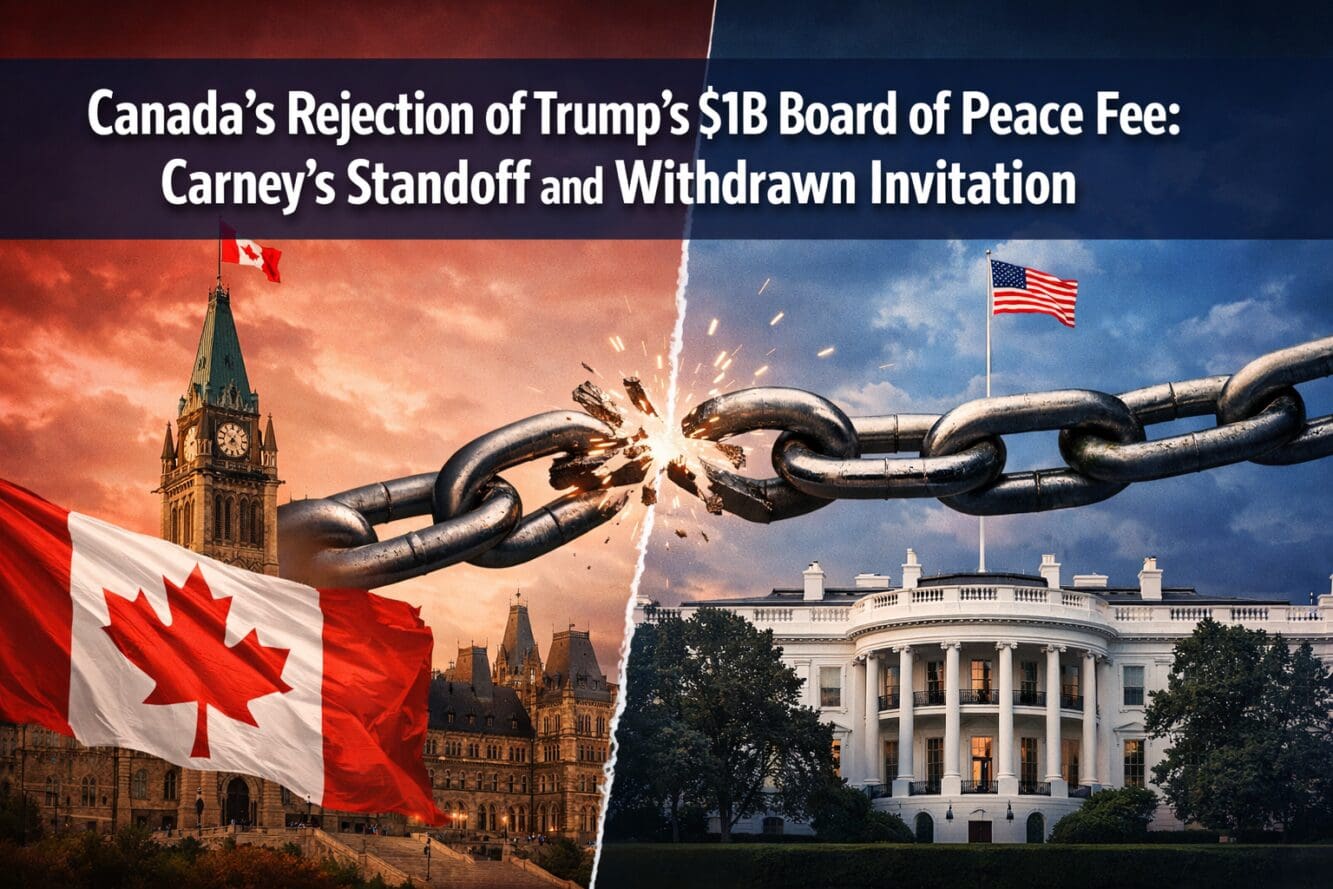
When diplomatic tensions escalate between neighboring nations, the consequences can reshape international relationships for years to come. In January 2026, Canada’s rejection of Trump’s $1B Board of Peace fee sparked a diplomatic standoff that culminated in the unprecedented withdrawal of Canada’s invitation to join a controversial global governance initiative. This high-stakes confrontation between Prime Minister Mark Carney and President Donald Trump reveals deeper fractures in the Canada-U.S. relationship and raises critical questions about the future of international cooperation.
Key Takeaways
🔑 Financial Rejection: Canada firmly refused to pay the $1 billion USD fee required for permanent membership on Trump’s Board of Peace, with Finance Minister François-Philippe Champagne stating categorically that “Canada is not going to pay.”[2]
🔑 Diplomatic Escalation: After PM Carney’s critical Davos speech warning of a “rupture” in the global order, Trump publicly withdrew Canada’s invitation via Truth Social, marking a dramatic breakdown in bilateral relations.
🔑 Limited Global Support: Only approximately 35 of 60 invited nations signed up for the Board of Peace, with major democracies including France, the UK, and Norway rejecting participation.[3]
🔑 Controversial Structure: Trump serves as chairman for life with final authority over all decisions, raising concerns about the board’s legitimacy and its potential to undermine existing international institutions.[3]
🔑 Alternative Priorities: Canada emphasized directing resources toward direct humanitarian aid to Gaza rather than paying membership fees to a Trump-controlled entity.[2]
Understanding Canada’s Rejection of Trump’s $1B Board of Peace Fee
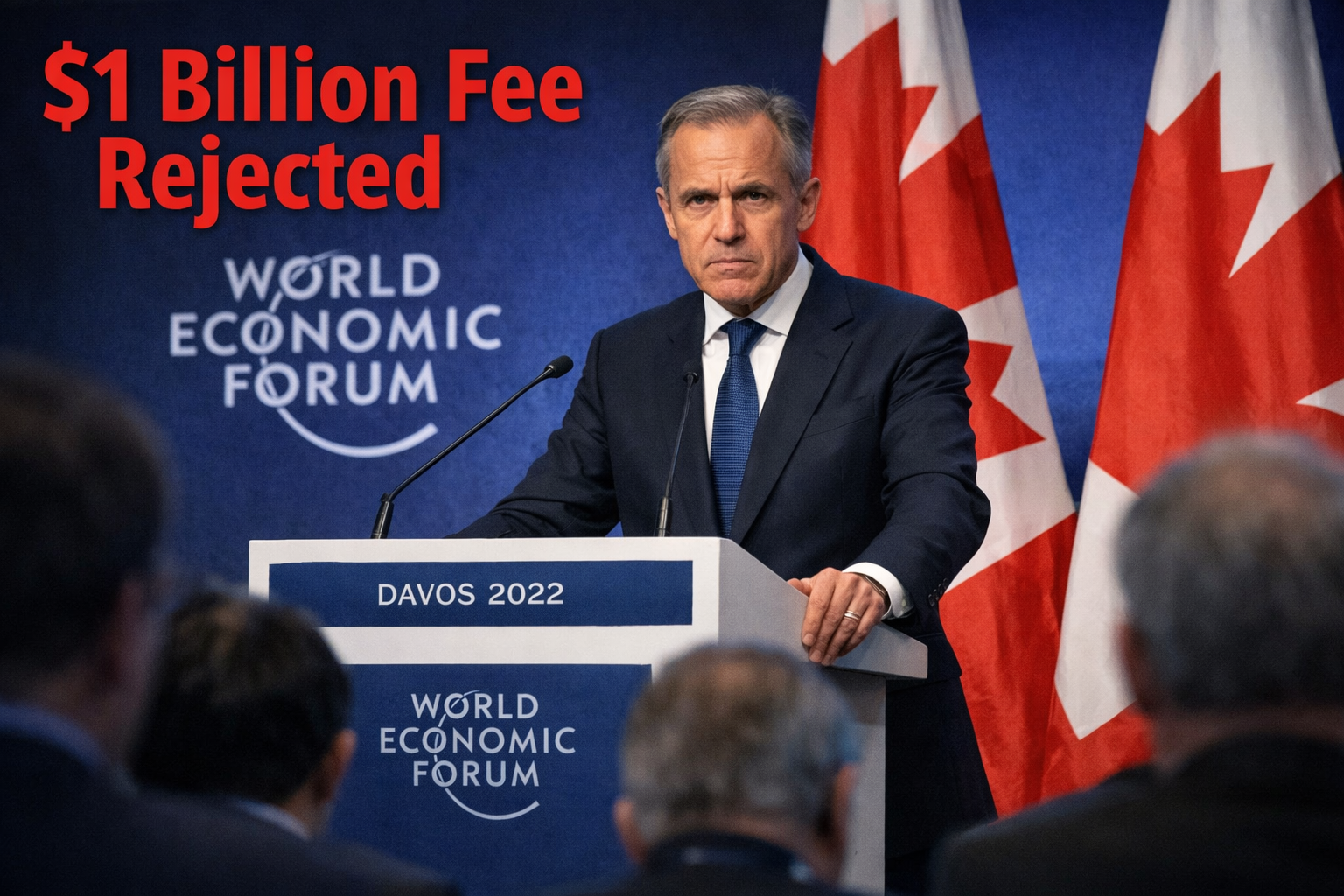
The controversy surrounding Canada’s rejection of Trump’s $1B Board of Peace fee began with what initially appeared to be diplomatic cooperation. On January 20, 2026, Prime Minister Mark Carney accepted President Trump’s invitation to join the newly formed Board of Peace “in principle.” However, within hours, the Canadian government clarified its position in unmistakable terms.
Finance Minister François-Philippe Champagne, speaking from the World Economic Forum in Davos, Switzerland, delivered Canada’s definitive stance: “There [are] a lot of details to be worked out, but one thing which is clear is that Canada is not going to pay if we were to join the Board of Peace.”[2]
This immediate clarification revealed the fundamental tension at the heart of the initiative. The Board of Peace, originally conceived as part of Trump’s Gaza ceasefire plan endorsed by the UN Security Council in November 2025, required member nations to pay $1 billion USD for permanent membership. Without this substantial payment, countries would receive only three-year terms on the board—a structure critics described as a “pay-to-play model of global influence.”[1]
The Financial Structure That Sparked Controversy
The Board of Peace’s financial architecture raised eyebrows across the international community. Countries faced a stark choice: commit $1 billion USD for permanent membership or accept limited three-year terms with no guarantee of renewal. The fund would be controlled directly by Trump, with oversight provided by a seven-member Executive Board—all members appointed by Trump himself.[3]
For context, $1 billion USD represents a significant portion of many nations’ foreign aid budgets. Canada’s government quickly determined that these funds could be better allocated to direct humanitarian assistance in Gaza rather than securing a seat at a table where Trump would serve as chairman for life with final authority over all board decisions, policy determinations, and charter interpretation.[3]
As Champagne explained, Canada wanted to ensure that “money to have maximum impact” and expressed particular concern about ensuring “unimpeded humanitarian aid flows at scale to the people of Gaza.”[2] This position reflected a fundamental disagreement about how international cooperation should function in addressing humanitarian crises.
The Davos Speech That Changed Everything
The situation escalated dramatically following Prime Minister Carney’s January 20, 2026 address at the World Economic Forum. In a speech that many interpreted as a direct response to Trump’s recent actions and territorial ambitions, Carney warned of a dangerous “rupture” in the postwar international order.
“Middle powers must act together because if we’re not at the table, we’re on the menu,” Carney declared, calling on nations to resist coercion from larger powers. He added pointedly: “We shouldn’t allow the rise of hard power to blind us to the fact that the power of legitimacy, integrity and rules will remain strong, if we choose to wield them together.”
While Carney never mentioned Trump by name, the timing and content left little doubt about his target. The speech came amid Trump’s repeated suggestions about annexing Canada—comments that had already inflamed Canadian public opinion and strained bilateral relations.
Trump’s response was swift and personal. Speaking at the same forum, he declared: “Canada lives because of the United States. Remember that, Mark, the next time you make your statements.”
Carney’s counter-response demonstrated Canada’s unwillingness to accept this characterization: “Canada doesn’t live because of the United States. Canada thrives because we are Canadian.”
For those interested in understanding the broader context of American politics and its impact on international relations, this exchange exemplified the increasingly confrontational tone characterizing U.S. foreign policy under Trump’s second term.
Trump’s Unprecedented Withdrawal of Canada’s Invitation
On January 22-23, 2026, President Trump took the extraordinary step of publicly withdrawing Canada’s invitation to join the Board of Peace. Posting on his Truth Social platform, Trump wrote:
“Dear Prime Minister Carney, Please let this Letter serve to represent that the Board of Peace is withdrawing its invitation to you regarding Canada’s joining, what will be, the most prestigious Board of Leaders ever assembled, at any time. Thank you for your attention to this matter!”
This public disinvitation represented an unprecedented diplomatic snub between the two nations. No official reason was provided, though the timing—just hours after the heated exchange at Davos—made the motivation transparent.
The withdrawal highlighted several concerning aspects of Trump’s approach to international relations:
- Personal grievances driving policy: The decision appeared motivated by Trump’s anger over Carney’s speech rather than strategic considerations
- Weaponization of international institutions: Using board membership as a tool for punishing perceived slights
- Erosion of diplomatic norms: Public humiliation of a close ally through social media rather than private diplomatic channels
The Canadian government responded with measured restraint, with officials declining to provide immediate public comment while privately expressing concern about the deteriorating relationship.
International Response: A Board Struggling for Legitimacy
Canada’s rejection of Trump’s $1B Board of Peace fee reflected broader international skepticism about the initiative. Of approximately 60 nations invited to participate, only about 35 had signed up by late January 2026.[3]
Major Democracies Decline Participation
Several of America’s closest allies either rejected the invitation outright or expressed significant reservations:
🇫🇷 France: President Emmanuel Macron became the first major leader to reject participation, citing concerns that the board’s charter “goes beyond the framework of Gaza.”[4] Trump’s response was characteristically combative, threatening to impose a “200% tariff on his wines and champagnes.”[4]
🇬🇧 United Kingdom: British officials flagged serious concerns about Russian President Vladimir Putin’s invitation, particularly given Putin’s outstanding International Criminal Court arrest warrant for alleged war crimes.
🇳🇴 Norway: The Norwegian government refused to participate “in its current format,” citing structural and governance concerns.
🇸🇪 Sweden: Swedish officials expressed reservations about the board’s scope and Trump’s lifetime chairmanship.
🇻🇦 Vatican: Pope Leo XIV declined the invitation after careful evaluation, representing a significant moral authority’s rejection of the initiative.[3]
Who Did Join?
The nations that did commit to the Board of Peace included:
- Saudi Arabia 🇸🇦
- Argentina 🇦🇷
- Indonesia 🇮🇩
- Bahrain 🇧🇭
- Qatar 🇶🇦
- Hungary 🇭🇺
- Belarus 🇧🇾
- Thailand 🇹🇭
- Slovenia 🇸🇮
- Paraguay 🇵🇾
Notably absent were China and Russia, despite Putin receiving an invitation. The composition raised questions about whether the board represented a genuine multilateral effort or primarily served Trump’s geopolitical interests.
Structural Concerns Beyond the $1B Price Tag
While the billion-dollar fee garnered headlines, Canadian officials identified numerous structural concerns that influenced their decision. Finance Minister Champagne emphasized that “a lot of details to be worked out,” highlighting uncertainty about:
Governance and Decision-Making
The board’s charter grants Trump extraordinary powers as chairman for life, including:
✅ Final authority over all board decisions
✅ Power to interpret the charter
✅ Control over policy determinations
✅ Appointment of all Executive Board members
✅ Management of the $1 billion membership fund
This concentration of power in a single individual—particularly one with clear political and business interests—raised fundamental questions about accountability and transparency.
Scope Creep Concerns
Originally presented as focused on Gaza reconstruction and governance, the board’s mandate appeared to expand rapidly. French officials expressed alarm that the charter extended “beyond the framework of Gaza,” potentially positioning the board to handle broader global conflicts.[4]
This scope expansion fueled concerns that Trump intended the Board of Peace to usurp functions traditionally handled by the United Nations. When asked directly whether he intended the board to replace the UN, Trump responded: “It might.”[3]
Pattern of Institutional Withdrawal
Canada’s hesitation must be understood within the context of Trump’s broader approach to international institutions. During his second term, Trump ordered U.S. withdrawal from 66 international organizations, including 31 associated with the United Nations.[3] This pattern suggested a preference for entities under his direct control rather than genuinely multilateral institutions.
For Canadians concerned about maintaining the rules-based international order, joining an institution designed to potentially replace the UN represented a fundamental contradiction. Those interested in Canada’s national identity and values might appreciate perspectives on celebrating Canada and what the country stands for internationally.
The Broader Canada-U.S. Relationship Crisis
Canada’s rejection of Trump’s $1B Board of Peace fee and the subsequent withdrawal of its invitation represent just one flashpoint in an increasingly troubled bilateral relationship. Several factors have contributed to rising tensions:
Annexation Rhetoric
Trump’s repeated suggestions about making Canada the “51st state” have profoundly offended Canadians across the political spectrum. While Trump frames these comments as jokes, they undermine trust and signal disrespect for Canadian sovereignty.
Trade Threats
Trump has threatened massive tariffs on Canadian goods, including a potential 100% tariff if Canada makes trade deals with China. These threats create economic uncertainty and complicate business planning for companies operating across the border.
Security Cooperation Concerns
The deteriorating relationship raises questions about future cooperation on:
- NORAD (North American Aerospace Defense Command)
- Border security and information sharing
- Arctic sovereignty and defense
- Intelligence sharing through Five Eyes alliance
Alternative Partnerships
In response to U.S. unpredictability, Prime Minister Carney announced a “new strategic partnership” with China during a January 2026 visit to Beijing. While this diversification makes strategic sense for Canada, it further complicates relations with Washington.
What This Means for Global Governance
The controversy surrounding the Board of Peace illuminates fundamental questions about the future of international cooperation:
Multilateralism vs. Unilateralism
Traditional multilateral institutions like the United Nations operate on principles of sovereign equality, with decisions requiring consensus or majority votes among member states. Trump’s Board of Peace represents a fundamentally different model—one where a single individual maintains lifetime control and final authority.
This shift from multilateral consensus to unilateral control raises critical questions:
- Can effective international cooperation exist when one person holds veto power?
- Does paying for influence undermine the legitimacy of global governance?
- What happens when the chairman’s interests conflict with humanitarian objectives?
The “Pay-to-Play” Precedent
If the Board of Peace model succeeds, it could establish a troubling precedent where international influence becomes explicitly transactional. Wealthy nations could buy permanent seats while smaller countries face exclusion or limited participation.
This approach contradicts the post-World War II consensus that international institutions should provide equal voice to all nations, regardless of economic power. The UN General Assembly’s “one nation, one vote” principle, while imperfect, reflects a commitment to sovereign equality that the Board of Peace explicitly rejects.
Middle Power Strategy
Prime Minister Carney’s Davos speech articulated a potential response: middle powers working together to maintain the rules-based order. Countries like Canada, Australia, South Korea, and European nations could form coalitions to preserve multilateral institutions and resist coercion from larger powers.
This strategy acknowledges that middle powers individually lack the economic or military might to challenge superpowers, but collectively can maintain significant influence and uphold international norms.
Lessons for Other Nations Considering Membership
Canada’s rejection of Trump’s $1B Board of Peace fee offers important lessons for other nations evaluating their participation:
Questions to Ask Before Joining
Nations considering board membership should carefully evaluate:
- Governance structure: Does lifetime chairmanship with final authority serve your national interests?
- Financial transparency: How will the $1 billion fund be managed and audited?
- Scope and mandate: Is the board’s mission clearly defined or subject to expansion?
- Alternative uses: Could the $1 billion create more impact through direct humanitarian assistance?
- Relationship implications: How will membership affect relations with countries that declined?
- Institutional legitimacy: Does the board complement or undermine existing international institutions?
The Humanitarian Aid Argument
Canada’s position that funds should go directly to humanitarian assistance rather than membership fees resonates with many development experts. $1 billion USD could provide:
- Food assistance for millions of displaced people
- Medical supplies and healthcare services
- Reconstruction of critical infrastructure
- Educational programs for children in conflict zones
- Economic development initiatives
The question becomes whether board membership would generate humanitarian outcomes exceeding what direct assistance could achieve—a calculation many nations find unconvincing.
Looking Ahead: Future of Canada-U.S. Relations
The standoff over the Board of Peace will likely have lasting implications for bilateral relations. Several scenarios could unfold:
Scenario 1: Continued Deterioration
If Trump maintains his confrontational approach and Canada refuses to acquiesce to demands it views as unreasonable, relations could continue declining. This might include:
- Escalating trade disputes and tariffs
- Reduced security cooperation
- Canadian pivot toward alternative partnerships
- Growing public animosity in both countries
Scenario 2: Pragmatic Reset
Both sides might recognize the mutual costs of continued confrontation and seek pragmatic accommodation. This could involve:
- Quiet diplomatic engagement away from public spotlight
- Issue-by-issue cooperation where interests align
- Agreement to disagree on certain matters while maintaining functional relationship
- Focus on economic interdependence as stabilizing force
Scenario 3: Structural Realignment
The crisis might accelerate Canada’s strategic diversification, reducing dependence on the United States across multiple dimensions:
- Expanded trade relationships with Asia, Europe, and Latin America
- Enhanced security cooperation with European NATO allies
- Greater emphasis on multilateral institutions
- Domestic policies reducing economic integration with U.S.
The most likely outcome involves elements of all three scenarios, with the relationship becoming more transactional and less based on shared values and automatic cooperation.
Conclusion: Sovereignty, Values, and International Cooperation
Canada’s rejection of Trump’s $1B Board of Peace fee and the subsequent withdrawal of its invitation represent more than a diplomatic spat—they illuminate fundamental questions about sovereignty, values, and the future of international cooperation in an increasingly multipolar world.
Prime Minister Carney’s firm stance that “Canada thrives because we are Canadian” articulates a principle that resonates beyond bilateral relations: nations must maintain sovereignty over their foreign policy decisions, even when facing pressure from more powerful neighbors.
The controversy also reveals the limitations of attempting to build international institutions around single individuals with lifetime authority and control. Effective global governance requires legitimacy, transparency, and accountability—qualities difficult to achieve when one person holds final authority over all decisions.
Key Takeaways for Citizens and Policymakers
For Canadians, this episode reinforces the importance of:
✅ Maintaining sovereign decision-making on international commitments
✅ Prioritizing humanitarian impact over symbolic participation
✅ Building coalitions with like-minded middle powers
✅ Defending multilateral institutions that provide smaller nations with voice and influence
For the international community, the Board of Peace controversy highlights:
✅ Skepticism toward pay-to-play governance models
✅ Importance of clear mandates and limited scope for international bodies
✅ Value of traditional multilateral institutions despite their imperfections
✅ Risks of concentrating power in single individuals
Next Steps: What Readers Can Do
Citizens concerned about these developments can:
- Stay informed about Canada-U.S. relations and international governance issues
- Contact elected representatives to express views on foreign policy priorities
- Support organizations working on humanitarian assistance in conflict zones
- Engage in informed discussion about Canada’s role in the world
- Monitor developments in multilateral institutions like the United Nations
For those interested in how global events affect local communities, exploring community engagement initiatives can provide perspective on how international relations ultimately impact daily life.
The standoff over the Board of Peace will not be the last challenge to Canada-U.S. relations, but how both nations navigate this crisis will shape their partnership for years to come. By standing firm on principles while remaining open to constructive engagement, Canada can protect its sovereignty while maintaining the world’s longest undefended border and one of its most important economic relationships.
References
[1] Watch – https://www.youtube.com/watch?v=mMUb6JyJ1zc
[2] aa.com.tr – https://www.aa.com.tr/en/americas/canada-reverses-possibility-of-paying-1b-to-join-trump-s-board-of-peace-/3805759
[3] Trumps Board Of Peace A Club Canada Can Afford Not To Join – https://www.policymagazine.ca/trumps-board-of-peace-a-club-canada-can-afford-not-to-join/
[4] Trump Board Peace Countries Joining Rejected Invitations Membership – https://time.com/7379643/trump-board-peace-countries-joining-rejected-invitations-membership/
Some content and illustrations on GEORGIANBAYNEWS.COM are created with the assistance of AI tools.
GEORGIANBAYNEWS.COM shares video content from YouTube creators under fair use principles. We respect creators’ intellectual property and include direct links to their original videos, channels, and social media platforms whenever we feature their content. This practice supports creators by driving traffic to their platforms.