




















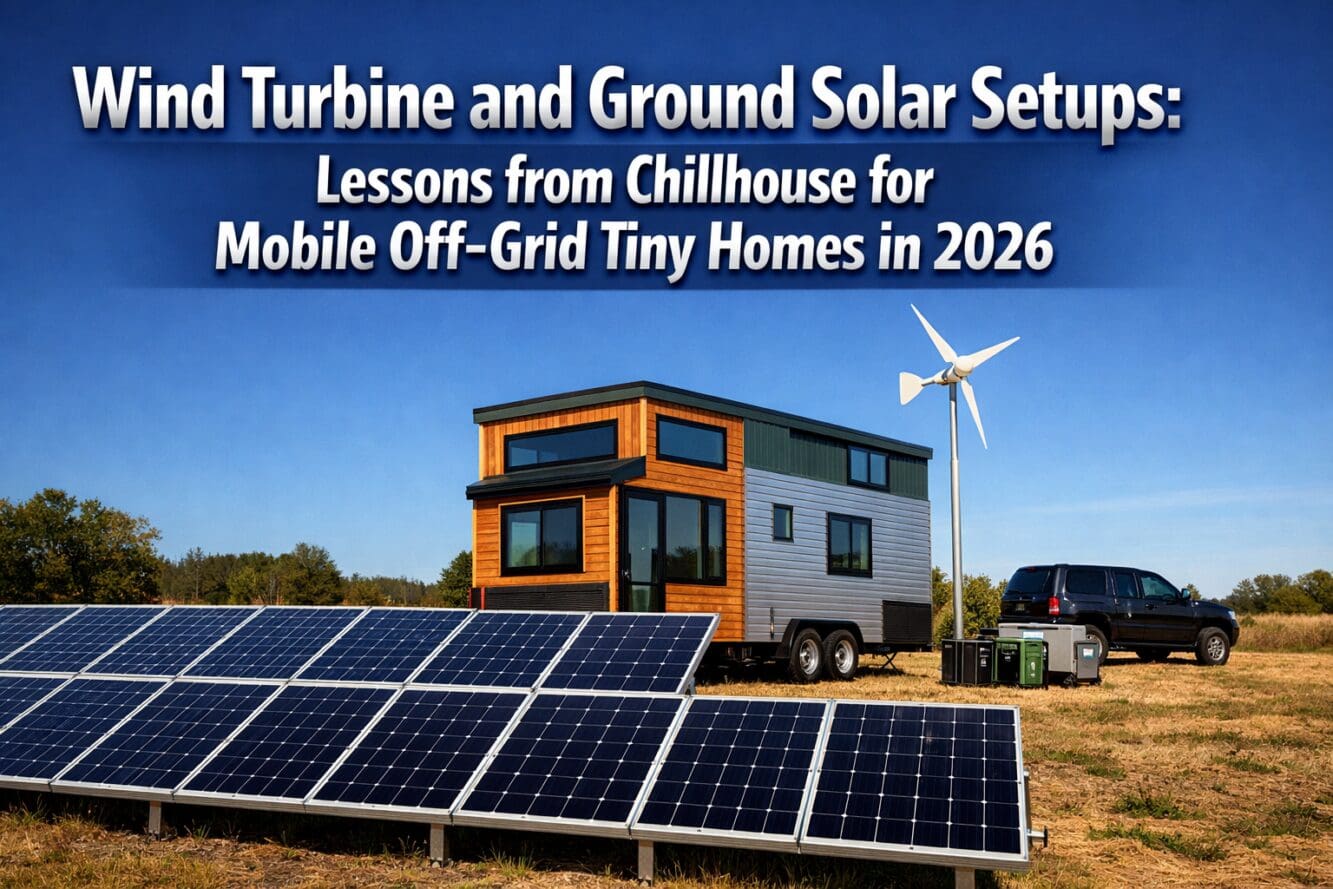
Wind Turbine and Ground Solar Setups: Lessons from Chillhouse for Mobile Off-Grid Tiny Homes in 2026
Last updated: February 21, 2026
Key Takeaways
- Ground-mounted solar panels offer unique advantages for mobile tiny homes, including easier transport and maintenance compared to roof installations
- The Chillhouse design demonstrates a hybrid wind-solar system that provides reliable power for two people living completely off-grid[1]
- Complete off-grid systems for tiny homes typically cost between $15,000-$45,000, significantly less than the $115,000+ needed for full-sized houses
- Hybrid configurations combining wind turbines and solar panels maximize energy production by capturing power day and night, in multiple weather conditions
- Towing logistics require careful planning for ground solar equipment, with panels typically transported separately from the tiny house structure
Quick Answer
Wind turbine and ground solar setups for mobile off-grid tiny homes combine portable solar panel arrays with compact wind turbines to create reliable, self-sufficient power systems. The Chillhouse model demonstrates this approach using ground-mounted panels that travel separately from the home, paired with a wind turbine for 24-hour energy generation[1]. This configuration costs $15,000-$45,000 for complete installation and works best for homes consuming 10-30 kWh daily in locations with moderate wind and sun exposure.
What Makes Ground-Mounted Solar Different for Tiny Homes?
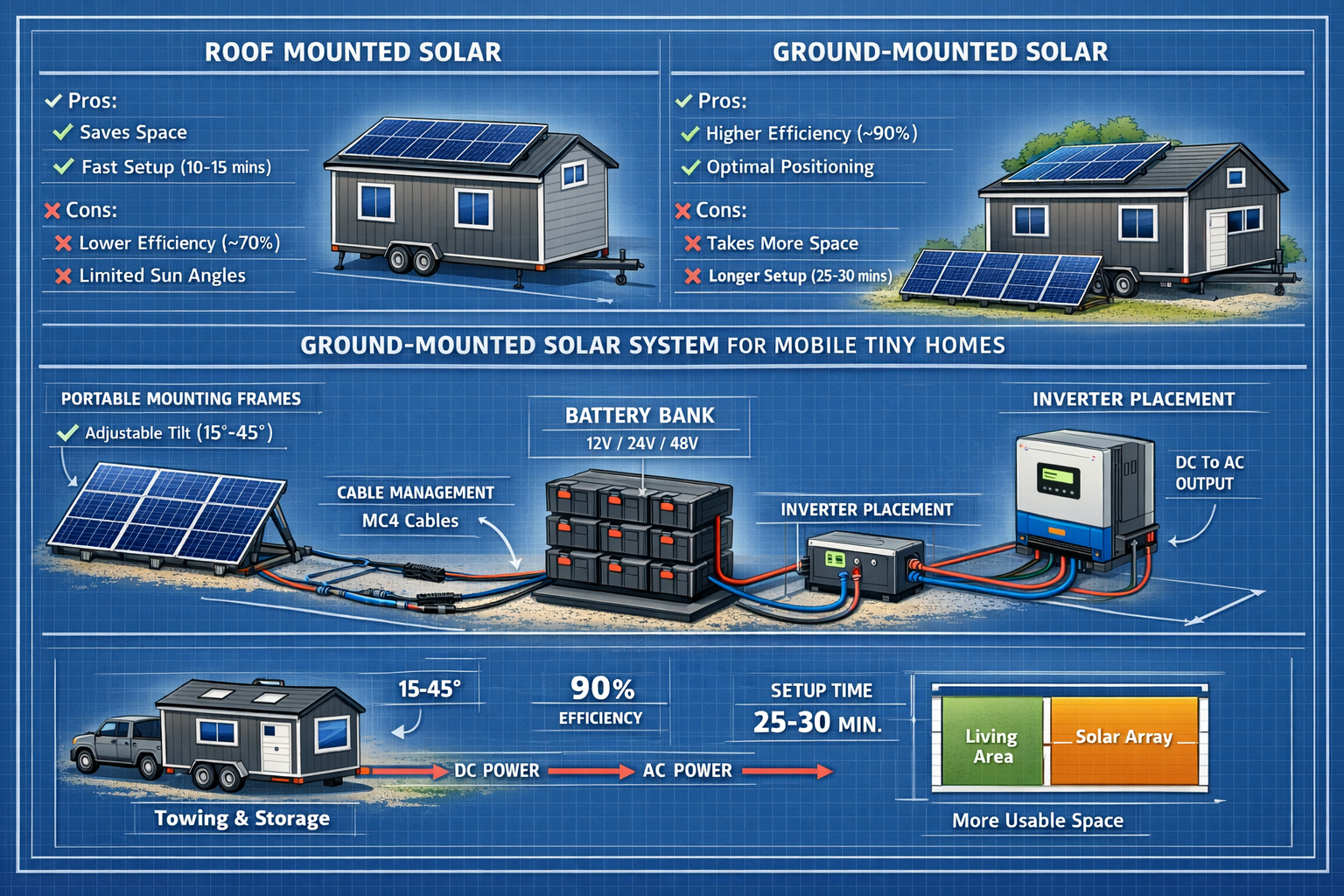
Ground-mounted solar panels represent an unconventional but practical choice for mobile tiny homes. Unlike traditional roof installations, these systems position panels on portable frames near the dwelling rather than attached to it.
The Chillhouse design showcases this approach with solar panels mounted on ground-level frames that can be transported separately with the towing vehicle[1]. This configuration solves several challenges specific to tiny house living:
Key advantages of ground mounting:
- Weight distribution – Removes 200-400 pounds from the roof structure, improving towing stability and reducing structural stress
- Maintenance access – Panels at ground level are easier to clean, inspect, and repair without climbing on the roof
- Angle optimization – Adjustable frames allow seasonal tilt changes to maximize sun exposure (30-45° in winter, 15-20° in summer)
- Cooling efficiency – Ground-mounted panels run 10-15% cooler than roof installations, improving power output
- Expansion flexibility – Adding panels requires no roof modifications or structural reinforcement
Setup and transport considerations:
The ground-mounted approach requires dedicated storage during travel. Most tiny house owners use a trailer or truck bed to transport the panel array, mounting hardware, and wiring. Setup time at a new location typically takes 2-4 hours for a basic system.
For those exploring sustainable living options in compact spaces, ground solar offers a practical entry point without permanent home modifications.
How Does the Chillhouse Wind-Solar Hybrid System Work?
The Chillhouse demonstrates a complete off-grid power solution combining wind turbine, solar panels, battery storage, and inverter to support two people living independently[1]. This hybrid approach addresses the fundamental limitation of single-source systems: intermittent generation.
System components and their roles:
| Component | Function | Typical Specifications |
|---|---|---|
| Solar Panels | Daytime power generation | 1,200-2,400W total capacity |
| Wind Turbine | Night/cloudy day generation | 400-1,000W rated output |
| Battery Bank | Energy storage | 10-20 kWh lithium or AGM |
| Inverter | DC to AC conversion | 2,000-3,000W pure sine wave |
| Charge Controller | Battery protection | MPPT 40-60A rating |
How the hybrid configuration maximizes reliability:
Solar panels typically generate peak power between 10 AM and 3 PM on clear days. Wind turbines often produce more power during evening hours and stormy weather when solar output drops. This complementary generation pattern means the battery bank receives charging input throughout most 24-hour periods.
According to recent data, solar and wind combined now provide 19.0% of US electricity, with both sources growing 12.2% year-over-year[electrek.co]. This trend reflects improving technology and cost-effectiveness that benefits tiny home applications.
Real-world performance expectations:
A properly sized hybrid system for a tiny home should generate 15-25 kWh daily in average conditions. This supports basic needs including:
- LED lighting (1-2 kWh/day)
- Refrigeration (2-3 kWh/day)
- Electronics and charging (2-4 kWh/day)
- Water pump (0.5-1 kWh/day)
- Heating/cooling assistance (variable, 5-15 kWh/day)
The Chillhouse includes a large fresh water tank and propane-powered boiler for hot water[1], demonstrating the smart strategy of using propane for high-energy heating tasks rather than depleting electrical reserves.
What Are the Real Costs of Off-Grid Power for Tiny Homes?
Understanding the complete financial picture helps aspiring off-grid dwellers budget accurately and avoid underfunding their power systems.
Initial equipment investment breakdown:
For a tiny home hybrid system similar to the Chillhouse design:
- Solar panels (1,500W): $1,200-$2,400
- Wind turbine (600W): $800-$2,500
- Battery bank (15 kWh lithium): $6,000-$9,000
- Inverter/charger (3,000W): $1,500-$2,500
- Mounting hardware: $400-$800
- Wiring and components: $300-$600
- Installation (DIY vs. professional): $0-$3,000
Total system cost: $15,000-$25,000 for a quality DIY installation, or $20,000-$35,000 professionally installed.
This contrasts sharply with full-sized homes, where off-grid solar-plus-storage systems cost $115,000 or more[now.solar]. The tiny home advantage comes from dramatically lower energy consumption – typically 10-30 kWh daily versus 30-50 kWh for conventional homes.
Ongoing operational costs:
- Battery replacement every 10-15 years: $5,000-$8,000
- Annual maintenance and cleaning: $100-$300
- Inverter replacement every 8-12 years: $1,200-$2,000
- Wind turbine bearing service every 3-5 years: $150-$400
Cost per kilowatt-hour over system lifetime:
With a 20-year lifespan generating 18 kWh daily average:
- Total generation: 131,400 kWh
- Total costs (equipment + maintenance): $28,000
- Cost per kWh: $0.21
This compares favorably to grid electricity averaging $0.16-$0.35 per kWh, especially considering energy independence and no monthly bills.
How Do You Size a Hybrid System for Your Tiny Home?
Proper system sizing prevents the two most common failures: undersized systems that leave you without power, and oversized systems that waste money on unused capacity.
Step 1: Calculate your daily energy consumption
List every electrical device and its usage:
- Refrigerator (120W × 8 hours) = 960 Wh
- LED lights (40W × 5 hours) = 200 Wh
- Laptop (50W × 6 hours) = 300 Wh
- Phone charging (10W × 3 hours) = 30 Wh
- Water pump (200W × 1 hour) = 200 Wh
- Miscellaneous (average) = 500 Wh
Daily total: 2,190 Wh or 2.2 kWh
Add 20-30% buffer for inefficiency and unexpected usage: 2.8-3.0 kWh daily requirement
Step 2: Determine solar panel capacity
Formula: Daily kWh ÷ Peak Sun Hours × 1.3 (inefficiency factor)
For a location with 4.5 peak sun hours:
3.0 kWh ÷ 4.5 hours × 1.3 = 867W minimum solar capacity
Recommended installation: 1,200-1,500W to account for cloudy days and seasonal variation.
Step 3: Size wind turbine supplement
Wind turbines rated at 400-800W provide excellent supplemental power for tiny homes. Choose based on your location’s average wind speed:
- Low wind areas (5-10 mph average): 400W turbine provides 1-3 kWh daily
- Moderate wind (10-15 mph average): 600W turbine provides 3-6 kWh daily
- High wind (15+ mph average): 800-1,000W turbine provides 6-12 kWh daily
Step 4: Calculate battery storage needs
Formula: Daily kWh × Days of Autonomy ÷ Depth of Discharge
For 3 days backup with lithium batteries (80% DoD):
3.0 kWh × 3 days ÷ 0.80 = 11.25 kWh minimum battery capacity
Recommended installation: 12-15 kWh for comfortable autonomy.
Common sizing mistakes to avoid:
- Basing calculations on summer usage without accounting for winter heating needs
- Ignoring inverter surge capacity for starting motors (refrigerators, pumps)
- Underestimating cloudy day frequency in your specific location
- Choosing battery capacity based only on cost rather than actual autonomy needs
What Are the Towing and Transportation Logistics?
Moving a tiny home with ground-mounted solar requires careful planning and proper equipment to ensure safe transport and quick setup at new locations.
Pre-transport preparation checklist:
✅ Disconnect and secure all electrical components
- Remove panels from ground mounts
- Disconnect battery bank (terminals covered)
- Secure inverter and charge controller
- Coil and tie all wiring
✅ Wind turbine disassembly
- Lower turbine mast (telescoping designs take 15-30 minutes)
- Remove blades and secure separately
- Protect generator housing
- Mark all connection points for reassembly
✅ Panel and equipment storage
- Stack panels with protective padding between each
- Secure in enclosed trailer or truck bed
- Weight distribution: heavier items over axles
- Weatherproof covering for open transport
Weight considerations for towing:
A complete ground solar and wind system adds approximately:
- Solar panels (6 × 250W): 120-150 lbs
- Wind turbine (disassembled): 60-100 lbs
- Mounting hardware: 80-120 lbs
- Total additional towing weight: 260-370 lbs
Ensure your towing vehicle’s capacity exceeds the combined weight of the tiny house, trailer, and all equipment by at least 20%.
Setup time at new location:
Experienced tiny house dwellers report these average setup times:
- Ground solar array: 2-3 hours (mounting frames, panel installation, wiring)
- Wind turbine: 1.5-2.5 hours (mast raising, blade attachment, electrical connections)
- Battery and inverter reconnection: 30-45 minutes
- System testing and optimization: 30-60 minutes
Total setup time: 4.5-7 hours for a complete hybrid system.
For those interested in collaborative living arrangements, shared equipment storage and setup assistance can reduce individual burden significantly.
When Does Wind-Solar Hybrid Make Sense vs. Solar-Only?
Not every tiny home needs both power sources. The decision depends on location, budget, and energy requirements.
Choose hybrid wind-solar if:
- Your location experiences frequent cloudy periods (Pacific Northwest, Northeast winters)
- Consistent wind averages 10+ mph year-round
- You need reliable winter power when solar production drops 40-60%
- Budget allows the additional $1,500-$3,500 for wind equipment
- You plan to stay stationary for extended periods (3+ months)
Choose solar-only if:
- Your location receives consistent sunshine (Southwest, Southern states)
- Wind speeds average below 8 mph
- You have a limited budget and can manage with larger battery bank
- You move frequently (monthly or more) and want simpler setup
- Noise concerns exist (wind turbines produce 40-50 dB at 100 feet)
Real-world performance comparison:
A tiny home in Colorado with hybrid system:
- Solar contribution: 12 kWh daily (summer), 6 kWh daily (winter)
- Wind contribution: 4 kWh daily (summer), 8 kWh daily (winter)
- Total: 16 kWh (summer), 14 kWh (winter) – consistent year-round
Same home with solar-only system:
- Solar contribution: 15 kWh daily (summer), 6 kWh daily (winter)
- Battery dependency increases 50% in winter months
The hybrid configuration provides more consistent power with smaller battery requirements, while solar-only systems need 30-50% larger battery banks to maintain winter autonomy.
What Maintenance Do These Systems Require?
Regular maintenance ensures reliable performance and maximum system lifespan. Off-grid power systems demand more attention than grid-tied installations because there’s no backup when components fail.
Monthly maintenance tasks (30-45 minutes):
- Solar panel cleaning – Remove dust, bird droppings, and debris that reduce output by 15-25%
- Battery voltage check – Verify each battery maintains proper charge (12.6V+ for lead-acid, 13.2V+ for lithium)
- Connection inspection – Tighten any loose terminals and check for corrosion
- Wind turbine visual check – Look for blade damage, unusual vibration, or loose mounting bolts
Quarterly maintenance (2-3 hours):
- Deep battery equalization (lead-acid only) – Controlled overcharge to balance cell voltages
- Inverter filter cleaning – Remove dust from cooling fans and vents
- Wind turbine lubrication – Grease bearings and moving parts per manufacturer specs
- Wiring inspection – Check for rodent damage, UV degradation, and proper strain relief
Annual professional inspection ($200-$400):
- Load testing batteries to verify actual capacity
- Thermal imaging to identify hot connections
- Wind turbine bearing replacement if needed
- System performance optimization and firmware updates
Warning signs requiring immediate attention:
🚨 Battery issues:
- Voltage drop below 11.8V (lead-acid) or 12.4V (lithium) under light load
- Swelling, leaking, or excessive heat
- Charging time increases by 50% or more
🚨 Solar problems:
- Output drops 30%+ on clear days
- Hot spots visible on panels
- Cracked or delaminating cells
🚨 Wind turbine concerns:
- Unusual noise or vibration
- Blades not spinning in 15+ mph winds
- Generator overheating
Addressing these issues quickly prevents minor problems from becoming expensive failures. Most tiny home owners report spending 8-12 hours annually on maintenance, plus $200-$500 in parts and professional services.
What Are the Legal and Regulatory Considerations?
Off-grid tiny homes occupy a complex regulatory space that varies significantly by location. Understanding these requirements prevents costly mistakes and legal complications.
Zoning and land use regulations:
Most jurisdictions classify tiny homes as either:
- RVs/Mobile homes – Subject to RV park regulations, often prohibited for permanent residence
- Accessory Dwelling Units (ADUs) – Allowed on property with existing primary residence
- Permanent dwellings – Must meet full building codes including minimum square footage (often 400+ sq ft)
Choose your location based on:
- Counties with tiny house-specific ordinances (increasingly common in 2026)
- Agricultural or rural zones with relaxed dwelling requirements
- Private land where you have owner permission and minimal enforcement
Electrical code compliance:
Even off-grid systems must meet National Electrical Code (NEC) requirements:
- Proper grounding – All metal components bonded to earth ground rod
- Overcurrent protection – Circuit breakers or fuses on all circuits
- Wire sizing – Minimum 10 AWG for 30A circuits, 12 AWG for 20A
- Junction box accessibility – No buried or permanently covered connections
- Disconnect switches – Required between all major components
Permit requirements vary by jurisdiction:
- Some areas require electrical permits even for off-grid systems
- Building permits may be needed for permanent installations
- Wind turbine height restrictions often limit residential turbines to 35-65 feet
- Setback requirements may mandate minimum distances from property lines
Insurance considerations:
Standard homeowners insurance rarely covers tiny homes. Specialized policies are available but may require:
- Certified electrical installation by licensed electrician
- Annual inspections of off-grid power systems
- Proof of proper anchoring for wind turbines
- Higher premiums for homes with lithium battery banks (fire risk)
Before investing in an off-grid tiny home, research your intended location’s specific requirements. Many tiny house owners find that rural counties with populations under 50,000 offer the most flexibility and least restrictive regulations.
Frequently Asked Questions
How long do off-grid solar batteries last in tiny homes?
Lithium batteries typically last 10-15 years with proper maintenance, while lead-acid batteries last 5-8 years. Battery lifespan depends heavily on depth of discharge – keeping batteries above 50% charge (lead-acid) or 20% charge (lithium) significantly extends their life. Temperature also matters; batteries in climate-controlled spaces last 30-40% longer than those exposed to extreme heat or cold.
Can I run air conditioning on a tiny home off-grid system?
Yes, but it requires significant capacity. A small 5,000 BTU AC unit consumes 400-600W while running, adding 4-8 kWh to daily usage. You’ll need at least 2,000W of solar panels, 800W+ wind turbine, and 20+ kWh battery capacity. Many tiny home owners use mini-split heat pumps (more efficient) or rely on passive cooling strategies to reduce electrical demand.
What happens during extended cloudy weather?
Hybrid wind-solar systems perform better during cloudy periods because wind often increases with storm systems. A properly sized system with 3 days battery autonomy can handle most weather events. For longer periods, many tiny home owners keep a small backup generator (2,000-3,000W) that runs 2-3 hours to recharge batteries when needed. This hybrid approach costs less than oversizing the renewable system.
How much does ground solar equipment weigh for towing?
A complete 1,500W ground solar system with mounting hardware weighs 200-280 pounds. Wind turbine components add another 60-100 pounds. This equipment typically travels in a separate trailer or truck bed rather than on the tiny house itself. Total additional towing weight including batteries and inverter ranges from 400-600 pounds depending on battery type and capacity.
Do I need special skills to install an off-grid system?
Basic electrical knowledge and mechanical aptitude are sufficient for DIY installation. You should understand DC circuits, proper wire sizing, and safe working practices around batteries. Many tiny home builders successfully install their own systems using online resources and manufacturer support. However, hiring a professional electrician for final connections and inspection ($500-$1,500) ensures code compliance and safety.
What’s the best battery type for mobile tiny homes?
Lithium iron phosphate (LiFePO4) batteries are ideal for mobile applications because they’re lighter (60% less weight than lead-acid), tolerate vibration better, and offer 80% usable capacity versus 50% for lead-acid. The higher upfront cost ($500-600 per kWh) is offset by 2-3x longer lifespan and better performance. AGM lead-acid batteries work well for budget builds but require more careful maintenance and monitoring.
How often should I clean solar panels?
Clean panels monthly in dusty environments or every 2-3 months in cleaner areas. Dirty panels lose 15-25% efficiency, which significantly impacts off-grid systems with no backup power. Use plain water and a soft brush – avoid harsh chemicals or abrasive materials. Early morning or evening cleaning prevents thermal shock to hot panels. Ground-mounted panels are much easier to clean than roof installations.
Can I add more panels or wind capacity later?
Yes, but plan for expansion from the start. Ensure your charge controller can handle additional panel wattage (most support 20-30% over initial rating), and verify your inverter capacity exceeds your maximum anticipated load. Adding a second wind turbine requires careful consideration of tower placement and electrical integration. Most tiny home owners start with 70-80% of their ultimate capacity and expand within 1-2 years.
What’s the minimum wind speed needed for power generation?
Most small wind turbines start generating at 6-8 mph wind speed, but meaningful power production begins around 10-12 mph. Below 8 mph average wind speed, solar-only systems typically provide better value. Check historical wind data for your specific location at 30-40 feet height (typical turbine mounting height) rather than ground-level measurements, which underestimate actual wind resources.
How do I calculate my tiny home’s energy needs accurately?
Track actual usage with a portable energy monitor ($25-50) for 2-4 weeks in your current living situation. Multiply wattage by hours used daily for each device, then add 20-30% buffer. Account for seasonal variations – heating and cooling can double or triple baseline consumption. Most tiny homes use 8-15 kWh daily for basic needs, 15-25 kWh with AC/heating, and 25-35 kWh for work-from-home setups with multiple devices.
Are there financing options for off-grid tiny home systems?
Personal loans and home improvement loans can finance off-grid systems, though interest rates (8-15%) are typically higher than solar loans for grid-tied homes. Some credit unions offer “green energy” loans with favorable terms for renewable installations. Equipment manufacturers occasionally provide financing, and some states offer rebates or tax credits for off-grid renewable systems. Budget for 20-30% down payment to secure better rates.
What’s the realistic lifespan of a complete off-grid system?
Solar panels last 25-30 years with gradual efficiency decline (0.5% annually). Wind turbines need major overhauls every 10-15 years but can operate 20+ years total. Inverters last 8-12 years, batteries 5-15 years depending on type. With proper maintenance and component replacement, the overall system provides reliable service for 20-25 years. Budget for battery replacement every 10 years and inverter replacement every 10-12 years.
Key Takeaways
✅ Ground-mounted solar panels provide easier maintenance, better cooling, and simplified towing logistics compared to roof installations, making them ideal for mobile tiny homes
✅ Hybrid wind-solar configurations deliver more consistent year-round power than single-source systems, especially in locations with seasonal weather variations
✅ Complete off-grid systems for tiny homes cost $15,000-$35,000 installed, with DIY installations at the lower end and professional installations at the higher end
✅ Proper system sizing requires accurate energy consumption calculations, location-specific solar and wind resource assessment, and adequate battery capacity for 2-3 days autonomy
✅ The Chillhouse model demonstrates practical off-grid living for two people using transportable ground solar, supplemental wind power, and efficient energy management[1]
✅ Towing logistics add 400-600 pounds to total vehicle load and require 4.5-7 hours for complete system setup at new locations
✅ Regular maintenance (8-12 hours annually plus $200-500 in costs) ensures reliable performance and prevents expensive component failures
✅ Location research is critical – choose areas with tiny house-friendly zoning, minimal permit requirements, and good solar/wind resources
✅ Lithium batteries offer the best performance for mobile applications despite higher initial costs, providing lighter weight and longer lifespan
✅ Realistic expectations matter – off-grid living requires active energy management, backup planning, and acceptance that some grid conveniences may not be practical
Conclusion
Wind turbine and ground solar setups for mobile off-grid tiny homes represent a practical path to energy independence in 2026. The Chillhouse design proves that thoughtful system configuration – combining ground-mounted panels, supplemental wind power, adequate battery storage, and efficient appliances – can support comfortable two-person living without grid connection[1].
The key to success lies in accurate planning. Calculate your actual energy needs, size components appropriately for your location’s solar and wind resources, and budget realistically for both initial investment and ongoing maintenance. Ground-mounted solar offers unique advantages for mobile applications, while hybrid wind-solar configurations provide more consistent power than single-source systems.
Your next steps:
- Track your energy usage for 2-4 weeks using a portable monitor to establish baseline consumption
- Research your intended location for zoning regulations, solar resources, and average wind speeds
- Design your system using the sizing formulas provided, adding 20-30% buffer for unexpected usage
- Get multiple quotes from installers if not going DIY, and compare component quality carefully
- Plan your towing logistics including equipment storage, weight distribution, and setup procedures
- Join tiny house communities online and locally to learn from others’ experiences and avoid common mistakes
The combination of improving technology, falling equipment costs, and growing interest in sustainable living makes 2026 an excellent time to pursue off-grid tiny house living. With 99%+ of new US generating capacity coming from solar, wind, and storage[electrek.co], the infrastructure and expertise supporting these systems continues to expand.
Whether you’re seeking weekend retreat independence, preparing for extended remote living, or pursuing a completely off-grid lifestyle, the lessons from innovative designs like the Chillhouse provide a proven roadmap. Start with solid planning, invest in quality components, and embrace the active energy management that off-grid living requires. The result is genuine energy independence and the freedom to live sustainably wherever your tiny home takes you.
References
[1] Chillhouse Atelier Bois Dici – https://newatlas.com/tiny-houses/chillhouse-atelier-bois-dici/
Some content and illustrations on GEORGIANBAYNEWS.COM are created with the assistance of AI tools.
GEORGIANBAYNEWS.COM shares video content from YouTube creators under fair use principles. We respect creators’ intellectual property and include direct links to their original videos, channels, and social media platforms whenever we feature their content. This practice supports creators by driving traffic to their platforms.