



















Intelligence Report on the War in Iran: Iran, Israel and USA Intel — 2026
Last updated: March 1, 2026
“The compound of Supreme Leader Ali Khamenei was struck and destroyed. Khamenei was killed during the attack.”
— Assessment based on satellite imagery and multiple intelligence sources [1]
Key Takeaways
- 🎯 Operation Genesis — the Israeli Air Force’s largest combat sortie in history — deployed approximately 200 fighter jets to strike 500 military targets across western and central Iran [1]
- 💀 Supreme Leader Ali Khamenei was killed during the opening strikes; his compound was confirmed destroyed by satellite imagery assessment [1]
- 🇺🇸 The US military buildup in the Middle East was described as the largest since the 2003 invasion of Iraq [1]
- 🤝 Full US-Israel coordination was confirmed by US officials for all strikes conducted [1]
- 🎯 Trump’s stated objective was regime change, not simply military degradation [1][2]
- 📍 Cities struck include Tehran, Isfahan, Qom, Karaj, and Kermanshah [1]
- ☢️ Iran’s air defenses, missile launchers, nuclear-related facilities, and command infrastructure were primary targets [1]
- 📋 Trump presented Iran with three non-negotiable demands before the strikes escalated [1]
- 🌍 Regional proxy groups — Hamas, Hezbollah, and the Houthis — are central to the broader conflict picture [1]
- ⚠️ The death of Khamenei creates a massive leadership vacuum with no clear succession plan in place
Quick Answer
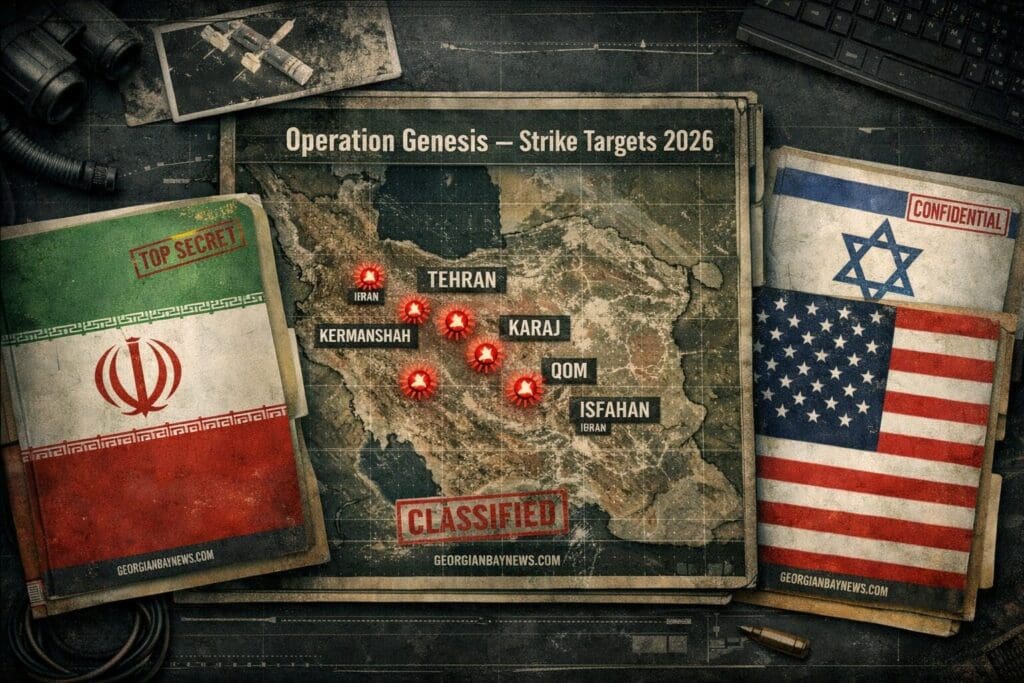
In late February 2026, Israel and the United States launched coordinated military strikes against Iran in what analysts are calling the most significant military escalation in the Middle East in over two decades. Israeli forces conducted Operation Genesis, striking 500 targets across Iran, while US forces operated from regional bases and aircraft carriers. Supreme Leader Ali Khamenei was killed during the attacks, triggering a deep political and military crisis inside Iran.
What Triggered the Iran-Israel-USA War in 2026?
The strikes did not come without warning. For months, diplomatic pressure had been building to a breaking point.
The Trump administration presented Iran with three firm demands [1]:
- Permanently end uranium enrichment — a red line for both Washington and Jerusalem
- Strictly limit ballistic missile programs — Iran’s missile arsenal had long threatened Israel and US regional bases
- Completely halt support for proxy groups — including Hamas, Hezbollah, and the Houthis in Yemen
Iran rejected these demands. Behind the scenes, US and Israeli intelligence agencies had been coordinating for months, mapping targets, timing strike windows, and preparing for what officials later described as “tactical surprise.” [1]
The US military buildup in the region — the largest since the 2003 invasion of Iraq — signaled that diplomacy had run its course [1]. When the strikes came, they were overwhelming in scale and precision.
Why it matters: This was not a reactive strike. It was a planned, coordinated campaign with a declared political objective — regime change in Tehran [1][2]. That framing makes this conflict categorically different from previous US-Iran confrontations.
How to Write an Intelligence Report on the War in Iran: Iran, Israel and USA Intel — The Opening Phase
To write an intelligence report on the war in Iran and include Iran, Israel and USA intel, analysts must start with the operational timeline and confirmed strike data. Here is what the opening phase of the conflict looked like on the ground.
Operation Genesis: The Israeli Strike
The Israeli Air Force launched what its own commanders called the largest combat operation in the country’s history [1]:
| Metric | Detail |
|---|---|
| Fighter jets deployed | ~200 |
| Military targets struck | ~500 |
| Cities targeted | Tehran, Isfahan, Qom, Karaj, Kermanshah |
| Operation codename | Operation Genesis |
| Confirmed missiles striking targets | 7 [1] |
Targets included:
- Air defense systems — to clear the sky for follow-on strikes
- Ballistic missile launchers — to degrade Iran’s retaliatory capability
- Nuclear-related facilities — particularly around Isfahan and Qom
- Command and control nodes — including leadership compounds
US Strike Operations
US forces operated from multiple Middle East bases and aircraft carriers, conducting strikes by both air and sea [1]. US officials confirmed full coordination with Israel on all strike packages — meaning target selection, timing, and sequencing were jointly approved [1].
Choose this framing if you’re briefing policymakers: The US role was not peripheral. Washington was a co-architect of the strike campaign, not simply a supporter standing by.
The Death of Supreme Leader Khamenei: What It Means
Ayatollah Ali Khamenei, who had led the Islamic Republic since 1989, was killed during the opening strikes [1]. His compound was assessed as heavily damaged or destroyed based on satellite imagery [1].
This is not a minor development. It is arguably the single most consequential political event in Iran since the 1979 Islamic Revolution.
What Khamenei’s death changes:
- No clear successor — Iran’s constitution allows the Assembly of Experts to appoint a new Supreme Leader, but the process is slow, contested, and vulnerable to factional power struggles
- Command authority fractures — The Islamic Revolutionary Guard Corps (IRGC) reports to the Supreme Leader. With that position vacant, internal chain-of-command questions become urgent
- Proxy networks lose central coordination — Hezbollah, Hamas, and the Houthis all received strategic direction from Khamenei’s office. That coordination is now disrupted
- Regime legitimacy crisis — The Supreme Leader is both a political and religious figure. His death creates a theological vacuum as much as a governmental one
Supreme National Security Council Secretary Ali Shamkhani was also reported killed in the strikes [1], removing another senior decision-maker from Iran’s security apparatus.
Imagine a country’s entire top tier of national security leadership — the equivalent of losing a head of state and national security advisor simultaneously. That is the situation Iran faces as of early March 2026.
For readers following American politics and US foreign policy decisions, the implications of Khamenei’s death extend far beyond the Middle East.
How to Write an Intelligence Report on the War in Iran: Assessing Iran’s Military and Political Response
Writing an intelligence report on the war in Iran requires assessing not just what happened, but what Iran can and cannot do next. Here is the current assessment.
Iran’s Military Capabilities — Post-Strike
Iran entered this conflict with a substantial military infrastructure. The strikes targeted the most dangerous elements:
Degraded (assessed):
- Long-range ballistic missile launch sites
- Air defense radar and missile batteries
- Key nuclear program facilities
- Senior military and political leadership
Likely intact or partially functional:
- Dispersed missile stockpiles in underground facilities
- IRGC ground forces and paramilitary units
- Cyber warfare capabilities
- Proxy networks in Lebanon, Gaza, Iraq, and Yemen
Iran’s Likely Response Options
Without Khamenei and with degraded military infrastructure, Iran’s options narrow considerably. Analysts at Chatham House note that the strikes have fundamentally altered the regional balance of power [3]. Likely Iranian responses include:
- Proxy escalation — directing Hezbollah or Houthi forces to strike Israel or US assets, though coordination is now harder
- Cyber attacks — against Israeli, US, and Gulf state infrastructure
- Strait of Hormuz pressure — threatening or partially disrupting oil shipping, though this carries severe economic self-harm
- Diplomatic outreach — seeking international condemnation and potential ceasefire terms
Common mistake in analysis: Assuming Iran will respond symmetrically. Iran has historically preferred asymmetric, deniable responses through proxies rather than direct conventional retaliation.
What Are Trump’s Strategic Objectives in Iran?
Trump’s stated objective was explicit: regime change [1][2]. This goes beyond the limited strike logic of previous administrations, which sought to deter or delay Iran’s nuclear program without toppling the government.
The three demands Trump presented before the strikes — ending enrichment, capping missiles, stopping proxy support — were structured to be unacceptable to the current Iranian government [1]. That framing suggests the demands were designed to justify escalation rather than invite negotiation.
Strategic goals, as assessed:
- Eliminate Iran’s nuclear weapons pathway permanently
- Dismantle the “axis of resistance” — the network of proxy groups that Iran has used to project power across the region
- Install a more compliant Iranian government — though what that looks like in practice remains undefined
- Reassert US deterrence credibility in the region after years of perceived retreat
The Center for Strategic and International Studies (CSIS) has flagged that the “what comes next” question is the hardest one — military success in the opening phase does not automatically translate into political success [5].
For context on how America’s political leadership has approached foreign conflicts historically, the pattern of declaring military objectives without a clear post-conflict plan has created problems before — most notably in Iraq after 2003.
Israel’s Role: Why Jerusalem Moved Now
Israel’s decision to launch Operation Genesis — the largest combat sortie in its history — reflects years of strategic calculation, not impulse [1].
Why Israel acted in 2026:
- Iran’s nuclear program had advanced closer to weapons-grade enrichment capacity than at any previous point
- US political alignment — the Trump administration provided the diplomatic cover and military coordination Israel needed
- Proxy exhaustion — after years of conflict with Hamas and Hezbollah, Israel assessed that striking the source (Iran) was preferable to continuing to fight the symptoms
- Intelligence window — months of joint US-Israeli planning created a narrow window of tactical surprise [1]
The 200-fighter-jet sortie striking 500 targets represents a commitment of nearly Israel’s entire frontline air combat capability [1]. This was not a warning shot. It was a maximum-effort strike designed to cripple Iran’s military infrastructure in a single operational phase.
Edge case to watch: If Iran retains functional ballistic missiles capable of reaching Israeli cities, the conflict’s next phase could bring direct strikes on Israeli civilian infrastructure — a scenario that would trigger further escalation.
Regional and Global Fallout: What the Intelligence Picture Shows
The Iran-Israel-USA conflict does not exist in a vacuum. Every neighboring country, every global oil market, and every US ally is now recalculating its position.
Key regional actors and their positions:
| Country/Group | Likely Response | Risk Level |
|---|---|---|
| Hezbollah (Lebanon) | Rocket/missile strikes on Israel | High |
| Houthis (Yemen) | Continued Red Sea disruptions | High |
| Iraq (pro-Iran militias) | Attacks on US bases in Iraq | Medium-High |
| Saudi Arabia | Quiet support for US/Israel, oil coordination | Medium |
| Russia | Diplomatic condemnation, possible arms supply to Iran | Medium |
| China | Economic pressure, calls for ceasefire | Low-Medium |
| Turkey | Condemnation, potential mediation role | Low |
Oil markets are the immediate global economic concern. Iran produces roughly 3 million barrels of oil per day (estimated, pre-conflict). Any disruption to Strait of Hormuz shipping — through which approximately 20% of global oil trade passes — would spike energy prices worldwide.
The Middle East Institute has assessed that the entire region is now “at the center” of a restructuring of power that will take years to resolve [6].
For those tracking America’s political and economic exposure to this conflict, energy prices, military spending, and allied commitments are the three immediate pressure points.
Intelligence Assessment: Comparing US, Israeli, and Iranian Capabilities
To properly write an intelligence report on the war in Iran with full Iran, Israel and USA intel, a side-by-side capability assessment is essential.
Military Capability Comparison (Pre-Strike Baseline)
| Capability | USA | Israel | Iran |
|---|---|---|---|
| Air superiority | Dominant (carriers + regional bases) | Strong (F-35s, F-15s) | Limited (aging fleet) |
| Ballistic missiles | Advanced (Tomahawks, precision) | Advanced (Jericho series) | Large stockpile, varied accuracy |
| Nuclear weapons | Yes (not deployed in this conflict) | Undeclared capability | Near-threshold (pre-strike) |
| Cyber warfare | Tier 1 | Tier 1 | Tier 2-3 |
| Proxy networks | NATO allies | Limited | Extensive (Hezbollah, Hamas, Houthis) |
| Naval power | Dominant | Regional | Limited (Strait of Hormuz focus) |
Key intelligence gap: The actual status of Iran’s dispersed and underground missile stockpiles remains uncertain. Satellite imagery can confirm surface damage; it cannot confirm destruction of deeply buried facilities.
The Institute for the Study of War’s Iran Update from late February 2026 highlights that battle damage assessment is ongoing and that initial strike reports may overstate damage to hardened underground targets [7].
What Happens After Khamenei? Iran’s Succession Crisis
The death of a Supreme Leader is constitutionally managed by Iran’s Assembly of Experts — an 88-member clerical body that selects the next Supreme Leader. But that process assumes a functioning government, not one that has just lost its top leadership in a military strike.
The succession problem:
- Khamenei had not publicly designated a successor
- His son, Mojtaba Khamenei, had been discussed in some circles but holds no formal position
- The IRGC, which controls significant military and economic power, will likely assert influence over the selection
- Factional fighting between hardline IRGC commanders and more pragmatic clerics could paralyze decision-making
Three possible outcomes:
- Rapid IRGC consolidation — military commanders effectively take control while a figurehead Supreme Leader is selected
- Factional paralysis — competing power centers fight for dominance, weakening Iran’s ability to respond coherently
- Reform opening — a minority scenario where moderate factions use the crisis to push for a negotiated settlement
The Institute for the Study of War notes that Iran’s internal political dynamics are now the most important variable in the conflict’s next phase [7].
FAQ: Iran, Israel and USA War — Your Questions Answered
Q: When did the US and Israel launch strikes on Iran?
The coordinated strikes began in late February 2026, with the opening phase of Operation Genesis confirmed by multiple sources including Euronews and Wikipedia’s conflict documentation [1][2].
Q: Was Ayatollah Khamenei really killed?
Yes. Satellite imagery assessment and multiple intelligence reports confirm that Khamenei’s compound was destroyed and that he was killed during the strikes [1].
Q: What was Operation Genesis?
Operation Genesis was the Israeli Air Force’s codename for its strike campaign against Iran. It involved approximately 200 fighter jets striking 500 military targets across western and central Iran [1].
Q: Did the US officially declare war on Iran?
As of early March 2026, the US has not issued a formal declaration of war. Trump announced “major combat operations” underway with a stated objective of regime change, but the legal framework governing the strikes remains under debate [1][2].
Q: What are Iran’s nuclear capabilities after the strikes?
Key nuclear-related facilities were targeted, particularly around Isfahan and Qom. However, the full extent of damage to hardened underground enrichment facilities is not yet confirmed [1][7].
Q: How does this affect global oil prices?
Iran produces an estimated 3 million barrels per day. Any Strait of Hormuz disruption could affect roughly 20% of global oil trade, causing significant price spikes. Markets are already pricing in elevated risk.
Q: What happens to Hezbollah and Hamas without Iranian support?
Both groups retain significant independent capability but lose strategic direction and resupply lines from Tehran. Expect short-term escalation as they act autonomously, followed by potential weakening over months.
Q: Is Russia or China involved?
Neither has taken direct military action. Russia is expected to provide diplomatic cover for Iran at the UN Security Council. China has called for a ceasefire and is watching oil supply disruptions closely.
Q: What did Trump demand from Iran before the strikes?
Trump’s three demands were: permanently end uranium enrichment, strictly limit ballistic missile programs, and completely halt support for Hamas, Hezbollah, and the Houthis [1].
Q: How long has this conflict been building?
Months of planning preceded the strikes [1]. But the underlying tensions — Iran’s nuclear program, proxy conflicts, and regional power competition — have been building for decades.
Q: What is the Assembly of Experts and why does it matter now?
The Assembly of Experts is an 88-member clerical body in Iran responsible for selecting the Supreme Leader. With Khamenei dead, this body must convene to appoint a successor — a process that could take weeks and is highly vulnerable to political interference.
Q: Where can I follow American political reaction to the strikes?
Coverage of American politics and the domestic US debate over the Iran strikes is ongoing across major news outlets.
Conclusion: What Comes Next and What You Should Watch
The Iran-Israel-USA war of 2026 is the most significant military conflict in the Middle East since the US invasion of Iraq in 2003. The death of Supreme Leader Khamenei, the destruction of 500 Iranian military targets, and the declared US objective of regime change have fundamentally altered the regional order.
The honest assessment: The opening military phase appears to have achieved tactical surprise and significant damage to Iran’s military infrastructure [1]. The harder question — what replaces the Islamic Republic if it collapses — has no clear answer yet [5].
Actionable steps for different audiences:
For policymakers and analysts:
- Monitor Iran’s Assembly of Experts for succession signals
- Track IRGC command communications for signs of internal fracture or consolidation
- Watch Hezbollah’s operational tempo in Lebanon as an indicator of Iranian proxy coordination capacity
For businesses and investors:
- Hedge energy exposure immediately — Strait of Hormuz risk is elevated
- Review supply chain exposure to Gulf region logistics
- Monitor cyber threat levels — Iranian cyber actors are likely to escalate attacks on Western infrastructure
For general readers:
- Follow verified intelligence sources and established news organizations
- Be skeptical of unverified casualty figures and battle damage claims in the first weeks of any conflict
- Understand that the political outcome of this conflict will take months or years to become clear
For journalists and researchers who need to write an intelligence report on the war in Iran and compile Iran, Israel and USA intel, the sources below provide the most verified baseline available as of early March 2026.
The world is watching Tehran. What emerges from Iran’s leadership vacuum — and whether the US and Israel have a credible plan for what comes after the strikes — will define the Middle East for a generation.
References
[1] 2026 Israeli–United States Strikes On Iran – https://en.wikipedia.org/wiki/2026_Israeli%E2%80%93United_States_strikes_on_Iran
[2] US And Israel Launch Strikes On Iran: What Has Happened So Far – https://www.euronews.com/2026/02/28/us-and-israel-launch-strikes-on-iran-what-has-happened-so-far
[3] US And Israel Attack Iran: Early Analysis — Chatham House Experts – https://www.chathamhouse.org/2026/02/us-and-israel-attack-iran-early-analysis-chatham-house-experts
[4] An Update On Military Actions In Iran – https://www.americanprogress.org/events/an-update-on-military-actions-in-iran/
[5] US And Israel Strike Iran: What Comes Next — CSIS – https://www.csis.org/events/us-and-israel-strike-iran-what-comes-next
[6] Iran At The Center: The Region At Stake — Middle East Institute – https://mei.edu/events/iran-at-the-center-the-region-at-stake/
[7] Iran Update February 26, 2026 — Institute for the Study of War – https://understandingwar.org/research/middle-east/iran-update-february-26-2026/
Content, illustrations, and third-party video appearing on GEORGIANBAYNEWS.COM may be generated or curated with AI assistance or reproduced pursuant to the fair dealing provisions of the Copyright Act, R.S.C. 1985, c. C-42. Attribution and hyperlinks to original sources are provided in acknowledgment of applicable intellectual property rights. Such referencing is intended to direct traffic to and support the original rights holders’ platforms.