
















Carl Jung Read the Tao Te Ching. It Broke His Theory of the Mind.
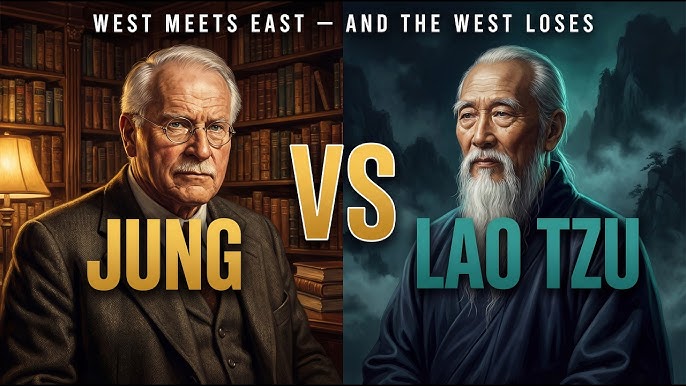
In 1929, Carl Jung — the most daring psychologist who ever lived — read a slim ancient scroll. Eighty-one poems.
Written by a man who may not have existed. And quietly admitted that an anonymous Chinese philosopher had understood the deepest truth about the human mind twenty-five centuries before he did. This is the story of what happened when the most sophisticated theory of the mind ever built in the West collided with the Tao Te Ching — and what that collision reveals about how you think, how you suffer, and how you might stop.
📚 SOURCES & FURTHER READING Everything in this video is grounded in documented history. Here are the primary sources: ▸ Jung, C.G. — Memories, Dreams, Reflections (1962) Vintage Books. Jung’s own account of his encounter with Eastern thought, the building of Bollingen Tower, and his admission about dreams near the end of his life. The single most important primary source for this video. ▸ Wilhelm, R. & Jung, C.G. — The Secret of the Golden Flower: A Chinese Book of Life (1931) Kegan Paul / Harcourt Brace. The Taoist inner alchemy text that confirmed for Jung what his patients were already doing. Jung’s commentary is the document where he essentially said: the East got there first. Available via archive.org. ▸ Jung, C.G. — Psychological Types, Collected Works Vol. 6 (1921) Princeton University Press. Contains Jung’s first serious written engagement with the Tao Te Ching, including direct quotations from Lao Tzu and his analysis of Tao as the “irrational third” beyond opposites. ▸ Jung, C.G. — The Transcendent Function, Collected Works Vol. 8 (1916/1957) Princeton University Press. The paper where Jung articulated the deepest goal of his method — the capacity to hold opposites without collapsing — the same thing the Taoist text described more simply. ▸ Bollingen Tower — Wikipedia & Historical Records Construction began 1923, continued for decades. Built by hand with local stonemasons. No electricity or telephone initially. Source: en.wikipedia.org/wiki/Bollingen_Tower ▸ The Secret of the Golden Flower — Wikipedia Full history of the text, its origins, Wilhelm’s translation, and Jung’s commentary. Source: en.wikipedia.org/wiki/The_Secret_of_the_Golden_Flower ▸ Karcher, S. — “Jung, the Tao, and the Classic of Change” Journal of Religion and Health, Vol. 38, No. 4 (1999). Academic analysis of how Taoism and the I Ching shaped Jung’s core psychological concepts including synchronicity and the Self. ▸ Zhu, C.J. — Commentary on Jung’s comparison of Eastern meditation with the Western unconscious Journal of Analytical Psychology (2009).
Includes the scholarly debate on where Jung’s interpretation of Taoist texts was accurate and where it overreached — the honest nuance behind the story. ▸ Graham Pemberton — “The Ideas of Carl Jung in Relation to Taoism” Medium / published research, 2023. Accessible overview of Jung’s relationship with Richard Wilhelm and the two Taoist texts they collaborated on. Source: graham-pemberton.medium.com ▸ Lao Tzu — Tao Te Ching (c. 4th century BCE) Multiple translations available. Recommended translations for English readers: Stephen Mitchell (poetic), Ursula K. Le Guin (literary), D.C. Lau (scholarly).
🔔 Subscribe for weekly deep dives into forgotten Taoist figures, untold stories, and ancient wisdom made urgent for modern life. Ancient wisdom. Forgotten stories. Modern clarity.
Content, illustrations, and third-party video appearing on GEORGIANBAYNEWS.COM may be generated or curated with AI assistance or reproduced pursuant to the fair dealing provisions of the Copyright Act, R.S.C. 1985, c. C-42. Attribution and hyperlinks to original sources are provided in acknowledgment of applicable intellectual property rights. Such referencing is intended to direct traffic to and support the original rights holders’ platforms.