




















Hudson’s Bay Pension Surplus Legal Battle: What Former Employees Need to Know About the Landmark Case
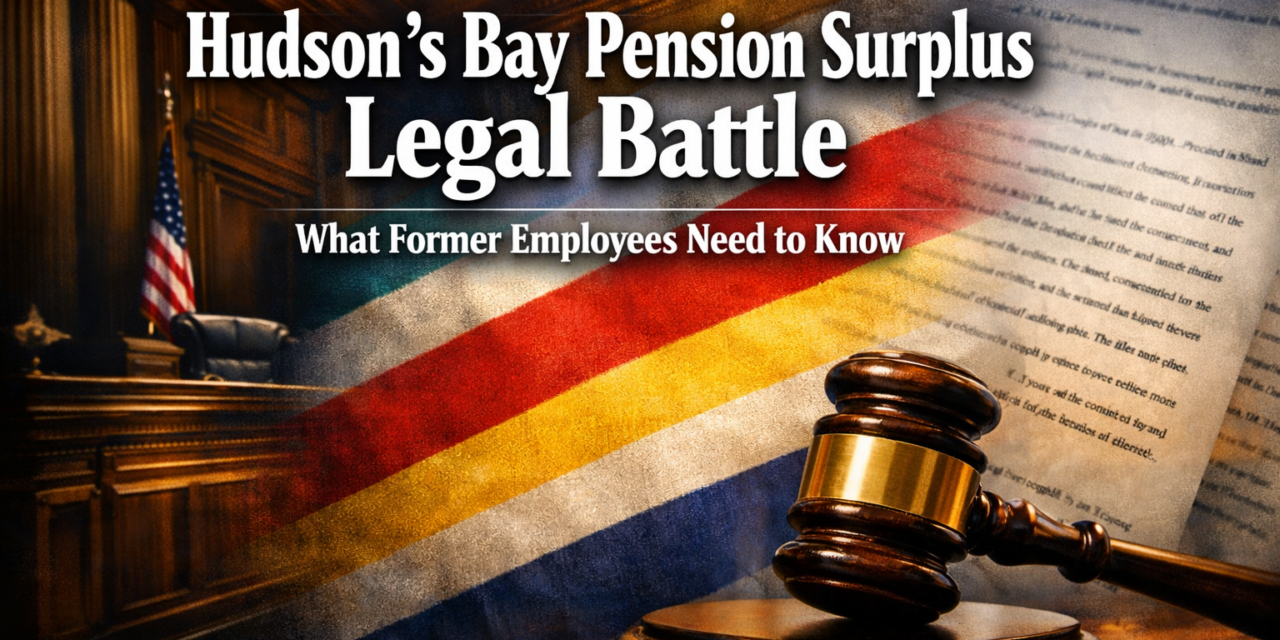
A $180 million windfall sits in a pension fund — and two sides are fighting over every dollar. On one side: thousands of former Hudson’s Bay Company employees who spent years, sometimes decades, building their careers at Canada’s oldest retailer. On the other: creditors owed a share of the company’s staggering $1.1 billion debt [2]. The Hudson’s Bay pension surplus legal battle: what former employees need to know about the landmark case is shaping up to be one of the most significant pension disputes in Canadian corporate history, with a court hearing expected before the June 30, 2026 deadline [2].
This isn’t just a legal technicality. It’s a fight that could set a precedent for how pension surpluses are handled in future corporate insolvencies across Canada — and it directly affects the retirement security of real people.
Key Takeaways 📌
- A roughly $180 million surplus exists in Hudson’s Bay’s wound-up pension plan, sparking a major legal dispute between former employees and corporate creditors [1].
- Ontario’s Superior Court has extended Hudson’s Bay’s creditor protection until June 30, 2026, partly to prepare for a dedicated pension surplus hearing [2].
- Judge Jessica Kimmel is presiding over the case, and earlier CCAA rulings may heavily influence the outcome [2][3].
- Hardship funds are currently being distributed to former staff during the restructuring process [2].
- The ruling could set a national precedent for how pension surpluses are treated in Canadian corporate bankruptcies.
The Background: How Hudson’s Bay Got Here

Hudson’s Bay Company, founded in 1670, is often called the oldest commercial corporation in North America. But heritage alone couldn’t save it from modern retail pressures. Approximately one year before March 2026, the company filed for protection under the Companies’ Creditors Arrangement Act (CCAA) carrying a crushing $1.1 billion in debt [2].
The CCAA filing triggered a cascade of consequences. Stores closed. Employees lost their jobs. And the company began liquidating assets — including an auction of 4,400 pieces of art and artifacts accumulated over centuries [2]. The collapse mirrors other corporate disasters where iconic brands failed to adapt to changing markets.
But buried within the wreckage was something unexpected: the company’s defined benefit pension plan had been overfunded. After all obligations to current and future pensioners were accounted for, roughly $180 million remained [1]. That surplus instantly became the most contested asset in the entire proceeding.
What Is a Pension Surplus — and Why Does It Matter?
A pension surplus occurs when a defined benefit pension plan holds more money than it needs to pay all promised benefits to retirees and former employees. Think of it as the “leftover” after every pension cheque has been guaranteed.
In normal times, a surplus might be quietly managed by the plan sponsor. But when a company enters insolvency, the question becomes urgent and adversarial:
“Who owns the extra money — the workers who contributed to the plan, or the creditors who are owed billions?”
This question sits at the heart of the Hudson’s Bay pension surplus legal battle: what former employees need to know about the landmark case is that the answer isn’t straightforward. Canadian law doesn’t provide a single, clear rule. Instead, courts must examine:
| Factor | What It Means |
|---|---|
| Plan documents | The original pension plan text may specify who gets surplus funds |
| Contribution history | Whether employees contributed their own money to the plan |
| Provincial pension law | Ontario’s Pension Benefits Act has specific surplus rules |
| Prior court rulings | Earlier CCAA decisions may guide the judge’s interpretation [3] |
| Trust law principles | Whether the surplus is held “in trust” for members |
The Two Sides of the Fight ⚖️
The Case for Former Employees
Former Hudson’s Bay workers argue that the pension surplus should flow back to plan members — the retirees and former employees who earned those benefits through years of service. Their position rests on several key arguments:
- Employee contributions helped build the fund
- Pension promises were part of their total compensation
- Provincial pension legislation often favors member entitlement to surplus on wind-up
- Workers already suffered job losses and deserve protection
For many of these individuals, the pension represents their primary retirement income. The stakes couldn’t be more personal. The broader economic pressures facing Canadian workers make this fight even more critical, as rising costs and economic uncertainty continue to squeeze household budgets.
The Case for Creditors
Creditors — including landlords, suppliers, and lenders — argue that the surplus is a company asset that should be available to satisfy Hudson’s Bay’s massive debts. Their reasoning includes:
- The employer was the plan sponsor and bore the investment risk
- Pension obligations have already been fully funded — members will receive every dollar they’re owed
- The surplus is “extra” and should be treated like any other corporate asset
- Creditors are owed $1.1 billion and have legitimate claims [2]
The Court Timeline: Key Dates and Developments 📅
Understanding the procedural timeline is essential for anyone following this case.
Here’s where things stand in 2026:
- ~Early 2025: Hudson’s Bay files for CCAA protection with $1.1 billion in debt [2]
- Ongoing: Asset liquidation proceeds, including art auctions and lease surrenders [2]
- March 2026: Original creditor protection deadline — extended by Judge Jessica Kimmel [2]
- Current: Hardship funds being distributed to former employees [2]
- Before June 30, 2026: A dedicated court hearing on the pension surplus is expected [2]
The extension to June 30, 2026 was specifically designed to give all parties time to prepare for the pension surplus hearing [2]. This signals that the court recognizes the complexity and importance of the issue.
Hudson’s Bay Pension Surplus Legal Battle: What Former Employees Need to Know About the Landmark Case Going Forward
How Prior Rulings Could Shape the Outcome
One of the most important factors in this dispute is the role of earlier CCAA and related court decisions. According to legal analysts, prior rulings in the Hudson’s Bay proceedings — and in similar Canadian insolvency cases — may significantly steer whether employees or creditors ultimately benefit from the $180 million surplus [3].
Canadian courts have dealt with pension surplus disputes before, notably in cases involving Nortel Networks and Indalex. These precedents established that the specific wording of pension plan documents, the nature of employee contributions, and the applicable provincial legislation all play critical roles.
For former Hudson’s Bay employees, the message is clear: the legal framework matters as much as the moral argument.
What Former Employees Should Do Right Now ✅
If you’re a former Hudson’s Bay employee or retiree affected by this case, here are concrete steps to take:
- Stay informed: Follow updates from the court-appointed monitor and official CCAA proceedings
- Review your pension statements: Understand your individual entitlements under the plan
- Connect with employee groups: Collective representation strengthens bargaining power
- Consult a pension lawyer: Individual legal advice can clarify your specific rights
- Apply for hardship funds: If eligible, these funds are being distributed during the restructuring [2]
- Document your employment history: Preserve records of your service years and contributions
The importance of community support during difficult transitions cannot be overstated. Former employees should lean on available resources.
The Bigger Picture: What This Means for Canadian Workers 🇨🇦
The Hudson’s Bay pension surplus case extends far beyond one company. It raises fundamental questions about worker protections in corporate insolvency.
Consider the broader implications:
- Precedent-setting: The ruling could influence how every future pension surplus dispute is handled in Canada
- Policy pressure: A decision favoring creditors could push lawmakers to strengthen pension protection legislation
- Retirement security: The case highlights the vulnerability of defined benefit pensions when employers fail
- Corporate accountability: It tests whether companies can effectively “claw back” pension surpluses through insolvency proceedings
As economic shifts continue to reshape industries, the question of how workers’ retirement savings are protected during corporate failures will only grow more urgent. The broader financial landscape shows that even the largest corporations face dramatic legal battles over money and obligations.
For communities like those in the Georgian Bay region — where many residents may have worked at Hudson’s Bay locations — the case hits close to home. Local economic development efforts become even more important when major employers disappear.
Conclusion
The Hudson’s Bay pension surplus legal battle: what former employees need to know about the landmark case comes down to a single, powerful question — when a company fails, who has the stronger claim to leftover pension money? The answer will affect thousands of lives and potentially reshape Canadian pension law.
Here’s what to do next:
- Monitor the June 30, 2026 deadline closely — the pension surplus hearing is expected before this date [2]
- Seek legal counsel if you’re a former employee with pension entitlements
- Join or support employee advocacy groups working on this issue
- Contact the court-appointed monitor for official updates on hardship fund distributions and surplus proceedings
The $180 million surplus represents more than money. It represents decades of work, trust in an employer, and the promise of a secure retirement. How the court rules will echo through Canadian pension law for years to come.
References
[1] An 180 Million Pension Surplus Triggers High Stakes Fight Over Windfall – https://insolvencyinsider.ca/p/an-180-million-pension-surplus-triggers-high-stakes-fight-over-windfall
[2] Hudson’s Bay Creditors Extension – https://globalnews.ca/news/11737864/hudsons-bay-creditors-extension/
[3] Benefits and Pensions Monitor – https://www.benefitsandpensionsmonitor.com/news/industry-news/an-180-million-pension-surplus-triggers-highstakes-fight-over-windfall/393266
[4] HC Mag – https://www.hcamag.com/ca/news/general/hudsons-bay-gets-extension-of-court-protection-from-creditors/569199
Content, illustrations, and third-party video appearing on GEORGIANBAYNEWS.COM may be generated or curated with AI assistance or reproduced pursuant to the fair dealing provisions of the Copyright Act, R.S.C. 1985, c. C-42. Attribution and hyperlinks to original sources are provided in acknowledgment of applicable intellectual property rights. Such referencing is intended to direct traffic to and support the original rights holders’ platforms.