










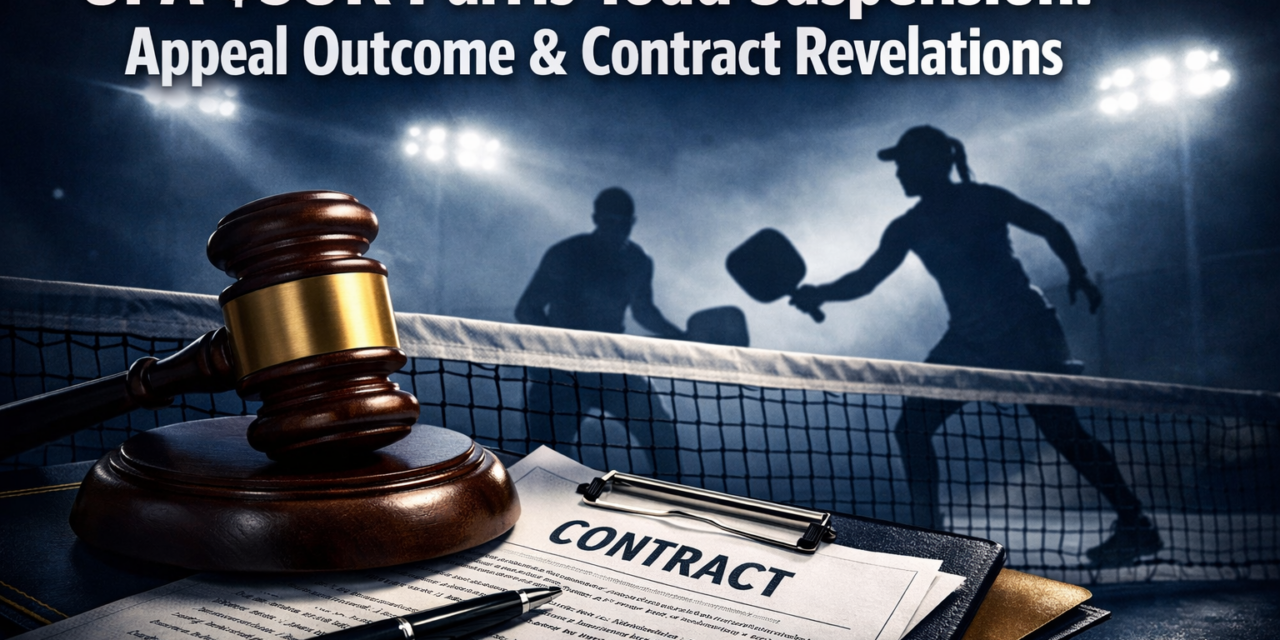
UPA $50K Parris Todd Suspension Update: Appeal Outcome, Player Contracts Revealed, and Future of Pro Tour Sanctions
Last updated: April 27, 2026
Quick Answer
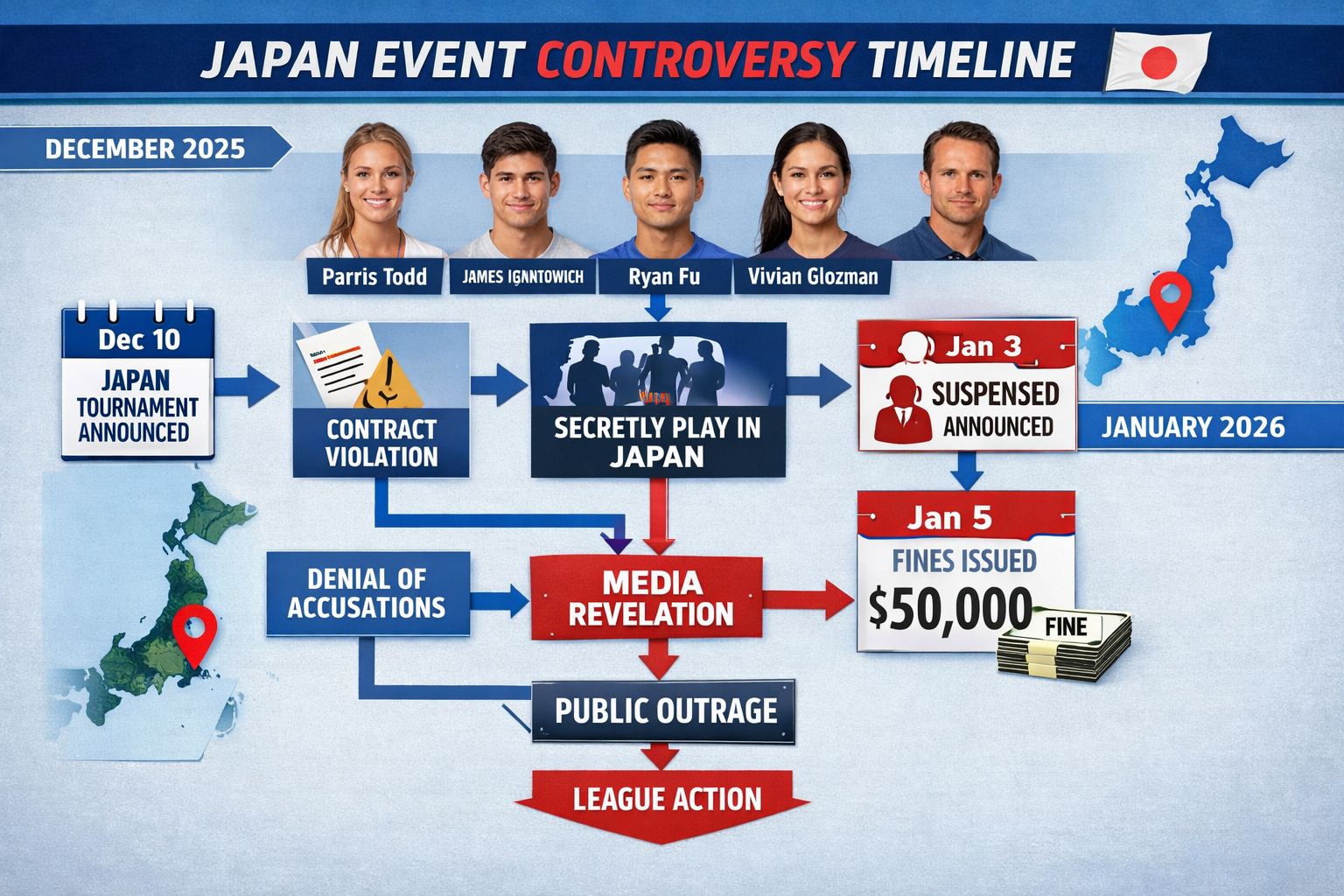
The UPA issued Parris Todd a $50,000 fine and two-event suspension for participating in unauthorized Japan events in December 2025, while three other players—James Ignatowich, Ryan Fu, and Vivian Glozman—had their contracts terminated entirely. Todd’s contract survived because she proactively requested permission beforehand, though the UPA claims she provided incomplete information. The players’ appeals were denied, and the UPA has maintained that participating in competitor events constitutes a “black-and-white violation” of player agreements, setting a precedent for how professional pickleball will handle unauthorized tournament participation moving forward.
Key Takeaways
- Parris Todd received a $50,000 fine and suspension from one PPA Tour event (January Masters) and one Major League Pickleball event (May season opener) for participating in unauthorized Japan events in December 2025[2]
- Three players—James Ignatowich, Ryan Fu, and Vivian Glozman—had their UPA contracts terminated for the same Japan event participation[1]
- Todd’s contract was not terminated because she requested permission in advance, though the UPA alleges she provided incomplete context[1]
- The players’ appeals were denied despite claims they received permission and weren’t compensated[2]
- UPA contracts remain confidential, but the organization confirmed that competitor event participation is a clear violation[2]
- Todd ceased involvement immediately after discovering discrepancies between her understanding and actual event activities[1]
- The incident establishes precedent for how professional pickleball tours will enforce exclusivity clauses and sanction unauthorized competitions
- No compensation defense failed—players argued they didn’t receive payment, but the UPA rejected this justification[1]
What Happened with Parris Todd’s Japan Event Participation?
Parris Todd participated in unauthorized pickleball events in Japan in early December 2025, which the UPA classified as unsanctioned competitor events. Unlike the three other players involved, Todd proactively contacted the UPA requesting permission before participating. However, the UPA determined that her request contained incomplete information about the nature of the events[1].
According to Todd’s statement, she “did not have all the details at the time” when making her permission request. When she discovered that certain activities didn’t align with her original submission, she “immediately ceased all involvement with the event and proactively contacted the UPA to report the discrepancy”[1].
Key differences in Todd’s case:
- She requested permission before participating (other players did not)
- She self-reported discrepancies when discovered
- Her contract was preserved (with penalties) rather than terminated
- She received a $50,000 fine plus two-event suspension instead of full contract termination
Common mistake to avoid: Assuming that requesting permission after the fact or claiming incomplete information will protect players from sanctions. The UPA’s response shows that even proactive communication doesn’t eliminate penalties when contract violations occur.
What Were the Specific Terms of Parris Todd’s Suspension?
The suspension specifically targets two high-profile events in the 2026 season. Todd is barred from competing in one PPA Tour event—the Masters tournament in January—and one Major League Pickleball event, specifically the first event of the 2026 season scheduled for May[2].
Suspension breakdown:
- Financial penalty: $50,000 fine
- PPA Tour: Banned from January Masters event
- Major League Pickleball: Banned from May season opener
- Contract status: Remains intact (not terminated)
- Future eligibility: Can compete in other 2026 events after serving suspension
This targeted suspension approach differs significantly from the complete contract terminations issued to Ignatowich, Fu, and Glozman. The two-event suspension allows Todd to maintain her professional standing while serving as a clear deterrent against future violations.
Choose this interpretation if: You’re a player considering whether partial disclosure to the UPA provides any protection. The answer is that it reduces but doesn’t eliminate consequences.
Why Were Ignatowich, Fu, and Glozman’s Contracts Terminated?
James Ignatowich, Ryan Fu, and Vivian Glozman faced the harshest penalty—complete contract termination with the UPA—because they participated in the same Japan events without requesting advance permission[1]. The three players filed an appeal claiming their contracts didn’t prohibit participation since they:
- Did not receive financial compensation
- Did not promote a rival tour
- Did not compete in another league
The UPA denied their appeal, maintaining that the Japan events qualified as competitor events regardless of compensation status[2]. The players claim they requested and were granted permission to participate in clinics and exhibitions, but the UPA disputes this characterization of events[2].
Critical distinction: The UPA’s position is that competitor event participation violates contracts independent of whether players receive payment. This closes a potential loophole players might have exploited by participating in “free” or “promotional” events.
Edge case: What if players participate in recreational or charity events? The UPA hasn’t clarified where the line falls between sanctioned competition, unsanctioned competition, and casual play. This ambiguity could create future conflicts.
What Do UPA Player Contracts Actually Say About Competitor Events?
The UPA has stated that its contracts with players are confidential. However, a UPA representative confirmed that “participating in competitor events is a black-and-white violation of UPA agreements”[2]. This suggests contracts contain explicit exclusivity clauses prohibiting participation in events that compete with UPA-sanctioned tournaments.
What we know about contract terms:
- Contracts are confidential and not publicly available
- Competitor event participation is explicitly prohibited
- The prohibition applies regardless of compensation
- Permission requests must be made in advance with complete information
- Violations can result in fines, suspensions, or contract termination
What remains unclear:
- How “competitor event” is specifically defined
- Whether international events receive different treatment
- If clinics and exhibitions fall under the same restrictions
- What constitutes “complete information” in permission requests
- Whether graduated penalties exist based on violation severity
Decision rule: If you’re under UPA contract and considering any organized pickleball event outside the UPA/PPA/MLP ecosystem, request explicit written permission with full event details. Assumptions about what’s permitted can cost you your contract.
For context on how professional sports organizations handle contract disputes and governance issues, the appeal and contract enforcement processes in other professional contexts demonstrate similar confidentiality and enforcement patterns.
What Was the Appeal Process and Why Did It Fail?
Ignatowich, Fu, and Glozman filed a formal appeal with the UPA challenging their contract terminations. Their appeal centered on three main arguments:
- No compensation received: They claimed participation was unpaid, therefore not competitive
- No rival tour promotion: They argued they didn’t actively promote a competing league
- No league competition: They maintained the events were exhibitions, not league matches
The UPA denied the appeal without publicly disclosing the specific reasoning beyond reiterating that competitor event participation violates player agreements[2]. The denial suggests the UPA interprets contract violations based on the nature of events themselves rather than the financial arrangements or promotional activities surrounding them.
Why the appeal likely failed:
- UPA contracts apparently don’t include a compensation exception
- The organization defines “competitor events” broadly
- Permission claims were disputed or deemed insufficient
- Contract language favors the organization’s interpretation
Common mistake: Players assumed that unpaid participation or calling events “exhibitions” would provide legal protection. The UPA’s stance shows that event classification depends on the organization’s determination, not player characterization.
How Does This Compare to Other Professional Sports Contract Enforcement?
Professional pickleball’s approach to contract enforcement mirrors patterns in established sports leagues but with some unique characteristics:
| Aspect | Professional Pickleball (UPA) | Traditional Pro Sports |
|---|---|---|
| Contract confidentiality | Fully confidential | Often partially public |
| Competitor event restrictions | Strictly enforced | Standard in major leagues |
| Appeal process | Internal, limited transparency | Often includes arbitration |
| Graduated penalties | Varies (fine vs. termination) | Common with CBA guidelines |
| Compensation relevance | Deemed irrelevant | Usually irrelevant |
| Permission requests | Required in advance | Standard protocol |
The UPA’s hardline stance reflects an emerging professional sport protecting its market position. Unlike established leagues with players’ unions and collective bargaining agreements, professional pickleball currently lacks formal player representation in governance decisions.
Choose the UPA model if: You’re building a new professional sports league and want to maintain tight control over player participation in external events. The approach prioritizes league exclusivity over player autonomy.
Understanding how professional organizations handle governance and enforcement provides useful context for how emerging sports leagues establish authority and maintain competitive boundaries.
What Are the Implications for Future Pro Tour Sanctions?
The UPA $50K Parris Todd suspension update establishes several precedents for professional pickleball governance moving forward:
Enforcement precedents set:
- Proactive disclosure matters: Todd’s advance permission request resulted in contract preservation versus termination
- Incomplete information isn’t protection: Even with advance notice, penalties apply if information is incomplete
- Compensation is irrelevant: Unpaid participation doesn’t exempt players from contract violations
- Appeals face high bar: Player appeals will likely fail unless contract language is ambiguous
- International events aren’t exempt: Geographic location doesn’t create exceptions
Future implications for players:
- Increased caution about international event participation
- More detailed permission requests with comprehensive event information
- Potential formation of player advocacy groups or unions
- Greater scrutiny of contract terms before signing
- Possible negotiation for clearer competitor event definitions
Future implications for the UPA:
- Pressure to clarify what constitutes a “competitor event”
- Potential need for more transparent governance processes
- Risk of player backlash if enforcement seems arbitrary
- Opportunity to establish clear precedent for emerging sport
- Possible development of formal appeal procedures with third-party arbitration
Edge case to watch: What happens when established international pickleball organizations host events that compete with UPA timing? The Japan incident involved relatively small events, but conflicts with major international federations could force the UPA to reconsider its absolutist approach.
For insights into how professional sports organizations navigate complex governance challenges, examining successful enforcement models in other competitive contexts proves instructive.
What Should Professional Pickleball Players Do Now?
Professional players under UPA, PPA, or MLP contracts should take immediate action to protect their standing and avoid similar sanctions:
Immediate action steps:
- Request full contract review: Have a sports attorney review your contract’s competitor event clauses
- Document all permissions: Get written approval for any non-UPA event participation, including clinics
- Provide complete information: When requesting permission, include full event details, organizers, participants, and format
- Clarify ambiguous situations: If unsure whether an event qualifies as competitive, ask explicitly
- Keep communication records: Maintain email trails and written approvals for all permission requests
- Understand penalty structure: Know what violations result in fines versus suspension versus termination
- Consider collective representation: Explore forming player associations for contract negotiation leverage
Red flags that require permission requests:
- Any organized tournament outside UPA/PPA/MLP sanctioning
- International events with competitive formats
- Exhibition matches with other professional players
- Clinics at facilities hosting competitor tours
- Promotional appearances for non-UPA events
- Social media content featuring competitor leagues
When to seek legal counsel:
- Before signing any professional contract
- When receiving ambiguous permission responses
- If facing sanctions or contract disputes
- When considering international opportunities
- If forming player advocacy groups
The complex relationship between professional athletes and governing organizations demonstrates why players need clear understanding of their contractual obligations and enforcement mechanisms.
FAQ
How much was Parris Todd’s fine for the Japan events?
Parris Todd received a $50,000 fine from the UPA for participating in unauthorized Japan events in December 2025[2].
Which events is Parris Todd suspended from?
Todd is suspended from one PPA Tour event (the January Masters) and one Major League Pickleball event (the May 2026 season opener)[2].
Why wasn’t Parris Todd’s contract terminated like the other players?
Todd’s contract was preserved because she proactively requested permission before participating, unlike Ignatowich, Fu, and Glozman who did not seek advance approval[1].
Were the players’ appeals successful?
No, the UPA denied the appeals filed by Ignatowich, Fu, and Glozman despite their arguments about lack of compensation and permission claims[2].
Do UPA contracts prohibit unpaid event participation?
Yes, the UPA maintains that competitor event participation violates contracts regardless of whether players receive compensation[2].
Are UPA player contracts public?
No, the UPA states that its contracts with players are confidential, though it confirms competitor event participation is explicitly prohibited[2].
What did Parris Todd say about the incomplete information?
Todd stated she “did not have all the details at the time” of her permission request and ceased involvement immediately upon discovering discrepancies[1].
Can players participate in international pickleball events?
Only with explicit UPA permission. The Japan incident demonstrates that international location doesn’t exempt events from being classified as competitor activities.
What happens if players participate in charity pickleball events?
The UPA hasn’t clarified this scenario. Players should request explicit permission for any organized pickleball activity to avoid potential violations.
Will there be more sanctions in professional pickleball?
Likely yes. This precedent establishes the UPA’s enforcement approach, and players testing boundaries will probably face similar consequences.
Can players negotiate different contract terms with the UPA?
Potentially, especially established star players with negotiating leverage, though the UPA’s confidentiality policy makes it difficult to know what variations exist.
Is there a players’ union in professional pickleball?
Not currently. The lack of collective player representation may contribute to the UPA’s strong enforcement position and limited appeal options.
Conclusion
The UPA $50K Parris Todd suspension update represents a defining moment for professional pickleball governance. Todd’s $50,000 fine and two-event suspension—combined with the contract terminations of Ignatowich, Fu, and Glozman—establishes clear precedent: the UPA will enforce competitor event restrictions regardless of compensation, international location, or claimed permissions. The failed appeals demonstrate that player arguments about unpaid participation or exhibition formats won’t override explicit contract language.
For professional pickleball players, the message is unambiguous. Request written permission with complete event details before participating in any organized pickleball activity outside UPA sanctioning. Proactive disclosure matters—it saved Todd’s contract while the other three players lost theirs entirely—but incomplete information still results in substantial penalties.
The incident also highlights gaps in professional pickleball’s governance structure. Without transparent contract terms, formal arbitration processes, or collective player representation, athletes operate with limited clarity about what’s permitted and minimal recourse when disputes arise. As the sport continues professionalizing, pressure will mount for clearer definitions of “competitor events,” more transparent enforcement standards, and possibly player union formation.
Take action now: If you’re a professional pickleball player, schedule a contract review with a sports attorney, document all permission requests in writing, and connect with other players to discuss collective representation. For fans and industry observers, this case provides a window into how emerging professional sports establish governance frameworks—sometimes through high-profile enforcement actions that set lasting precedent.
The future of pro tour sanctions in pickleball will be shaped by how players, organizations, and the broader community respond to these initial enforcement actions. The UPA has drawn its line; now players must decide whether to accept these terms or push for more balanced governance structures.
References
[1] Pickleballheadlines – https://blog.trackithub.com/pickleballheadlines/
[2] Parris Todd Fined Suspended Upa Ppa Tour Major League Pickleball – https://thekitchenpickle.com/blogs/news/parris-todd-fined-suspended-upa-ppa-tour-major-league-pickleball
Content, illustrations, and third-party video appearing on GEORGIANBAYNEWS.COM may be generated or curated with AI assistance or reproduced pursuant to the fair dealing provisions of the Copyright Act, R.S.C. 1985, c. C-42. Attribution and hyperlinks to original sources are provided in acknowledgment of applicable intellectual property rights. Such referencing is intended to direct traffic to and support the original rights holders’ platforms.