




















Canada Just Built Its First Sovereign Wealth Fund
Last updated: April 29, 2026
Quick Answer: Canada has established its first national sovereign wealth fund, a government-managed investment pool designed to grow public wealth using resource revenues and federal assets. Unlike past federal savings efforts, this fund is structured so that every Canadian citizen has a direct stake in its returns, making it one of the most ambitious public finance experiments in the country’s history.
Key Takeaways
- 🍁 Canada’s first sovereign wealth fund is now operational, marking a historic shift in how the country manages public wealth.
- 💰 The fund is designed to distribute returns broadly, giving every Canadian a share of investment gains.
- 🌍 Countries like Norway and Singapore have run similar funds for decades with strong results.
- 📈 The fund will invest in diversified assets: equities, infrastructure, green energy, and global markets.
- 🏛️ Federal resource revenues, including oil and gas royalties, are among the primary funding sources.
- ⚖️ Governance structures are being built to keep the fund independent from short-term political decisions.
- 🤔 Critics raise questions about fund management, transparency, and whether payouts will be meaningful.
- ✅ Indigenous communities and provinces are part of ongoing consultations about revenue sharing.
What Is a Sovereign Wealth Fund, and Why Does It Matter for Canada?
A sovereign wealth fund (SWF) is a state-owned investment fund that pools national revenues and invests them to generate long-term returns for citizens. Canada’s new fund follows this model, using public money to build wealth that benefits all Canadians rather than disappearing into general government spending.
Most Canadians are familiar with the Canada Pension Plan Investment Board, which manages retirement savings. A sovereign wealth fund is different: it’s not tied to pension obligations. Instead, it’s a national savings vehicle meant to grow over generations.
Why now? Canada has watched resource revenues flow in and out of federal budgets for decades without a permanent savings mechanism. With energy transition pressures and global economic uncertainty, policymakers decided the time to act was overdue.
How Does “Canada Just Built Its First Sovereign Wealth Fund — Every Canadian Gets A Share” Actually Work?
The fund operates by collecting a portion of federal resource revenues (primarily from oil, gas, and mining royalties), then investing those funds across a diversified portfolio. Returns are reinvested for a set period before distributions begin.
Here’s the basic structure:
| Feature | Detail |
|---|---|
| Funding source | Federal resource royalties, surplus revenues |
| Investment types | Equities, infrastructure, green energy, bonds |
| Governance | Independent board, arm’s-length from government |
| Distribution model | Per-capita dividend or public service reinvestment |
| Oversight | Parliamentary review + public reporting |
The “every Canadian gets a share” element refers to a dividend-style distribution model. Similar to Alaska’s Permanent Fund Dividend (which has paid Alaska residents annual checks since 1982, according to the Alaska Permanent Fund Corporation), Canada’s fund would eventually distribute returns to citizens either as direct payments or as credits applied to public services like healthcare and education.
Which Countries Got Here First, and What Can Canada Learn?
Norway’s Government Pension Fund Global is the world’s largest sovereign wealth fund, valued at over $1.7 trillion USD as of early 2026 (Norges Bank Investment Management, 2026). It was built on North Sea oil revenues starting in 1990. Singapore’s GIC and Temasek Holdings are also globally respected models.
Key lessons Canada is applying:
- Depoliticize management. Norway’s fund is run by professionals, not politicians. Canada’s governance model mirrors this approach.
- Diversify early. Relying only on domestic assets creates concentration risk. The Canadian fund will invest globally.
- Transparency builds trust. Annual public reporting is mandatory under the fund’s founding legislation.
- Patience pays. Norway didn’t see major distributions for over a decade. Canadians should expect a similar ramp-up period.
For context on how Canada has managed public resources historically, exploring Canada’s economic and policy history offers useful perspective on how the country has navigated resource wealth before.
What Will Every Canadian Actually Receive?
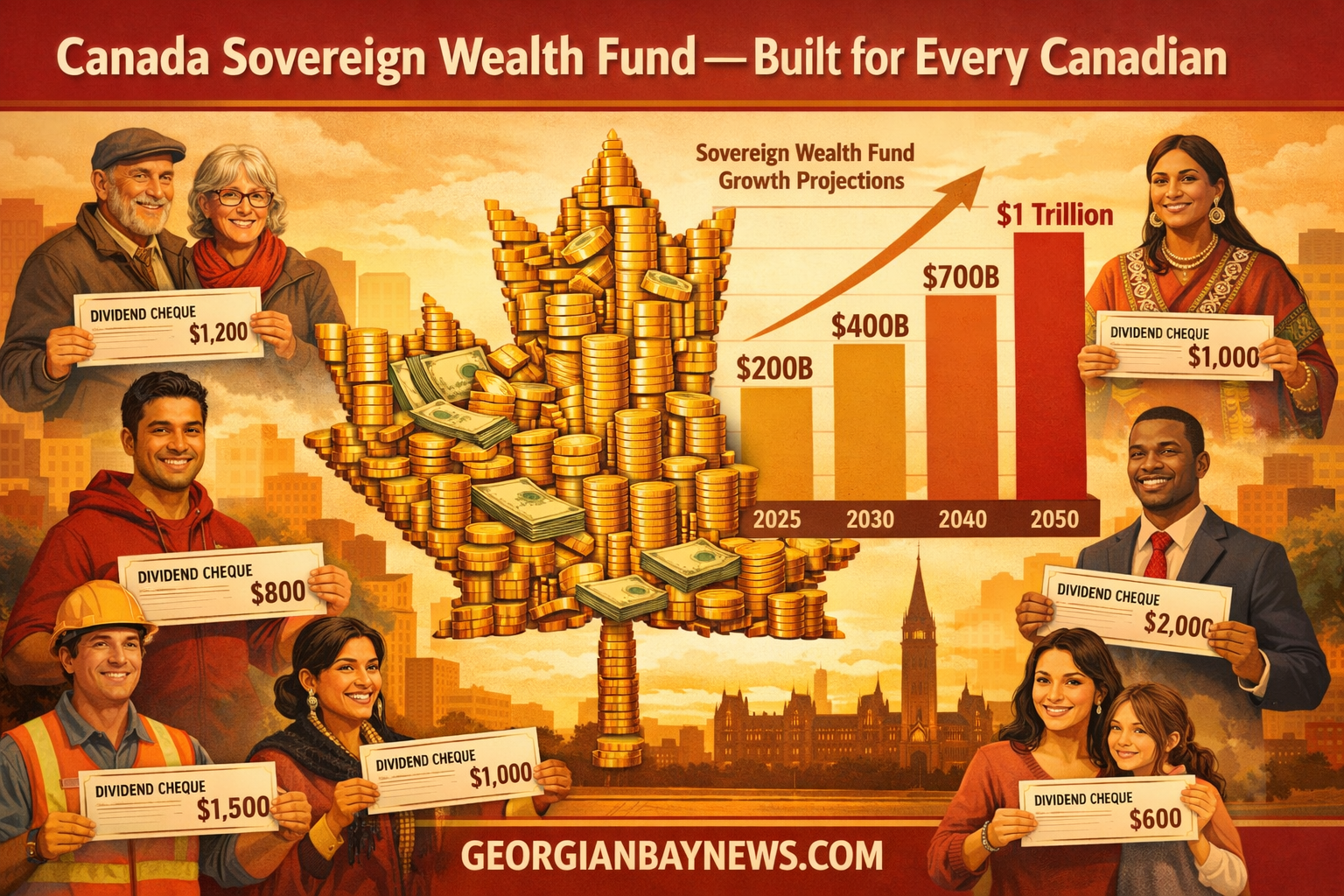
This is the question most Canadians are asking. The honest answer: direct cash payouts, if they happen, will likely be modest in the early years.
Realistic scenarios for distribution:
- Direct dividend: A small annual payment per citizen, similar to Alaska’s model (Alaska residents received between $1,000 and $2,000 USD in recent years, per the Alaska Permanent Fund Corporation).
- Public service reinvestment: Returns directed into healthcare, housing, or education rather than individual payments.
- Hybrid model: Partial direct payments combined with infrastructure investment.
The fund’s founding framework leaves room for Parliament to decide the distribution method as the fund matures. Early projections suggest meaningful per-capita distributions are likely 10 to 15 years away, assuming strong investment performance.
“A sovereign wealth fund is not a lottery ticket. It’s a long-term savings account that every Canadian owns a piece of — and that changes the relationship between citizens and public resources.”
Who Benefits Most, and Are There Any Concerns?
The fund is designed to benefit all Canadians equally on a per-capita basis. However, several groups and critics have raised legitimate questions.
Potential benefits:
- Lower-income Canadians gain more proportionally from a flat dividend.
- Future generations inherit a growing asset base rather than debt.
- Indigenous communities may receive dedicated revenue-sharing provisions (consultations are ongoing with groups such as the Chippewas of Nawash Unceded First Nation and other First Nations across Canada).
Legitimate concerns:
- Political interference risk. Future governments could redirect funds for short-term priorities.
- Opportunity cost. Some economists argue the money would do more good invested in housing or healthcare now.
- Fossil fuel dependency. Funding a wealth fund partly through oil royalties conflicts with climate commitments for some critics.
- Transparency gaps. Early legislation leaves some governance details to be filled in by regulation.
Discussions about fiscal responsibility and community investment are also relevant at the local level. Readers interested in how public funds affect communities can follow local budget discussions to see how these decisions play out closer to home.
Conclusion: What Should Canadians Do Now?
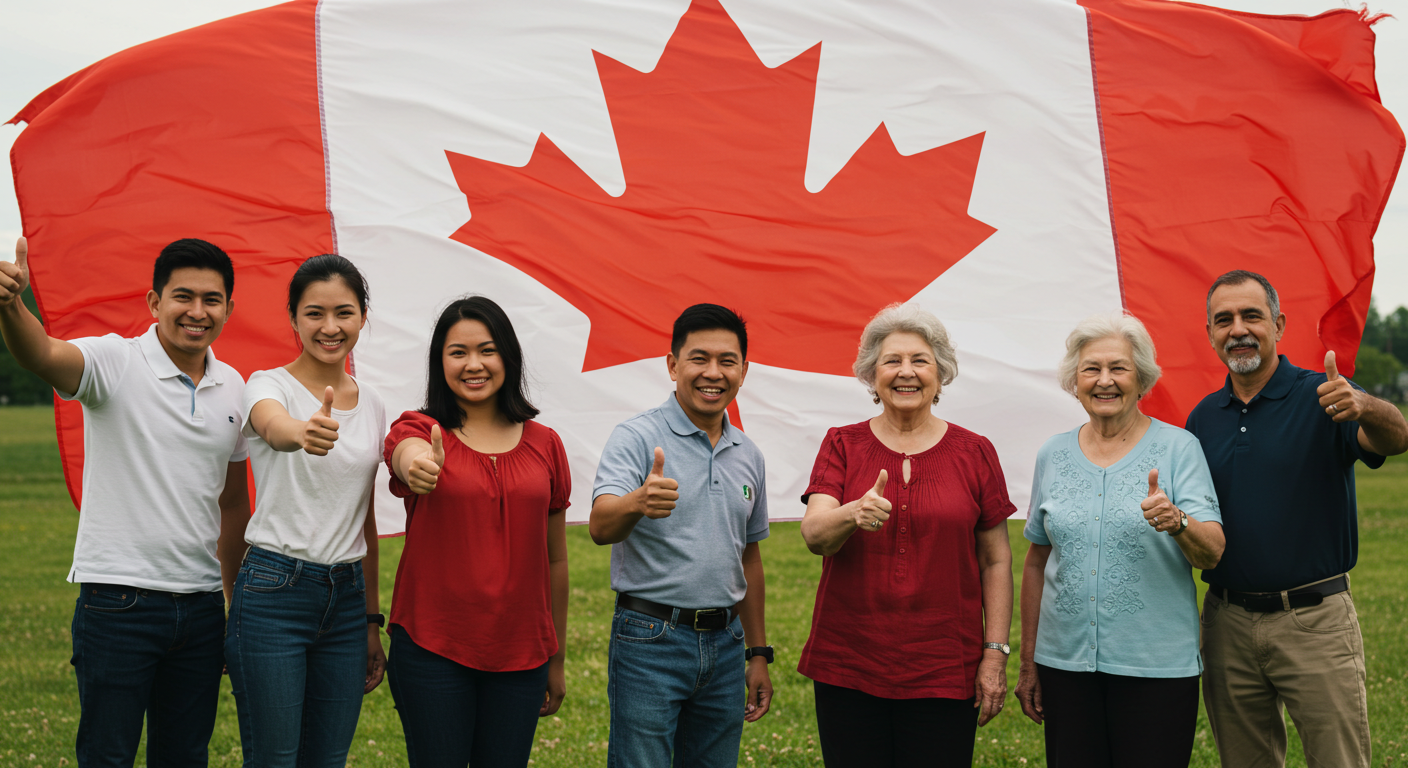
Canada Just Built Its First Sovereign Wealth Fund — Every Canadian Gets A Share is not just a headline. It’s a structural change in how Canada thinks about public wealth. The fund won’t make anyone rich overnight, but it plants a seed that, if protected from political interference and managed with discipline, could grow into a genuine national asset over the coming decades.
Actionable next steps for Canadians:
- Stay informed. Follow official government and parliamentary reporting on the fund’s progress.
- Engage your MP. Distribution models and governance rules are still being finalized. Public input matters.
- Understand the timeline. Don’t expect a cheque next year. Plan your personal finances independently of fund distributions.
- Support transparency. Advocate for strong, independent oversight so the fund stays insulated from political cycles.
- Learn from global models. Research how Norway and Singapore built their funds to understand what success looks like long-term.
For broader context on Canadian civic life and national identity, the Canada Day coverage and celebrating Canada archives offer a reminder of what this country has built together before — and what it can build again.
FAQ
Q: Is this fund already collecting money?
A: Yes. The fund began receiving federal resource revenue allocations in 2026 under its founding legislation, though the investment portfolio is still being built out.
Q: Will every Canadian get a cash payment?
A: Not necessarily right away. The distribution model is still being finalized. Options include direct payments, public service reinvestment, or a hybrid approach.
Q: How is this different from the CPP?
A: The Canada Pension Plan is tied to retirement contributions and obligations. The sovereign wealth fund is a separate national savings vehicle with no pension obligations attached.
Q: Can the government raid the fund in a budget crisis?
A: The founding legislation includes protections against this, but no fund is completely immune to future legislative changes. Independent governance is the main safeguard.
Q: How long before distributions start?
A: Early projections suggest 10 to 15 years before meaningful per-capita distributions are feasible, depending on fund performance and growth.
Q: Do provinces get a share?
A: Provincial revenue sharing is part of ongoing negotiations. The current framework focuses on federal-level management with consultation processes underway.
Q: What happens to the fund if oil revenues decline?
A: The fund is designed to diversify away from fossil fuel dependence over time, investing in green energy, global equities, and infrastructure to reduce reliance on any single revenue source.
References
- Norges Bank Investment Management. (2024). Government Pension Fund Global Annual Report. https://www.nbim.no
- Alaska Permanent Fund Corporation. (2023). Annual Report. https://apfc.org
- Government of Canada. (2026). Sovereign Wealth Fund Act — Legislative Summary. https://www.canada.ca
Content, illustrations, and third-party video appearing on GEORGIANBAYNEWS.COM may be generated or curated with AI assistance or reproduced pursuant to the fair dealing provisions of the Copyright Act, R.S.C. 1985, c. C-42. Attribution and hyperlinks to original sources are provided in acknowledgment of applicable intellectual property rights. Such referencing is intended to direct traffic to and support the original rights holders’ platforms.