

















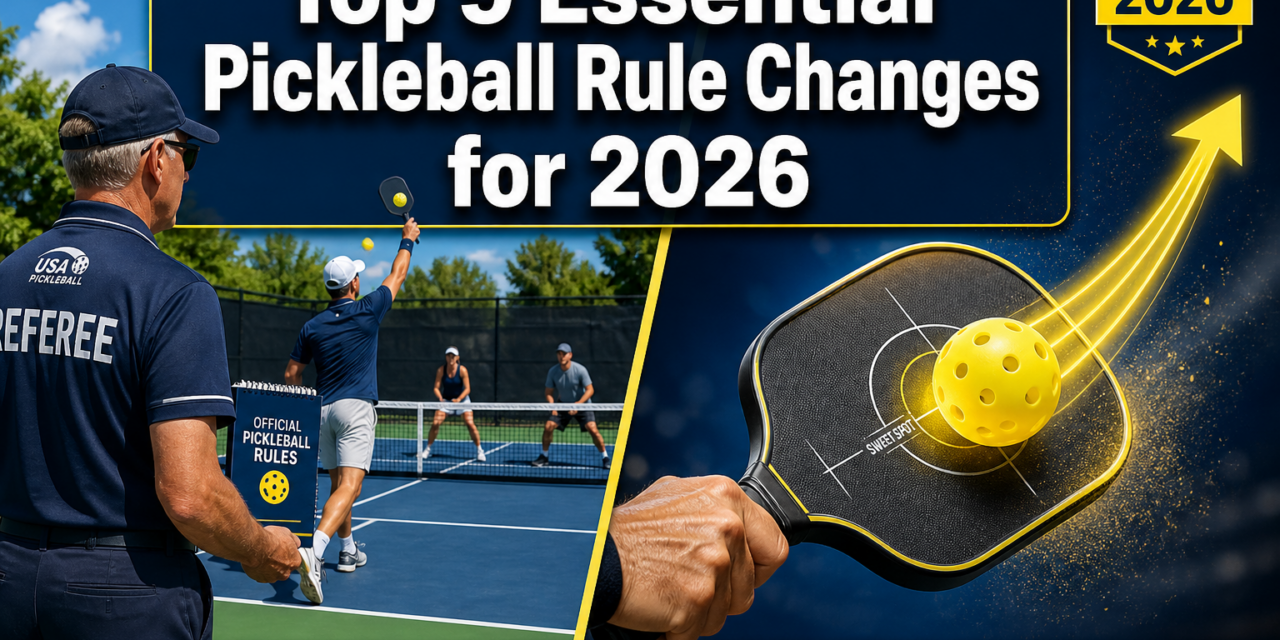
Top 9 Essential Pickleball Rule Changes for 2026: Serve, Shot, and Strategy Impacts Explained
Last updated: May 3, 2026
Quick Answer
The 2026 USA Pickleball rulebook introduces nine critical changes that reshape competitive play, including elimination of the rally-scoring freeze at match point, stricter immediate line-call requirements, tightened serve mechanics enforcement, and expanded referee authority. These updates favor aggressive players who can exploit new post-strike scoring opportunities while demanding faster decision-making from defensive specialists. Both recreational and tournament players must adapt their serve technique, line-call timing, and match-point strategies to stay competitive under the updated regulations.
Key Takeaways
- Match point freeze eliminated: Players can now win on either serve or receive at match point, ending prolonged stalemates[4]
- Line calls must be immediate: Calling a ball out after your opponent contacts it results in losing the point[1][4]
- Serve mechanics tightened: Paddle head must be clearly below wrist at contact with visible upward arc[1][5]
- Post strikes now count: Balls hitting the net post after bouncing on opponent’s side win you the point[1][2]
- Catch/carry enforcement stricter: Referee discretion removed for unintentional control violations[3]
- Spectator input banned: Players cannot ask spectators for line-call help without penalty[4]
- Referee authority expanded: Officials can issue warnings during warm-ups before match starts[4]
- 10-second serve rule continues: Maintains fast game pace from previous years[3]
- Spin serve remains prohibited: No changes to the ban on adding spin during serve[3]

What Are the Most Game-Changing Pickleball Rule Updates for 2026?
The most impactful changes center on timing, serve mechanics, and scoring finality. The elimination of the rally-scoring “freeze” at match point means games end faster and more decisively—you no longer need to be serving to clinch victory[4]. This single change prevents the frustrating back-and-forth side-outs that could extend close matches by 10-15 minutes.
The immediate line-call requirement fundamentally changes defensive strategy. Players must commit to out calls before their opponent strikes the ball[1][4]. Waiting to see if your partner can return it before calling out now results in an automatic point loss. This rule punishes hesitation and rewards confident, quick decision-making at the baseline.
Key strategic impacts:
- Aggressive players benefit: Faster match conclusions favor players who can maintain offensive pressure
- Defensive specialists must adapt: No more “wait and see” on borderline line calls
- Communication becomes critical: Doubles teams need clear, instant call protocols
- Mental game intensifies: Players face more pressure to make split-second judgment calls
Choose aggressive tactics if you can consistently force opponents into making quick line decisions. Stick with defensive play only if your team has exceptional court coverage and communication systems already in place.
How Do the 2026 Serve Rule Changes Affect Your Game?
The 2026 serve rules tighten enforcement on paddle position and ball trajectory without fundamentally changing legal serve mechanics. The paddle head must be clearly below the wrist joint at contact, and the serve must follow a visible upward arc[1][5]. While these requirements existed previously, the 2026 rulebook removes gray areas and strengthens referee discretion to call illegal serves.
Practical serve checklist for 2026:
- Paddle position: Keep paddle face pointing down at contact, entire head below wrist
- Ball trajectory: Create obvious upward arc from contact point to apex
- Contact point: Strike ball below waist level (navel height maximum)
- Foot position: At least one foot behind baseline, no contact with court until after strike
- Motion: Single continuous upward swing, no stopping or double-motion
Common mistake: Players with flat or drive serves may struggle with the “clear upward arc” requirement. If your serve barely clears the net with minimal arc, expect more illegal serve calls in 2026. Adjust by contacting the ball slightly lower and increasing your upward swing angle by 10-15 degrees.
The spin serve prohibition continues unchanged—no hand spin, no paddle spin, no exceptions[3]. Players coming from tennis backgrounds must completely eliminate topspin or slice motion from their serve routine.
What Is the New Post Strike Rule and How Do You Use It?
When a ball bounces on your opponent’s side of the court and then contacts the net post (or post system), you win the point[1][2]. This reverses previous rules where any post contact ended the rally regardless of where the ball bounced first. The change creates new tactical opportunities, particularly for players who can execute sharp-angle backspin returns.
Strategic applications:
- Target the post intentionally: Advanced players can aim cross-court returns toward the post area for unexpected winners
- Backspin returns: Balls with heavy backspin that bounce short and wide have higher post-contact probability
- Third-shot drops: Drops that land near the sideline and drift toward the post now carry winning potential
- Risk-reward calculation: Attempting post shots carries lower risk since contact after opponent’s bounce wins the point
Edge case: If the ball hits the post before bouncing on your opponent’s side, the rally ends and you lose the point (this rule remains unchanged). The winning post strike only applies after the ball has legally bounced in your opponent’s court.
Choose post-targeting shots when your opponent is pulled wide and the angle allows for post contact after the bounce. Avoid this tactic on serves or when you’re out of position, as mistiming results in easy point losses.
How Does the Immediate Line Call Rule Change Your Strategy?
Players must call a ball out before their opponent makes contact with the next shot, or the ball is automatically ruled in[1][4]. This eliminates the common recreational practice of waiting to see if your partner can keep the rally alive before making an out call. Delayed calls now result in losing the point.
Implementation for doubles teams:
- Assign line responsibility: Each player owns specific lines (baseline vs. sideline)
- Use clear verbal calls: Shout “out” immediately and loudly enough for opponents to hear
- No hesitation allowed: Make the call within 0.5 seconds of ball landing
- Trust your partner: If they don’t call it out, play the ball as in
- When uncertain, play it: Borderline balls should be played rather than called out late
Common mistake: Players who habitually track the ball after it passes them will struggle with this rule. The ball moves too fast to watch it land, look up at your partner’s position, assess if they can return it, then call it out. By that time, your opponent has already struck the ball and your call is invalid.
Drill for improvement: Practice “instant call” drills where a coach or partner feeds balls to various court positions while you call out/in within one second of landing. Record your accuracy rate and work toward 90%+ correct immediate calls.
This rule heavily favors players with excellent court vision and spatial awareness. If you struggle with line judgment, consider positioning yourself slightly deeper to give more reaction time for borderline balls.
What Changes to Catch and Carry Enforcement Should You Know?
Referee discretion for unintentional catch or carry violations has been removed, making enforcement more strict and consistent[3]. A catch occurs when the ball visibly comes to rest on your paddle during contact. A carry happens when the ball stays on your paddle while you move the paddle through space.
What this means in practice:
- Soft hands penalized: Extremely soft dinks or resets with prolonged paddle contact will draw more calls
- Topspin technique matters: Rolling the paddle over the ball increases catch/carry risk
- Paddle texture irrelevant: Even unintentional catches caused by paddle surface texture result in faults
- Video review unchanged: In tournaments with video review, slow-motion footage determines violations
Adjust your technique if:
- Your dinks frequently make a “thud” sound rather than a “pop” (indicates longer contact time)
- You use extreme paddle angles (greater than 45 degrees from vertical) on soft shots
- You “guide” the ball with paddle movement during contact rather than striking cleanly
Choose firmer contact on touch shots near the net. Defensive players who rely on ultra-soft resets may need to add slightly more pace to avoid catch violations under stricter 2026 enforcement.
How Do Spectator and Referee Authority Rules Impact Tournament Play?
Players cannot solicit help from spectators on line calls, and violations result in warnings or technical fouls[4]. This rule primarily affects tournament play where spectators often have better viewing angles than players or referees. Asking “Was that out?” to the crowd now carries penalties.
Referees gained expanded authority to issue warnings or technical fouls before matches begin, including during warm-up periods[4]. This change addresses unsportsmanlike conduct, equipment violations, or disruptive behavior that previously went unaddressed until official match start.
Tournament implications:
- Pre-match conduct matters: Arguing about court assignments or warm-up time can result in technical fouls before first serve
- Line call disputes limited: Players must accept referee decisions without crowd consultation
- Sportsmanship emphasis: Officials have more tools to enforce respectful behavior throughout event
- Warm-up violations: Using illegal paddles or practicing prohibited shots during warm-up carries penalties
For recreational play: These rules rarely apply unless you’re in sanctioned tournaments with certified referees. However, adopting the “no spectator input” standard improves sportsmanship and self-reliance in club play.
What Rules Remain Unchanged from Previous Years?
Two significant rules continue without modification in 2026. The 10-second serve rule maintains game pace by requiring players to serve within 10 seconds after the score is called[3]. This prevents stalling tactics and keeps recreational games moving efficiently.
The spin serve prohibition remains fully in effect—players cannot apply spin to the ball with their hand or paddle during the serve motion[3]. This ban, introduced in previous years, prevents the extreme spin serves that gave some players unfair advantages.
Why these rules didn’t change:
- 10-second rule: Successfully speeds up play without negative impacts
- Spin serve ban: Achieved its goal of leveling the playing field for recreational players
- No complaints: Minimal pushback from players or officials on either rule
Understanding what didn’t change helps players focus practice time on actual rule adjustments rather than relearning already-established regulations.
How Should Aggressive vs. Defensive Players Adapt to 2026 Rules?
The 2026 rule changes create distinct advantages and challenges for different playing styles. Aggressive, offensive-minded players gain more opportunities to close out points and matches quickly, while defensive specialists must sharpen their decision-making speed.
Aggressive player advantages:
- Match point pressure: Can win on receive, maintaining offensive momentum to finish[4]
- Post strike opportunities: Intentional post targeting adds new winner options[1][2]
- Opponent hesitation: Stricter line-call timing forces defensive players into rushed decisions[1]
- Faster match conclusions: Less time for defensive players to mount comebacks
Defensive player challenges:
- Immediate call pressure: Must decide out/in instantly without seeing partner’s positioning[1][4]
- Catch/carry risk: Soft touch shots face stricter enforcement[3]
- Less stalling time: 10-second serve rule continues limiting reset time[3]
- Match point vulnerability: Can’t extend matches through side-out strategies[4]
Adaptation strategies by style:
For aggressive players: Practice post-targeting drills, develop faster serve routines to exploit the 10-second rule, and work on maintaining offensive pressure at match point regardless of serve/receive status.
For defensive players: Train immediate line-call recognition, firm up touch shots to avoid catch violations, improve offensive capabilities for match point situations, and develop better court coverage to compensate for instant-call requirements.
Choose your adaptation focus based on which rule changes most directly impact your current weaknesses. Defensive players should prioritize line-call speed training, while aggressive players benefit most from post-strike angle practice.
What Drills Help You Master the 2026 Rule Changes?
Specific practice routines accelerate adaptation to the new regulations. These drills target the skills most affected by 2026 rule updates.
1. Instant Line Call Drill
- Partner feeds balls to various court positions
- Call out/in within one second of landing
- Track accuracy rate, aim for 90%+ correct calls
- Focus on borderline balls 1-3 inches from lines
2. Legal Serve Mechanics Check
- Video record serves from side angle
- Verify paddle head below wrist at contact
- Measure upward arc angle (should be 15-25 degrees minimum)
- Practice 50 serves per session with form focus
3. Post Strike Target Practice
- Set up cones 6 inches from net posts
- Practice cross-court returns aiming for post contact after bounce
- Use backspin to increase post-strike probability
- Track successful post contacts per 20 attempts
4. Match Point Pressure Simulation
- Play games to 11, but practice receiving at match point
- Develop offensive return strategies when receiving at 10-10
- Build confidence in closing matches without serving
5. Catch/Carry Contact Drill
- Practice dinks with firmer contact (shorter contact time)
- Record sound of paddle contact (should be crisp “pop”)
- Reduce paddle angle on soft shots to below 30 degrees
- Partner watches for visible ball pause on paddle face
Dedicate 15-20 minutes per practice session to rule-specific drills during the first two months of 2026. Once the adjustments become automatic, reduce drill time to 5-10 minutes for maintenance.
FAQ
Can I still win at match point if I’m receiving serve in 2026?
Yes. The rally-scoring freeze has been eliminated, so you can win the match whether serving or receiving at match point[4]. This prevents extended side-out battles that previously prolonged close games.
What happens if I call a ball out after my opponent hits it?
You lose the point. The 2026 rules require immediate out calls before your opponent makes contact with the ball[1][4]. Delayed calls are treated as if you never called the ball out.
How far below my wrist does the paddle need to be when serving?
The entire paddle head must be clearly below your wrist joint at the moment of contact[1][5]. Even partial overlap between paddle top and wrist bottom may be called illegal. Keep a visible gap of 1-2 inches for safety.
Do post strikes always win the point now?
Only if the ball bounces on your opponent’s side first, then hits the post[1][2]. If the ball hits the post before bouncing in your opponent’s court, you lose the point (this rule remains unchanged from previous years).
Can referees give me a technical foul during warm-up?
Yes. Referees now have authority to issue warnings or technical fouls before the match officially starts, including during warm-up periods[4]. Unsportsmanlike conduct or equipment violations during warm-up carry penalties.
Is the spin serve legal again in 2026?
No. The prohibition on adding spin to the serve (whether by hand or paddle) continues unchanged in 2026[3]. All spin serves remain illegal.
How long do I have to serve after the score is called?
Ten seconds. This rule continues from previous years and maintains faster game pace[3]. Exceeding 10 seconds results in a fault.
Can I ask spectators if a ball was out?
No. Soliciting help from spectators on line calls is prohibited and results in warnings or penalties[4]. Players must make their own calls or rely on referee decisions.
What counts as a catch or carry violation?
A catch occurs when the ball visibly comes to rest on your paddle during contact. A carry happens when the ball stays on your paddle while you move the paddle through space. Referee discretion has been removed, making enforcement more strict[3].
Do these rules apply to recreational play?
Most rules apply to all levels of play, but enforcement varies. Tournament play with certified referees follows strict enforcement. Recreational club play typically uses honor system for line calls and may not enforce technical rules like 10-second serves as rigidly.
How can I practice immediate line calls?
Set up drills where a partner feeds balls to various court positions while you call out/in within one second of landing. Track your accuracy rate and work toward 90%+ correct immediate calls. Video recording helps identify hesitation patterns.
What’s the best way to avoid illegal serve calls?
Keep your paddle head clearly below your wrist (1-2 inch gap), create an obvious upward arc from contact to apex (15-25 degrees minimum), and strike the ball below waist level. Video recording your serves from a side angle helps verify legal mechanics.
Conclusion
The top 9 essential pickleball rule changes for 2026 reshape competitive dynamics by eliminating match-point freezes, requiring immediate line calls, tightening serve enforcement, introducing post-strike scoring opportunities, and expanding referee authority. These updates favor aggressive players who can exploit faster match conclusions and new winning angles while challenging defensive specialists to sharpen their decision-making speed and line-call accuracy.
Action steps for immediate implementation:
- Video record your serves to verify paddle position and upward arc meet 2026 standards
- Practice instant line calls for 15 minutes per session until 90%+ accuracy becomes automatic
- Drill post-strike angles with cross-court backspin returns targeting the net post area
- Firm up touch shots to avoid catch/carry violations under stricter enforcement
- Develop match-point receiving strategies since you can now win while receiving serve
Start adapting these changes in practice immediately rather than waiting for tournament pressure to expose weaknesses. Players who master the 2026 rules first gain significant competitive advantages throughout the year. Focus your training time on the rule changes that most directly impact your playing style—aggressive players should emphasize post strikes and match-point offense, while defensive players must prioritize line-call speed and firmer contact on soft shots.
The 2026 rulebook creates a faster, more decisive game that rewards preparation, quick thinking, and clean technique. Invest time now in rule-specific drills to ensure these updates enhance rather than hinder your competitive performance.
References
[1] Watch – https://www.youtube.com/watch?v=s9p4ABM_M7E
[2] Watch – https://www.youtube.com/watch?v=6CxYffY-8u8
[3] Pickleball Rule Changes 2026 – https://empowerpickleball.com/pickleball-rule-changes-2026/
[4] New Pickleball Rules 2026 – https://www.justpaddles.com/blog/post/new-pickleball-rules-2026/
[5] Pickleball Serve Rules 2026 – https://betterpickleball.com/pickleball-serve-rules-2026/
Content, illustrations, and third-party video appearing on GEORGIANBAYNEWS.COM may be generated or curated with AI assistance or reproduced pursuant to the fair dealing provisions of the Copyright Act, R.S.C. 1985, c. C-42. Attribution and hyperlinks to original sources are provided in acknowledgment of applicable intellectual property rights. Such referencing is intended to direct traffic to and support the original rights holders’ platforms.