






















🇨🇦 CRA’s $8.7M Penalty for Website Security Gaps: What Canadian Taxpayers Need to Know About Data Breaches and Protections
A federal court has ordered the Canada Revenue Agency to pay $8.7 million to affected taxpayers—not because of a tax error, but because security flaws on its website caused massive time losses and exposed personal data. This landmark ruling marks one of the largest penalties ever levied against a Canadian government agency for digital negligence, and it sends a clear message: even the government must be held accountable for cybersecurity failures.
The story behind CRA’s $8.7M penalty for website security gaps: what Canadian taxpayers need to know about data breaches and protections begins with thousands of Canadians who lost hours—sometimes days—trying to access their accounts, reset compromised credentials, and verify their identities after hackers exploited vulnerabilities in the CRA’s online systems. The payout represents compensation for documented time losses, emotional distress, and the costs of identity protection services that affected users had to purchase on their own.
Key Takeaways
- 💰 $8.7 million court-ordered payout compensates Canadian taxpayers for time losses and distress caused by CRA website security failures
- 🔓 Security vulnerabilities in the CRA’s My Account portal allowed credential-stuffing attacks affecting over 30,000 accounts
- ⏰ Massive time losses documented by affected taxpayers averaged 12-20 hours per person in recovery efforts
- 🛡️ New government reforms are being implemented, including mandatory multi-factor authentication and real-time breach notifications
- 📋 Affected Canadians may still be eligible to file claims through the class-action settlement process
How the CRA Data Breach Unfolded
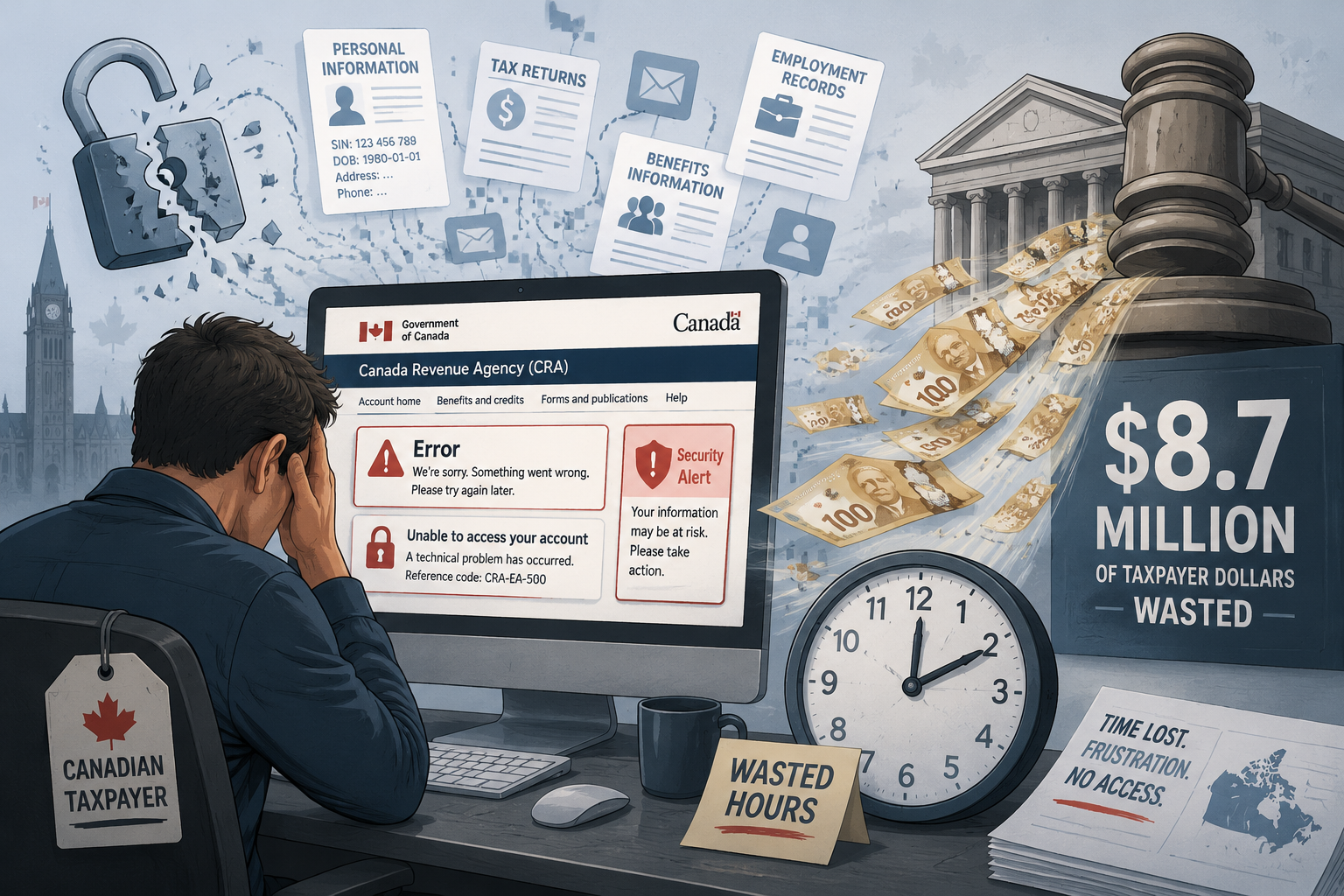
The breach timeline stretches back to 2020, when cybercriminals exploited credential-stuffing attacks against the CRA’s My Account and My Service Canada Account portals. Hackers used stolen usernames and passwords from other data breaches to gain unauthorized access to thousands of CRA accounts.
Here’s what happened step by step:
| Timeline | Event |
|---|---|
| Summer 2020 | Initial credential-stuffing attacks detected |
| August 2020 | CRA forced to shut down online services temporarily |
| 2020-2022 | Affected taxpayers report hours spent on recovery |
| 2023 | Class-action lawsuit filed on behalf of affected users |
| 2025 | Court rules in favor of plaintiffs |
| 2026 | $8.7M settlement distribution begins |
The court found that the CRA failed to implement adequate security measures that were industry-standard at the time, including:
- Multi-factor authentication (MFA)
- Rate-limiting on login attempts
- Real-time anomaly detection
- Timely breach notification to affected users
“The Agency’s failure to adopt basic cybersecurity protocols that were widely available and commonly used in the private sector constitutes negligence in the protection of taxpayer data.” — Federal Court ruling excerpt
Breaking Down the $8.7M Settlement: Who Gets What
The court-ordered payout is structured to compensate different categories of harm. Understanding how the money is distributed helps affected taxpayers know what they may be entitled to receive.
Compensation Categories
| Category | Amount Per Claimant | Eligibility |
|---|---|---|
| Time loss compensation | $150-$500 | Anyone who spent time recovering account access |
| Identity theft damages | $1,000-$5,000 | Those who experienced actual identity fraud |
| Emotional distress | $500-$1,500 | Documented anxiety or stress from the breach |
| Out-of-pocket expenses | Actual costs | Credit monitoring, identity protection services purchased |
The settlement also includes $1.2 million allocated to legal fees and administrative costs for processing claims. The remaining funds are distributed proportionally based on documented harm.
How to File a Claim
Affected taxpayers who received notification from the CRA about compromised accounts can:
- Visit the official settlement website (details available through the Federal Court registry)
- Submit documentation of time spent on recovery
- Provide receipts for any identity protection services purchased
- Complete a sworn declaration of harm experienced
⚠️ Important: The claims deadline is expected to close in late 2026. Taxpayers should act promptly.
Why This Penalty Matters for CRA’s $8.7M Penalty for Website Security Gaps: What Canadian Taxpayers Need to Know About Data Breaches and Protections
This case sets a powerful precedent for government accountability in the digital age. Previously, government agencies in Canada operated under a different standard than private-sector organizations when it came to data protection obligations. This ruling changes that landscape significantly.
Key Legal Precedents Established
- Government agencies owe a duty of care to protect personal information with the same rigor as private companies
- Time losses are compensable harm — courts now recognize that forcing citizens to spend hours fixing government-caused problems has real economic value
- Failure to adopt industry-standard security constitutes negligence, even for government bodies
- Timely notification is mandatory — delays in informing affected individuals increase liability
The broader implications extend beyond the CRA. Every federal agency that handles personal data—from Immigration, Refugees and Citizenship Canada (IRCC) to Employment and Social Development Canada (ESDC)—must now evaluate whether their security measures meet the standard established by this ruling [4].
Personal Data Security Tips for Canadian Taxpayers
While government reforms are underway, individual Canadians should take proactive steps to protect their information. Here are practical, actionable strategies:
🔐 Immediate Steps
- Enable multi-factor authentication on all CRA accounts (now available as of 2025)
- Use unique, strong passwords — never reuse passwords across government and personal accounts
- Monitor your credit report through Equifax Canada or TransUnion Canada at least quarterly
- Set up CRA email notifications for any changes to your account
📱 Ongoing Protection
- Use a password manager (such as 1Password, Bitwarden, or Dashlane) to generate and store unique credentials
- Check the “Have I Been Pwned” website regularly to see if your email appears in known data breaches
- Freeze your credit if you suspect your SIN has been compromised
- File your taxes early each year to prevent fraudulent returns filed in your name
🚨 Red Flags to Watch For
| Warning Sign | What It Means |
|---|---|
| Unexpected CRA correspondence | Someone may have changed your mailing address |
| Tax refund you didn’t expect | A fraudulent return may have been filed |
| Denied benefits applications | Your identity may be compromised |
| Unknown direct deposit changes | Immediate action required |
Government Reforms Coming in 2026 and Beyond
In response to the court ruling and growing public pressure, the Canadian government has announced several reforms to strengthen digital security across federal agencies:
Immediate Changes (2026)
- Mandatory MFA for all government online services
- 48-hour breach notification requirement (down from the previous informal standard of weeks)
- Annual third-party security audits of all citizen-facing government websites
- Dedicated cybersecurity ombudsperson to handle complaints
Long-Term Reforms (2027-2028)
- Digital identity verification system using biometrics for high-risk transactions
- Zero-trust architecture implementation across all federal IT systems
- Increased funding — an additional $500 million allocated to government cybersecurity infrastructure
- Privacy impact assessments required before launching any new digital service
These reforms align with broader trends in government accountability. Financial oversight and transparency are increasingly expected at all levels of government, whether at the federal level in Canada or in municipal and state-level governance elsewhere [3].
What This Means for Future CRA Interactions
The $8.7 million penalty represents more than just compensation—it signals a fundamental shift in how the Canadian government approaches digital service delivery. Taxpayers can expect:
Better security: The embarrassment and financial cost of this ruling ensure that cybersecurity will receive proper funding and attention going forward.
Faster communication: The 48-hour notification requirement means Canadians will learn about breaches quickly enough to take protective action.
Greater transparency: Annual security audits and public reporting create accountability mechanisms that didn’t previously exist.
Stronger legal protections: Future breach victims will have clearer legal pathways to compensation, thanks to the precedents established in this case.
Conclusion
CRA’s $8.7M penalty for website security gaps: what Canadian taxpayers need to know about data breaches and protections boils down to three essential actions. First, check whether you were affected by the 2020 CRA breach and file a claim before the deadline closes. Second, implement personal security measures—especially multi-factor authentication and unique passwords—to protect yourself regardless of government improvements. Third, stay informed about the ongoing reforms that will reshape how federal agencies handle your data.
This ruling proves that government agencies are not above accountability. Canadian taxpayers deserve the same level of data protection from their government that they expect from their banks, healthcare providers, and online retailers. The $8.7 million payout is both compensation for past failures and a down payment on a more secure digital future.
Your next steps:
- ✅ Check your CRA My Account for any security alerts
- ✅ Enable multi-factor authentication today
- ✅ Review the class-action settlement eligibility criteria
- ✅ Set up credit monitoring if you haven’t already
- ✅ File your 2025 tax return early to prevent fraud
References
[3] Hamilton County 23 Hamilton Final – https://ohioauditor.gov/AuditSearch/Reports/2024/Hamilton_County_23_Hamilton_FINAL.pdf
[4] Canada – https://globalnews.ca/canada/
Content, illustrations, and third-party video appearing on GEORGIANBAYNEWS.COM may be generated or curated with AI assistance or reproduced pursuant to the fair dealing provisions of the Copyright Act, R.S.C. 1985, c. C-42. Attribution and hyperlinks to original sources are provided in acknowledgment of applicable intellectual property rights. Such referencing is intended to direct traffic to and support the original rights holders’ platforms.