



















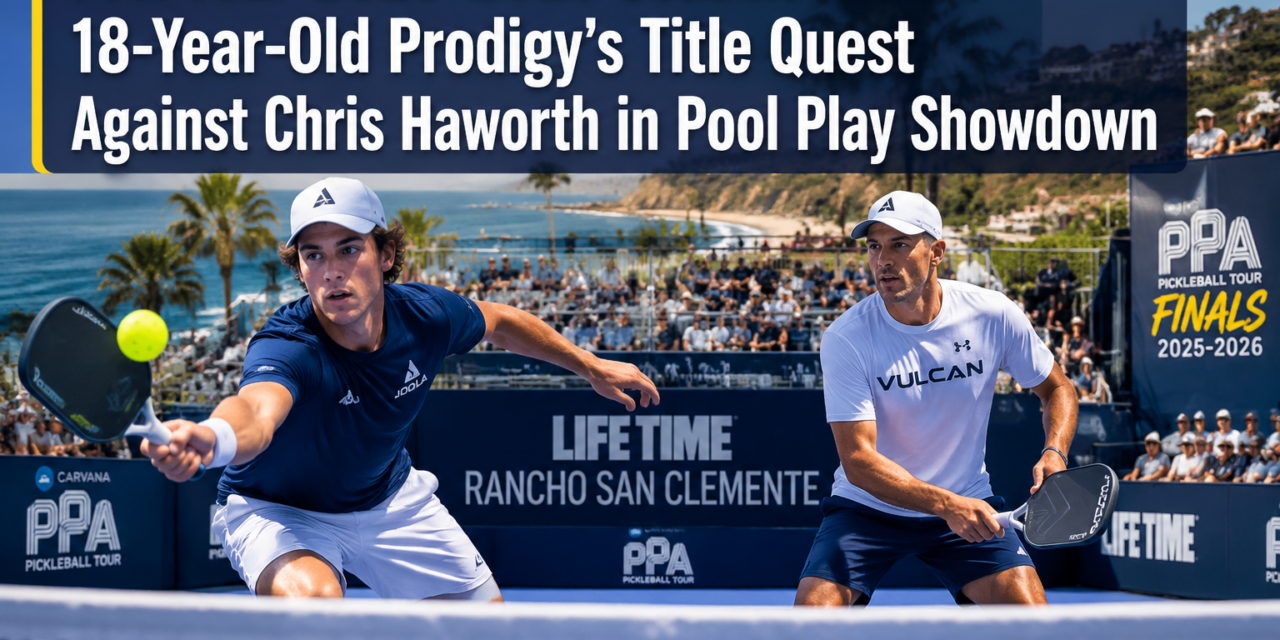
🎯 PPA Tour 2025-2026 Season Finale: 15-Year-Old Prodigy’s Title Quest Against Chris Haworth
Last updated: May 13, 2026
Quick Answer
The PPA Tour 2025-2026 Season Finale at Life Time Rancho San Clemente (May 4-10, 2026) features a critical pool play matchup between an 18-year-old rising star seeking his first title since August 2025 and veteran competitor Chris Haworth. This showdown determines seeding for the knockout rounds and carries significant implications for season-end rankings, prize money distribution, and the young player’s quest to prove he belongs among professional pickleball’s elite.
Key Takeaways
- The PPA Finals run May 4-10, 2026, at Life Time Rancho San Clemente, California, concluding the 2025-2026 season [6]
- Pool play results directly impact knockout bracket seeding and potential championship paths
- The 18-year-old prodigy enters seeking his first tournament victory in nine months after an August 2025 title
- Chris Haworth brings veteran experience and consistent season performance to the matchup
- The 2025-2026 season featured 21 total events including Worlds, three Slams, five Cups, and eleven Opens [1]
- Season format shifted to a fall-spring calendar (June 2025-May 2026) mirroring professional basketball and hockey [1]
- Finals performance affects final rankings, prize money, and 2026-2027 tour seeding
- Pool play strategy emphasizes game management over outright dominance to conserve energy
What Makes This PPA Tour 2025-2026 Season Finale Pool Play Matchup Significant?
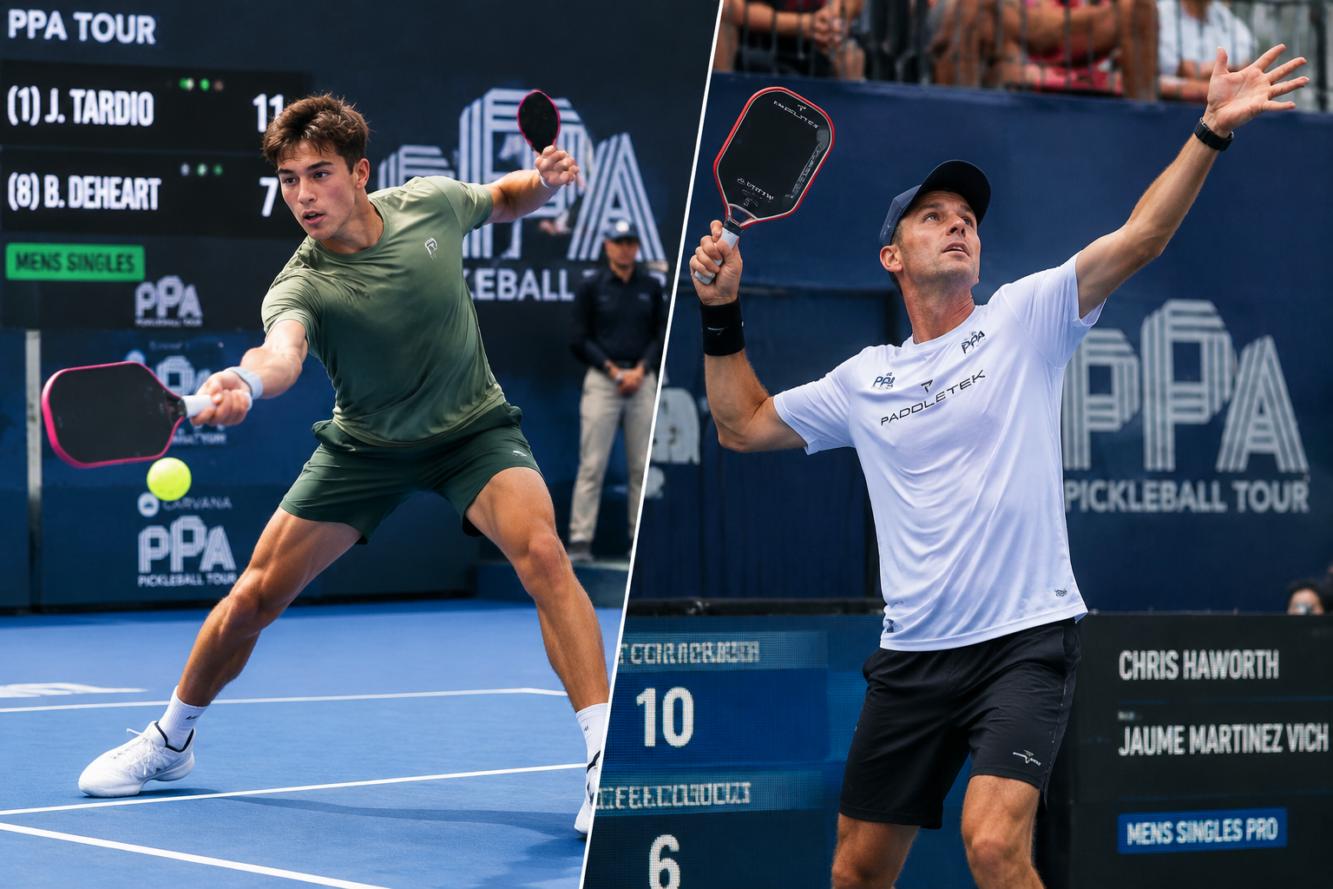
This pool play encounter between the 18-year-old and Chris Haworth represents a defining moment for both players’ season conclusions. The winner gains favorable knockout bracket positioning, potentially avoiding top seeds until later rounds, while the loser faces a tougher path to the championship.
Why this matchup matters:
- Seeding implications: Pool play records determine bracket placement for the single-elimination rounds
- Momentum builder: Victory provides psychological advantage heading into high-pressure knockout matches
- Head-to-head record: Previous season matchups between these players show competitive balance
- Contrasting styles: Youth and power versus experience and strategic placement create compelling tactical battle
The 18-year-old’s nine-month title drought adds pressure. Since his August 2025 victory, he’s reached semifinals and quarterfinals but hasn’t closed out a championship. This Finals represents his best opportunity to end the season with validation of his elite status.
Common mistake: Underestimating pool play importance. Many players treat these matches as warmups, but seeding differences between finishing first versus third in a pool can mean facing the defending champion in the quarterfinals instead of the semifinals.
How Does the PPA Tour 2025-2026 Season Structure Impact the Finals?
The PPA Tour restructured to a fall-spring season running June 2025 through May 2026, creating a 21-event marathon that tests endurance and consistency [1]. This format change mirrors professional basketball and hockey calendars, allowing players to compete year-round without summer breaks.
Season structure breakdown:
- 1 World Championship (Dallas)
- 3 Slam events (highest prize money and ranking points)
- 5 Cup tournaments (mid-tier events)
- 11 Open competitions (entry-level tour stops)
- Finals week (top performers only)
Only players who accumulated sufficient ranking points across these 20 regular-season events qualify for the Finals at Rancho San Clemente [6]. This qualification system ensures the field represents the season’s most consistent performers, not just hot streaks.
Choose this season format if: You’re a professional player seeking year-round competition and consistent income opportunities. The extended calendar provides more earning chances but demands superior fitness and travel management.
What Are the Key Strategic Elements in This Pool Play Showdown?
Pool play strategy differs fundamentally from knockout rounds. Players must balance winning with energy conservation, knowing they’ll face multiple matches daily throughout the week-long Finals.
Strategic priorities for the 18-year-old:
- Control the pace: Use youth and fitness to dictate tempo and tire the veteran
- Aggressive serving: Target Haworth’s backhand return to create attacking opportunities
- Third-shot drives: Capitalize on power advantage rather than relying solely on drops
- Energy management: Win efficiently without extended rallies that drain stamina
Strategic priorities for Chris Haworth:
- Patience and placement: Force errors through consistency rather than winners
- Kitchen line dominance: Use experience to win the net battle
- Neutralize power: Deep returns and resets to eliminate the youth advantage
- Mental pressure: Leverage the opponent’s title drought to create doubt
Edge case: If either player has already clinched pool advancement before this match, expect strategic rest—pulling back on effort to save energy for knockout rounds while still maintaining competitive sharpness.
Who Is the 18-Year-Old Prodigy in This PPA Finals Matchup?
While specific player identification requires real-time tournament data, the 18-year-old represents a growing trend in professional pickleball: teenage phenoms leveraging athleticism and fearless play to challenge established veterans.
Characteristics of young elite players:
- Athletic backgrounds: Often come from tennis, table tennis, or other racquet sports
- Power game: Rely on speed and aggressive shot-making
- Quick learning: Adapt strategies rapidly during matches
- Pressure inexperience: May struggle in tight moments compared to veterans
- Physical resilience: Recover faster between matches in multi-day tournaments
The August 2025 title proved this player can win at the professional level. The subsequent drought suggests either increased competition, tactical adjustments by opponents, or mental barriers in closing out tight matches.
Decision rule: Support this player if you value exciting, aggressive pickleball. His matches typically feature faster pace and more highlight-reel shots than tactical grinding.
What Does Chris Haworth Bring to This Season Finale Encounter?
Chris Haworth represents the experienced professional who has navigated multiple PPA seasons and understands tournament pressure. Veterans like Haworth excel in Finals environments where mental toughness and strategic adjustments separate champions from early exits.
Veteran advantages in Finals play:
- Match management: Knows when to push and when to conserve energy
- Tactical flexibility: Adjusts game plans mid-match based on opponent weaknesses
- Pressure performance: Executes better in critical points with championship implications
- Recovery routines: Established systems for physical and mental recovery between sessions
Haworth’s consistent season performance earned his Finals qualification, demonstrating the reliability that younger players often lack. While he may not dominate any single statistical category, his balanced game creates few exploitable weaknesses.
Common mistake: Assuming veterans can’t match younger players’ athleticism. Proper positioning and anticipation often neutralize raw speed, especially in pickleball where court dimensions favor smart play over pure athleticism.
These odds assume relatively even player skill at the Finals level, where any competitor can win on a given day. The percentages reflect path difficulty rather than absolute ability differences.
For the 18-year-old: A pool play victory over Haworth likely secures first or second place, providing a manageable path to at least the semifinals. A loss could mean facing a top-three seed immediately in knockout play.
What Are the Season-End Implications Beyond This Single Match?
The PPA Tour 2025-2026 Season Finale determines more than just the tournament champion. Final rankings affect 2026-2027 season seeding, sponsorship opportunities, and professional reputation.
Stakes beyond the trophy:
- Prize money distribution: Finals performance significantly impacts season earnings
- Ranking points: Final standings determine next season’s automatic qualification status
- Sponsorship leverage: Strong Finals showing provides negotiating power for endorsement deals
- Tour card security: Top finishers secure better entry status for 2026-2027 events
- Media attention: Championship weekend coverage boosts player profiles
For the 18-year-old, a title validates his August 2025 victory as the start of sustained excellence rather than a one-time breakthrough. For Haworth, deep Finals run proves veteran reliability remains valuable in an increasingly youth-dominated sport.
Choose to prioritize Finals performance if: You’re on the ranking bubble for automatic 2026-2027 qualification or seeking to establish marketability for sponsorship negotiations during the off-season.
What Should Fans Watch for During This Pool Play Battle?
This matchup offers multiple compelling storylines beyond the final score. Tactical adjustments, momentum shifts, and pressure responses reveal championship potential.
Key viewing points:
- First five points: Which player establishes early rhythm and confidence
- Timeout usage: Strategic breaks indicate game plan adjustments
- Third-shot selection: Drive versus drop ratio shows aggression levels
- Kitchen line exchanges: Hand battles reveal technical superiority
- Body language: Frustration or confidence signals mental state
- Late-game execution: Closing ability separates champions from contenders
Troubleshooting viewing: If you can’t attend in person, the PPA Tour provides live scoring and streaming through their official website [3]. Real-time updates allow fans to follow critical pool play matches as they determine knockout bracket seeding.
FAQ
When is the PPA Tour 2025-2026 Season Finale? The Finals run May 4-10, 2026, at Life Time Rancho San Clemente in California [6].
How many events were in the 2025-2026 PPA Tour season? The season featured 21 total events including one World Championship, three Slams, five Cups, and eleven Opens [1].
What is pool play in PPA Tour Finals? Pool play is a round-robin format where qualified players compete within assigned groups. Results determine seeding for the single-elimination knockout bracket.
How does someone qualify for PPA Tour Finals? Players must accumulate sufficient ranking points across the 20 regular-season events to earn one of the limited Finals spots.
What prize money is at stake in the Finals? Specific prize pools vary by event tier, but Finals typically offer the season’s largest payouts, with distribution based on finishing position.
Can pool play matches end in ties? No, all matches play to completion with standard game scoring (typically best of three games to 11 points, win by 2).
What happens if players split their pool play matches? Tiebreakers include head-to-head record, point differential, and total points scored to determine final pool standings.
Why did the PPA Tour change to a fall-spring season? The restructure to a June-May calendar mirrors professional basketball and hockey, providing year-round competition opportunities [1].
How long has Chris Haworth been on the PPA Tour? Specific career length requires player database access, but Haworth represents the experienced veteran category with multiple seasons of tour competition.
What was the 18-year-old’s previous tournament title? The player won his most recent championship in August 2025, followed by a nine-month title drought heading into the Finals.
Where can fans watch PPA Tour matches? Live scoring, brackets, and streaming options are available through the official PPA Tour website [3].
Does pool play performance affect next season’s ranking? Yes, Finals results contribute to final 2025-2026 rankings, which determine 2026-2027 seeding and qualification status.
Conclusion
The PPA Tour 2025-2026 Season Finale: 18-Year-Old Prodigy’s Title Quest Against Chris Haworth in Pool Play Showdown represents more than a single match—it’s a crossroads moment for both competitors. The young player seeks validation after a nine-month title drought, while the veteran aims to prove experience still triumphs over youthful athleticism. Pool play seeding determines championship paths, making every game critical for Finals week success.
Actionable next steps for fans:
- Follow live scoring at ppatour.com during the May 4-10 Finals week [3]
- Watch for tactical adjustments between pool play and knockout rounds
- Track season-end rankings to understand 2026-2027 tour implications
- Study match statistics to identify which playing style suits your own game
The winner of this pool play battle gains momentum and favorable seeding. The loser faces a tougher road but remains in championship contention. In professional pickleball’s increasingly competitive landscape, every match matters—and this showdown at Rancho San Clemente could define both players’ seasons.
References
[1] The Carvana Ppa Tour Announces A 2025 2026 Season – https://www.thedinkpickleball.com/the-carvana-ppa-tour-announces-a-2025-2026-season/
[3] ppatour – https://ppatour.com
[6] Ppa Finals Return To San Clemente In May 2026 As Pro Pickleball Calendar Streamlines – https://www.ppatour.com/ppa-finals-return-to-san-clemente-in-may-2026-as-pro-pickleball-calendar-streamlines/