

















Senior Co-Housing, Home Sharing, and ‘Golden Girls’ Living: Practical Paths to Community Without Moving to a Facility
Last updated: May 20, 2026
Quick Answer: The number of North Americans 65+ living with unrelated roommates has nearly doubled since 2006, reaching roughly 1 million people, driven by rising housing costs and the health risks of social isolation [4]. Senior co-housing, home sharing, and “Golden Girls” living offer structured, community-based alternatives to assisted living or nursing facilities. With the right legal agreements, compatibility screening, and financial planning, these models can support aging in place on your own terms.
Key Takeaways
- 🏠 Three main models exist: formal senior cohousing communities, nonprofit-matched home sharing, and informal “Golden Girls” housemate arrangements.
- 💰 Cost savings are real — shared housing can cut monthly housing costs by 40–60% compared to solo renting or standard senior apartments.
- 🤝 Loneliness drops significantly in organized cohousing, with self-reported isolation rates falling from about 25% to under 10% [4].
- 📋 A written house agreement is non-negotiable — covering finances, chores, guests, privacy, and care expectations.
- 🔍 Compatibility screening matters more than affordability — mismatched sleep schedules or cleanliness standards sink more arrangements than money problems.
- 🌎 Nonprofit matchmakers exist and do 30–40 hours of interviews and home visits per match, costing roughly $7,000 in staff time [5].
- 👩⚕️ Some models now plan for dementia, layering professional care into the shared home rather than forcing a move to a facility [3].
- 📱 Online communities (Facebook groups, Reddit threads) are filling gaps left by traditional senior housing providers [9][10].
What Are the Main Models of Senior Co-Housing and Home Sharing?
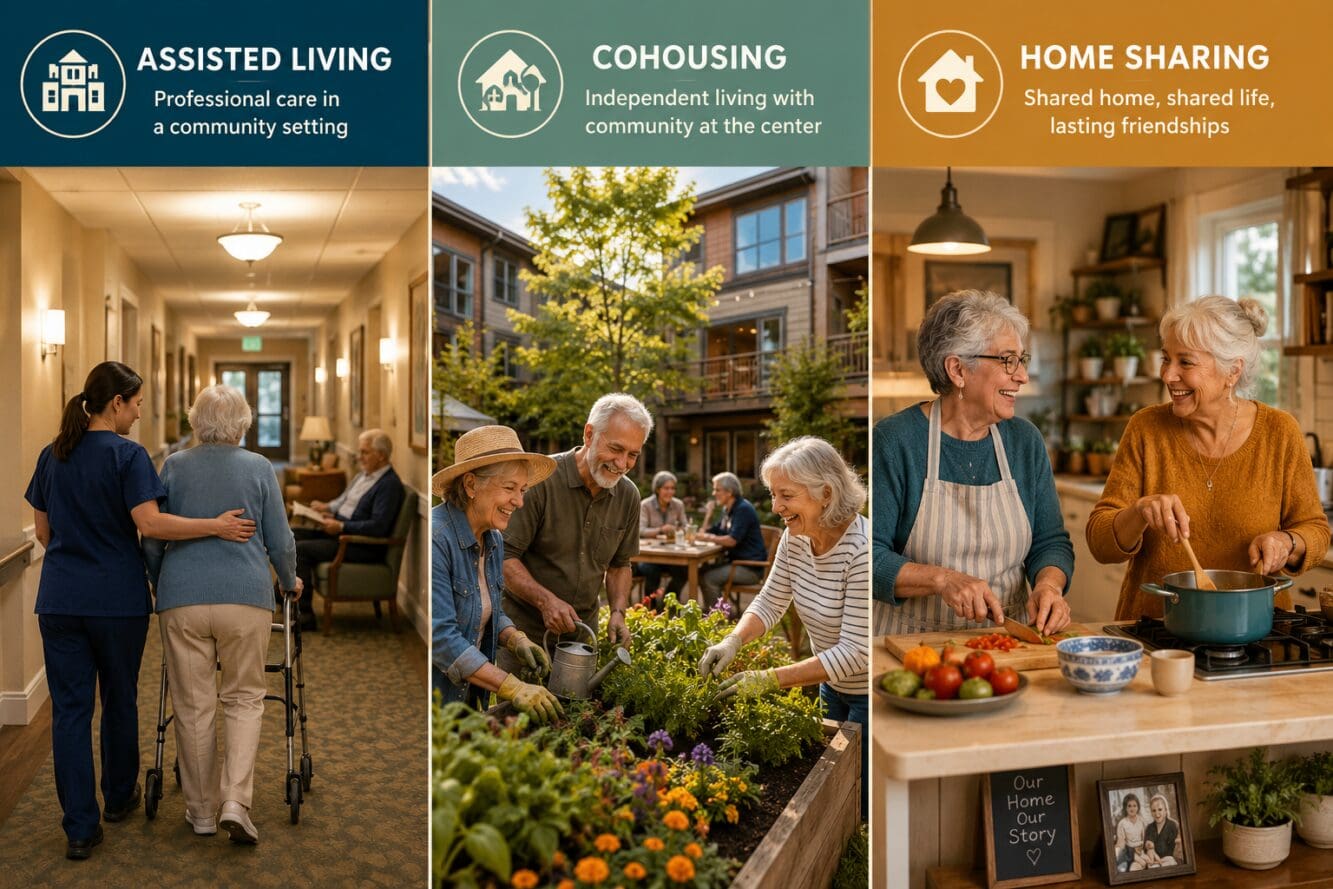
Senior co-housing, home sharing, and “Golden Girls” living each describe a distinct arrangement, though all three share the same core goal: community without a facility.
ModelStructureBest ForSenior Cohousing CommunityPurpose-built or converted neighborhood; private units + shared common spacesAdults who want intentional community from the ground upNonprofit Home Share MatchAgency pairs homeowner with a renter/helper; screened and monitoredOlder homeowners wanting financial relief + light help“Golden Girls” Housemate Arrangement2–4 older adults share an existing home by mutual agreementWomen or LGBTQ+ elders prioritizing companionship and cost-sharing
Explore more stories about cohousing communities and how they’re evolving across North America.
Choose cohousing communities if you want shared infrastructure (common dining rooms, gardens, maintenance crews) and a larger social circle. Choose home sharing if you already own a home and want to offset costs while staying put. Choose the Golden Girls model if you want close daily companionship with a small group of like-minded peers.
Who Is Senior Co-Housing, Home Sharing, and ‘Golden Girls’ Living Actually For?
These models work best for a specific profile of older adult — and they’re not the right fit for everyone.
Good candidates include:
- Single older women (about half of women 65+ are single) [4]
- LGBTQ+ elders who may face discrimination in traditional facilities
- Adults without nearby family who want built-in mutual support
- People who are housing-cost-burdened (11 million older households now spend 30%+ of income on housing) [4]
- Those in early-to-mid stages of aging who can still manage daily tasks
Less suitable for:
- Adults with advanced dementia requiring 24-hour supervision (though some models are beginning to address this) [3]
- People who strongly value solitude and find shared spaces stressful
- Those without the financial or legal capacity to negotiate a house agreement
“Shared housing is a smart way for older people, especially women, to regain autonomy while staying economically afloat.” — Modern Elder Academy [4]
What Does a Nonprofit Home-Share Match Actually Look Like?
Nonprofit home-share programs are structured, screened arrangements — not casual roommate ads. Sunshine Home Share Colorado, for example, pairs older homeowners (typically 55+) with renters who provide both rent and agreed-upon household help [5].
How the process works:
- Both parties apply and complete background checks.
- Staff conduct 30–40 hours of interviews and home visits per match.
- A formal agreement covers rent ($700–$800/month is typical, versus nearly $2,000 for a small Denver apartment), chores, and house rules [5].
- Quarterly check-ins follow to prevent conflict and keep arrangements stable.
Common mistake: Skipping the formal agreement because the match “feels right.” Agencies report that undocumented expectations — especially around caregiving and guests — are the most common source of conflict.
The program made about 30 matches in one recent year, with an equal number of homeowners on the waiting list [5]. Demand is outpacing supply in most regions.
What Legal and Financial Agreements Do Shared Living Arrangements Require?
A written house agreement is the single most important document in any shared living arrangement. Advocates and practitioners consistently identify it as the difference between a sustainable arrangement and a breakdown [1][7].
A solid house agreement should cover:
- Finances: Rent or cost-sharing formula, utilities split, shared grocery budgets, what happens if one person can’t pay.
- Chores and maintenance: Who handles what, how often, and what “clean enough” means.
- Guests and privacy: Overnight visitors, quiet hours, personal space boundaries.
- Care and health: What happens if one housemate’s health declines? Who calls family? Who contacts a doctor?
- Exit terms: How much notice is required to leave? What if the arrangement isn’t working?
- Conflict resolution: A named process (e.g., a neutral mediator) before anyone moves out.
Also consult a lawyer about: Tenancy rights in your province or state, impact on property taxes if a homeowner, and whether any income from home sharing affects government benefits.
How Does the ‘Golden Girls’ Housemate Model Work in Practice?
The Golden Girls model is typically a small, female-led intentional household — two to four older adults sharing an existing home, splitting costs, and providing daily companionship [7]. It’s less formal than cohousing and less structured than a nonprofit match, which is both its strength and its risk.
Advocates describe the shift from “roommates” to “housemates with shared values” as the key mindset change [7]. Residents share meals, make house decisions jointly, and provide informal emotional support — while retaining their own bedrooms and personal autonomy.
Four principles that make Golden Girls homes work [1]:
- Clear, written house agreements (see above)
- Genuine respect for privacy and individual differences
- Equitably shared responsibilities
- Proactive conflict resolution before tensions escalate
Online communities like the Groovy Golden Girls Co-housing Group on Facebook and threads on r/AskWomenOver60 show real-time peer learning about trust, legal agreements, and caregiving boundaries [9][10].
Can Shared Housing Work Even as Care Needs Increase?
Some of the most innovative models are now planning explicitly for dementia and advanced aging. A Canadian initiative led by Solterra Co-Housing is piloting a model where professional care is layered into the existing shared home as residents’ needs grow, rather than requiring a move to a facility [3].
The goal is to keep residents in familiar, community-based settings even as care needs increase. Organizers acknowledge that hospice and end-of-life care still need fuller integration into this model [3].
What this means practically:
- Choose a home that can accommodate accessibility modifications (wider doorways, grab bars, single-floor living).
- Build care escalation terms into the house agreement from day one.
- Identify local home care agencies before a crisis, not during one.
Conclusion: Practical Next Steps for Assessing Shared Living
Senior co-housing, home sharing, and “Golden Girls” living represent a genuine and growing alternative to facility-based care — but they require honest self-assessment and careful planning to succeed.
Actionable next steps:
- Assess your compatibility honestly. Take stock of sleep schedules, cleanliness standards, social needs, and financial expectations before approaching anyone else.
- Contact a nonprofit home-share agency in your region to understand local options and waiting lists.
- Draft a house agreement template before you need one — use it as a conversation starter with potential housemates.
- Consult a lawyer about tenancy law, property implications, and government benefit impacts in your area.
- Join an online community to hear real experiences from people already living this way [9][10].
- Plan for care escalation by including health and exit terms in any agreement from the start [3].
The model that works best depends on your health, finances, personality, and goals. But for the millions of older adults who want community without a facility, these practical paths are more accessible in 2026 than ever before.
FAQ
Q: Is senior home sharing the same as assisted living?
No. Home sharing is a private arrangement between individuals. There is no facility operator, licensing requirement, or institutional oversight. Residents maintain full autonomy over their daily lives.
Q: How do I find a Golden Girls–style housemate?
Start with nonprofit home-share agencies in your region, Facebook groups like the Groovy Golden Girls Co-housing Group [9], or local senior centers that post housing boards.
Q: What does shared senior housing typically cost?
In a nonprofit-matched arrangement, rent can run $700–$800/month plus agreed-upon household help, compared to nearly $2,000 for a solo small apartment in cities like Denver [5].
Q: What if my housemate’s health declines significantly?
This should be addressed in the house agreement before moving in. Some newer models, like Solterra Co-Housing, plan for professional care to be layered in rather than requiring a move [3].
Q: Is this model suitable for men?
Yes, though most current participants and advocates are women. The model works for any older adult who values community, cost-sharing, and aging in place.
Q: Do I need a lawyer to set up a shared living arrangement?
A lawyer isn’t always required, but consulting one is strongly recommended — especially for homeowners, people on fixed government incomes, or anyone with significant assets.
Q: How are conflicts handled in shared housing?
Best practice is to name a conflict resolution process in the house agreement before any dispute arises — for example, agreeing to use a neutral mediator before either party considers leaving [1].
Q: Are there models that work for LGBTQ+ elders specifically?
Yes. LGBTQ+-affirming cohousing communities and intentional households exist in several U.S. and Canadian cities, offering culturally safe alternatives to mainstream senior facilities.
References
[1] Making Golden Girls Home Reality – https://generations.asaging.org/making-golden-girls-home-reality/
[2] Facebook – https://www.facebook.com/chipconleyauthor/posts/the-coming-explosion-of-golden-girls-housingremember-the-golden-girlsfour-older-/1143258470952817/
[3] Golden Girls Shared Living On The Rise – https://changingaging.org/retirement/golden-girls-shared-living-on-the-rise/
[4] The Coming Explosion Of Golden Girls Housing – https://www.meawisdom.com/the-coming-explosion-of-golden-girls-housing/
[5] Aging In Colorado Sunshine Home Share Senior Housing – https://coloradosun.com/2025/07/07/aging-in-colorado-sunshine-home-share-senior-housing/
[6] Senior Apartment – https://goldenplacements.com/senior-apartment/
[7] Are You A Good Fit For A Golden Girls House – https://www.womenlivingincommunity.com/are-you-a-good-fit-for-a-golden-girls-house/
[9] Groovy Golden Girls Co-housing Group – https://www.facebook.com/groups/groovygoldengirls/
[10] Golden Girls (r/AskWomenOver60) – https://www.reddit.com/r/AskWomenOver60/comments/1qlpgeo/golden_girls/
Content, illustrations, and third-party video appearing on GEORGIANBAYNEWS.COM may be generated or curated with AI assistance or reproduced pursuant to the fair dealing provisions of the Copyright Act, R.S.C. 1985, c. C-42. Attribution and hyperlinks to original sources are provided in acknowledgment of applicable intellectual property rights. Such referencing is intended to direct traffic to and support the original rights holders’ platforms.