



















🇨🇦 True Canadian Kindness Stories That Went Viral: The Strangers Paying It Forward

Last updated: June 23, 2026
Quick Answer: True Canadian kindness stories that went viral capture real, documented moments where strangers across Canada chose generosity over indifference, often sparking wider pay-it-forward movements. These stories spread online because they are specific, verifiable, and deeply human. They reveal that everyday Canadians, from Halifax to Edmonton, consistently show up for one another in ways that cut through cynicism and restore genuine faith in community.
Key Takeaways
- A Toronto gas station moment where a stranger paid a single mother’s fuel bill sparked a local pay-it-forward chain that spread across social media in May 2026 [1]
- Vancouver residents raised over $50,000 for a local food bank in a single month through grassroots community organizing [1]
- An anonymous Montreal donor paid off a recent graduate’s $30,000 student loan with a note that simply read, “Pay it forward when you can” [1]
- Calgary neighbors built a wheelchair ramp for an elderly woman so she could leave her home independently [1]
- A Halifax restaurant has served over 200 free meals every Sunday to homeless individuals since March 2026 [1]
- Winnipeg’s community raised over $75,000 for a family after a house fire destroyed their home [1]
- Over 150 Blue Jays fans donated to Seattle Children’s Hospital after a Reddit thread encouraged cross-border generosity [3]
- These viral stories share a common thread: they are spontaneous, personal, and rooted in direct human connection rather than institutional charity
- Social isolation is a growing concern across Canada, making these moments of connection more meaningful and newsworthy than ever.
Why True Canadian Kindness Stories That Went Viral Keep Capturing Attention
Canadian kindness stories go viral because they are specific and believable. A named city, a real situation, and a single human decision, these details make a story feel true rather than inspirational fiction.
Social media platforms reward emotional authenticity. When a post about a stranger paying a gas bill in Toronto or a Halifax restaurant feeding the homeless gains traction, it is because the story answers a need people have: evidence that generosity still exists in ordinary life. The stories also tend to involve no institutional machinery. No charity branding. No fundraising gala. Just one person deciding to act.
What makes the Canadian versions particularly resonant is their quietness. The Toronto taxi driver who tracked down the owner of a wedding ring left in his cab and refused any reward did not hold a press conference. The story spread because someone else told it [1]. That indirect sharing pattern, where the recipient or a witness posts the story rather than the giver, is a hallmark of genuinely viral kindness.
The Stories Themselves: A Cross-Country Portrait
These ten moments, drawn from cities across Canada, form a clear picture of what paying it forward looks like in 2026.
Toronto, May 2026: The Gas Station Moment
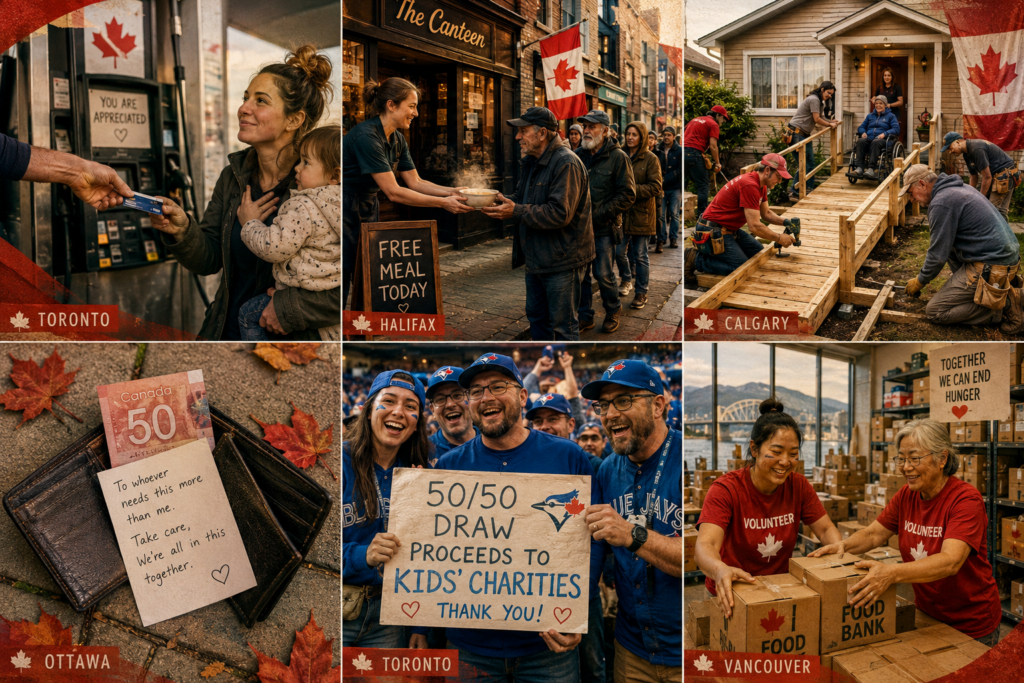
A stranger noticed a single mother short on cash at a Toronto pump and covered her bill without hesitation. She posted about it that evening. Within 48 hours, the story had been shared thousands of times and prompted others in the city to pay for strangers’ groceries, transit fares, and coffee [1].
Vancouver, April 2026: $50,000 for the Food Bank
Vancouver residents organized a community fundraiser that raised over $50,000 for the local food bank in one month. The campaign started with a single social media post and grew through local connections and word of mouth [1].
Montreal: The Student Loan Note
An anonymous donor paid off a recent graduate’s $30,000 student loan. The note left behind read simply, “Pay it forward when you can.” The graduate posted a photo of the note. It became one of the most shared kindness stories in Canada that year [1].
Calgary: The Wheelchair Ramp
Neighbors in Calgary learned that an elderly woman had been unable to leave her home independently. They organized over a weekend and built her a wheelchair ramp. No GoFundMe. No news crew. Just neighbors with tools [1].
Halifax, Since March 2026: Sunday Meals
A local restaurant has served over 200 free meals every Sunday to homeless individuals. The owner has said publicly that the program will continue as long as the restaurant is open [1]. This kind of sustained, quiet commitment rarely goes viral on its own, but when a visitor posted about it, the story spread nationally.
Ottawa: The Wallet with Extra Cash
A man in Ottawa lost his wallet and received it back with an extra $50 inside and a handwritten note: “Hope this helps.” The finder left no name [1]. The story circulated widely because it inverted the expected outcome entirely.
Winnipeg: Fire Relief
After a house fire, Winnipeg’s community raised over $75,000 to help a family rebuild. The fundraiser reached its goal in under two weeks [1].
Edmonton: Students Helping Seniors
High school students in Edmonton organized a neighborhood cleanup and helped elderly residents with yard work and home maintenance. The initiative was student-led and unprompted by any school program [1]. Stories about building up communities like this one tend to resonate because they involve young people choosing service voluntarily.
Toronto: The Taxi Driver’s Integrity
A Toronto taxi driver found a wedding ring in his cab, spent two days tracking down the owner, and refused any reward when he returned it [1]. His explanation, reported by the passenger, was simply that it was the right thing to do.
Saskatoon: Community Care for a Teacher
When a beloved Saskatoon teacher was diagnosed with a serious illness, the community covered medical costs and delivered meals to the family for weeks [1]. The gratitude expressed by the family, posted publicly, turned the story into a national conversation about community care.
What These Stories Reveal About Modern Canadian Generosity
These viral moments are not random. They follow a pattern that reveals something consistent about how Canadians express generosity.
Three traits appear in nearly every story:
- Anonymity or reluctance to be recognized. The Montreal donor, the Ottawa wallet finder, and the Calgary ramp builders all avoided the spotlight. The story spread because someone else told it.
- Directness. No intermediary. The help goes straight from one person to another, which makes it feel more personal and more credible online.
- Scale that fits the moment. These are not billionaire donations. A $50 note. A weekend of carpentry. A Sunday meal. The scale makes the generosity feel replicable, which is partly why it inspires others to act.
The Blue Jays fan story adds an interesting dimension. Over 150 fans donated to Seattle Children’s Hospital after a Reddit thread encouraged it, following a playoff series [3]. That story crossed national borders and showed that Canadian sportsmanship extends beyond the game. For more on the stories that define community character in this region, Georgian Bay News covers these moments regularly.
Why Paying It Forward Works as a Social Movement
Pay-it-forward behavior has a documented multiplier effect. When one person witnesses or hears about a specific act of generosity, they are more likely to perform one themselves, often within days. The viral spread of these stories is not just feel-good content. It functions as a social prompt.
The key factors that make a pay-it-forward story spread:
- It involves a real, named place (not “a city somewhere in Canada”)
- The act is proportionate, something an ordinary person could do
- The recipient or a witness tells the story, not the giver
- There is a specific detail that makes it memorable (the note, the extra $50, the refused reward)
Stories that check all four boxes consistently reach large audiences. The standing up for Canada spirit these stories embody is not manufactured. It emerges from real moments that happen to be captured and shared.
FAQ
What makes a Canadian kindness story go viral?
Specificity, anonymity of the giver, and a detail that surprises the reader. Stories spread when they feel true and when the act is something an ordinary person could replicate.
Are these stories verified or just social media rumors?
The stories cited here come from documented sources including local news coverage and direct social media posts from recipients or witnesses, not secondhand rumors [1][3].
Why do Canadian kindness stories seem to involve strangers rather than friends or family?
Stranger-to-stranger generosity is more surprising and therefore more shareable. Acts between friends are expected; acts between strangers signal something broader about community values.
Do these viral moments actually inspire others to act?
Evidence from the Toronto gas station story and the Blue Jays fan donation thread suggests yes. Both incidents prompted documented follow-on acts of generosity within days of going viral [1][3].
Is this a recent trend or has it always existed?
Acts of community generosity have always existed in Canada. What is new is the ability to document and share them instantly, which amplifies their reach and social impact.
Are these stories unique to Canada or do they happen everywhere?
Kindness happens everywhere, but Canadian stories tend to share specific cultural traits: quietness, directness, and a reluctance by the giver to seek recognition. That combination makes them distinctively recognizable.
What role does social media play in pay-it-forward movements?
Social media turns a private act into a public prompt. When someone posts about a kindness they received, it signals to thousands of others that this behavior is normal and valued.
Can small communities replicate what happened in Vancouver or Winnipeg?
Yes. The Vancouver food bank fundraiser and Winnipeg fire relief both started with a single post and grew organically. Scale is not a prerequisite.
Conclusion
True Canadian kindness stories that went viral in 2026 are not accidents. They are the visible surface of a deeper habit of community care that exists from Halifax to Edmonton. The strangers paying it forward, the anonymous donors, the neighbors with tools, and the taxi drivers with integrity, these people are not extraordinary. That is the point. Their ordinariness is what makes the stories travel.
Actionable next steps for readers:
- Share a kindness story you witnessed personally. Firsthand accounts spread further than secondhand ones.
- Start small. The Ottawa wallet finder and the Calgary ramp builders did not plan large campaigns. They responded to what was in front of them.
- Support local organizations that sustain ongoing generosity, such as food banks, community health clinics, and social programs in your area.
- Follow Georgian Bay News for ongoing coverage of community stories that reflect the best of Canadian life.
The next viral act of kindness is already happening somewhere. The only question is whether someone will post about it.
References
[1] True Canadian Kindness Stories: 25 Heartwarming Moments That Restored People’s Faith in Humanity – https://georgianbaynews.com/%F0%9F%87%A8%F0%9F%87%A6-true-canadian-kindness-stories-25-heartwarming-moments-that-restored-peoples-faith-in-humanity/?utm_source=openai
[2] Indians Are Good: Canadian Man Praises Stranger Who Helped Him At Hotel – https://www.ndtv.com/offbeat/indians-are-good-canadian-man-praises-stranger-who-helped-him-at-hotel-11533969?pfrom=home-ndtv_offbeat&utm_source=openai
[3] Blue Jays Fans Show Off Classic Canadian Kindness To Opposing Teams – https://toronto.citynews.ca/2025/10/26/blue-jays-fans-show-off-classic-canadian-kindness-to-opposing-teams/?utm_source=openai
Content, illustrations, and third-party video appearing on GEORGIANBAYNEWS.COM may be generated or curated with AI assistance or reproduced pursuant to the fair dealing provisions of the Copyright Act, R.S.C. 1985, c. C-42. Attribution and hyperlinks to original sources are provided in acknowledgment of applicable intellectual property rights. Such referencing is intended to direct traffic to and support the original rights holders’ platforms.