

















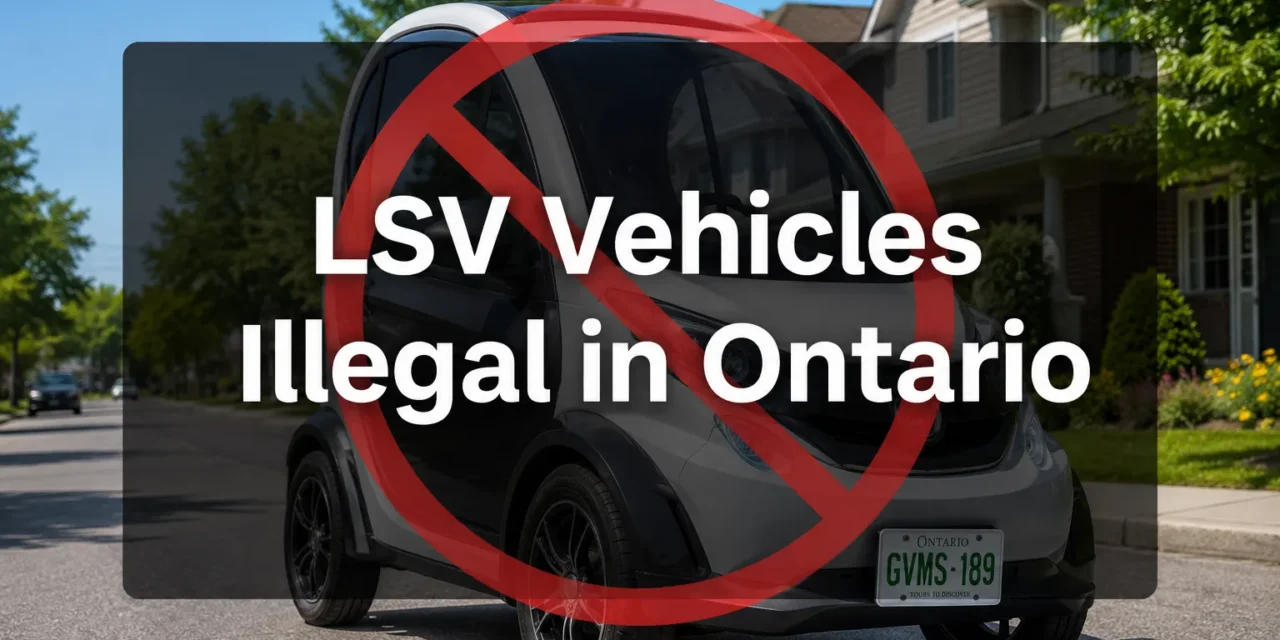
🚗 Low-Speed Vehicles are illegal to operate on municipal roadways, in bicycle lanes, and on sidewalks throughout Ontario
Last updated: July 25, 2026
Quick Answer: Low-Speed Vehicles (LSVs) are illegal to operate on municipal roadways, in bicycle lanes, and on sidewalks throughout Ontario. These electric vehicles cannot be registered or plated in the province, and driving one on public roads can result in provincial charges, fines, and potential vehicle impoundment under the Highway Traffic Act.
Key Takeaways
- LSV vehicles are completely illegal to operate on any public roadway, bicycle lane, or sidewalk in Ontario
- Ontario does not recognize LSVs as a vehicle class and will not issue license plates or permits for them
- Penalties for illegal LSV operation include fines up to $1,000, demerit points, and possible vehicle impoundment
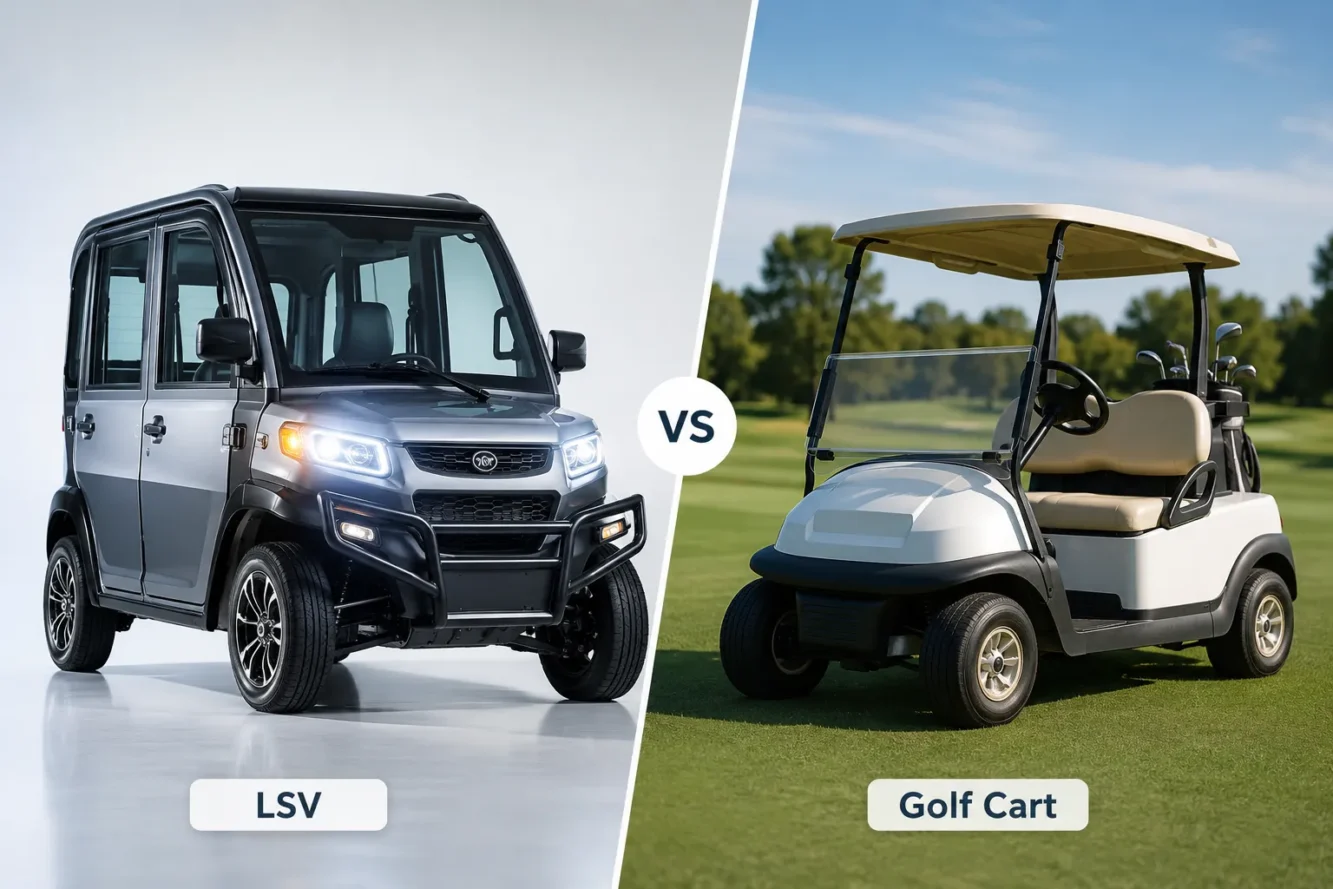
- LSVs differ from golf carts in having safety features like headlights, turn signals, and seat belts, but this doesn’t make them legal in Ontario
- Private property operation is the only legal use for LSVs in the province
- No exceptions exist for residential areas, community roads, or designated pathways
- Municipal Accommodations Scheme (MAS) vehicles are a separate legal category with specific permits
What Are LSV Vehicles and Why Are They Illegal in Ontario?
Low-Speed Vehicles (LSVs) are four-wheeled electric vehicles designed to travel at speeds between 32 km/h and 40 km/h. Ontario’s Highway Traffic Act does not recognize LSVs as a legitimate vehicle category, making them illegal to operate on any public road, regardless of posted speed limits or road type.
LSVs typically include features such as:
- Headlights, tail lights, and turn signals
- Seat belts and safety restraints
- Windshields and mirrors
- Maximum speed capability of 40 km/h
- Electric motor propulsion
- Four wheels and enclosed or semi-enclosed cabin
The province’s refusal to legalize LSVs stems from safety concerns. Ontario’s Ministry of Transportation maintains that these vehicles do not meet federal Motor Vehicle Safety Standards (MVSS) required for highway use. Without meeting these standards, LSVs cannot be certified for road use, registered, or insured as motor vehicles in the province.
Unlike some U.S. states and Canadian provinces that have created special LSV classifications, Ontario has chosen not to accommodate these vehicles within its regulatory framework. This decision reflects concerns about mixing low-speed electric vehicles with regular traffic, even on roads with lower speed limits.
Can You Drive an LSV on Ontario Roads?
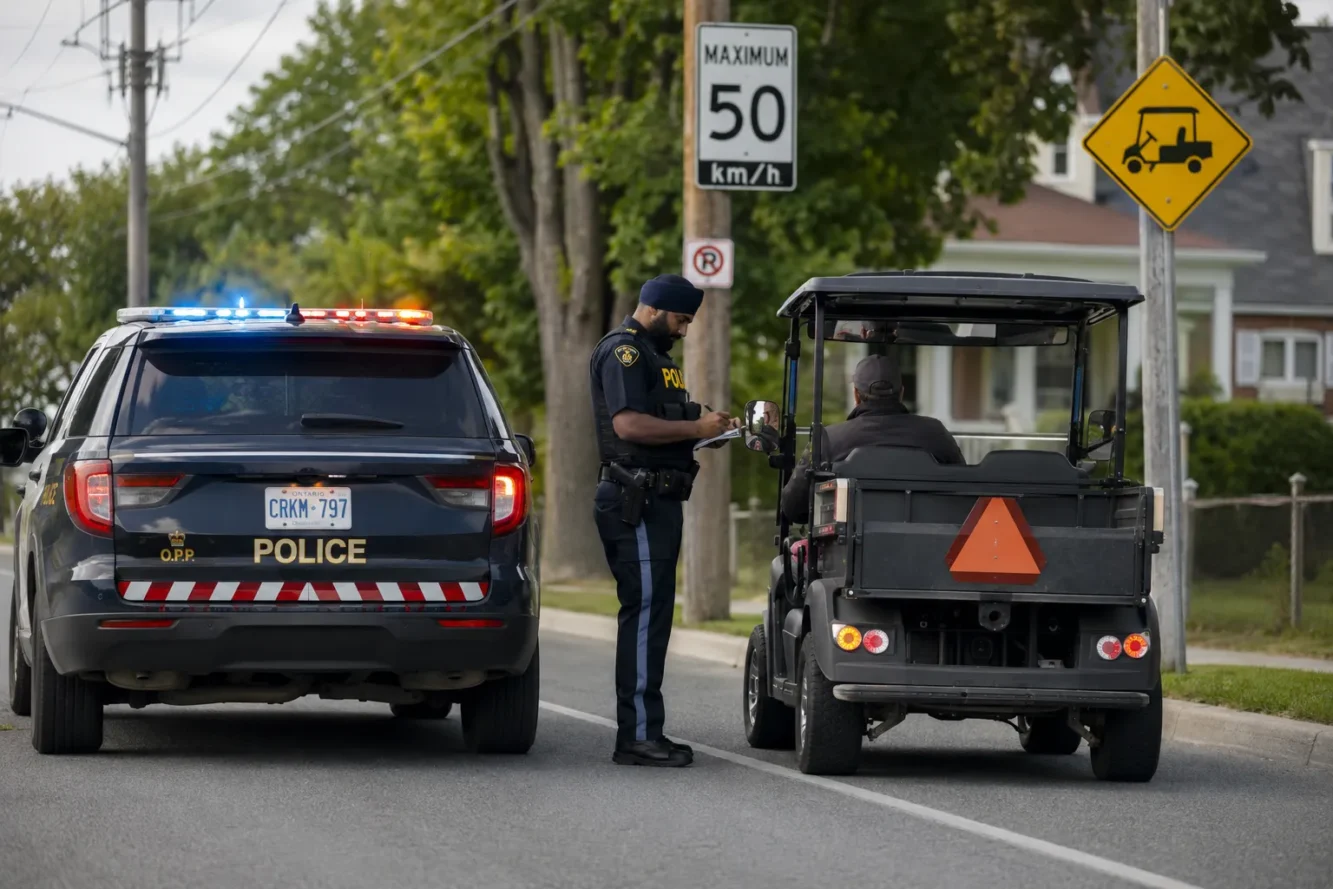
No, you cannot legally drive an LSV on any Ontario road, street, or highway. This prohibition applies to all public roadways regardless of speed limit, traffic volume, or municipal designation.
The ban encompasses:
- Municipal streets and roads in cities, towns, and townships
- Provincial highways and connecting roads
- Residential streets even in quiet neighborhoods
- Rural roads with low traffic volumes
- Parking lots open to public use
- Bicycle lanes and multi-use pathways
- Sidewalks and pedestrian areas
Operating an LSV on any of these surfaces constitutes a violation of the Highway Traffic Act. Police officers have the authority to stop LSV operators, issue tickets, and potentially impound the vehicle. The fact that an LSV has safety equipment like lights and seat belts does not change its illegal status in Ontario.
Some LSV owners mistakenly believe that staying on roads with 40 km/h speed limits makes operation legal. This is incorrect. Speed limit matching does not override the fundamental requirement that all road vehicles must be registered, plated, and meet federal safety standards.
What’s the Difference Between an LSV and a Golf Cart?
LSVs and golf carts are distinct vehicle types, though both face legal restrictions in Ontario. LSVs are equipped with automotive safety features and designed for road use, while traditional golf carts are basic utility vehicles intended for golf courses and private property.
Key differences include:
FeatureLSVGolf CartSpeed capability32-40 km/h15-25 km/hSafety equipmentHeadlights, turn signals, seat belts, mirrorsMinimal or noneIntended useRoad transportationGolf course, private propertyEnclosureOften enclosed or semi-enclosedTypically open-airFederal standardsMeets some U.S. LSV standardsNo road standards
Despite these differences, both vehicles are illegal on Ontario public roads. The additional safety features of LSVs do not grant them legal status because Ontario has not created an LSV vehicle class. A golf cart with added lights and seat belts is still not a legal road vehicle.
The legal distinction matters primarily for private property use. LSVs may be marketed as “street legal” in jurisdictions where such classifications exist, but this designation has no validity in Ontario. Buyers should understand that purchasing an LSV for Ontario use means restriction to private property only.
Where Can You Legally Operate an LSV in Ontario?
Private property is the only legal location for LSV operation in Ontario. This includes golf courses, private estates, resort properties, industrial campuses, and other enclosed private land where public road access is not required.
Legal LSV operation locations:
- Golf courses and country clubs with private roads
- Private resort properties with internal road networks
- Industrial facilities and manufacturing campuses
- Agricultural properties and large private estates
- Retirement communities with private internal streets (if municipality permits)
- Private event venues and fairgrounds
The critical factor is that the property must be genuinely private with no public through-access. A private road that connects to public roadways or allows public passage may still fall under Highway Traffic Act jurisdiction. Property owners should verify their specific situation with local authorities before allowing LSV use.
Some gated communities and planned developments have internal private roads where LSVs might operate legally. However, the moment an LSV enters a public road, even briefly to cross from one private property to another, the operator violates provincial law. For information on related EV technology developments, residents can explore emerging electric vehicle options.
What Are the Penalties for Driving an LSV Illegally in Ontario?
Operating an LSV on Ontario public roads can result in multiple charges under the Highway Traffic Act, with combined penalties potentially exceeding $1,000 plus administrative consequences.
Common charges include:
- Operating an unregistered motor vehicle: $85-$200 fine
- Operating without insurance: $5,000-$50,000 fine for first offense
- Operating an unsafe vehicle: $85-$500 fine
- Driving without a valid permit: $85-$200 fine
- Equipment violations: $85-$200 per violation (lights, signals, etc.)
Beyond monetary fines, operators face:
- Demerit points on their driver’s license (if applicable charges warrant)
- Vehicle impoundment at owner’s expense
- Towing and storage fees typically $200-$500
- Court appearances for serious or repeat violations
- Insurance implications affecting future rates
Police officers have discretion in charging decisions. A cooperative first-time offender might receive a single charge with a warning, while repeat offenders or those operating recklessly may face multiple charges. The absence of insurance is particularly serious, as Ontario mandates insurance for all motor vehicles on public roads.
Municipalities cannot override provincial law by permitting LSV use on local roads. Any municipal bylaw attempting to allow LSV operation would conflict with the Highway Traffic Act and be legally invalid.
How Much Does an LSV Ticket Cost in Ontario?
A typical LSV traffic stop results in fines ranging from $200 to $1,000 depending on the specific charges laid. The most common single charge, operating an unregistered vehicle, carries a set fine of approximately $85 to $200.
However, most LSV stops result in multiple charges because the vehicle inherently violates several requirements:
Typical multi-charge scenario:
- Operating unregistered vehicle: $200
- No insurance: $5,000 minimum (often reduced in court)
- Improper vehicle class: $200
- Equipment violations: $85-$200
The insurance charge represents the most serious financial risk. While the statutory minimum is $5,000, first-time offenders who demonstrate they misunderstood the law may receive reduced penalties through court proceedings. Repeat offenders face escalating fines and potential license suspension.
Additional costs include vehicle recovery if impounded. Towing fees typically run $150-$300, with daily storage charges of $40-$80. A vehicle impounded for even a few days while legal matters resolve can accumulate $500+ in recovery costs beyond the ticket fines.
Some LSV operators attempt to argue their vehicle is not a “motor vehicle” under the Act. This defense consistently fails because LSVs are self-propelled, multi-wheeled vehicles designed for transportation, meeting the legal definition of motor vehicle regardless of speed capability.
Can You Get a License Plate for an LSV in Ontario?
No, Ontario’s Ministry of Transportation will not issue license plates or vehicle registration for LSVs under any circumstances. The province does not recognize LSVs as a registrable vehicle class, making legal road operation impossible.
To receive Ontario registration and plates, a vehicle must:
- Meet federal Motor Vehicle Safety Standards (MVSS)
- Be certified by the manufacturer for Canadian road use
- Pass a safety standards inspection
- Be insurable as a motor vehicle
- Fit within recognized provincial vehicle classes
LSVs fail the first two requirements. Manufacturers do not certify LSVs to meet federal safety standards because these vehicles are designed for jurisdictions with separate LSV classifications. Without federal certification, Ontario’s Ministry of Transportation cannot process registration regardless of the vehicle’s equipment or safety features.
Some LSV buyers inquire about registering their vehicle as a motorcycle, moped, or limited-speed motorcycle. These attempts fail because LSVs have four wheels and enclosed cabins, disqualifying them from two-wheeled vehicle categories. Similarly, LSVs cannot be registered as passenger cars because they lack federal certification.
Municipal Accommodations Scheme (MAS) vehicles represent a separate category. These are modified vehicles with specific permits for individuals with mobility disabilities. MAS permits are not available for standard LSVs and apply only to specially modified vehicles meeting strict criteria for disability accommodation.
What Counts as a Municipal Roadway for LSV Rules?
A municipal roadway includes any road, street, highway, lane, or public passage maintained for vehicle traffic within Ontario. This broad definition encompasses virtually all paved and unpaved routes accessible to the public.
Municipal roadways include:
- City and town streets of all sizes
- Subdivision roads in residential areas
- Rural township roads including gravel roads
- Connecting links between provincial highways
- Public parking lots and access roads
- Roads in municipal parks and recreation areas
The determining factor is public access, not ownership or maintenance responsibility. A road maintained by a municipality, province, or private entity that allows public passage falls under Highway Traffic Act jurisdiction. Even roads posted with lower speed limits (30 km/h school zones, 40 km/h residential streets) remain municipal roadways where LSV operation is prohibited.
Not considered municipal roadways:
- Driveways on private property
- Internal roads on private estates with no public access
- Golf cart paths on private courses
- Private industrial facility roads with controlled access
- Agricultural field access routes on private farms
The distinction can be subtle in planned communities and gated developments. A road within a gated community that provides access only to residents and their guests, with no public through-traffic, may be considered private. However, if emergency services, delivery vehicles, or the general public can access the road, it likely falls under Highway Traffic Act jurisdiction. Municipalities can provide specific guidance on road classification in ambiguous situations.
Are There Any Exceptions to LSV Bans in Ontario?
No general exceptions exist that would allow LSV operation on Ontario public roads. The province has not created any special permits, seasonal allowances, or community-specific exemptions for LSV use.
Situations that do NOT create exceptions:
- Living in a rural area with low traffic
- Operating only on roads with 40 km/h speed limits
- Using the LSV for short distances only
- Adding additional safety equipment beyond standard LSV features
- Obtaining municipal council approval or support
- Having a valid driver’s license and insurance
The only legitimate exception involves Municipal Accommodations Scheme (MAS) vehicles, which are not LSVs but rather specially modified vehicles for individuals with mobility disabilities. MAS permits require:
- Medical documentation of mobility disability
- Vehicle modification to accommodate the specific disability
- Municipal approval and permit issuance
- Compliance with specific equipment and operational requirements
- Restriction to designated routes and areas
Standard LSVs do not qualify for MAS permits. These permits are designed for modified golf carts or similar vehicles adapted for individuals who cannot operate standard motor vehicles due to disability. The permit process is rigorous and limited to legitimate accessibility needs.
Some Ontario residents have advocated for LSV legalization, particularly in rural and resort communities. As of 2026, no legislative changes are pending. Residents interested in local transportation developments should monitor municipal council discussions, though any LSV legalization would require provincial action.
What Should You Do If You Got Caught Driving an LSV in Ontario?
If stopped by police while operating an LSV, cooperate fully, accept the charges, and consider consulting a paralegal or traffic lawyer to address the tickets. Arguing with the officer will not change the outcome and may result in additional charges.
Immediate steps:
- Pull over safely when signaled by police
- Provide identification and vehicle ownership documents
- Answer questions honestly about your knowledge of LSV laws
- Accept the tickets without argument
- Arrange vehicle removal if impounded (call a towing service)
- Document the stop including charges, officer information, and circumstances
After the stop:
- Review all charges carefully to understand each violation
- Note the court date if one is assigned
- Consider legal representation especially if facing insurance charges
- Gather evidence of any mitigating circumstances (proof of misunderstanding, dealer misrepresentation, etc.)
- Explore early resolution options through the court system
For the insurance charge specifically, first-time offenders who can demonstrate they genuinely believed their LSV was legal may receive reduced penalties. Evidence such as dealer marketing materials claiming “street legal” status or confusion about vehicle classification can support mitigation arguments.
Do not:
- Attempt to flee or evade police
- Argue that the officer is wrong about LSV legality
- Claim your LSV is a golf cart or different vehicle type
- Ignore the tickets or fail to appear in court
- Continue operating the LSV on public roads
If you purchased the LSV from a dealer who claimed it was legal for Ontario roads, document all communications and marketing materials. While this won’t eliminate charges, it may support a complaint to consumer protection authorities and provide grounds for seeking a refund or return.
How Is an LSV Different From a Regular Golf Cart Legally?
Legally in Ontario, LSVs and golf carts are treated identically: both are prohibited from operating on public roads, bicycle lanes, and sidewalks. The technical differences between the vehicles do not create different legal status.
Technical differences:
Golf carts are basic utility vehicles with minimal equipment, typically capable of 15-25 km/h, designed exclusively for golf course use. LSVs are more sophisticated vehicles with automotive safety features, capable of 32-40 km/h, designed in other jurisdictions for neighborhood road use.
Legal reality in Ontario:
Neither vehicle class is recognized for road use. Both lack federal Motor Vehicle Safety Standards certification. Neither can be registered or plated. Operating either on public roads results in similar charges under the Highway Traffic Act.
The distinction matters primarily for marketing and buyer expectations. Golf cart purchasers generally understand their vehicle is limited to private property. LSV buyers, particularly those familiar with U.S. jurisdictions where LSVs are “street legal,” may incorrectly assume Ontario allows similar use.
Some modified golf carts are marketed with added lights, seat belts, and other equipment to resemble LSVs. These modifications do not change the vehicle’s legal status. A golf cart with added safety equipment remains an unregistrable vehicle prohibited from road use.
For individuals with mobility disabilities, the MAS permit system applies equally to modified golf carts and other adapted vehicles, but not to standard LSVs marketed for general consumer use.
Can You Use an LSV on Bike Paths or Trails in Ontario?
No, LSVs are prohibited from bike paths, multi-use trails, and any pedestrian or cycling infrastructure in Ontario. These pathways are designated for non-motorized use (bicycles, pedestrians) or, in some cases, limited motorized use by specific vehicle types that do not include LSVs.
Prohibited LSV locations:
- Dedicated bicycle lanes on roadways
- Multi-use pathways in parks and along waterfronts
- Rail trails and converted railway corridors
- Recreational trails in conservation areas
- Sidewalks in urban and suburban areas
- Shared-use paths on bridges and through neighborhoods
Municipal bylaws typically restrict pathway use to pedestrians, bicycles, and sometimes e-bikes that meet specific power and speed requirements. LSVs exceed these parameters and are explicitly motor vehicles, making them inappropriate and illegal for pathway use.
Some LSV owners reason that if roads are too dangerous for their low-speed vehicle, pathways designed for slower traffic would be appropriate. This logic fails legally and practically. Pathways are engineered for much lighter vehicles and pedestrian traffic, with narrower widths, tighter curves, and infrastructure (bridges, gates) that cannot accommodate four-wheeled motor vehicles.
E-bikes and electric scooters that are legal on some Ontario pathways meet specific criteria including power limits (500 watts), speed limits (32 km/h), and weight restrictions. LSVs exceed all these parameters and fall under motor vehicle regulations rather than assisted-bicycle regulations.
Operating an LSV on a pathway can result in charges for illegal pathway use in addition to the standard charges for operating an unregistered, uninsured motor vehicle. For those interested in alternative transportation options in Ontario, exploring legal recreational vehicles for designated areas provides better alternatives.
Frequently Asked Questions
Are LSVs legal anywhere in Canada?
Some Canadian provinces and territories have created LSV classifications allowing limited road use under specific conditions. British Columbia, Alberta, and Saskatchewan have LSV programs with varying restrictions. Ontario has not adopted such a framework and has no current plans to do so.
Can I drive my LSV if I only use private roads?
Yes, LSV operation is legal on genuinely private roads with no public access. However, the moment you enter any public roadway, even briefly, you violate the Highway Traffic Act. Verify with your municipality that roads you intend to use are truly private.
What if I bought my LSV from a Canadian dealer who said it was legal?
Dealer misrepresentation does not eliminate legal liability, but document all claims made about legality. You may have grounds for a return or refund based on misrepresentation, and you can file a consumer complaint. However, you remain responsible for any charges from illegal operation.
Can I register my LSV in another province and drive it in Ontario?
No. Ontario does not recognize out-of-province LSV registrations as valid for operating on Ontario roads. A vehicle registered as an LSV in Alberta, for example, cannot legally operate on Ontario public roads even with valid Alberta plates and insurance.
Are electric golf carts legal on Ontario roads if they have lights and seat belts?
No. Adding safety equipment to a golf cart does not make it road-legal. The vehicle must meet federal Motor Vehicle Safety Standards and be registrable in a recognized vehicle class. Modified golf carts remain prohibited from public roads.
How do police identify LSVs versus legal vehicles?
LSVs typically lack Ontario license plates, which immediately identifies them as illegal. Even if an owner fabricates or attaches invalid plates, the vehicle’s appearance, size, and lack of federal certification markings make it identifiable to trained officers.
Can municipalities create bylaws allowing LSV use on local roads?
No. Municipal bylaws cannot override provincial legislation. The Highway Traffic Act is provincial law that applies uniformly across Ontario. Any municipal bylaw attempting to permit LSV road use would be legally invalid and unenforceable.
What about LSVs on ice roads or seasonal winter roads?
Ice roads and winter roads maintained for public use are still considered roadways under the Highway Traffic Act. LSV operation on these routes is illegal. Private ice roads on lakes bordered entirely by private property may allow LSV use, but verify access and jurisdiction carefully.
Are there plans to legalize LSVs in Ontario?
As of 2026, no active legislation or policy review is underway to create an LSV classification in Ontario. While some community groups and advocates have raised the issue, the provincial government has not indicated any intention to change current policy.
What should I do with an LSV I already own?
Limit use to private property where legal, consider selling to a buyer in a jurisdiction where LSVs are legal, or explore whether the vehicle can be modified and certified to meet federal standards (typically not economically feasible). Do not risk charges by operating on public roads.
Can LSVs be used on First Nations reserve roads?
Road jurisdiction on First Nations reserves can be complex, involving federal, provincial, and band council authority. Some reserves may permit LSV use on internal roads, but this varies by community. Contact the specific First Nations band council for their policies before operating an LSV on reserve roads.
Do LSV laws apply to visitors from the United States?
Yes. U.S. visitors cannot operate LSVs on Ontario roads even if the vehicle is legally registered and plated in their home state. Ontario law applies to all vehicles operating within the province regardless of the operator’s residence or the vehicle’s registration origin.
Conclusion
LSV vehicles remain illegal in Ontario for operation on any municipal roadway, bicycle lane, sidewalk, or public pathway. The province’s firm stance reflects safety concerns and the absence of federal certification for these vehicles. Despite their automotive-style safety equipment and popularity in other jurisdictions, LSVs cannot be registered, plated, or legally operated on Ontario public roads as of 2026.
Residents who own or are considering purchasing an LSV should understand that legal use is restricted exclusively to private property. Operating an LSV on public roads risks substantial fines, vehicle impoundment, and insurance-related penalties that can exceed $5,000. No exceptions exist for rural areas, low-speed roads, or short-distance travel.
If you currently own an LSV:
- Restrict all use to private property with no public access
- Do not attempt to register or plate the vehicle
- Consider selling if you cannot use it legally in your situation
- Never operate on public roads, even briefly
If you are considering purchasing an LSV:
- Verify you have adequate private property for legal operation
- Understand the vehicle cannot be used for transportation to stores, services, or public destinations
- Confirm dealer claims about legality in writing and research independently
- Consider whether legal alternatives like electric bicycles, e-bikes, or registered motor vehicles better meet your needs
For those seeking low-speed electric transportation options in Ontario, exploring properly certified electric vehicles, e-bikes within legal power limits, or mobility devices with appropriate permits provides legal alternatives. Until Ontario creates an LSV classification and registration framework, these vehicles remain firmly in the category of private-property-only equipment, similar to ATVs and traditional golf carts.