




















🇨🇦 The Great Story of the Terry Fox Run: Canada’s Marathon of Hope

Last updated: September 20, 2026
Quick Answer: The Terry Fox Run is the world’s largest one-day fundraiser for cancer research, held every September across Canada and dozens of countries. It began in 1980 when Terry Fox, a 21-year-old amputee from British Columbia, ran 5,373 kilometres across Canada to raise money for cancer research before his illness forced him to stop near Thunder Bay, Ontario. Today, more than C$1 billion has been raised in his name, and the run continues to grow every year.
Key Takeaways
- Terry Fox began his Marathon of Hope on April 12, 1980, dipping his right leg into the Atlantic Ocean at St. John’s, Newfoundland.
- He ran an average of 42 kilometres (roughly a marathon) every day for 143 days before cancer forced him to stop near Thunder Bay, Ontario, on September 1, 1980.
- The first official Terry Fox Run was held on September 13, 1981, drawing more than 300,000 participants across Canada.
- The Terry Fox Foundation has channelled run proceeds into the Terry Fox Research Institute and funded cancer research projects across Canada.
- More than C$1 billion has been raised in Terry Fox’s name since 1980, making it one of the most successful charitable fundraising legacies in Canadian history.
- The 2026 Terry Fox Run marks the 46th annual event, reaching nearly 600 Canadian communities and dozens of international locations.
- Participants can take part in person, virtually, or through school runs, there are no registration fees and no minimum donation required.
- The hashtag #tryliketerry is used today to rally participants, students, and volunteers around the world to honour Terry’s legacy.
Who Was Terry Fox and Why Did He Run Across Canada
Terry Fox was a young Canadian athlete from Port Coquitlam, British Columbia, who lost his right leg to osteosarcoma (bone cancer) in 1977 at age 18. After witnessing the suffering of fellow cancer patients during his own treatment, he was determined to do something meaningful, so he trained for 18 months and launched the Marathon of Hope, a cross-country run to raise $1 for every Canadian, funding cancer research.
Terry’s story is one of extraordinary willpower. Fitted with a custom prosthetic leg, he ran through rain, wind, and physical pain every single day. His goal was not personal fame but a future where cancer would no longer take lives the way it had threatened his own. The Terry Fox Foundation describes his mission simply: to give hope to people living with cancer and to fund the research that might one day end it.
You can read more about inspiring Canadian stories of perseverance and community spirit across Georgian Bay and beyond.
The Marathon of Hope: Key Dates From April 1980 Onward
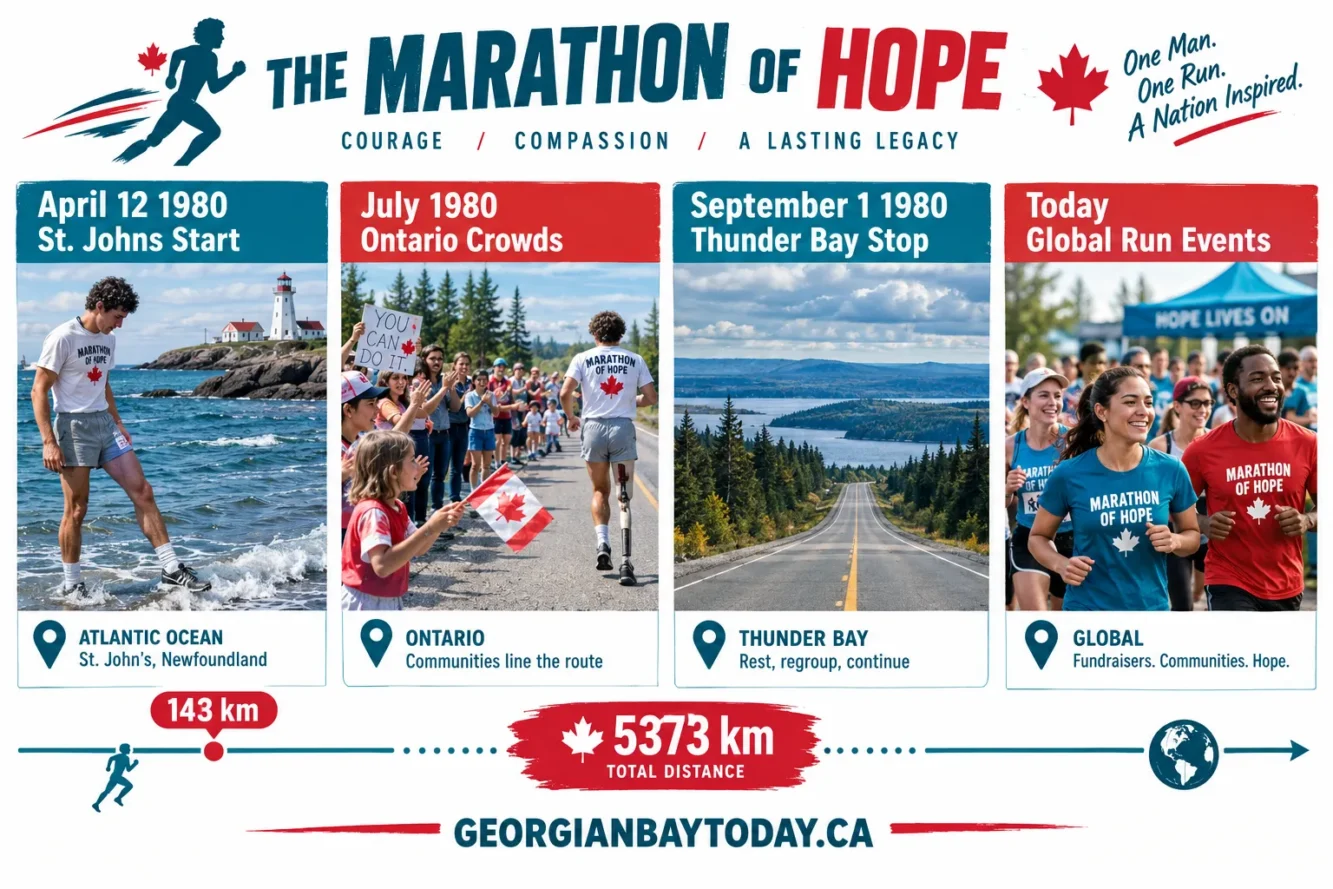
The Marathon of Hope is one of the most carefully documented athletic and humanitarian journeys in Canadian history. Terry Fox ran every day from April 12, 1980, through September 1, 1980, covering ground from the Atlantic coast to the Canadian Shield of northern Ontario.
Here is a look at key milestones from the run:
- April 12, 1980, Terry dips his prosthetic leg into the Atlantic Ocean at St. John’s, Newfoundland, and begins running west. This is the official start of the Marathon of Hope.
- April 21, 1980, Terry reaches Gambo, Newfoundland, completing his first full week on the road.
- April 26, 1980, He arrives in Gander, Newfoundland, averaging over 40 kilometres per day.
- April 30, 1980, Terry crosses into Nova Scotia after completing Newfoundland.
- May 6, 1980, He runs through Truro, Nova Scotia, gaining early media attention.
- May 7, 1980, Terry reaches Amherst, Nova Scotia, on the border with New Brunswick.
- May 11, 1980, He enters New Brunswick, continuing his relentless westward pace.
- May 15, 1980, Terry runs through Moncton, New Brunswick, where crowds begin to gather.
- May 18, 1980, He reaches Fredericton, the provincial capital of New Brunswick.
- May 20, 1980, Terry crosses into Quebec, having already covered hundreds of kilometres.
- May 25, 1980, He runs through Quebec City, where public support begins to surge.
- May 26, 1980, Terry continues west through the Quebec countryside, logging another full marathon distance.
- May 29, 1980, He approaches the Ontario border, having crossed three Atlantic provinces.
- June 1, 1980, Terry enters Ontario, the most populous province in Canada, and the public response intensifies.
- June 3, 1980, He runs through Hawkesbury, Ontario, with growing media coverage.
- June 6, 1980, Terry reaches Ottawa, the nation’s capital, where he is welcomed by thousands.
- June 7, 1980, He runs through the Ottawa region, meeting supporters and dignitaries.
- June 8, 1980, Terry continues west through eastern Ontario.
- June 10, 1980, He passes through Kingston, Ontario, on his way toward Toronto.
- June 15, 1980, Terry runs through the Greater Toronto area, where massive crowds line the route.
- June 22, 1980, He continues through southern Ontario, passing through Hamilton and surrounding communities.
- June 28, 1980, Terry reaches London, Ontario, completing another week of marathon-distance running.
- June 29, 1980, He runs through communities west of London, heading toward the Great Lakes region.
- July 1, 1980, Terry celebrates Canada Day on the road, a moment that resonated deeply with Canadians watching from coast to coast.
- July 5, 1980, He continues north and west through Ontario, logging consistent daily kilometre totals.
- July 6, 1980, Terry runs through Sudbury, Ontario, entering the Canadian Shield.
- July 9, 1980, He pushes through difficult terrain north of Lake Superior.
- July 10, 1980, Terry continues along the Trans-Canada Highway through northwestern Ontario.
- July 11, 1980, He runs through communities approaching Thunder Bay, Ontario, still covering roughly 42 kilometres every day.
By the time Terry reached the outskirts of Thunder Bay in late August and early September 1980, he had run 5,373 kilometres, more than any reasonable person could have imagined when he first stepped into the Atlantic Ocean that April.
What Stopped Terry Fox and What Happened Next
On September 1, 1980, Terry Fox was forced to stop running near Thunder Bay, Ontario, when doctors discovered that his cancer had spread to his lungs. He had run 5,373 kilometres, an average of 42 kilometres per day for 143 consecutive days. He held a tearful press conference and told Canadians he would return to finish the run once he recovered.
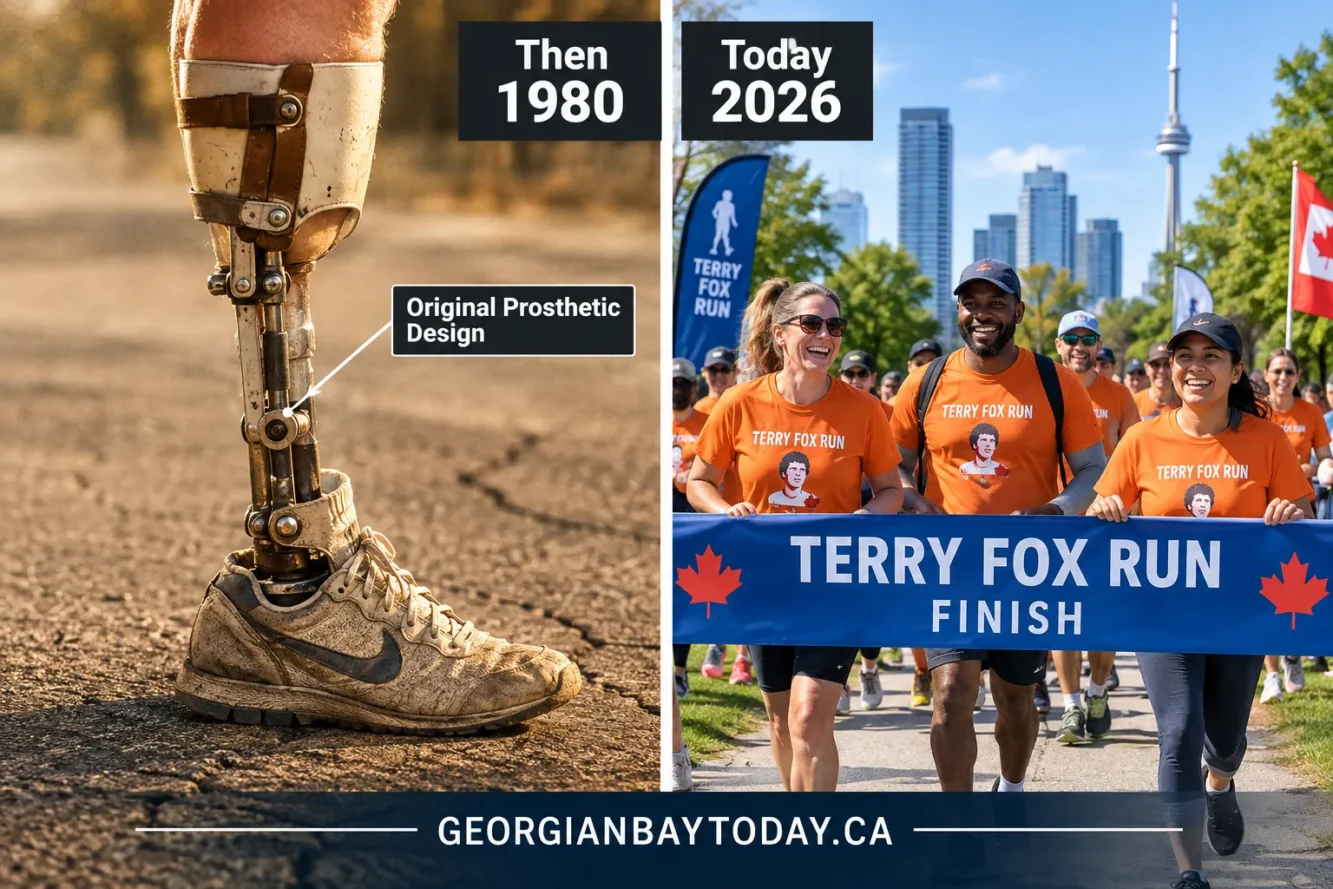
Terry Fox passed away on June 28, 1981, at the age of 22, one month before his 23rd birthday. He never got to finish the run, but his legacy was already set in motion. The CBC has documented how his story galvanized a nation and sparked one of the most enduring charitable movements in Canadian history. His prosthetic leg, a rudimentary artificial limb by today’s standards, became a symbol of human resilience that still resonates in 2026.
How Far Did Terry Fox Actually Run and What Type of Prosthetic Did He Use
Terry Fox ran 5,373 kilometres, covering the equivalent of a full marathon every single day for 143 days. He used a custom-built artificial leg with a simple mechanical design, far less advanced than modern prosthetics. The limb caused him significant pain and required constant adjustment, yet he ran on it day after day without complaint.
His prosthetic was developed specifically for the run and was not designed for the kind of repetitive impact that marathon running demands. Sports medicine experts today note that the physical toll on Terry’s body was extraordinary. Despite this, he averaged approximately 42 kilometres per day, a feat that elite athletes with two healthy legs would find challenging.
The Birth of the Annual Terry Fox Run
The first official Terry Fox Run was held on September 13, 1981, just months after Terry’s death, and drew more than 300,000 participants across Canada. It was organized to fulfil his wish that the run, and the fundraising for cancer research, would continue in his name.
Today, the Terry Fox Run takes place every September across nearly 600 communities in Canada and in dozens of countries around the world. The 2026 event marks the 46th annual run. Participants can run, walk, cycle, or roll, there are no registration fees and no minimum donation. The event is open to everyone, from school children to seniors, from competitive runners to wheelchair users.
The Terry Fox School Run is a separate program that allows students to participate during the school year. The school run program reaches hundreds of thousands of students annually and is one of the most recognized school fundraising events in Canada.
How Much Money Has the Terry Fox Run Raised in Total
More than C$1 billion has been raised in Terry Fox’s name since 1980, a milestone announced in 2025 and confirmed through the 2026 fundraising cycle. This makes the Terry Fox Run one of the most successful charitable fundraising campaigns in Canadian history and the world’s largest one-day cancer research fundraiser.
According to the Terry Fox Foundation’s impact report, funds raised through the run are directed to the Terry Fox Research Institute and to cancer research projects at universities and hospitals across Canada. The 2022-2023 impact report confirmed that run revenues supported dozens of active research projects. Individual communities set ambitious goals: for example, the Kenora, Ontario, Terry Fox Run set a $1 million fundraising goal for a recent event, reflecting the scale of community commitment.
The Terry Fox Foundation’s impact hub provides a live view of how funds are being used today, including research milestones and community fundraising totals.
Why Is the Terry Fox Run Still Happening Today
The Terry Fox Run continues in 2026 because cancer research still needs funding, and because Terry’s story continues to inspire new generations of participants, volunteers, and donors. The run is not just a fundraiser, it is a cultural institution in Canada that connects communities, schools, and families to a shared purpose.
The Terry Fox Foundation’s powering progress report outlines how modern cancer research funded through the run is producing real results, including advances in genomics, immunotherapy, and precision oncology. In communities like Prince Albert, Saskatchewan, cancer survivors participate in the run as a deeply personal act of hope and solidarity.
The hashtag #tryliketerry has become a rallying cry on social media platforms including Facebook, Twitter, Instagram, LinkedIn, YouTube, and TikTok, helping the Terry Fox Foundation reach new audiences every year. The tryliketerry terry journal program encourages participants to document their experience, an audio archive tryliketerry maintains as part of its digital outreach. The 8221 tryliketerry terry journal entries collected over the years form a remarkable archive tryliketerry uses to share personal stories of motivation and loss.
Terry Fox Run Events Near Me in 2026: How to Find and Join One
The 2026 Terry Fox Run takes place in September across nearly 600 Canadian communities and dozens of international locations. Finding a run near you is straightforward through the Terry Fox Foundation’s official website, which lists every registered event by city and province.
- Canada: Events run from Vancouver, British Columbia, to St. John’s, Newfoundland, including major runs in Toronto, Ottawa, and communities across Ontario, Alberta, and Quebec.
- Terry Fox Run Vancouver: One of the largest urban events, held at Jericho Beach.
- Terry Fox Run Toronto: Held at various locations across the Greater Toronto Area.
- International: Events are held in the United States, Europe, and Asia through Canadian embassies and expatriate communities.
If there is no run in your area, the Terry Fox Foundation encourages individuals to organize their own community event. The About Us Contact Us section of the foundation website (available in both English and français) provides guidance for new organizers. Contact fran ais options are available for francophone communities across Canada.
How to Organize a Terry Fox Run in Your Community
Organizing a Terry Fox Run is open to anyone, a school, a workplace team, a neighbourhood group, or a single motivated individual. The Terry Fox Foundation provides a full organizer toolkit through its website, covering everything from route planning to volunteer recruitment.
Key steps to organize a run:
- Register your event on the Terry Fox Foundation website under “Other Events Ways to Give.”
- Set a fundraising goal and create a team page.
- Recruit volunteers to manage the route, registration table, and participant support.
- Promote the event through local school networks, social media, and community boards.
- Collect donations online or in person, every dollar goes to cancer research through the Terry Fox Research Institute.
The Give Your Impact Shop and Merchandise Terry section of the foundation website also allows organizers to order official run materials. The Impact Donate Give Today page makes it easy for participant and team donors to give today. Student and school organizers can access the Terry Fox School Run program separately, which provides age-appropriate resources for classroom and school-wide events.
The run participant team structure is flexible: a run participant can join as an individual, form a team, or donate their time as a volunteer. There are no registration fees, and the Give Today option is available year-round through the foundation’s website.
Can You Do the Terry Fox Run Virtually or Online
Yes, virtual participation in the Terry Fox Run is fully supported. Participants who cannot attend an in-person event can run, walk, or cycle any distance on their own, log their kilometres, and raise funds online through the Terry Fox Foundation’s digital platform.
Virtual participation became a major feature of the run during the COVID-19 pandemic and has remained a permanent option. The 2022 impact report confirmed that virtual participants contributed significantly to total fundraising in recent years. Today, virtual runners can use the tryliketerry terry journal feature to share their experience and connect with the broader community.
Terry Fox Run vs. Other Charity Runs: What Makes It Different
The Terry Fox Run stands apart from other charity runs in several important ways. There are no registration fees, no corporate sponsorship logos on race bibs, and no competitive timing, the focus is entirely on fundraising for cancer research, not on athletic performance.
| Feature | Terry Fox Run | Typical Charity Run |
|---|---|---|
| Registration fee | None | Often $30,$100 |
| Corporate branding | Minimal | Common |
| Competitive timing | No | Often yes |
| Research focus | 100% cancer research | Varies |
| School program | Yes | Rare |
| Virtual option | Yes | Sometimes |
This model has allowed the Terry Fox Run to maintain its integrity and community focus for over four decades. The CTV News coverage of the 44th annual run noted that hundreds of participants in Winnipeg alone turned out without any competitive incentive, simply to give to cancer research in Terry’s name.
How Can I Participate in the Terry Fox Run if I Have a Disability
The Terry Fox Run is one of the most inclusive charity events in Canada. Participants can walk, run, cycle, use a wheelchair, or complete any form of physical activity, the distance and pace are entirely up to the individual.
Terry Fox himself ran on a prosthetic leg, and his example has always made the run a welcoming space for people of all abilities. Schools, community centres, and run organizers are encouraged to accommodate participants with disabilities, and the virtual run option ensures that anyone who cannot travel to an event location can still take part and raise funds from home. The school run program also includes adaptive physical education options for students with disabilities.
FAQ
How far did Terry Fox actually run?
Terry Fox ran 5,373 kilometres during his Marathon of Hope in 1980, covering an average of approximately 42 kilometres per day for 143 consecutive days. He started in St. John’s, Newfoundland, on April 12, 1980, and was forced to stop near Thunder Bay, Ontario, on September 1, 1980, when cancer spread to his lungs.
What date is the Terry Fox Run?
The Terry Fox Run is held every year in September, typically on the second Sunday of the month. In 2026, the run takes place across nearly 600 communities in Canada and dozens of international locations. School runs often take place during the school week leading up to or following the main event. Check the Terry Fox Foundation website for the exact date in your community.
What were Terry Fox’s last words?
Terry Fox did not leave a single set of documented “last words” in the way the question implies. At his emotional press conference on September 1, 1980, when he was forced to stop running near Thunder Bay, Ontario, he told Canadians: “I just wish people would realize that anything is possible if you try.” He passed away on June 28, 1981, at age 22. His words and example continue to inspire millions today.
Has anyone completed Terry Fox’s run?
Yes. In 2005, athlete and amputee Jeff O’Brien completed a cross-country run in Terry Fox’s honour. Several other runners and teams have also attempted or completed coast-to-coast runs to continue Terry’s legacy. However, none of these runs are considered official completions of the original Marathon of Hope, that route remains Terry’s alone. The Terry Fox Foundation honours these efforts as tributes rather than continuations.
Conclusion
The story of the Terry Fox Run is, at its core, the story of one person’s refusal to accept that cancer would have the final word. Terry Fox ran across Canada in 1980 on a prosthetic leg, averaging a full marathon every single day, because he believed that research could change outcomes for future patients. He was right, and the more than C$1 billion raised in his name since then is proof.
In 2026, the run is bigger than ever, with nearly 600 communities across Canada and participants around the world taking part every September. Whether you run, walk, volunteer, or simply donate, there are no barriers to joining this movement.
What to do today:
- Visit the Terry Fox Foundation website to find a Terry Fox Run near you or register a new event.
- Use #tryliketerry on social media to connect with the global community.
- Encourage your local school to sign up for the Terry Fox School Run program.
- Donate directly through the Impact Donate Give Today page if you cannot attend in person.
- Share Terry’s story, because every new person who hears it is a potential future participant, volunteer, or donor.
Terry Fox ran so that others might live longer, healthier lives. Today, the best way to honour that is to keep running.
Content, illustrations, and third-party video appearing on GEORGIANBAYNEWS.COM may be generated or curated with AI assistance or reproduced pursuant to the fair dealing provisions of the Copyright Act, R.S.C. 1985, c. C-42. Attribution and hyperlinks to original sources are provided in acknowledgment of applicable intellectual property rights. Such referencing is intended to direct traffic to and support the original rights holders’ platforms.