




















🏡 When Your Home Sits on the Market, What Is the Market Telling You | Rick Crouch
by Rick Crouch | Real Estate General, Real Estate Help Tips, Real Estate Selling
Your home has been listed for weeks or perhaps even months, the offers haven’t materialized and showings have been minimal. What are Buyers seeing that you may not be seeing?
Selling a home in today’s real estate market is very different from selling during the highly competitive markets of 2020 and 2021, when limited inventory, exceptionally low interest rates and intense Buyer demand often resulted in multiple offers and sales above asking price.
Today, Buyers have more choices and they have more information at their disposal. Smart Buyers and the Realtors® advising them are paying close attention to a property’s MLS® history. Buyers can see more than you might think and their Realtor® can certainly advise them of any pertinent information they should know.
When a property has been listed for some time, Buyers and their real estate representatives can often review its listing’s MLS® history, including:
- When it was originally listed
- The original asking price
- Any subsequent price reductions
- How long it has been on the market
- Whether a listing has expired or been cancelled and relisted
- Previous listing prices
- When the property last sold
- What it sold for
- How its current asking price compares with its previous sale
- How the property has performed relative to comparable homes
This doesn’t necessarily mean Buyers will view a property negatively. But it does mean they may or will have questions.
What happens when a home sits on the market?
Initially, a new listing attracts attention because it is new. The first week or two on the market is critical Buyers who have been watching the market may be among the first to see it. Your property may receive showings, online views via realtror.ca and other online websites as well as inquiries.
If the property doesn’t sell, however, something changes. The listing becomes less “new.”
Buyers who initially considered it may move on to other properties. New listings enter the market. Comparable properties may sell and Buyers begin to develop a perception of the property based on what they are seeing or, sometimes what they are not seeing.
Eventually, a property that has been available for a long time can become known as “the house that’s been sitting.” On of the first questions I often receive from a Buyer(s) when showing a property is “How long has it been listed?” Depending on the length of a listing, the Buyer’s perception can influence both their interst in a property as well as their approach to negotiating an offer.
The questions smart Buyers may be asking
An experienced Buyer’s agent may start asking: Why hasn’t this property sold? Is it the price?
- Is there something about the property that isn’t apparent from the photographs?
- Is there a condition issue? Is the location limiting demand? or is the layout less desirable than competing properties?
- Are there deficiencies revealed through inspection?
- Or perhaps the property is simply priced above what today’s Buyers are prepared to pay.
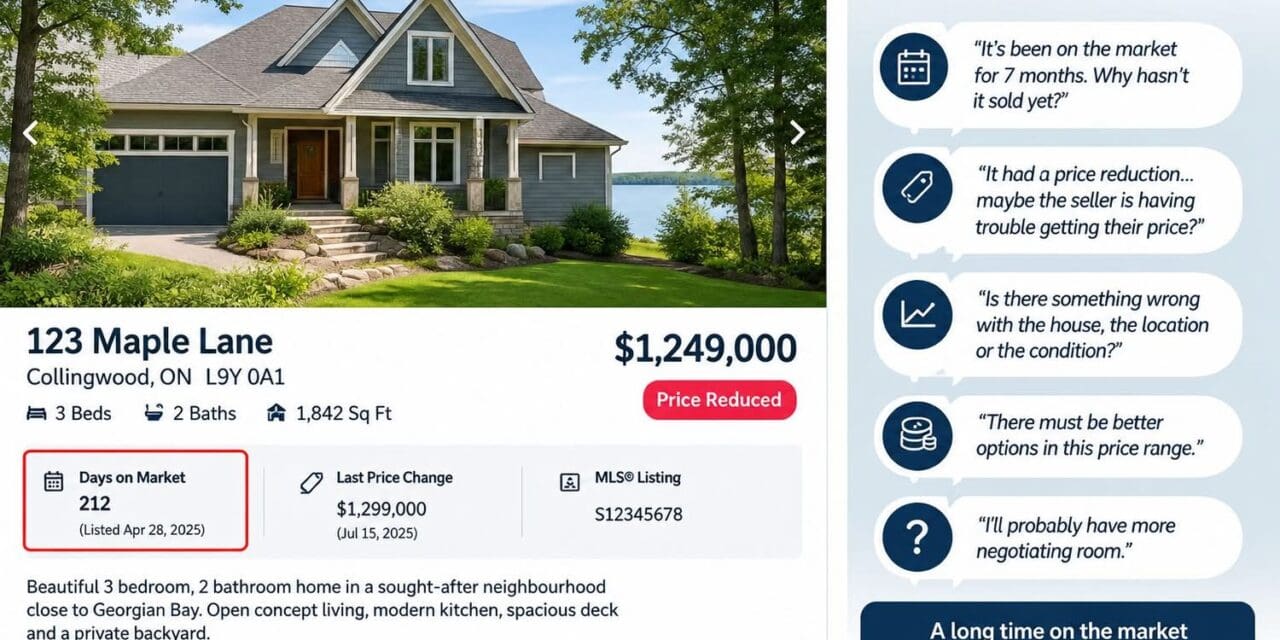
None of these assumptions is necessarily correct. Below is the image a Buyer may see in their mind and thew questions they may be asking themselves and perception is not necessarily reality.

The Image a Buyer May See
When a property remains unsold, Buyers have an opportunity to investigate and/or ask questions as to why. And once Buyers believe there is a reason a property hasn’t sold, that perception can become part of the negotiation or they may simply choose to move on to something else without even booking a showing to view it first hand.
Price reductions can create another signal
Price reductions are a normal part of real estate as markets change. Sellers reassess their sale needs and objectives. Buyers‘ expectations change. And sometimes the original pricing strategy simply doesn’t produce the desired result.
Worse, multiple reductions can create an unintended message. For example:
Listed at $1,099,000 → reduced to $1,049,000 → reduced to $999,000
A Buyer may reasonably wonder: “If the Seller has already reduced the price twice, how much more room is there, are they more motivated or?”
Rather than seeing the current asking price as the property’s true market value, the Buyer may see it as the starting point for negotiation. That doesn’t mean a price reduction is necessarily a mistake. It means that how and when you adjust the price matters.
The danger of “chasing the market down.”
One of the most difficult decisions for a Seller is recognizing that the market may not support the price they originally had in mind. Some Sellers respond by making small reductions and waiting to see what happens. If nothing happens, they reduce it again and again.
The problem is that the market doesn’t necessarily respond to incremental reductions.
A property that is priced significantly above its competitive market may receive little attention at $1,049,000 compared with $999,000 even though the difference is only $50,000.
The objective isn’t simply to reduce the price. The objective is to position the property where today’s Buyers recognize its value.
Days on market (DOM) become part of the conversation. Further, DOM is not inherently negative as some properties legitimately take longer to sell especially those in the higher price segments ie: over $2 million or those with unique features that may appeal to a smaller Buyer market.
A unique waterfront property, luxury home, acreage or highly specialized property may have a relatively small pool of qualified buyers. Finding the right Buyer can take time.
The chart below illustrates how DOM has changed in the Southern Georgian Bay area in the last 5 years through to the end of August.

Days-On-Market 2022 to 2026
But DOM becomes increasingly relevant when a property has been exposed to the market long enough whereby many of the potential Buyers have already seen it. At that point, simply waiting longer may not change the outcome.
The question becomes: What new information, price, presentation or strategy will cause the next Buyer to act differently from the Buyers who have already passed?
Sometimes the market is giving you valuable information This is perhaps the most important point for Sellers to understand. Your asking price is an opinion perhaps your’s or that of your Realtor®.
Conversely, the market’s response is information. If a properly marketed property receives very little activity, few showings and no offers over an extended period, that response deserves attention.
It doesn’t automatically mean the property is overpriced, but it does suggest that something about the current price, the listing’s presentation, condition, positioning or marketing strategy may not be connecting with enough qualified Buyers.
The market may effectively be saying: “At this price, Buyers are not convinced the value is there.”
That’s useful information, don’t take it personally. Selling a home can be emotional. You’ve invested money, time often in the form of “sweat equity” and memories into the property. You know its improvements, its features and everything that makes it special.
A potential Buyer, however, doesn’t have that history or emotional connection. They are comparing your property against every other property they can buy with their available budget.
Their question for Buyer isn’t: “What is this home worth to the Seller?” Their question is: “Is this the best use of my money compared with my alternatives?” That distinction is fundamental to today’s market, a market that has changed from the COVID 19 pandemic condtions of strong demand, low mortgage rates and property inventory that was listed for sale.
So, what should a Seller do?
If your property has been on the market longer than expected, don’t simply react by making another arbitrary price reduction. Step back and conduct a fresh market assessment.
This needs to include:
- The competition
What similar properties are currently available? Are they priced below you? How do their condition, features, location and presentation compare? - What properties have sold
What are Buyers actually paying not just what Sellers are asking? This should include the “list-to-sale” price ratios ie: the percentage of what those properties sold for versus their asking price - Your property’s MLS® history
How long has it been exposed to the market? Have there been price changes? Has it previously been listed? What does the history tell a Buyer? - Feedback from showings
Are Buyers consistently identifying and reacting to the same concerns? - Your property’s presentation
Photography, staging, repairs, cleanliness, landscaping and overall presentation can influence whether Buyers move from interest to action. - Your pricing strategy
Is the property positioned to attract today’s Buyers, or is the price based primarily on what you believe the property should be worth, what you want or need to get? Frankly, none of that matters in the eyes of potential Buyers. - The strategy, not just the price
Sometimes the answer isn’t simply “reduce the price.” It may involve repositioning the property, improving its presentation, changing the marketing approach or reassessing the target Buyers.
NOTE: Switching your listing from one real estate company/brand and or agent to another without addressing fundamental issues such as the property’s price, condition etc. may/will have little impact on improving your selling success.
What is the market telling you?
A home that sits on the market isn’t necessarily a problem, but it is information.
The longer a property remains unsold, the more opportunity Buyers have to study its history, compare it with alternatives and form an opinion about why it hasn’t sold.
If the market isn’t responding, the solution isn’t necessarily to wait longer and hope something changes.
Instead, you need to ask: What has the market told us so far? Then use that information to make an informed adjustment.
In today’s market, successful selling isn’t simply about putting a property on MLS® and waiting for a Buyer. It is about understanding the market, interpreting the feedback and making strategic decisions based on evidence.
The Bottom Line
If your home has been on the market for weeks or months without selling, don’t ignore the signal. The market may be telling you that the price, presentation, positioning or some combination of the three needs to be reconsidered.
The answer isn’t always a lower price, but there is always a reason for the lack of response, and understanding that reason is the first step toward changing the outcome.
The goal isn’t to “chase the market down.” With over 25 years experience I have learned that is a situation no Seller can afford to or should put themselves in. The only approach is to position your property correctly where the market is today and one which will capture the attention or a worthy and willing Buyers.
That is where experienced, objective advice from a Realtor® that knows your market area can make a significant difference.
Trusted Advice Generates Elevated Results
NOTE: The author is a Broker, Market Value Appraiser-Residential with Sotheby’s International Realty Canada and a Past President (2008) of the One Point Association of REALTORS®. 📧 rcrouch@sothebysrealty.ca Direct 📞 705-443-1037
This post is not intended to solicit homes or other properties already listed for sale on the MLS® System.