

















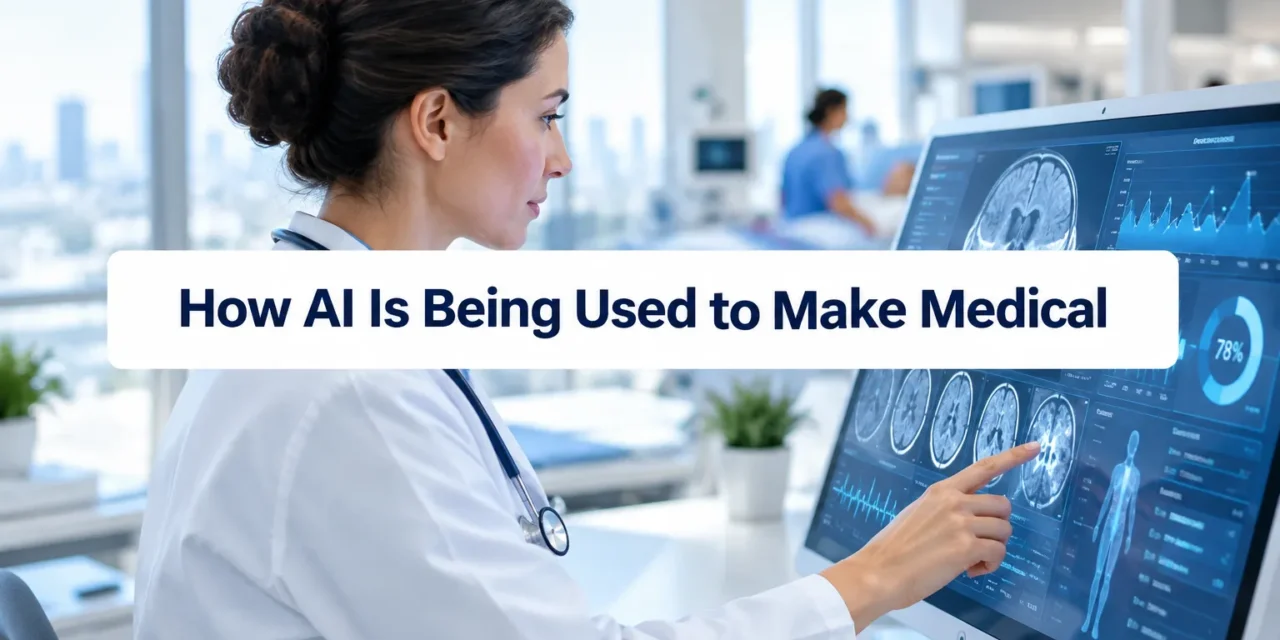
🩻 How AI Is Being Used to Make Medical Decisions, and What Patients Should Ask
Last updated: October 24, 2026
Quick Answer
AI now supports diagnosis, risk scoring, documentation, and treatment planning in thousands of clinics and hospitals, but it almost always works alongside a licensed clinician rather than replacing one. Patients should ask whether AI was used in their care, how accurate it is for their condition, who reviews its output, and what happens if they decline it.
Key Takeaways
- Regulators have cleared more than 1,600 AI-enabled medical devices, most built for decision support rather than autonomous diagnosis [1].
- AI performs well in narrow tasks like image screening but is inconsistent across broader clinical decisions [2].
- Clinical decision support tools must still be reviewed by a human provider in nearly all current use cases [3].
- AI documentation tools (“scribes”) are spreading fast but show measurable error rates that can affect notes and billing [4].
- Patients can ask three core questions: Was AI involved? How was it checked? What’s my opt-out option? [5]
- Professional groups, including the AMA, say patients should use AI chatbots to prepare for appointments, not to replace medical advice [6].
- Bias in training data can skew results for women, older adults, and people of color, so context matters [2].
- Insurers can and do use AI in coverage decisions, and patients have a right to ask about and appeal those decisions [7].
What types of medical decisions is AI being used for right now
AI currently supports four main categories of medical decisions: image-based diagnosis, risk prediction, clinical documentation, and treatment recommendation. It is used across radiology, pathology, cardiology, oncology, and primary care workflows [1].
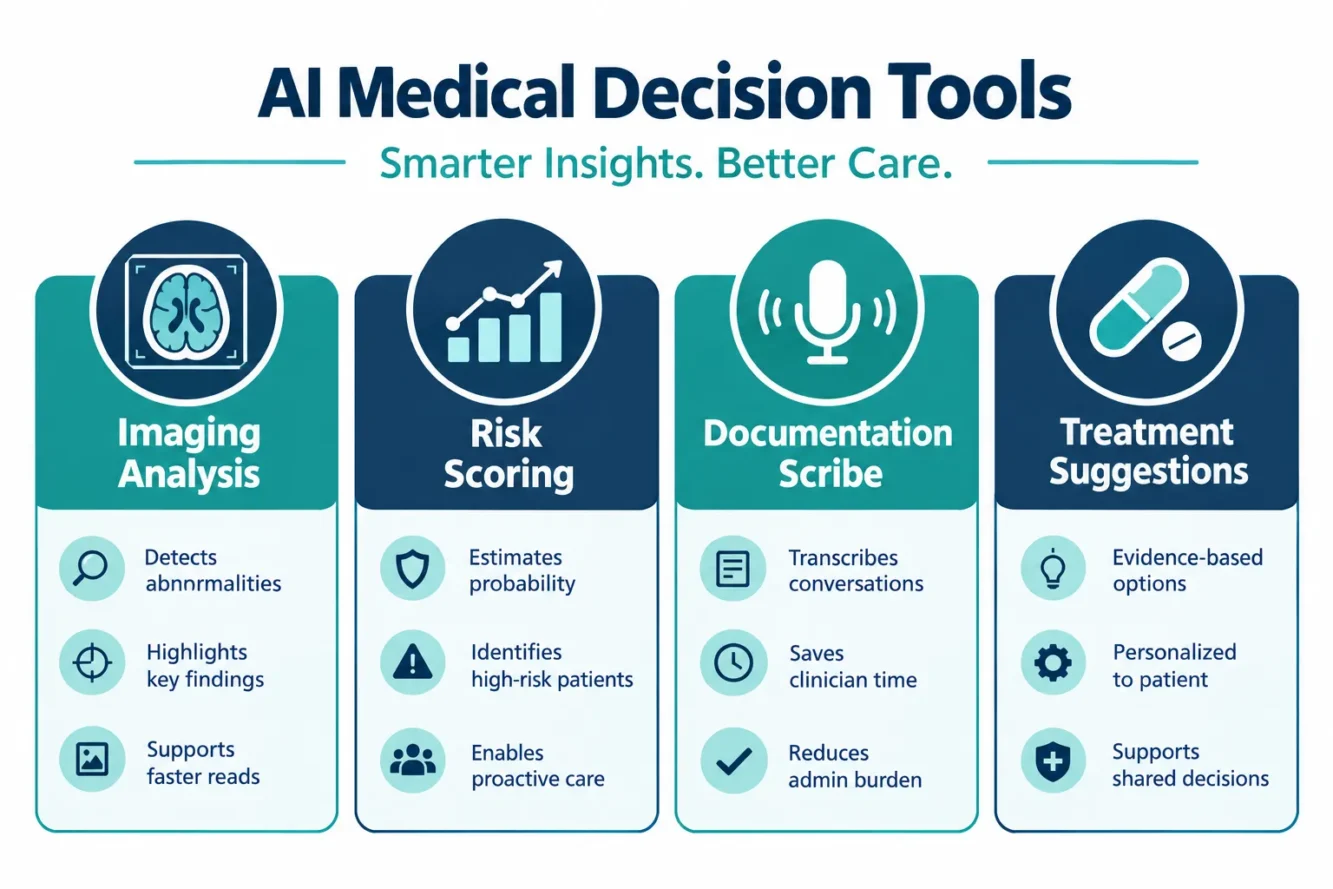
Common applications include:
- Image analysis: spotting tumors, fractures, or diabetic retinopathy in scans
- Risk scoring: predicting sepsis, readmission, or heart failure before symptoms worsen
- Documentation: AI scribes that draft visit notes from conversations
- Treatment support: dosing calculators and drug-interaction alerts tied to electronic health records
Choose to ask your provider directly if a scan or lab result was reviewed with software support, since this is now common in large health systems and most patients are never explicitly told.
How accurate is AI compared to doctors at diagnosing diseases
AI can match or exceed physician accuracy for narrow, well-defined tasks like detecting specific patterns in medical images, but it performs less reliably across the full range of clinical judgment doctors apply daily. Evidence that AI decision support actually improves patient outcomes remains limited and inconsistent across studies [2].
A common mistake is assuming a high accuracy rate on a research dataset means the same performance in a real clinic. Models trained on one hospital’s patient population can perform worse elsewhere. Ask your doctor whether the AI tool used in your diagnosis was validated on patients similar to you in age, ethnicity, and health history.
What questions should I ask my doctor about AI in my care
Three questions cover most of what matters: Was AI used in my diagnosis or treatment plan? How confident is the tool, and did a human double-check it? What would change if I asked for a fully human-reviewed second opinion? Ethicists consistently point to these same three core questions as the baseline for informed consent involving AI [5].
Additional questions worth asking:
- What data trained this tool, and does it include people like me?
- Is this tool FDA-cleared, and for what specific use?
- Can I request my case be reviewed without AI involvement?
- How is my health data stored and shared when AI tools process it?
What are the main risks and errors with AI in healthcare
The biggest risks are automation bias, documentation errors, and overreliance on tools that were never designed to make final decisions. AI scribes, for example, are scaling quickly but show error rates that can distort clinical notes or missed details [4].
Edge case: a tired clinician under time pressure may accept an AI suggestion without fully verifying it, this is automation bias, and it’s a recognized concern even in well-designed multi-agent AI systems built to support rather than replace doctors [2]. Mistake to avoid: never assume a note or treatment plan generated with AI assistance is automatically correct just because it looks polished.
How can AI bias affect my medical diagnosis and treatment
AI bias happens when a tool was trained mostly on data from one group, making it less accurate for patients outside that group, such as women, older adults, or people of color. This can lead to missed or delayed diagnoses for underrepresented populations [2].
Decision rule: if you belong to a group historically underrepresented in medical research, ask specifically whether the AI tool used in your case was tested on a population similar to yours. If your provider can’t answer, that’s a signal to request additional human review.
Can AI replace doctors or is it just a tool to help them
AI is currently built to assist clinicians, not replace them. Nearly all FDA-cleared AI medical devices are decision-support tools requiring a licensed professional to interpret and act on results [1][8].
Commercial AI systems, including newer multi-agent designs, are explicitly engineered to support clinical workflows rather than operate independently, largely because of the automation bias risk and the current limits of real-world accuracy [2]. Full autonomy in diagnosis or treatment remains rare and tightly regulated.
What medical conditions is AI best at detecting
AI performs strongest in pattern-recognition tasks with clear visual or numeric signals, such as diabetic eye disease, certain skin cancers, lung nodules on CT scans, and heart rhythm abnormalities on ECGs. These are conditions with large, well-labeled training datasets.
AI is weaker at conditions requiring nuanced judgment, such as mental health diagnoses, complex multi-symptom cases, or rare diseases with limited data. Choose a second human opinion if an AI-assisted result touches a rare or ambiguous condition.
Which hospitals and clinics are using AI for patient decisions
Large academic medical centers and health systems are the most common adopters, typically through radiology, pathology, and electronic health record platforms like those built by major clinical software vendors [3]. Smaller clinics increasingly use AI documentation tools even if they don’t use diagnostic AI.
There is no single public registry of every clinic using AI, but patients can ask directly at check-in or during visits whether AI tools are part of their diagnostic or documentation workflow.
How do I know if my doctor is using AI to make decisions about me
The most reliable way is to ask directly, since disclosure is not always automatic or required in every state or system. Say something like: “Was any AI software involved in reviewing my scan, lab, or treatment plan?”
Watch for indirect signs too: automated risk alerts in patient portals, AI-generated visit summaries, or dosing suggestions flagged as “decision support” in your chart. If your notes seem unusually fast or detailed, ask if an AI scribe was used [4].
What should patients know about AI before agreeing to it
Patients should know that AI tools are decision support, not final authority, and that a human clinician is expected to review and confirm any AI-generated suggestion before it affects care [3]. Consumer health guidance consistently warns against changing medications or treatment plans based on AI output alone, including popular chatbots [6][9].
Before agreeing to an AI-assisted test or tool, confirm: Is it FDA-cleared for this specific use? Who reviews the result? What’s the fallback if it’s wrong?
Are there situations where AI shouldn’t be used in healthcare
Yes. AI should not be the sole basis for emergency decisions, rare disease diagnosis, mental health crises, or any situation requiring nuanced ethical judgment. New FDA guidance has also narrowed what legally counts as regulated “clinical decision support” versus unregulated wellness apps, meaning some consumer AI tools carry no formal safety review at all [8].
Edge case: AI chatbots marketed for general wellness are not held to the same standard as cleared medical devices. Never use a general consumer chatbot as a substitute for a licensed provider’s judgment in an urgent situation [6].
How do I opt out or decline AI-assisted medical decisions
Patients generally have the right to request a fully human-reviewed diagnosis or treatment plan, though the process varies by health system. Ask your provider in writing if you want it documented in your chart that you decline AI-assisted review for a specific decision.
Decision rule: if a hospital cannot clearly explain how to opt out, request the request be escalated to patient relations or a hospital ombudsperson in writing.
What’s the difference between AI for diagnosis versus treatment
Diagnostic AI analyzes data, like images or lab values, to flag a possible condition, while treatment AI suggests a course of action, like medication dosing or care pathways, once a diagnosis is established. Both categories require clinician sign-off under current regulatory frameworks [1][3].
| Feature | Diagnostic AI | Treatment AI |
|---|---|---|
| Main task | Detect patterns in scans, labs, data | Suggest dosing, pathways, next steps |
| Example | Flagging a lung nodule on CT | Recommending insulin dose adjustment |
| Risk focus | Missed or false-positive findings | Wrong dosage or care pathway |
| Oversight needed | Radiologist or specialist review | Prescribing clinician confirmation |
Can insurance companies use AI to deny coverage or treatment
Yes, insurers can use AI to help process coverage decisions, including prior authorization and claims reviews, and this has drawn increased regulatory and congressional attention [7]. Patients have the right to ask whether AI was involved in a denial and to appeal that decision through a human reviewer.
If you receive a coverage denial, ask the insurer directly: “Was this decision made or assisted by an algorithm, and can I request a human-only review?” Federal policymakers continue to examine transparency requirements here [7].
Conclusion
AI is already woven into diagnosis, documentation, risk scoring, and treatment planning across many hospitals and clinics, but it remains a support tool layered under human clinical judgment, not a replacement for it. The clearest path to safe, informed care is simple: ask whether AI was used, ask how it was checked, and ask what your options are if you want a fully human review. Regulators and professional bodies expect more transparency and accountability around these tools going forward, but until standards catch up, patients carry much of the responsibility for asking the right questions [5][10].
Next steps: before your next appointment, write down the three core questions above, ask your provider plainly about AI involvement, and request documentation of any AI-assisted decision in your medical record for future reference.
For related reporting and community context, see coverage on topics like job search strategies, kindness in community care, and connection in patient-provider relationships.
FAQ
Is AI legally allowed to make a final medical diagnosis without a doctor?
No. Nearly all FDA-cleared AI tools require a licensed clinician to review and confirm results before they affect patient care [1].
Can I ask my doctor to skip AI tools entirely?
Yes, you can request a fully human-reviewed diagnosis or treatment plan, though the process for documenting this varies by provider and health system.
Do AI chatbots like ChatGPT count as medical advice?
No. Health organizations recommend using AI chatbots only to prepare questions or understand terms, not as a substitute for a clinician’s judgment [6][9].
Are AI medical tools regulated the same as other medical devices?
Not always. New FDA guidance narrows what counts as regulated clinical decision support versus unregulated consumer wellness tools, so oversight varies [8].
Can AI bias affect my diagnosis if I’m not in the majority group studied?
Yes. Tools trained mostly on one demographic can be less accurate for underrepresented groups, so ask if the tool was validated on patients like you [2].
Can insurance companies use AI to deny my claim?
Yes, and you have the right to ask whether AI was involved and to request a human-only appeal of that decision [7].
What’s the safest way to use AI during my own research before an appointment?
Use it to organize questions and understand medical terms, not to self-diagnose or adjust medication on your own [6][10].
References
- Artificial Intelligence Enabled Medical Devices. fda.gov.
- Nature Article D41591-026-00040-4. nature.com.
- Clinical Decision Support. elsevier.com.
- JMIR 2026;1:e98630. jmir.org.
- New AMA Infographic Helps Patients Safely Navigate AI Healthcare. ama-assn.org.
- AI in Healthcare: Can a Chatbot Answer Your Medical Questions. health.harvard.edu.
- Congressional Research Service Report. congress.gov.
- Guidances Digital Health Content. fda.gov.
- Using AI Health Questions. health.yahoo.com.
- 5 Prompts Help Patients Get Most Out of AI Chatbots. ama-assn.org.
Meta Title: How AI Makes Medical Decisions: Questions Patients Should Ask
Meta Description: Learn how AI is used in diagnosis, treatment, and insurance decisions, plus the key questions patients should ask their doctor in 2026.
Tags: AI in healthcare, medical decision support, patient advocacy, clinical AI, diagnostic AI, healthcare bias, AI chatbots, patient rights, AI regulation, treatment planning, medical privacy, FDA medical devices