

















🤖 What Is an AI Agent? A Plain-English Guide to Autonomy, Permissions, Monitoring and Failure Risks
Last updated: November 3, 2026
Quick Answer
An AI agent is a software system that can decide its own next steps and act on tools, apps, or accounts, inside limits a human sets up front. That’s the core answer to what is an AI agent in plain terms: autonomy plus permission. Unlike a chatbot, which only replies to messages, an agent can book something, send something, or change something on its own, which is why governance questions around monitoring and failure risk matter so much.[1]
Key Takeaways
- An AI agent combines decision-making autonomy with real access to tools and accounts, not just conversation.[1]
- Autonomy works best as a dial, not a switch: low-risk tasks can run freely, high-risk ones need a human checkpoint.[1][2]
- Each agent should get its own narrow identity and permissions, never broad, all-access control.[3][4]
- Continuous monitoring, not occasional check-ins, is becoming the standard for catching agent mistakes early.[1][2]
- Common failure modes include goal hijacking, memory contamination, and cascading errors across connected systems.[3][5]
- Small businesses can start small: one agent, one task, reversible actions only.
- Human approval only works if it’s meaningful, not a pop-up people click without reading.[5][6]
What’s the simplest way to understand what an AI agent actually does
The simplest way to think about an AI agent is as a digital worker with a job description, a toolbox, and a boss who sets limits. It doesn’t just answer questions, it takes actions, chains steps together, and calls on other software to get a task done.[1]
For example, instead of telling you how to cancel a subscription, an agent can log into the account and cancel it. That shift from “telling” to “doing” is the entire story of what is an AI agent in practice.
How much freedom does an AI agent have to make decisions on its own
An AI agent’s freedom is set by its owner, and it should scale with how risky and reversible the action is. Routine, low-stakes tasks can run with little oversight, but anything hard to undo should always route through a person first.[1][2]
Decision rule: choose full autonomy if the action is reversible and low-cost (like drafting an email). Choose a human checkpoint if the action touches money, legal commitments, or data deletion.
Are AI agents just chatbots with a fancy name
No. A chatbot answers; an agent acts. Chatbots are conversational tools that generate text replies, while agents can independently call APIs, tools, and other systems once their goals and limits are configured.[1]
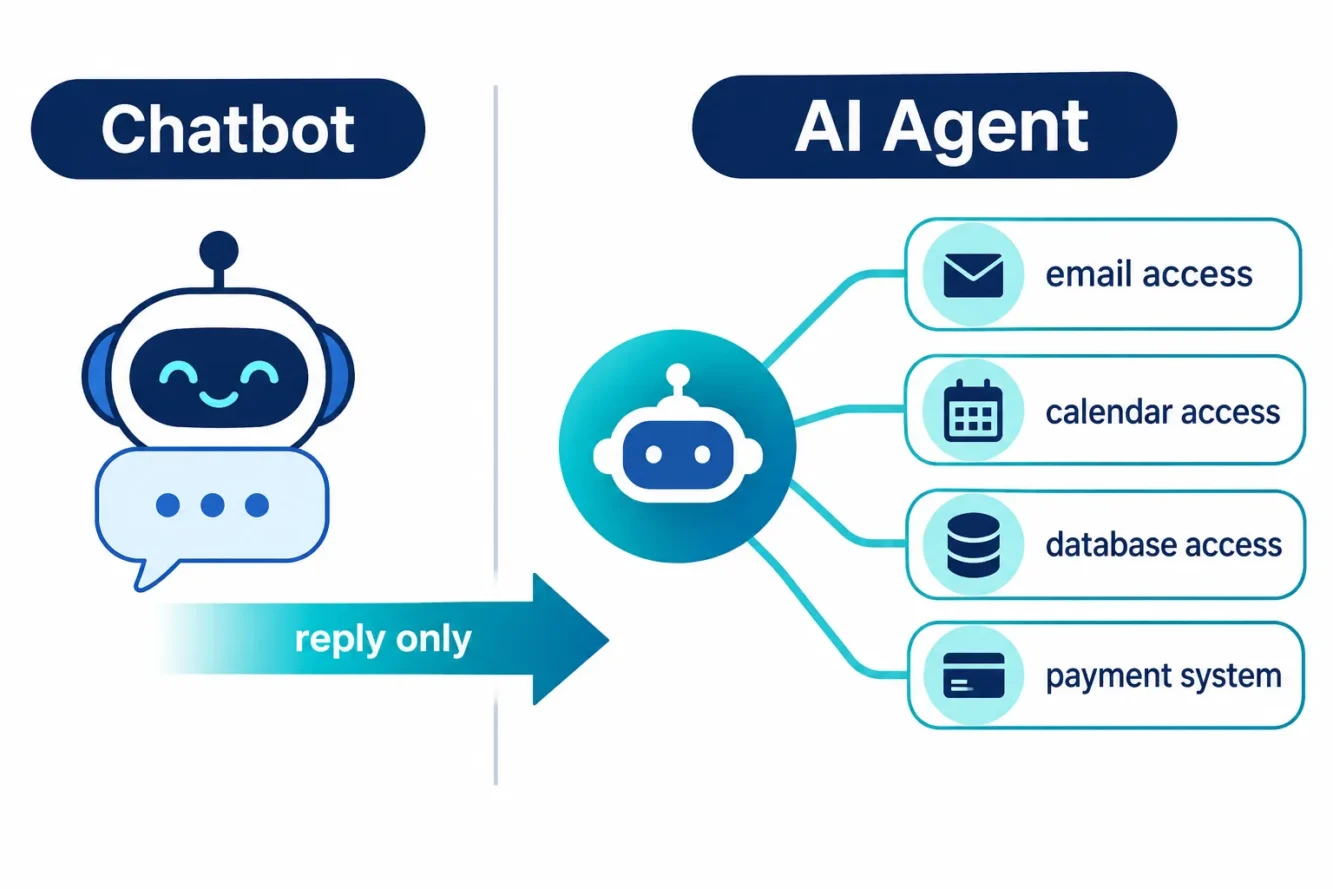
A chatbot might draft a refund email for you to send. An agent might process the refund itself, update the order record, and notify the customer, all without someone clicking send each time.
What’s the real difference between AI agents and regular automation
Regular automation follows a fixed script; an agent decides the script as it goes. Traditional automation (like a scheduled report or a simple “if this, then that” rule) does the same steps every time. An agent can change its approach mid-task based on what it finds.
- Automation: predictable, rule-based, breaks if conditions shift unexpectedly.
- AI agent: adaptive, can reorder steps, pull in new tools, and handle unplanned situations.
Common mistake: assuming an agent is just “automation with AI branding.” That ignores the autonomy piece, which is exactly what creates both the benefit and the risk.
Is my small business actually ready for an AI agent
Readiness depends less on budget and more on whether you can define clear boundaries and watch what the agent does. A small business is ready if it can name one specific task, limit the agent’s access to only what that task needs, and assign someone to check its activity regularly.
Edge case: a business with messy, undocumented processes is not ready yet. Agents amplify whatever structure already exists, good or bad. Fix the process first, then automate it.
What happens when an AI agent makes a major mistake
When an agent fails, the damage can spread faster than with a human error because the agent can act across multiple systems in seconds. Research describes this shift as moving from prediction error to control failure, where a small misjudgment early in a task can cause a large, hard-to-reverse outcome later.
Example: an agent misreads a shipping address, updates records, triggers a payment, and notifies a courier, all before anyone notices. That’s why rollback plans and activity logs matter as much as the agent’s initial setup.[7]
How do you set boundaries on what an AI agent is allowed to do
Boundaries come from narrow permissions, tiered approval rules, and a written list of actions the agent can never take on its own. Security and governance guidance now converge on a “least privilege” model: give each agent only the access its specific job requires, nothing broader.[3][4]
Checklist for setting boundaries:
- List every system the agent needs to touch.
- Grant access only to those systems, not the whole account.
- Mark irreversible actions (payments, deletions, legal notices) as “human approval required.”
- Set a rule that the agent can never grant itself new permissions.[6]
- Review the permission list monthly.
What are people getting wrong most about AI agents
The biggest mistake is treating an agent like a smarter chatbot instead of a system with real access and real consequences. People also assume human review is happening just because a confirmation screen pops up, even when users click through it without reading, a pattern researchers call consent fatigue.[5][6]
A second common error is the “everything agent”: one agent wired into every tool and account because it’s convenient. Microsoft’s security guidance flags this as a dangerous pattern, since a single failure or compromise then affects everything the agent touches.[4]
What permissions do you need to give an AI agent
An agent needs its own identity, its own credentials, and permissions scoped tightly to one role, the same way you’d set up a new employee’s accounts rather than handing over your own login. Current guidance treats agents as distinct identities requiring audit trails and lifecycle management, not shared logins.[3]
- Use short-lived, scoped credentials instead of permanent broad access.
- Keep an inventory of every agent and what it can touch.[7]
- Log which agent acted, on whose behalf, and why, for every action.
What are the biggest things that can go wrong with AI agents
The biggest risks are named failure categories now tracked by security researchers: agent hijacking, cross-domain prompt injection, goal hijacking, memory contamination, resource exhaustion, and excessive agency.[3][5][8]
Newer concerns include agentic supply chain compromise (a corrupted tool or plugin the agent relies on) and inter-agent trust escalation, where one compromised agent tricks another into acting on bad instructions.[3] Mitigations include zero-trust design, tighter supply-chain checks, and detailed logging.[3]
Can you really let an AI agent work without someone watching it
Not safely, no. Even highly autonomous agents need a way for a human to pause, override, or shut them down at any moment, and that control has to be continuous, not a once-a-week review.[1][2]
Guidance from cloud security researchers recommends monitoring configuration changes over time and building in automatic rollback when an agent breaks a governance rule.[7] Static, scheduled check-ins are no longer considered enough given how fast agents can act.[1][2]
What if an AI agent gets confused or stuck on a task
A well-designed agent should stop and ask for help instead of guessing when it’s uncertain, but many systems don’t do this reliably yet, which is a known failure pattern researchers are actively studying.[9]
Reproducible diagnostic work now exists for issues like error cascades, reward hacking, and “over-reasoning loops,” where an agent spins through unnecessary steps instead of completing a task.[9] Edge case: if an agent seems to be looping or repeating failed attempts, that’s a signal to intervene manually rather than let it keep trying.
What does it cost to actually implement an AI agent
Costs vary widely by scope, and no verified industry-wide figure applies to every business, so treat any specific number you see elsewhere with caution. What’s consistent across guidance is that cost isn’t just software: it includes setting up identity and permission systems, logging infrastructure, and ongoing monitoring.
Enterprises are advised to treat agents like employees, budgeting for onboarding (identity setup), supervision (monitoring tools), and offboarding (revoking access when a project ends).
What other ways can I automate things besides using AI agents
Plenty of tasks don’t need an agent at all. Rule-based automation, scheduled scripts, and simple workflow tools can handle repetitive, predictable work without the added risk of autonomous decision-making.
- Choose rule-based automation if the task never changes and the steps are fixed.
- Choose an AI agent if the task requires judgment calls, varies case to case, or needs to pull from multiple unpredictable sources.
FAQ
What is an AI agent in one sentence?
It’s a software system that can decide its own next steps and act on tools or accounts within limits a human sets.[1]
Is an AI agent the same as a chatbot?
No, a chatbot only replies with text, while an agent can take real actions across connected systems.[1]
Can an AI agent act without any human oversight?
It can, but governance guidance strongly recommends keeping a human able to pause or override it at all times.[1][2]
What’s the biggest risk with AI agents?
Cascading failures, where a small mistake early in a task triggers larger, harder-to-reverse problems later.
Do AI agents need their own login credentials?
Yes, current security guidance treats agents as distinct identities needing their own scoped, short-lived credentials.[3]
Are small businesses ready to use AI agents?
Many are, if they start with one clearly defined task and limit the agent’s access to only what that task needs.
What should never be fully automated by an agent?
Irreversible actions like payments, deletions, or legal commitments should always require human review.[6]
Conclusion
Understanding what is an AI agent comes down to two words: autonomy and access. An agent can decide what to do next and actually do it, which is powerful and risky at the same time. The practical path forward is narrow permissions, continuous monitoring, and human checkpoints on anything hard to undo.
If you’re considering adopting one, start with a single low-risk task, write down exactly what the agent can and can’t touch, and check its activity logs regularly rather than assuming it’s working correctly. For readers curious about where this technology is headed next, it’s worth exploring how AI is learning to understand the physical world and how newer AI models are expanding what’s possible. For everyday safety alongside these tools, a quick read on avoiding phone and internet scams is a sensible companion piece. And if the pace of all this feels like a lot, a short guide on breathing techniques for stress reduction isn’t a bad idea either.
References
- Shaping Global Governance of AI Agents. brookings.edu.
- AI Agents Securing the Path From Intent to Action. cloudsecurityalliance.org.
- Taxonomy of Failure Modes in Agentic AI Systems V2 0. cdn-dynmedia-1.microsoft.com.
- Defense in Depth Autonomous AI Agents. microsoft.com.
- Updating Taxonomy Failure Modes Agentic AI Systems Year Red Teaming Taught US. microsoft.com.
- Who Answers Machine Closing Accountability Gap Agentic Workflows. unesco.org.
- AI Agents Gaining Autonomy Faster Than Businesses Can Secure Them. techtarget.com.
- 2609.22712. arxiv.org.
- 2026.emnlp Tutorials. aclanthology.org.
Meta Title: What Is an AI Agent? A Plain-English Guide to Risks
Meta Description: What is an AI agent? A clear guide to autonomy, permissions, monitoring, and failure risks every consumer and business should understand before using one.
Tags: AI agents, artificial intelligence, autonomy, AI permissions, AI monitoring, AI governance, AI safety, chatbots vs agents, agentic AI, AI failure modes, small business AI, AI security