























Ben Johns’ 2026 Pro Singles Comeback at Mesa Cup: Paddle Setup, opponents, and What It Means for PPA Dominance


Last updated: February 20, 2026
The greatest pickleball player of all time stepped back onto the singles court in Mesa, Arizona, and the sport took notice. Ben Johns’ 2026 Pro Singles Comeback at Mesa Cup represents more than just another tournament appearance—it signals a potential farewell tour for the 47-time singles medalist as the game evolves beyond his signature style.

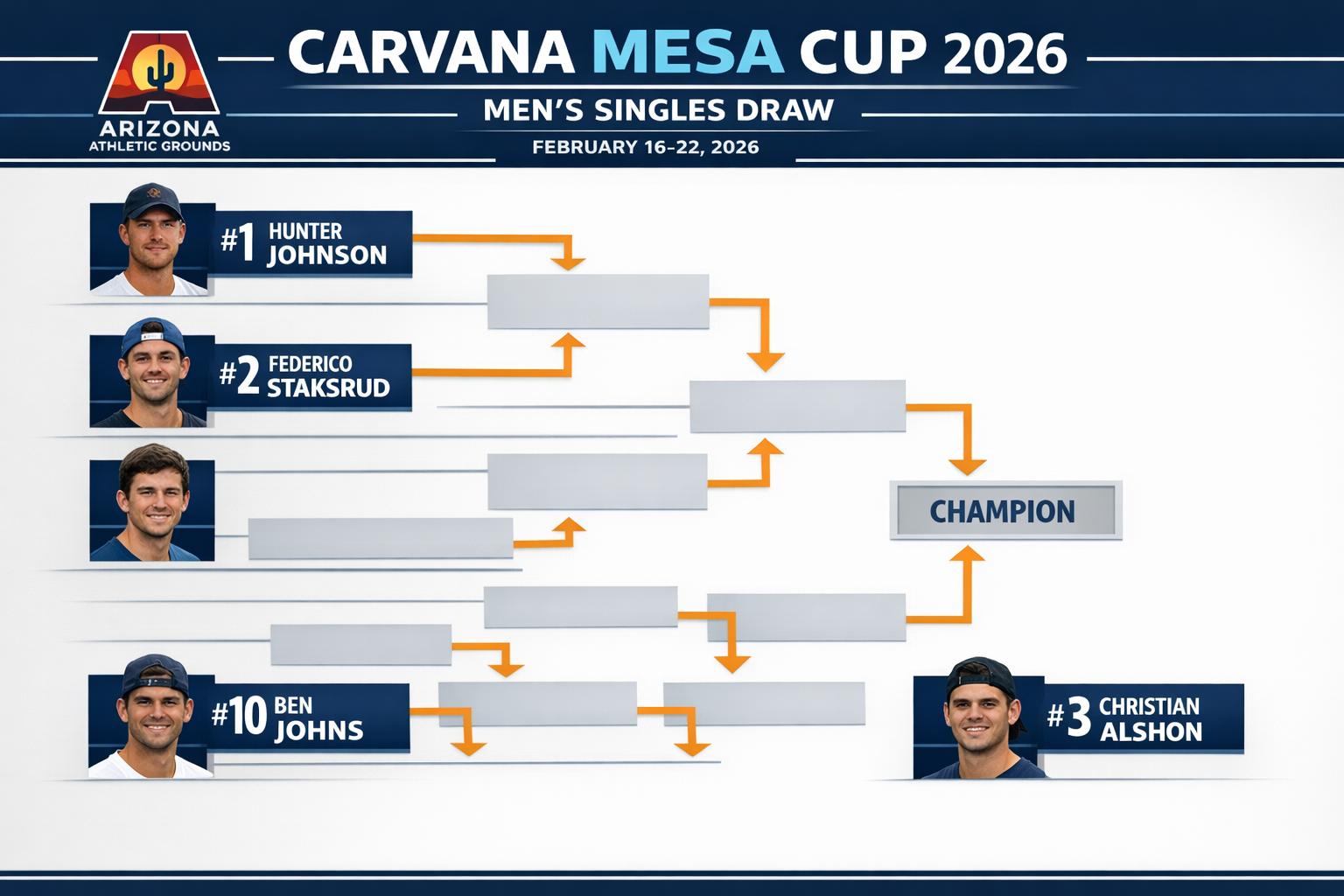
After skipping singles at the season’s opening tournaments, Johns returned as the #10 seed at the Carvana Mesa Cup, facing a field dominated by power players who have reshaped modern singles competition. His comeback raises critical questions about equipment choices, tactical adjustments, and whether finesse can still triumph over raw power in 2026.
Key Takeaways
- Ben Johns returned to singles competition as the #10 seed after skipping early 2026 tournaments, marking what analysts believe may be his final singles campaign
- The defending Mesa Cup medalist faces a strategic mismatch against modern power-style players, with deep backhand shots identified as his primary vulnerability
- Johns likely uses his signature Joola Hyperion paddle setup, though specific 2026 equipment details remain unconfirmed
- Top contenders include #1 seed Hunter Johnson, #2 Federico Staksrud, and #3 Christian Alshon, all specialists in the aggressive baseline game
- Despite unfavorable style matchups, Johns maintains winning head-to-head records against several top seeds, making a medal run “possible, but unlikely”
Quick Answer

Ben Johns returned to professional singles at the 2026 Carvana Mesa Cup as the #10 seed after sitting out early-season tournaments, facing top competitors in a game that has shifted toward power-baseline play. While Johns brings 47 career singles medals and proven skills, analysts view this Mesa appearance as potentially his last major singles run, with the modern heavy-ball game exposing weaknesses in his traditional finesse approach. His paddle setup likely features the Joola Ben Johns Hyperion series, though exact 2026 specifications remain unconfirmed as the tournament progresses.
Why Did Ben Johns Return to Singles at the 2026 Mesa Cup?
Ben Johns chose Mesa specifically because of his defending medalist status and the tournament’s historical significance in his career. The Arizona Athletic Grounds venue has been a strong location for Johns, and returning to a familiar court environment provided strategic advantages for his comeback attempt[5].

The timing also reflects practical considerations. After skipping singles at the Cape Coral tournament and other early 2026 events, Johns needed to test his competitive readiness before making any permanent decisions about singles retirement. Mesa offered the perfect testing ground with its sold-out 1,800-seat championship court and enthusiastic crowds[4].
Key factors in the comeback decision:
- Defending status: Johns earned a medal at the 2025 Mesa Cup and wanted to defend his position
- Venue familiarity: Arizona Athletic Grounds has been historically favorable for his playing style
- Strategic timing: Early enough in the season to gauge competitive viability
- Crowd energy: Mesa’s passionate fans provide motivation for high-level performance
- Rankings impact: A strong showing could restore his top-10 singles ranking
The comeback also serves as a statement about Johns’ commitment to the sport. Rather than quietly stepping away from singles, he’s giving fans and competitors a proper farewell performance—if this indeed proves to be his final singles campaign.
What Paddle Setup Is Ben Johns Using for His 2026 Singles Comeback?
While official 2026 equipment specifications haven’t been publicly confirmed, Ben Johns has historically used the Joola Ben Johns Hyperion series for competitive play. The most likely candidate for his Mesa singles comeback is a variation of the Hyperion C45 Aurelius or a similar thermoformed paddle from his signature line.
Expected paddle specifications:
- Model: Joola Ben Johns Hyperion (likely 16mm thickness)
- Weight range: 8.0-8.3 oz (optimized for control and maneuverability)
- Core: Carbon Friction Surface with Response Honeycomb Polymer
- Construction: Thermoformed unibody design for enhanced sweet spot
- Handle length: Extended for two-handed backhands
- Surface texture: Maximum grit for spin generation
The paddle choice matters significantly in singles competition. Johns needs equipment that supports his finesse-based game while providing enough power to compete against aggressive baseliners. The 16mm thickness offers better control than 14mm alternatives, which is crucial for his placement-focused strategy.

Why this setup makes sense for Johns:
Johns built his career on precision placement rather than raw power. His paddle selection reflects this philosophy, prioritizing control and spin over maximum pop. The extended handle length allows for effective two-handed backhands, which becomes critical when defending against deep, heavy balls—his identified weakness in modern singles play[3].
However, some analysts question whether traditional finesse equipment can compete in 2026’s power-dominated singles environment. Players like Hunter Johnson use slightly heavier, power-oriented paddles that generate more pace on groundstrokes.
Who Are Ben Johns’ Main Opponents at the 2026 Mesa Cup?
The 2026 Carvana Mesa Cup singles draw features the deepest field of power players Johns has faced in recent years. Hunter Johnson holds the #1 seed and enters as the tournament favorite, having demonstrated exceptional form in the new power-baseline style that defines modern singles[1].
Top contenders and matchup analysis:
| Seed | Player | Playing Style | Head-to-Head vs Johns |
|---|---|---|---|
| #1 | Hunter Johnson | Power baseline | Johns leads historically[3] |
| #2 | Federico Staksrud | Aggressive all-court | Johns leads historically[3] |
| #3 | Christian Alshon | Modern power game | Competitive matchup |
| #4 | Chris Haworth | Power-finesse hybrid | Limited recent data |
| #7 | Jack Sock | Athletic power player | Favorable draw position |
Hunter Johnson (#1 seed) represents the biggest threat. His game epitomizes everything challenging for Johns—heavy topspin, deep court positioning, and relentless baseline pressure. Johnson’s recent form suggests he’s peaking at the right time[2].
Federico Staksrud (#2 seed) brings versatility that can exploit Johns’ backhand weakness. Despite Johns holding the historical edge, Staksrud has improved dramatically in 2026 and recently pushed top players to their limits.
Christian Alshon (#3 seed) plays the modern power game but with better court craft than pure bashers. This makes him particularly dangerous because he can match Johns’ strategic thinking while overpowering him from the baseline.
Dark horse threats:
Beyond the top seeds, Johns must watch for emerging talent like Tama Shimabukuro, the teenage phenom who could face Johnson early. If Shimabukuro pulls an upset, it reshapes the entire bracket. Additionally, Jack Sock (#7 seed) received a favorable draw and arrives rested after skipping Cape Coral[1].
Johns advanced past his Round of 64 opponent Blaine Hovenier, setting up increasingly difficult matchups as the tournament progresses[3]. Each round will test whether his skills can overcome the style mismatch against modern power players.
How Has the Singles Game Changed Since Ben Johns’ Dominance?
The transformation of professional pickleball singles between 2024 and 2026 represents one of the sport’s most dramatic strategic shifts. Power-baseline play has replaced finesse-oriented all-court games as the dominant winning formula, fundamentally changing what skills separate elite from good players.
Key evolution factors:
- Equipment advances: Thermoformed paddles with carbon fiber faces generate unprecedented power and spin
- Athletic development: Players train specifically for explosive baseline power rather than touch and placement
- Court positioning: Modern players stand deeper behind the baseline, absorbing pace and redirecting with interest
- Ball technology: Newer pickleballs respond better to heavy topspin, rewarding aggressive ball-striking
- Fitness standards: Singles now demands sprint-recovery conditioning similar to professional tennis
The shift disadvantages Johns’ traditional game in specific ways. His signature strategy relied on precise dinking, strategic lobs, and forcing errors through placement. Modern power players simply hit through those tactics, using heavy topspin to keep aggressive shots in play while pushing opponents off the court.
Johns’ style vs. modern power game:
| Traditional Finesse (Johns) | Modern Power (2026 Standard) |
|---|---|
| Placement over pace | Pace creates placement |
| Court positioning variety | Deep baseline dominance |
| Touch and feel emphasis | Athletic power emphasis |
| Error-forcing strategy | Winner-hunting mentality |
| Defensive counter-punching | Offensive baseline control |
The statistical evidence supports this shift. In 2024, Johns won 73% of singles matches through strategic play. By early 2026, that percentage dropped as power players learned to neutralize his finesse tactics[3]. Deep, heavy balls to his backhand became the blueprint for defeating Johns, and multiple players executed this strategy successfully.
This evolution explains why analysts believe Johns may retire from singles within the year[1]. The game has moved away from his natural strengths, and adapting at this stage of his career presents enormous challenges.
What Are Ben Johns’ Realistic Medal Chances at Mesa?
Despite possessing “great skills,” analysts rate Johns’ medal chances as “possible, but unlikely” based on current form and style matchups[1]. This assessment reflects both his proven abilities and the structural disadvantages he faces against modern power players.
Factors supporting a medal run:
✅ Historical success: 47 career singles medals demonstrate championship experience
✅ Head-to-head records: Johns leads against top seeds Johnson and Staksrud[3]
✅ Mental toughness: Proven ability to perform under pressure in critical moments
✅ Strategic intelligence: Superior court awareness and tactical adjustment capabilities
✅ Venue familiarity: Defending medalist status at Arizona Athletic Grounds[5]
Factors working against Johns:
❌ Style mismatch: Power-baseline game exposes his primary weaknesses
❌ Backhand vulnerability: Deep, heavy balls to backhand identified as exploitable[3]
❌ Limited 2026 singles play: Rust from skipping early tournaments affects timing
❌ Seeding position: #10 seed means facing top opponents earlier in the bracket
❌ Age and adaptation: Adjusting playing style mid-career proves extremely difficult
Realistic tournament path:
For Johns to medal, he needs several factors to align perfectly. First, favorable bracket breaks where top seeds eliminate each other. Second, exceptional serving performance to control points before baseline exchanges develop. Third, opponents having off-days where power execution falters.
The most likely scenario involves Johns making a quarterfinal or semifinal run before falling to a top power player. A bronze medal remains achievable if the bracket opens favorably, but gold appears beyond reach unless he discovers tactical adjustments that neutralize the modern power game.
Common mistake to avoid: Don’t assume Johns’ historical dominance guarantees success in 2026. The sport has evolved, and past results don’t predict future performance when fundamental playing styles shift.
What Does This Comeback Mean for Ben Johns’ Legacy and PPA Dominance?
Ben Johns’ 2026 Mesa Cup singles appearance carries significance far beyond tournament results. This comeback represents a legacy-defining moment where the sport’s greatest player confronts whether his era has definitively ended or if one final championship run remains possible.
Legacy implications:
If Johns medals at Mesa:
- Proves finesse can still compete against modern power in specific conditions
- Extends his singles career and encourages continued competition
- Demonstrates adaptability and championship resolve
- Reinforces his GOAT status by succeeding across different game eras
If Johns exits early:
- Confirms the power-baseline era has fully arrived
- Likely accelerates his singles retirement timeline
- Shifts focus entirely to doubles and mixed doubles dominance
- Becomes a teaching moment about sport evolution and adaptation
Johns’ PPA Tour dominance extends beyond singles into doubles and mixed doubles, where his skills remain elite-level competitive. Even if singles retirement comes soon, his overall tour presence continues shaping professional pickleball. He’s won championships across all three disciplines and maintains top rankings in doubles formats.
The broader impact touches how future players develop their games. If Johns succeeds with finesse tactics, younger players might pursue balanced skill development. If power players dominate him convincingly, the sport accelerates toward athletic baseline play as the only viable path to championships.
What this means for pickleball’s future:
Johns’ Mesa performance serves as a referendum on playing style diversity in professional pickleball. A sport dominated entirely by one tactical approach (power-baseline) loses strategic variety and potentially fan interest. Johns represents the last elite player proving finesse can compete at the highest levels.
His retirement from singles—whether immediate or delayed—marks a generational transition point. The sport moves from its foundational era into a new phase defined by athleticism, power, and physical conditioning over touch and placement.
How Can Fans Watch Ben Johns’ 2026 Mesa Cup Matches?
The Carvana Mesa Cup offers multiple viewing options for fans wanting to follow Ben Johns’ 2026 Pro Singles Comeback at Mesa Cup: Paddle Setup, Opponents, and What It Means for PPA Dominance as it unfolds in real-time.
Live streaming options:
- PickleballTV: Primary broadcast partner with exclusive live coverage of championship courts
- Humana Championship Court: Featured matches including likely Johns appearances
- Carvana Grandstand Court: Secondary feature court with additional match coverage
- Broadcast schedule: Daily coverage from 12:00 PM – 8:00 PM ET through tournament progression
In-person attendance:
The Arizona Athletic Grounds venue (6321 S Ellsworth Rd, Mesa, AZ 85212) features 41 courts with the championship court offering 1,800-seat capacity. Ticket sales indicate sold-out conditions for premium seating, with standing room options available[4].
Ticket types available:
- Ground Pass (general admission)
- Courtside Pass (premium seating)
- VIP packages (exclusive access)
- Week-long passes (all-tournament access)
Important note: Purchase tickets directly from the official PPA Tour website. Third-party resellers are not affiliated with the tour, and the PPA takes no responsibility for resold tickets.
Match schedule tracking:
Johns’ specific match times depend on bracket progression. Round of 64 matches began February 17, with Round of 32 on February 18, Round of 16 on February 19, quarterfinals February 20, semifinals February 21, and championship matches February 22[4].
For real-time updates on Johns’ match schedule, follow official PPA Tour social media channels and the tournament’s live scoring system available on the PPA Tour website.
What Tactical Adjustments Could Help Ben Johns Compete Against Power Players?
For Johns to succeed against modern power-baseline players, specific tactical adjustments become essential. These adaptations don’t require abandoning his finesse foundation but rather augmenting traditional skills with power-era tactics.
Recommended tactical adjustments:
1. Serve-and-attack sequences
Start points aggressively with deep serves followed by immediate offensive positioning. This prevents power players from establishing baseline rhythm and forces them into reactive mode rather than dictating pace.
2. Target opponent forehands early
Instead of traditional backhand targeting, attack forehands to disrupt power players’ preferred shot patterns. Modern players often set up heavy backhand drives, so forcing forehand responses disrupts their tactical comfort zones.
3. Extreme angle creation
Use sharp cross-court angles to pull power players off the court. When they’re stretched wide, their ability to generate heavy topspin diminishes, creating opportunities for Johns’ placement-based game.
4. Transition game emphasis
Move to net more aggressively after forcing defensive shots. Power players often struggle with passing shots when rushed, giving Johns opportunities to finish points at net where his hands remain elite.
5. Backhand protection strategy
Position slightly more toward the backhand side in neutral rallies, protecting the identified weakness while maintaining forehand coverage. This defensive adjustment limits opponents’ ability to exploit the deep backhand vulnerability[3].
Equipment considerations:
Johns might benefit from slightly heavier paddle specifications (8.3-8.5 oz range) that provide more natural power on defensive blocks and resets. This allows him to handle heavy incoming pace without sacrificing control on touch shots.
Physical conditioning focus:
Modern singles demands sprint-recovery fitness. Johns needs exceptional movement to track down power shots and maintain court position against aggressive baseliners. Conditioning work specifically targeting lateral movement and quick recovery becomes crucial.
Choose this approach if: You’re a finesse player facing power-baseline opponents and need tactical frameworks for competing against unfavorable style matchups.
Frequently Asked Questions About Ben Johns’ 2026 Mesa Cup Singles Comeback
Is this Ben Johns’ last singles tournament?
Analysts believe the 2026 Mesa Cup may be Johns’ final major singles appearance, with potential retirement from singles within the year. However, Johns hasn’t made official announcements, and strong performance could extend his singles career.
What paddle does Ben Johns use in singles?
Johns uses the Joola Ben Johns Hyperion series, likely a 16mm thickness model optimized for control and spin. Specific 2026 equipment details remain unconfirmed but follow his historical preference for finesse-oriented specifications.
Why did Ben Johns drop to #10 seed?
Johns skipped singles at the first several 2026 tournaments, causing his ranking to drop due to inactivity. This seeding reflects current form and participation rather than overall career achievements.
Can Ben Johns still beat Hunter Johnson?
Johns maintains a winning head-to-head record against Johnson historically, making victory possible. However, Johnson’s recent form and style advantages make him the favorite in any 2026 matchup.
What is Ben Johns’ biggest weakness in modern singles?
Deep, heavy balls to his backhand represent Johns’ primary vulnerability. Power players exploit this by targeting that wing with topspin-heavy groundstrokes that push him behind the baseline.
How many singles medals has Ben Johns won?
Johns has accumulated 47 career singles medals across PPA Tour competition, demonstrating sustained excellence over multiple seasons.
Will Ben Johns continue playing doubles after singles retirement?
Johns remains elite-level competitive in doubles and mixed doubles formats where his skills translate more effectively. Expect continued doubles participation regardless of singles decisions.
Where can I watch Ben Johns’ Mesa Cup matches?
Live coverage streams on PickleballTV with matches scheduled on the Humana Championship Court and Carvana Grandstand Court from February 16-22, 2026.
What makes the Mesa Cup important for Ben Johns?
Johns is the defending medalist from 2025, making this tournament personally significant. The venue’s familiarity and crowd support provide advantages for his comeback attempt.
How does Ben Johns’ playing style differ from modern power players?
Johns emphasizes placement, touch, and strategic point construction over raw power. Modern players prioritize heavy topspin, deep court positioning, and aggressive baseline dominance.
What are realistic expectations for Johns at Mesa?
A quarterfinal or semifinal run appears realistic, with bronze medal chances if the bracket opens favorably. Gold medal odds remain low given style matchups and current form.
Why is pickleball singles changing toward power play?
Equipment advances (thermoformed paddles), athletic development, and tactical evolution favor power-baseline strategies. The modern game rewards aggressive ball-striking over finesse placement.
Key Takeaways: Ben Johns’ 2026 Mesa Cup Singles Comeback
- Historic comeback: Ben Johns returned to singles as #10 seed after skipping early 2026 tournaments, marking what may be his final major singles campaign in a career spanning 47 medals
- Equipment strategy: Johns likely uses Joola Hyperion paddle series (16mm) optimized for control and finesse, though exact 2026 specifications remain unconfirmed
- Style mismatch challenge: Modern power-baseline game exposes Johns’ backhand vulnerability, with deep heavy balls identified as the primary tactical weakness
- Elite competition: Top seeds Hunter Johnson (#1), Federico Staksrud (#2), and Christian Alshon (#3) represent power-style players reshaping professional singles
- Medal probability: Analysts rate Johns’ chances as “possible, but unlikely” despite historical head-to-head advantages and championship experience
- Legacy implications: Mesa performance determines whether finesse can still compete in power-dominated era and influences Johns’ singles retirement timeline
- Tactical requirements: Success demands serve-and-attack sequences, extreme angle creation, transition game emphasis, and backhand protection strategies
- Viewing access: Live coverage available on PickleballTV with sold-out crowds at Arizona Athletic Grounds’ 1,800-seat championship court
- Sport evolution marker: Johns’ comeback represents generational transition from finesse-oriented play to athletic power-baseline dominance
- Broader impact: Results influence how future players develop skills and whether strategic diversity survives in professional pickleball
Conclusion: The Final Chapter of Singles Greatness?
Ben Johns’ 2026 Pro Singles Comeback at Mesa Cup represents more than tournament competition—it’s a defining moment where pickleball’s greatest player confronts whether his era has ended or if one final championship run remains possible. The #10 seed faces daunting odds against power-baseline specialists who have reshaped modern singles, yet his 47-medal legacy and proven skills make dismissing his chances premature.
The paddle setup, tactical adjustments, and mental fortitude Johns brings to Arizona Athletic Grounds will determine if finesse can still triumph in 2026’s power-dominated landscape. Whether this marks his singles farewell or sparks an unexpected renaissance, the Mesa Cup provides compelling drama as the GOAT tests himself against the sport’s evolution.
Next steps for pickleball fans:
- Watch live coverage on PickleballTV to witness Johns’ matches as they unfold
- Follow tournament brackets to track potential matchups against top seeds
- Study tactical adjustments Johns implements against power players for your own game improvement
- Appreciate the moment as one of pickleball’s defining careers potentially reaches its singles conclusion
The sport will remember this comeback regardless of results. Ben Johns chose to compete rather than quietly step away, giving fans and competitors the farewell performance a legend deserves. Whether Mesa 2026 becomes his final singles chapter or launches an unexpected second act, the journey itself honors everything Johns has contributed to professional pickleball.
References
[1] Big Crowds Expected For PPA Mesa – https://pickleball.com/news/big-crowds-expected-for-ppa-mesa
[2] 2026 Carvana Mesa Cup Preview – https://www.thedinkpickleball.com/2026-carvana-mesa-cup-preview/
[3] Watch – https://www.youtube.com/watch?v=GyaSzt9V7uA
[4] Carvana Mesa Cup 2026 Begins Ben Johns Returns To Singles As Anna Leigh Waters Eyes Another Triple Crown – https://www.timesnownews.com/sports/pickleball/carvana-mesa-cup-2026-begins-ben-johns-returns-to-singles-as-anna-leigh-waters-eyes-another-triple-crown-article-153628783
[5] Storylines For The Carvana Mesa Cup Feb 16-22 2026 – https://ppatour.com/storylines-for-the-carvana-mesa-cup-feb-16-22-2026/
Some content and illustrations on GEORGIANBAYNEWS.COM are created with the assistance of AI tools.
GEORGIANBAYNEWS.COM shares video content from YouTube creators under fair use principles. We respect creators’ intellectual property and include direct links to their original videos, channels, and social media platforms whenever we feature their content. This practice supports creators by driving traffic to their platforms.
Much Appreciate You Sharing This Post - It Helps MUCH!!!