




















Celebrity Money in Pickleball: How New Facility Deals, Club Franchises, and Restaurant‑Court Hybrids Are Reshaping Local Play

Last updated: June 1, 2026
Quick Answer
Celebrity money in pickleball is driving a wave of upscale facility deals, franchise expansions, and restaurant-court hybrids that are transforming how and where Americans play. Tennis legend Andre Agassi invested $20 million in Ballers, a multisport club combining pickleball with art and dining, while Drew Brees is developing 30 Picklr franchise locations across the Midwest [1][2]. These ventures are creating premium indoor clubs with full-service bars and restaurants, but they’re also raising questions about court access, membership fees, and whether the market can sustain hundreds of new facilities competing for the same players.
Key Takeaways
- Andre Agassi participated in a $20 million investment in Ballers, a Philadelphia multisport club blending pickleball with cultural programming and dining [1]
- Drew Brees became an investor and franchise owner in The Picklr, planning 30 locations across the Midwest as part of his business portfolio [2]
- The Picklr sold over 300 franchises by October 2024, with 98 locations under contract and plans for more than 1,080 indoor courts by end of 2025 [3]
- CityPickle received significant minority investment from Avenue Sports Fund in June 2024 to expand urban clubs combining bookable courts with full restaurant and bar services [4]
- As of March 2026, industry observers warn of potential market oversaturation as competition intensifies among indoor pickleball facilities [5]
- Successful facilities diversify revenue through memberships, leagues, clinics, events, and food service rather than relying solely on court rentals [7]
- By May 2026, 41% of private club leaders cited pickleball as an overcapacity concern, with some top clubs reconsidering space allocation [8]
- Many facility business plans fail due to incorrect assumptions about court utilization rates and sustainable pricing models [10]


What Celebrities Are Investing in Pickleball Right Now
High-profile athletes and celebrities are pouring capital into pickleball ventures across multiple business models. Andre Agassi joined a $20 million Series A round for Ballers, which opened its Philadelphia flagship in July 2025 as a multisport members’ club featuring pickleball, squash, padel, art installations, and social programming [1]. Former NFL quarterback Drew Brees became an ambassador, investor, and franchise owner for The Picklr in February 2024, with plans to develop 30 locations throughout the Midwest [2].
These investments represent more than celebrity endorsements. Both Agassi and Brees are taking active operational roles, with Brees integrating The Picklr into his broader business portfolio alongside other ventures. The celebrity involvement brings marketing reach and credibility that helps these facilities attract members and secure prime real estate in competitive markets.
Other professional athletes have also entered the space through ownership stakes in regional clubs and franchise agreements, though specific investment amounts often remain undisclosed. The trend reflects a broader shift where retired athletes view pickleball facilities as viable long-term business opportunities rather than short-term promotional deals.
How Much Money Are Pro Athletes Putting Into Pickleball Facilities
Professional athletes are committing seven- and eight-figure sums to pickleball facility investments. The Ballers deal involving Agassi totaled $20 million for the Series A round, though individual investment amounts were not disclosed [1]. Franchise investments like Brees’s commitment to develop 30 Picklr locations represent multi-million dollar obligations when accounting for franchise fees, real estate, construction, and operating capital.
Individual franchise units typically require substantial upfront capital. While exact figures vary by brand and market, investors should expect to allocate significant resources for:
- Franchise fees and royalty structures
- Real estate acquisition or long-term leases
- Facility construction and court installation
- Equipment, furniture, and technology systems
- Working capital for initial operations
The scale of athlete investments reflects confidence in pickleball’s growth trajectory, but also creates financial risk if facilities cannot achieve projected utilization rates and revenue targets. Many athletes are leveraging their personal brands to drive membership sales and media attention that independent operators cannot match.
Which Pickleball Franchises Are the Most Profitable
Profitability data for pickleball franchises remains limited because most concepts launched recently and few locations have reached operational maturity. The Picklr achieved a $59 million valuation by October 2024 after selling over 300 franchises, with 98 locations under contract and plans for more than 1,080 courts by end of 2025 [3]. However, a comprehensive FRANdata report notes that numerous units are signed but few are operational, and financial performance claims may not align with Franchise Disclosure Documents [6].
Key factors affecting franchise profitability:
- Location and demographics: Urban markets with high household incomes and limited public court access perform better
- Revenue diversification: Facilities generating income from memberships, leagues, clinics, events, and food service outperform those relying solely on court rentals [7]
- Utilization rates: Many business plans fail due to overly optimistic assumptions about how many hours per day courts will generate revenue [10]
- Competition density: Markets with multiple facilities opening simultaneously face pricing pressure and member acquisition challenges
Investors should conduct independent financial analysis rather than relying solely on franchisor projections. The FRANdata report emphasizes the importance of scrutinizing Franchise Disclosure Documents and validating claims with existing franchisees in comparable markets [6].
How Do Restaurant-Court Hybrid Business Models Actually Work
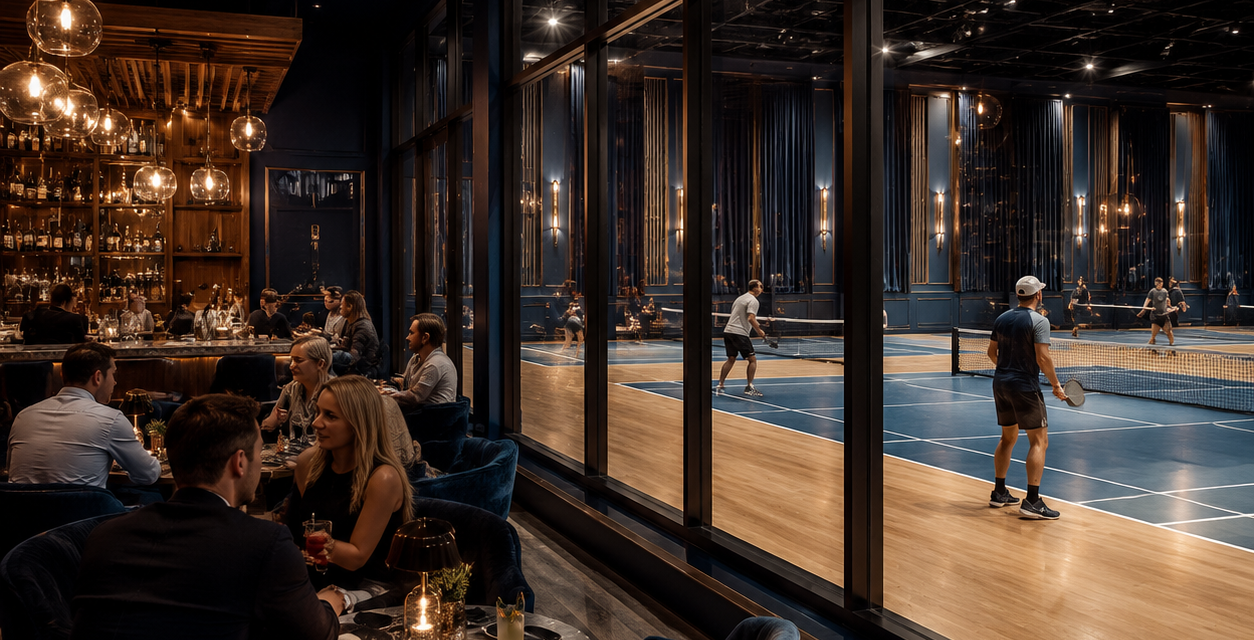
Restaurant-court hybrids combine bookable pickleball courts with full-service dining and bar operations under one roof. CityPickle pioneered this urban club concept, securing significant investment from Avenue Sports Fund in June 2024 to expand permanent indoor locations that integrate courts with food and beverage services [4]. The model creates multiple revenue streams while encouraging longer customer visits and higher per-person spending.
Core elements of successful hybrids:
- Court reservations: Players book courts by the hour, similar to traditional facilities
- Food and beverage sales: Full-service restaurants and bars operate during all facility hours, serving both players and spectators
- Membership tiers: Premium memberships offer priority booking, discounts on food, and access to exclusive events
- Event programming: Leagues, tournaments, corporate events, and social mixers drive consistent traffic
- Spectator experience: Viewing areas with quality seating and sightlines encourage non-playing guests to dine while watching
The restaurant component serves strategic purposes beyond revenue. It extends customer dwell time, creating opportunities for social interaction that build community and member retention. Facilities report that players often arrive early or stay after matches to eat and socialize, increasing overall spending per visit.
However, operating a restaurant adds complexity, requiring food service expertise, health permits, inventory management, and additional staffing. Many facilities partner with experienced restaurant operators or hire dedicated food and beverage directors to manage this side of the business.
Are Pickleball Restaurants and Courts Actually Making Money
Financial performance varies widely based on execution, location, and market conditions. Successful facilities in 2026 are diversifying revenue streams beyond court rentals, incorporating memberships, leagues, clinics, events, and food and beverage services to maximize profitability [7]. However, many business plans fail due to incorrect assumptions about court utilization and pricing, with some operators discovering that relying solely on court rental fees cannot sustain operations [10].
The challenge centers on realistic utilization rates. Many projections assume courts will generate revenue 8-12 hours per day, but actual usage often falls short, especially during weekday daytime hours and late evenings. Facilities that successfully fill these gaps through programming, leagues, and corporate bookings perform better financially.
Food and beverage operations can significantly boost margins when executed well. Restaurants typically carry higher profit margins than court rentals and generate revenue from non-playing guests. However, they also require higher operating costs, specialized staff, and consistent quality to build repeat business.
Early indicators suggest that well-capitalized facilities in strong markets with experienced management are achieving profitability, while undercapitalized ventures in saturated markets struggle. The shakeout anticipated by industry observers in March 2026 will likely separate successful operators from those with flawed business models [5].
How Are Local Pickleball Courts Changing Because of Big Money
Celebrity and corporate investment is creating a two-tier system for pickleball access. Premium indoor facilities offer climate-controlled courts, professional lighting, upscale amenities, and social programming, while traditional public outdoor courts remain free but often crowded and weather-dependent. This divide affects where and how everyday players access the sport.
Changes reshaping local play:
- Membership requirements: Many new facilities operate on membership or reservation-only models, limiting spontaneous play
- Higher costs: Premium clubs charge monthly memberships ranging from basic court access to VIP tiers with dining discounts and priority booking
- Improved quality: Professional facilities offer consistent playing surfaces, better lighting, and climate control year-round
- Social programming: Leagues, clinics, and events create structured play opportunities but require advance registration and fees
- Reduced public court pressure: Some communities report decreased crowding at free public courts as serious players migrate to paid facilities
The transformation mirrors what occurred in fitness, where boutique studios and premium gyms emerged alongside traditional recreation centers. Players now choose between free public access with variable quality and paid premium experiences with consistent conditions and amenities.
Which Cities Have the Best New Pickleball Facilities
A March 2026 analysis identified top U.S. markets for pickleball club launches based on court-per-capita indices and demand-supply gaps [9]. While specific cities were analyzed, the strongest markets share common characteristics: high household incomes, limited existing indoor court supply, large populations of active adults aged 35-65, and favorable real estate costs for facility development.
Characteristics of strong pickleball markets:
- Population density supporting multiple facilities without oversaturation
- Household incomes above $75,000 capable of supporting membership fees
- Limited existing indoor court capacity relative to player demand
- Weather patterns that drive demand for year-round indoor play
- Available real estate with suitable zoning and ceiling heights
Major metropolitan areas in the Midwest, Southeast, and Southwest have seen concentrated facility openings, with Drew Brees focusing his 30 Picklr locations across Midwestern markets [2]. Urban cores with young professional populations support upscale concepts like CityPickle, while suburban markets accommodate larger family-oriented facilities [4].
However, rapid expansion in attractive markets raises oversaturation concerns. By March 2026, industry observers noted that competition was intensifying as multiple facilities opened in the same geographic areas, creating pricing pressure and member acquisition challenges [5].
What Does It Cost to Join a Celebrity-Backed Pickleball Club
Membership fees at premium pickleball facilities vary by market, amenities, and tier structure, but players should expect to pay significantly more than public court access. While specific pricing for celebrity-backed clubs is not uniformly disclosed, upscale facilities typically offer multiple membership levels with different benefits and price points.
Common membership structures:
- Basic/Individual: Court access during off-peak hours, limited monthly reservations
- Premium/Unlimited: Unrestricted court booking, priority scheduling, guest privileges
- VIP/Founder: All premium benefits plus dining discounts, private event access, locker storage
- Corporate: Multi-user packages for companies, team-building events, flexible booking
Additional costs beyond membership often include:
- Court reservation fees for prime-time slots
- Guest fees when bringing non-members
- Clinic and coaching sessions
- League and tournament entry fees
- Food and beverage purchases
The value proposition depends on usage frequency and priorities. Serious players who visit multiple times weekly may find memberships cost-effective compared to per-visit fees, while casual players might prefer pay-as-you-go options at lower-cost facilities.
Can Average Players Access These New Fancy Pickleball Spaces
Most premium facilities offer some form of access for non-members, though policies vary by venue and market conditions. Many clubs provide day passes, punch cards, or drop-in rates that allow occasional players to experience upscale amenities without monthly membership commitments. However, access may be limited during peak hours when member demand is highest.
Access options for non-members:
- Day passes: Single-visit access at higher per-hour rates than member pricing
- Punch cards: Multi-visit packages offering modest discounts versus single-visit rates
- Off-peak rates: Reduced pricing for weekday daytime or late-night slots
- Trial memberships: Short-term introductory offers to experience full membership benefits
- Corporate partnerships: Some employers negotiate group rates for employees
The reality is that premium facilities prioritize member satisfaction and retention. During high-demand periods, court availability for non-members may be limited or nonexistent. Players seeking consistent access to upscale venues typically need membership, while those playing occasionally can often find drop-in opportunities during slower periods.
Public courts remain the most accessible option for budget-conscious players, though they come with trade-offs in quality, availability, and amenities. The two-tier system means players must choose between free access with variable conditions or paid premium experiences with consistent quality.
What Are the Risks of Investing in Pickleball Right Now
The pickleball facility market faces several significant risks that could impact investor returns. As of March 2026, industry observers warn of potential oversaturation as the indoor club sector attracts intense competition and numerous facilities vie for the same player base [5]. By May 2026, 41% of private club leaders cited pickleball as an overcapacity concern, with some top clubs reconsidering space allocation [8].
Major investment risks:
- Market oversaturation: Too many facilities opening simultaneously in attractive markets, creating pricing pressure and reducing utilization rates
- Utilization assumptions: Many business plans rely on overly optimistic court usage projections that don’t materialize [10]
- Trend uncertainty: Questions persist about whether pickleball represents a long-term sport or a temporary fitness trend
- Franchise performance gaps: FRANdata reports that numerous franchise units are signed but few are operational, with financial claims potentially misaligned with disclosure documents [6]
- Capital intensity: High upfront costs for real estate, construction, and equipment create significant financial exposure
- Operating complexity: Restaurant-court hybrids require expertise in both recreation management and food service
The anticipated shakeout will likely eliminate undercapitalized operators and facilities in weak locations. Investors with deep pockets, experienced management teams, and strong market positioning have the best chance of weathering competitive pressure, while those entering with thin margins or flawed assumptions face higher failure risk.
What Mistakes Are Investors Making in the Pickleball Market
Many pickleball facility investments fail due to preventable errors in planning and execution. The most common mistake involves incorrect assumptions about court utilization, with operators projecting revenue based on courts being booked 8-12 hours daily when actual usage falls far short [10]. This fundamental miscalculation undermines entire business models built on court rental fees alone.
Critical investor mistakes:
- Overestimating utilization: Assuming courts will generate consistent revenue throughout operating hours without accounting for weekday daytime and late-night gaps
- Underestimating competition: Failing to account for other facilities opening in the same market simultaneously
- Single revenue stream: Relying solely on court rentals instead of building comprehensive revenue ecosystems with memberships, events, and food service [7]
- Insufficient capital: Underestimating working capital needs to sustain operations until reaching break-even
- Weak market analysis: Choosing locations based on general pickleball popularity rather than specific demographic and competitive analysis
- Franchise due diligence failures: Not independently validating franchisor claims or thoroughly reviewing Franchise Disclosure Documents [6]
Successful investors focus on creating comprehensive revenue ecosystems rather than simple court rental operations. They conduct rigorous market analysis, maintain adequate capital reserves, and plan for competitive scenarios rather than best-case projections. The facilities most likely to survive the anticipated shakeout are those built on conservative assumptions with multiple revenue streams and experienced management.
Is Pickleball Just a Trend or a Long-Term Sport Investment
Pickleball has demonstrated sustained growth beyond typical fitness trend timelines, but questions about long-term viability persist as the market matures. The sport’s participation has expanded consistently for over a decade, with infrastructure investment from major athletes and institutional capital suggesting confidence in its staying power. However, the rapid facility expansion and potential oversaturation create uncertainty about whether current growth rates can continue.
Factors supporting long-term viability:
- Multi-generational appeal across ages 8-80+
- Lower physical barriers than tennis, making it accessible to older adults
- Social aspects that build community and encourage repeat participation
- Professional tour development and media coverage increasing legitimacy
- Institutional investment from experienced sports and entertainment operators
Concerns about sustainability:
- Rapid facility expansion potentially outpacing player growth
- Private club backlash with 41% of leaders citing overcapacity concerns [8]
- Questions about whether casual players will sustain paid memberships long-term
- Competition from other emerging racquet sports like padel
The most likely scenario involves market maturation where growth rates moderate but the sport establishes itself as a permanent fixture in American recreation. Facilities that survive the current expansion phase will likely achieve stable long-term operations, while those built on unsustainable assumptions will close or consolidate. Investors should approach pickleball as a legitimate long-term opportunity but recognize that not all markets can support the current pace of facility development.
Conclusion
Celebrity money in pickleball is fundamentally reshaping how Americans access and experience the sport. Andre Agassi’s $20 million investment in Ballers, Drew Brees’s 30-location Picklr franchise commitment, and institutional capital flowing into concepts like CityPickle demonstrate that major players view pickleball facilities as viable long-term businesses [1][2][4]. These ventures are creating upscale social clubs that combine premium courts with restaurant and bar services, offering experiences far beyond traditional recreation centers.
However, the rapid expansion brings significant risks. Industry observers warn of potential oversaturation as hundreds of facilities compete for the same players, and many business plans rely on overly optimistic utilization assumptions that don’t reflect operational reality [5][10]. The anticipated market shakeout will separate well-capitalized operators with diversified revenue streams from those built on flawed projections.
For everyday players, the transformation creates a two-tier system. Premium facilities offer superior playing conditions, amenities, and programming but require memberships or higher fees. Public courts remain free but often crowded and weather-dependent. The choice depends on budget, playing frequency, and priorities.
Next steps for stakeholders:
- Potential investors: Conduct rigorous independent market analysis, validate all franchisor claims through Franchise Disclosure Document review, and plan for competitive scenarios rather than best-case projections
- Players: Evaluate whether membership costs justify usage frequency, or whether public courts and drop-in options meet needs
- Communities: Monitor whether premium facility growth reduces public court crowding or creates access barriers for lower-income residents
- Facility operators: Focus on building comprehensive revenue ecosystems with memberships, events, food service, and programming rather than relying solely on court rentals
The celebrity money flowing into pickleball reflects genuine opportunity, but success will require realistic planning, adequate capitalization, and execution excellence as the market matures and competition intensifies through 2026 and beyond.
Frequently Asked Questions
Which celebrities own pickleball facilities?
Andre Agassi invested in Ballers, a Philadelphia multisport club featuring pickleball, and Drew Brees became an investor and franchise owner in The Picklr with plans for 30 Midwest locations. Both athletes took active operational roles rather than simple endorsement deals.
How much does it cost to open a pickleball franchise?
Costs vary by brand and market but typically include franchise fees, real estate acquisition or leases, facility construction, court installation, equipment, and working capital. Total investment often reaches multiple millions for a full-scale facility with restaurant components.
Are pickleball clubs profitable?
Profitability varies widely based on location, management, and execution. Successful facilities diversify revenue through memberships, leagues, events, and food service rather than relying solely on court rentals. Many business plans fail due to overly optimistic utilization assumptions.
Can I play at celebrity-backed pickleball clubs without a membership?
Most premium facilities offer day passes, punch cards, or drop-in rates for non-members, though access may be limited during peak hours when member demand is highest. Policies vary by venue and market conditions.
Is the pickleball facility market oversaturated?
Industry observers warn of potential oversaturation as of March 2026, with intense competition as multiple facilities open in attractive markets simultaneously. By May 2026, 41% of private club leaders cited pickleball as an overcapacity concern.
What makes restaurant-court hybrids successful?
Successful hybrids combine bookable courts with quality food and beverage operations, creating multiple revenue streams while encouraging longer visits and higher per-person spending. They require expertise in both recreation management and food service to execute well.
How many hours per day do pickleball courts actually generate revenue?
Many facilities discover that actual utilization falls short of projections assuming 8-12 hours of daily revenue generation. Weekday daytime and late-night periods often have low demand, making realistic utilization assumptions critical for financial planning.
What cities are best for opening a pickleball facility?
Strong markets feature high household incomes, limited existing indoor court supply, large populations of active adults aged 35-65, favorable real estate costs, and weather patterns driving year-round indoor play demand. Specific market analysis is essential before site selection.
How do pickleball franchises compare to independent facilities?
Franchises offer brand recognition, operational systems, and marketing support but require franchise fees and royalties. Independent facilities have more flexibility but must build brand awareness and systems from scratch. Success depends on execution in either model.
What’s the biggest mistake pickleball facility investors make?
The most common error is overestimating court utilization rates, projecting revenue based on courts being booked throughout operating hours when actual usage falls far short. This miscalculation undermines business models built primarily on court rental fees.
Will pickleball still be popular in five years?
Pickleball has demonstrated sustained multi-year growth with multi-generational appeal and institutional investment suggesting long-term viability. However, growth rates will likely moderate as the market matures, and not all current facilities will survive the anticipated shakeout.
Do celebrity-backed clubs offer better playing experiences?
Premium facilities typically offer superior court surfaces, professional lighting, climate control, and upscale amenities compared to public courts. Whether the enhanced experience justifies membership costs depends on individual playing frequency and budget priorities.
References
[1] Note – https://thenote.app/note?id=CdXz5zHNQW_zxZt1hVhJj&utm_source=openai
[2] Drew Brees To Join The Picklr As Ambassador And Franchise Investor – https://pickleballunion.com/drew-brees-to-join-the-picklr-as-ambassador-and-franchise-investor/?utm_source=openai
[3] Indoor Pickleball Franchise The Picklr Hits 59 Million Valuation – https://www.thedinkpickleball.com/indoor-pickleball-franchise-the-picklr-hits-59-million-valuation/?utm_source=openai
[4] Avenue Sports Fund Invests In Citypickle – https://www.citybiz.co/article/572421/avenue-sports-fund-invests-in-citypickle/?utm_source=openai
[5] Indoor Pickleball Club Boom Draws Investors Franchises And – https://www.prismnews.com/sports/amateur-pickleball/indoor-pickleball-club-boom-draws-investors-franchises-and?utm_source=openai
[6] Research Pickleball Franchise Industry Report – https://frandata.com/report-downloads/research-pickleball-franchise-industry-report/?utm_source=openai
[7] Pickleball Court Revenue Guide – https://pickleballcourtguide.com/blog/pickleball-court-revenue-guide?utm_source=openai
[8] Pickleball Backlash Clubs Removing Courts – https://privateclubmarketing.com/pickleball-backlash-clubs-removing-courts/?utm_source=openai
[9] Top 3 Markets Launch Pickleball Club 2026 – https://www.courtsource.us/blog/top-3-markets-launch-pickleball-club-2026?utm_source=openai
[10] The 1 200 Per Court Math Why 90 Of Pickleball Facilities Get The Numbers Wrong – https://forwrdhq.com/news/the-1-200-per-court-math-why-90-of-pickleball-facilities-get-the-numbers-wrong?utm_source=openai
Much Appreciate You Sharing This Post - It Helps MUCH!!!