





















By David Suzuki
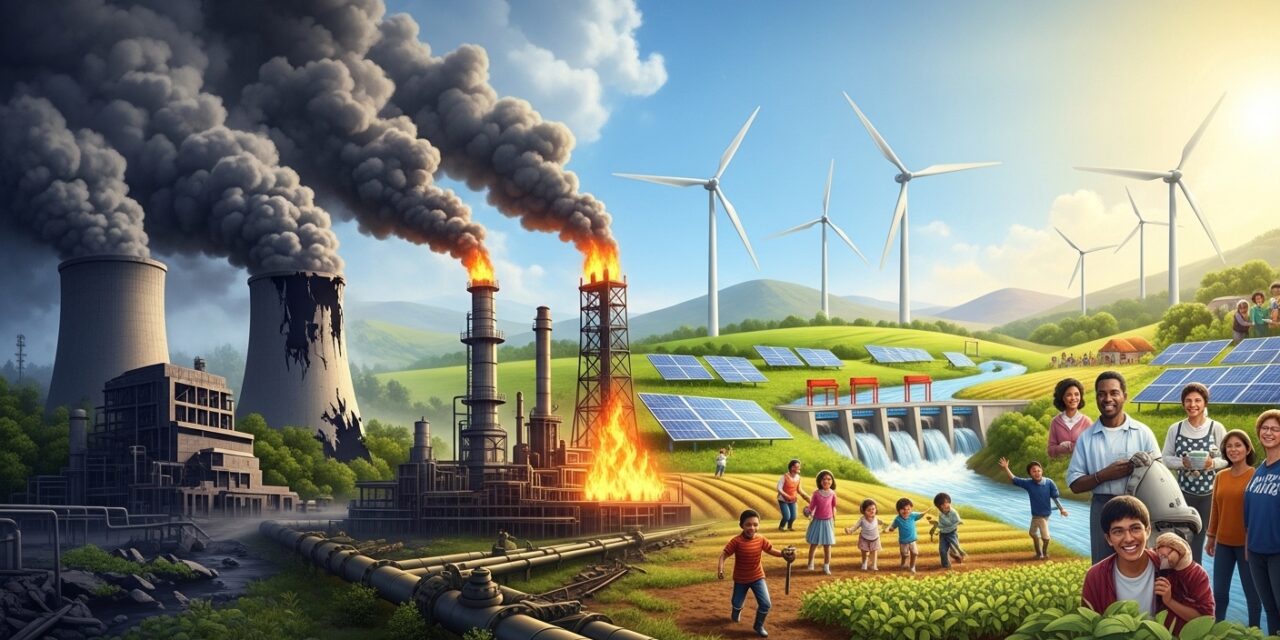
The world must move away from coal, gas and oil — quickly. Fossil fuels pollute land, water and air, create global instability and energy price volatility, increase the gap between rich and poor and alter the climate in ways that threaten health and survival.
But it’s difficult to accomplish this when the global economic system prevents governments from protecting public health and the environment.
The First Conference on Transitioning Away from Fossil Fuels — held in Santa Marta, Colombia, from April 24 to 29 — shone a spotlight on this contradiction. Hosted by Colombia and the Netherlands, it brought government representatives from 57 nations together with Indigenous Peoples, scientists, academics, non-governmental organizations, farmers, youth, women and labour, health and social movements.
Participants underscored that the climate crisis is far beyond an environmental emergency; it’s the ultimate test of whether international cooperation, strained under current economic and legal systems, can serve communities and people rather than protecting concentrated private power.
The international trade and investment treaties that underpin the global economy allow corporate interests to override peoples’ rights to a healthy environment, life, water, food and democratic decision-making.
The Santa Marta conference made clear that the global struggle against fossil fuel dependence must be understood as part of a much longer movement for global economic justice. Formal colonial rule may have receded but many of its economic structures have endured through trade, finance and law.
Assisted by investment treaties and investor-state dispute settlements, foreign corporations have been granted powerful rights to challenge public interest measures when they feel their profits — or even speculative profits — are affected. Communities facing environmental harm, displacement or threats to health from extractive industries enabled through foreign investments have no equivalent standing.
More than 2,500 international investment treaties, including several Canada has signed, allow corporations to bypass domestic courts and bring claims before private tribunals that operate with limited transparency and outside ordinary judicial safeguards, escaping virtually all public scrutiny.
This means foreign corporations can contest climate measures, environmental protections, Indigenous rights and public health decisions that might hinder their profits in a parallel, opaque legal system designed to buttress investor privilege. Even when governments’ duties to regulate in the public interest ultimately prevail, the risk of costly claims can create a regulatory chill and discourage ambitious action before policies are enacted.
The fossil fuel sector has been a principal benefactor. Worldwide, companies have challenged coal phase-outs and cancelled infrastructure projects, drilling restrictions and other efforts necessary to accelerate the energy transition, uphold human and environmental rights and protect climate and biodiversity. Although states have committed to transition away from fossil fuels (as evidenced by the decision at the 2023 COP28 climate summit to “accelerate action across all areas by 2030”), they remain constrained by legal arrangements that can penalize them for doing so.
Canada has been an active participant, promoting investment protections through trade and bilateral investment agreements that have benefited many Canadian extractive interests abroad.
Canada has also been a target. When democratic institutions in Quebec rejected the development of a new liquefied natural gas pipeline and export terminal, and subsequently adopted measures to restrict fossil fuel development, American corporations (Lone Pine Resources and Ruby River Capital) reframed those decisions as investor losses requiring compensation and sued the Quebec and federal governments for billions.
New legal developments such as the Building Canada Act and the sovereign wealth fund could help build a more resilient and forward-looking economy, but only if they contribute to ending Canada’s lethal fossil fuel dependence. Public investment can and should play a central role in financing renewable energy, public infrastructure and a just transition. But these tools must be governed by clear public interest objectives. If deregulation weakens safeguards, or public funds are used to prolong fossil fuel dependence, we’re not transforming the system but extending it.
If Canada wants credibility on climate leadership, it must end support for investor-state dispute settlements, reform trade and investment rules, respect Indigenous rights and ensure new public institutions and initiatives such as a sovereign wealth fund serve the transition rather than the status quo.
The Santa Marta conference leaves no doubt: climate action requires unhinging power from foreign corporate privilege and putting it toward justice, democracy and the communities most affected.
David Suzuki is a scientist, broadcaster, author and co-founder of the David Suzuki Foundation. Written with David Suzuki Foundation Director-General for Quebec and Atlantic Canada Sabaa Khan.
Learn more at davidsuzuki.org.
REFERENCES:
First Conference on Transitioning Away from Fossil Fuels:
https://transitionawayconference.com
Global struggle against fossil fuel dependence:
Investor-state dispute settlement:
https://www.iisd.org/publications/report/investment-treaty-and-isds-reform-questions-answers
More than 2,500 international investment treaties:
COP28:
Lone Pine Resources:
https://davidsuzuki.org/story/canada-is-trading-away-its-environmental-rights
Ruby River Capital:
https://www.policyalternatives.ca/news-research/toxic-legacy
Building Canada Act:
Sovereign wealth fund:
https://www.cbc.ca/news/business/canada-sovereign-wealth-fund-explainer-9.7179217
Ending Canada’s lethal fossil fuel dependence:
https://davidsuzuki.org/action/reject-albertas-pipeline-ploy