






















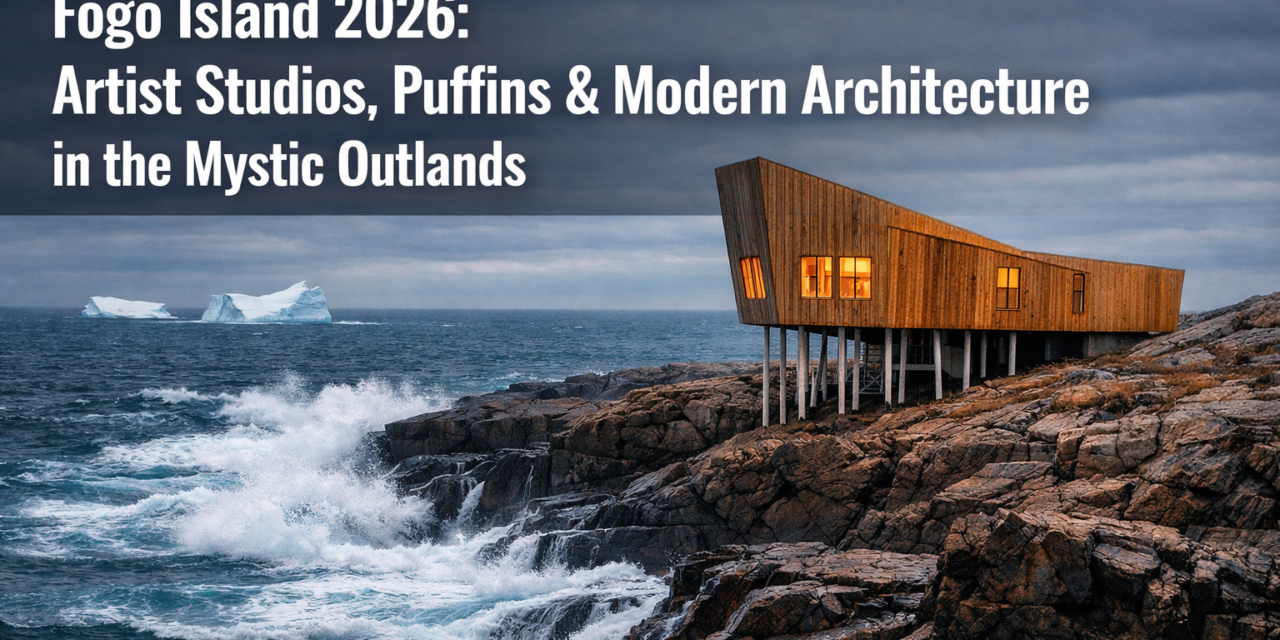
Fogo Island Newfoundland 2026: Artist Studios, Puffins and Modern Architecture in the Mystic Outlands

Last updated: April 2, 2026
Quick Answer: Fogo Island, a remote 25-by-14-kilometre island off Newfoundland’s northeast coast, has become one of the most compelling cultural destinations in North America. In 2026, visitors can explore four architect-designed artist studios, watch Atlantic puffin colonies from coastal cliffs, stay at the acclaimed Fogo Island Inn, and paddle historic harbours on a brand-new kayaking experience. This is the definitive guide to planning a trip that blends raw coastal wilderness with world-class contemporary architecture.
Key Takeaways
- Four off-grid artist studios designed by architect Todd Saunders sit along Fogo Island’s coastline, ranging from 200 to 1,200 square feet [2].
- Atlantic puffins nest on Fogo Island’s cliffs from late May through early September, making summer the prime wildlife-viewing window.
- Fogo Island Inn, a striking modern structure on stilts, anchors the island’s hospitality and reinvests profits into the local community.
- A new 2026 paddling experience lets guests explore Joe Batt’s Harbour by water, echoing how early settlers first arrived [5].
- The studios reference traditional Newfoundland fishing stages in their stilt-leg construction, connecting modern design to centuries-old outport culture [2].
- Getting to Fogo Island requires a ferry from Farewell, Newfoundland, adding to the sense of deliberate disconnection.
- The island is part of a growing “Mystic Outlands” travel trend focused on remote, culturally rich destinations over mass tourism hubs.

What Makes Fogo Island Newfoundland 2026 a Must-Visit Destination?
Fogo Island sits at the edge of the North Atlantic, closer to Ireland than to Toronto. That geographic extremity is the point. In 2026, the island represents a counter-movement to overtourism: a place where fewer than 2,500 residents share their home with visiting artists, architects, hikers, and wildlife enthusiasts.
The appeal breaks down into three pillars:
- Architecture and art: Four contemporary artist studios and the Fogo Island Inn have put this tiny community on the global design map [7].
- Wildlife: Puffin colonies, caribou herds, and migrating whales make the island a living nature documentary.
- Cultural authenticity: Outport communities like Tilting, Joe Batt’s Arm, and Deep Bay maintain traditions stretching back to the 1600s.
The “Mystic Outlands” label, increasingly used by travel writers in 2026, describes destinations where isolation itself is the luxury. Fogo Island fits that definition better than almost anywhere else in Canada. For travelers who value spending time in nature for rest and restoration, this island delivers on every level.
How Were the Artist Studios on Fogo Island Designed and Built?
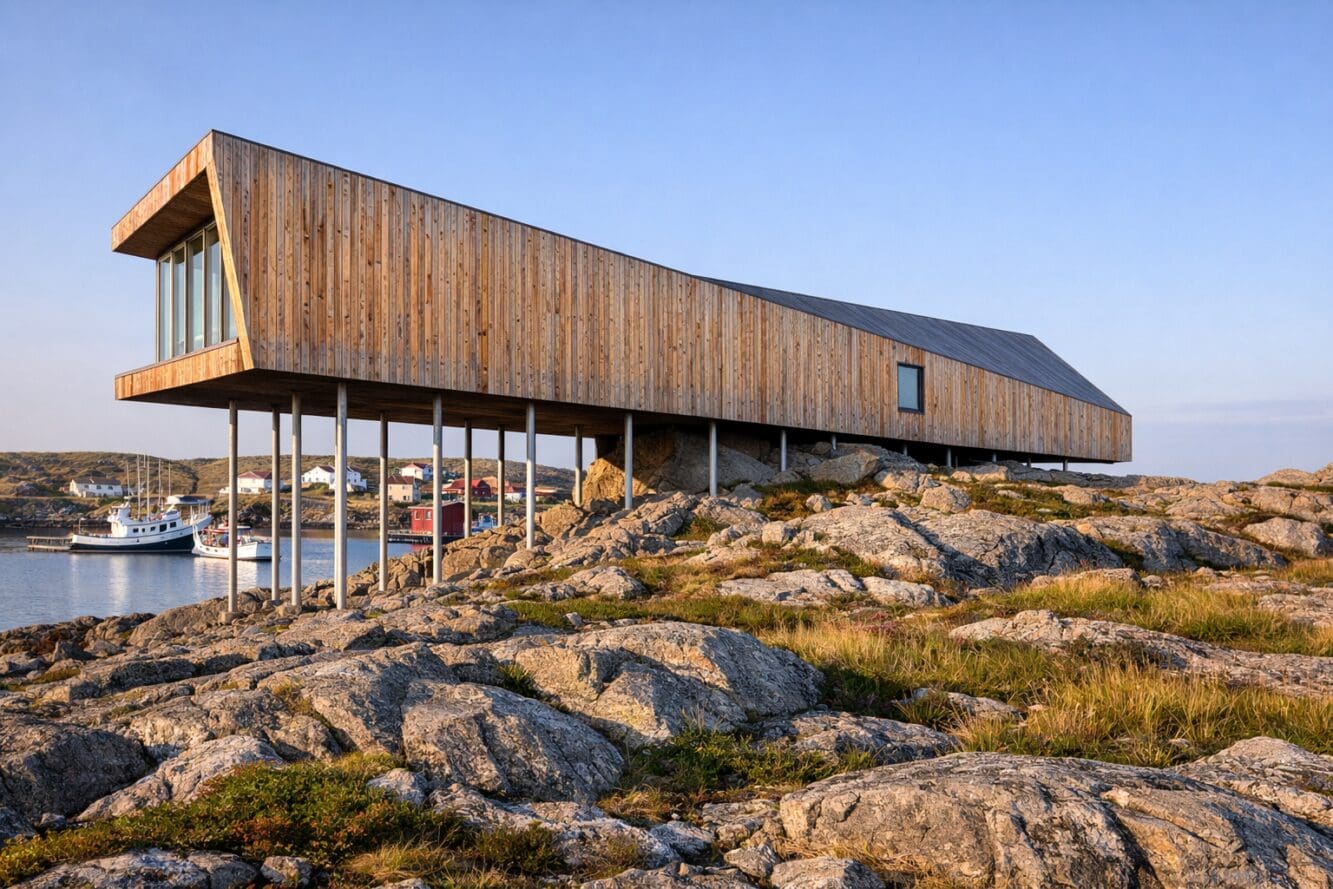
Newfoundland-born, Norway-based architect Todd Saunders designed four artist studios between 2008 and 2011, each placed in a different community on the island [1]. The original plan called for six studios total, but the four completed structures have become architectural landmarks in their own right [2].
The Four Studios
| Studio | Location | Key Feature |
|---|---|---|
| Long Studio | Joe Batt’s Arm | Elevated on stilt legs referencing traditional fishing stages [2] |
| Tower Studio | Shoal Bay | Perched on rocky coastline with vertical orientation [3] |
| Bridge Studio | Deep Bay | Spans a steep hillside overlooking an inland pond [3] |
| Squish Studio | Tilting | Low-profile structure integrated into the coastal landscape |
All four studios are completely off-the-grid. They use compost toilets, solar-powered electricity, and wood-burning stoves [2]. Sizes range from 200 to 1,200 square feet, giving resident artists anything from a compact writing room to a spacious painting or sculpture workspace [2].
Common mistake: Some visitors assume the studios are open for public tours at any time. They’re working spaces for artists-in-residence through the Fogo Island Arts program, which launched in 2010 [1]. Exterior viewing and photography are always possible, but interior access depends on whether an artist is currently in residence and willing to receive visitors.
The stilt-leg construction of the Long Studio deserves special attention. Those legs aren’t just an aesthetic choice. They directly reference the fishing stages that outport communities across Newfoundland built for centuries to salt and dry cod [2]. Saunders took a vernacular building tradition and translated it into contemporary architecture, and the result feels both alien and deeply rooted at the same time.
Where Can You Watch Puffins on Fogo Island in 2026?
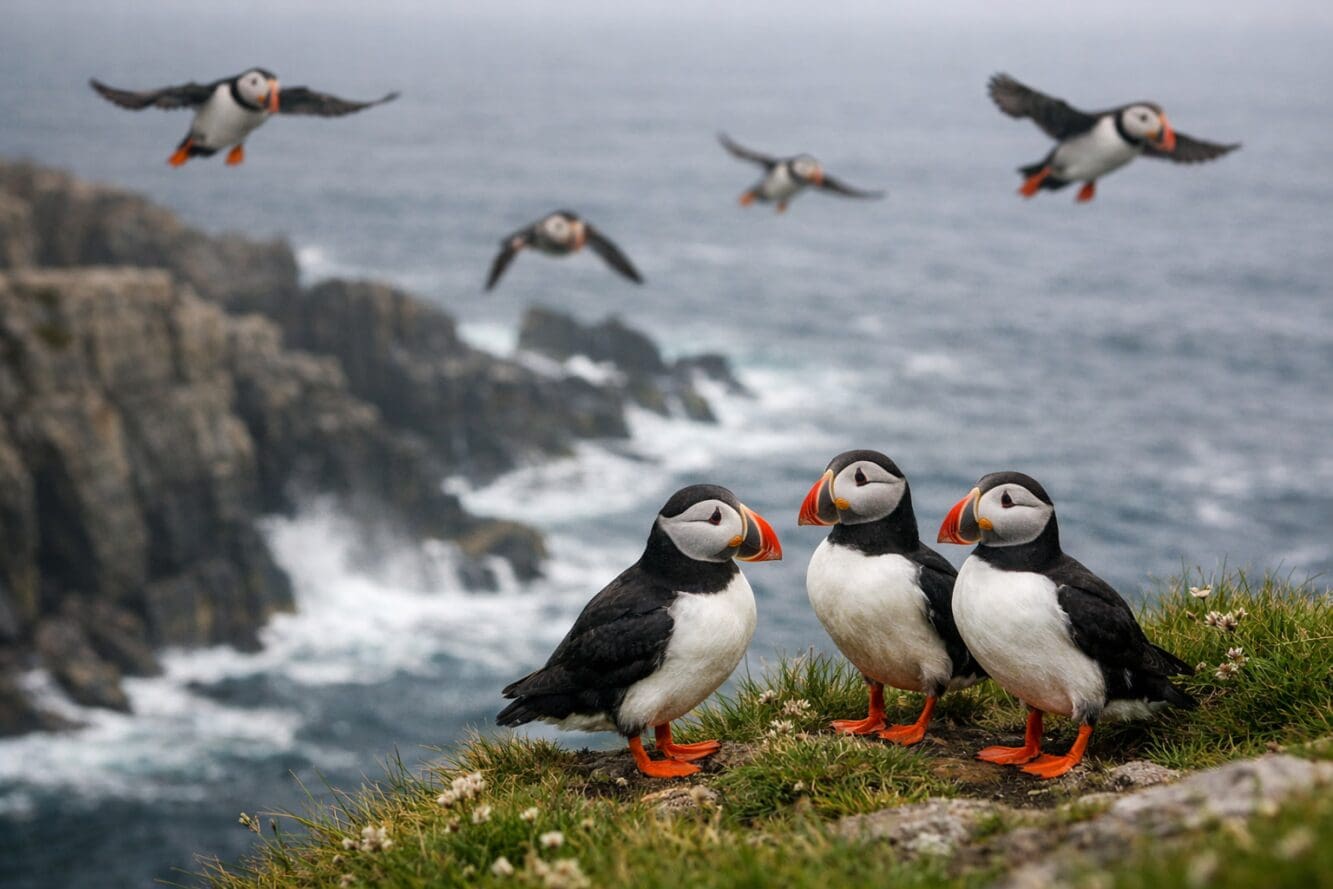
Atlantic puffins arrive on Fogo Island’s coastal cliffs in late May and stay through early September. The best viewing spots are along the island’s eastern and northern shorelines, particularly near the communities of Tilting and Stag Harbour.
Best practices for puffin watching:
- Timing: Early morning and late afternoon, when puffins are most active returning to burrows with fish.
- Distance: Stay at least 15 metres from nesting areas. Puffins are sensitive to disturbance during breeding season.
- Gear: Binoculars are essential. A 200mm+ camera lens helps for photography.
- Season peak: Late June through mid-July typically offers the highest activity, with chicks being fed in burrows.
Fogo Island’s puffin colonies aren’t as massive as those at Witless Bay or Cape St. Mary’s further south in Newfoundland, but the advantage here is solitude. Visitors often have clifftop viewing spots entirely to themselves. The experience of watching puffins while also being within walking distance of a Todd Saunders studio is unique to Fogo Island.
Beyond puffins, the island supports populations of caribou, moose, and various seabird species. Humpback and minke whales are regularly spotted from shore between June and August. For anyone interested in wild species and biodiversity, Fogo Island’s ecosystem is remarkably intact.
What Is the Fogo Island Inn and Why Does Its Architecture Matter?
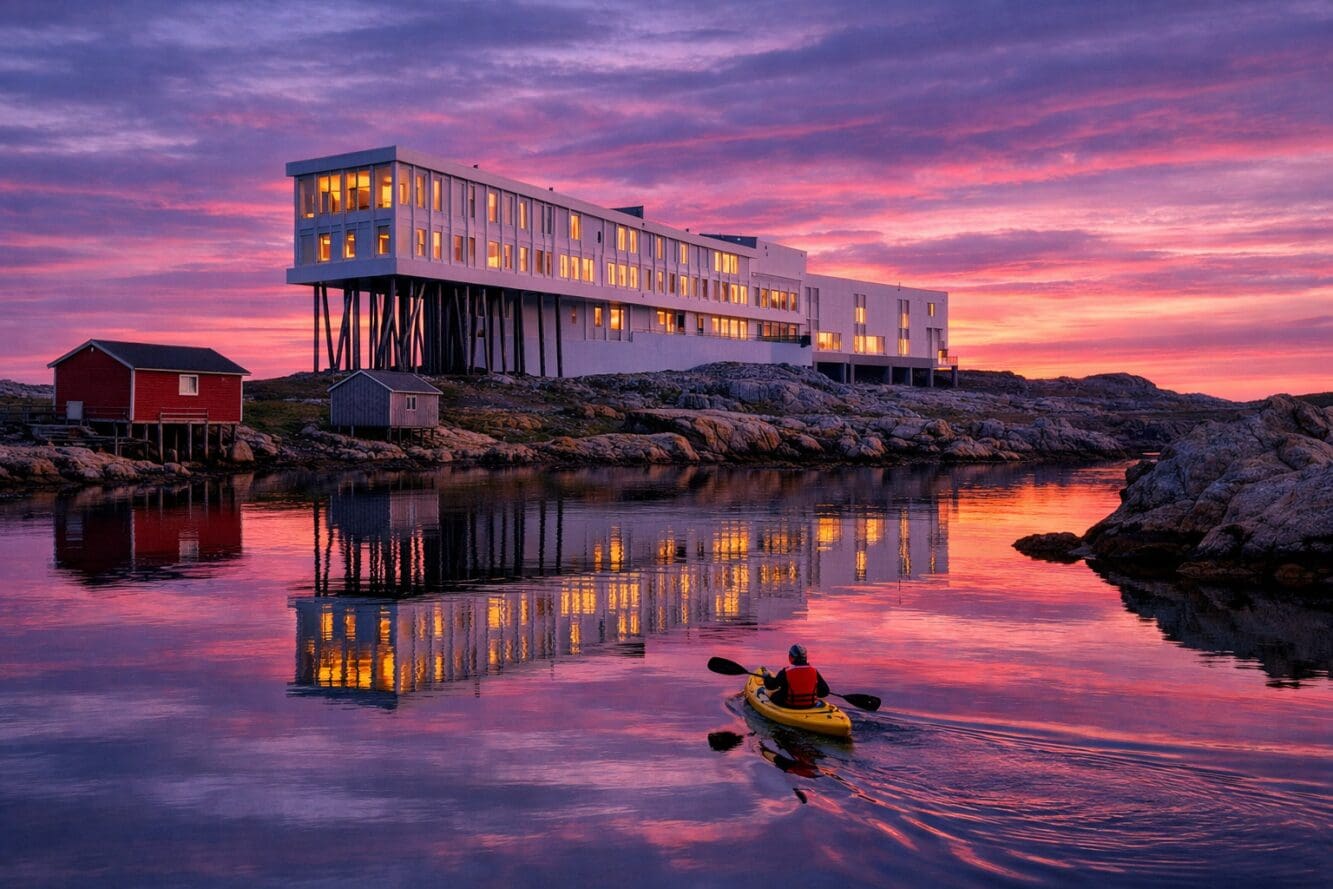
The Fogo Island Inn is a 29-room hotel designed by Todd Saunders, the same architect behind the artist studios. It sits on stilts above the rocky shoreline of Joe Batt’s Arm, and its angular white form looks like something between a spaceship and a traditional Newfoundland saltbox house [4].
The inn matters for three reasons:
- Community reinvestment: It operates as a social business under the Shorefast Foundation. Revenue goes back into the island’s economy and cultural programs.
- Architectural statement: The building demonstrates that world-class contemporary design can exist in a remote outport community without erasing local identity [6].
- Cultural programming: Guests participate in activities rooted in local traditions, from berry picking to boat building to community kitchen suppers.
New for 2026: A paddling activity now allows guests to explore Joe Batt’s Harbour by water, replicating how early settlers once experienced the community from the sea [5]. This is a meaningful addition because it shifts the perspective from land-based sightseeing to the water-level view that defined life here for centuries.
Room rates at the inn are significant (expect to pay well over $1,000 CAD per night in peak season), but the price includes meals, community host guidance, and access to programming. For travelers comparing this to other custom-designed architectural experiences, the Fogo Island Inn stands apart because the architecture serves a social mission, not just aesthetics.
Choose the inn if: You want a fully immersive cultural experience with high-end comfort. Choose independent travel if: You’re on a budget and prefer self-directed exploration. Fogo Island has B&Bs, vacation rentals, and campgrounds as alternatives.
How Does Fogo Island Newfoundland 2026 Fit the Mystic Outlands Travel Trend?
The “Mystic Outlands” trend in 2026 describes a shift toward destinations that are geographically remote, culturally distinctive, and intentionally low-capacity. Fogo Island didn’t invent this trend, but it may be its clearest example.
What defines a Mystic Outlands destination:
- Geographic isolation requiring deliberate effort to reach (ferry, small plane, or long drive)
- A living local culture, not a reconstructed or theme-park version
- Contemporary creative infrastructure (studios, galleries, residencies) layered onto traditional communities
- Limited visitor capacity by design, not by accident
- Landscape that feels untamed and elemental
Fogo Island checks every box. The 45-minute ferry crossing from Farewell acts as a natural filter. There’s no cruise ship dock, no airport with commercial jet service, and no chain hotels. The island’s carrying capacity is inherently limited, which preserves the experience.
This trend connects to broader conversations about sustainable community planning and how small towns balance tourism revenue with quality of life for residents. Fogo Island’s model, where tourism profits fund community programs rather than extract wealth, offers a template other remote communities are studying.
What Should a 2026 Fogo Island Itinerary Look Like?
A minimum of three full days on the island is recommended. Five days allows for weather flexibility and deeper engagement with the community.
Sample 5-Day Itinerary
Day 1: Arrival and Orientation
- Ferry from Farewell to Fogo Island (departs multiple times daily; check schedule for 2026 updates)
- Settle into accommodation
- Evening walk along the shoreline at Joe Batt’s Arm
Day 2: Studios and Architecture
- Morning visit to the Long Studio and Tower Studio [3]
- Afternoon hike between Shoal Bay and Deep Bay to see the Bridge Studio
- Evening community supper or local restaurant
Day 3: Wildlife and Coastal Hiking
- Early morning puffin watching near Tilting
- Full-day hike on one of the island’s coastal trails (the Tilting to Oliver’s Cove trail is outstanding)
- Watch for whales from the headlands
Day 4: Cultural Immersion
- New 2026 harbour paddling experience at Joe Batt’s Arm [5]
- Visit the Fogo Island Arts gallery
- Afternoon in the community of Fogo (the island’s largest settlement)
- Attend an emerging artist performance or event if available
Day 5: Departure Day
- Morning visit to Squish Studio in Tilting
- Final coastal walk
- Afternoon ferry back to the mainland
Edge case: Weather on Fogo Island is unpredictable. Fog can roll in for days. Build flexibility into the schedule and have indoor alternatives (the inn’s library, local museums, community visits) ready. The ferry occasionally cancels in rough seas, so don’t book a same-day flight out of Gander.
What Are the Practical Details for Getting to Fogo Island?
Getting there requires planning. There’s no shortcut.
- By air: Fly to Gander International Airport (YQX), then drive approximately 100 km north to Farewell.
- By ferry: The MV Veteran runs between Farewell and Fogo Island. The crossing takes about 45 minutes. Reservations are recommended in summer.
- By car: A vehicle is highly recommended on the island. Roads connect the main communities, but there’s no public transit.
- Best months: June through September for wildlife and the warmest weather. July and August are peak season.
Budget consideration: Fogo Island can be visited affordably. Not everyone stays at the inn. Local B&Bs and rental properties offer rooms from roughly $100-200 CAD per night. Groceries are available but more expensive than the mainland due to ferry transport costs. Bringing some supplies from Gander is a smart move.
For those interested in exploring dramatic island landscapes by drone or video, Fogo Island’s terrain is extraordinary from the air, but check local regulations before flying.
Pros and Cons of Visiting Fogo Island in 2026
| Pros | Cons |
|---|---|
| Uncrowded, authentic cultural experience | Remote location requires significant travel time |
| World-class architecture in a wild setting | Weather can disrupt plans (fog, wind, ferry cancellations) |
| Excellent wildlife viewing (puffins, whales) | Limited dining and shopping options |
| Community-based tourism model | Fogo Island Inn is expensive for many budgets |
| New 2026 paddling experience adds variety | Cell service and internet are limited in some areas |
| Strong arts and residency programming | Not ideal for travelers who need constant entertainment |
Conclusion
Fogo Island in 2026 offers something increasingly rare: a destination where architecture, wildlife, and community culture exist in genuine balance rather than manufactured harmony. The artist studios by Todd Saunders are reason enough to make the journey, but the puffin cliffs, the new harbour paddling experience, and the outport communities give the trip layers that reward longer stays.
Actionable next steps:
- Book ferry reservations early for July or August travel. Summer slots fill up.
- Decide on accommodation based on budget: the inn for full immersion, B&Bs or rentals for independent exploration.
- Pack for all weather. Bring layers, rain gear, and binoculars regardless of the forecast.
- Reserve an arts residency visit through Fogo Island Arts if you want interior studio access.
- Allow buffer days in your Newfoundland itinerary for weather delays.
Fogo Island doesn’t try to be everything to everyone. It’s a place for people who want to slow down, look closely, and feel the edge of the continent under their feet. In 2026, that kind of soulful cultural experience is worth the effort to reach.
FAQ
How do I get to Fogo Island from St. John’s?
Drive approximately 5.5 hours from St. John’s to Farewell, then take the 45-minute ferry. Alternatively, fly from St. John’s to Gander and drive 1.5 hours to the ferry terminal.
Can I visit the artist studios inside?
Exterior viewing is always available. Interior access depends on whether an artist-in-residence is present and open to visitors. Check with Fogo Island Arts for current schedules [2].
When is the best time to see puffins on Fogo Island?
Late June through mid-July is peak puffin season. Birds are present from late May through early September.
How much does Fogo Island Inn cost per night?
Rates vary by season but typically exceed $1,000 CAD per night in summer. This includes meals, activities, and community host services.
Is Fogo Island good for families with children?
Yes, but it’s best suited for families who enjoy outdoor activities and can handle unpredictable weather. There are no amusement parks or structured kids’ programs outside the inn.
Do I need a car on Fogo Island?
A car is strongly recommended. The island is about 25 km long, and communities are spread out with no public transit.
What is the new paddling experience in 2026?
Guests can now kayak through Joe Batt’s Harbour, experiencing the community from the water as early settlers did [5].
Are the artist studios off-grid?
Yes. All four studios operate with solar power, compost toilets, and wood-burning stoves. There is no connection to municipal utilities [2].
Can I camp on Fogo Island?
Camping options exist, though they are limited. Check with the town of Fogo Island for current campsite availability and regulations.
How many days should I spend on Fogo Island?
A minimum of three full days is recommended. Five days allows for weather flexibility and deeper cultural engagement.
References
[1] architonic – https://www.architonic.com/en/pr/fogo-island-artists-studios-(the-long-studio)/5100998/
[2] Studios – https://www.fogoislandarts.ca/studios/
[3] Watch – https://www.youtube.com/watch?v=5lvoovvKC_g
[4] Architecture Design – https://fogoislandinn.ca/our-inn/our-radical-approach/architecture-design/
[5] Fogo Island Inn A Tether To The Edge Of The World – https://rolandbast.com/fogo-island-inn-a-tether-to-the-edge-of-the-world/
[6] The Fogo Island Effect – http://www.canadianarchitect.com/the-fogo-island-effect/
[7] Fogo Island Artist Studios – https://architizer.com/projects/fogo-island-artist-studios/
Content, illustrations, and third-party video appearing on GEORGIANBAYNEWS.COM may be generated or curated with AI assistance or reproduced pursuant to the fair dealing provisions of the Copyright Act, R.S.C. 1985, c. C-42. Attribution and hyperlinks to original sources are provided in acknowledgment of applicable intellectual property rights. Such referencing is intended to direct traffic to and support the original rights holders’ platforms.
Much Appreciate You Sharing This Post - It Helps MUCH!!!