






















Kazuma Okamoto’s Early Impact: Is the Blue Jays’ New Power Bat the Real Deal or a Hot Start Mirage?


Last updated: May 14, 2026
Quick Answer: Kazuma Okamoto’s early impact with the Blue Jays is backed by six consecutive 30-homer NPB seasons, a $60 million contract, and spring training exit velocities above 103 mph — making this look far more like a legitimate power bat than a temporary hot streak. The underlying contact quality and plate discipline data support a real, sustainable middle-of-the-order contributor in 2026 and beyond.
Key Takeaways
- 🔵 Toronto signed Okamoto to a four-year, $60 million deal — one of the richest contracts ever given to a direct NPB position-player import [9]
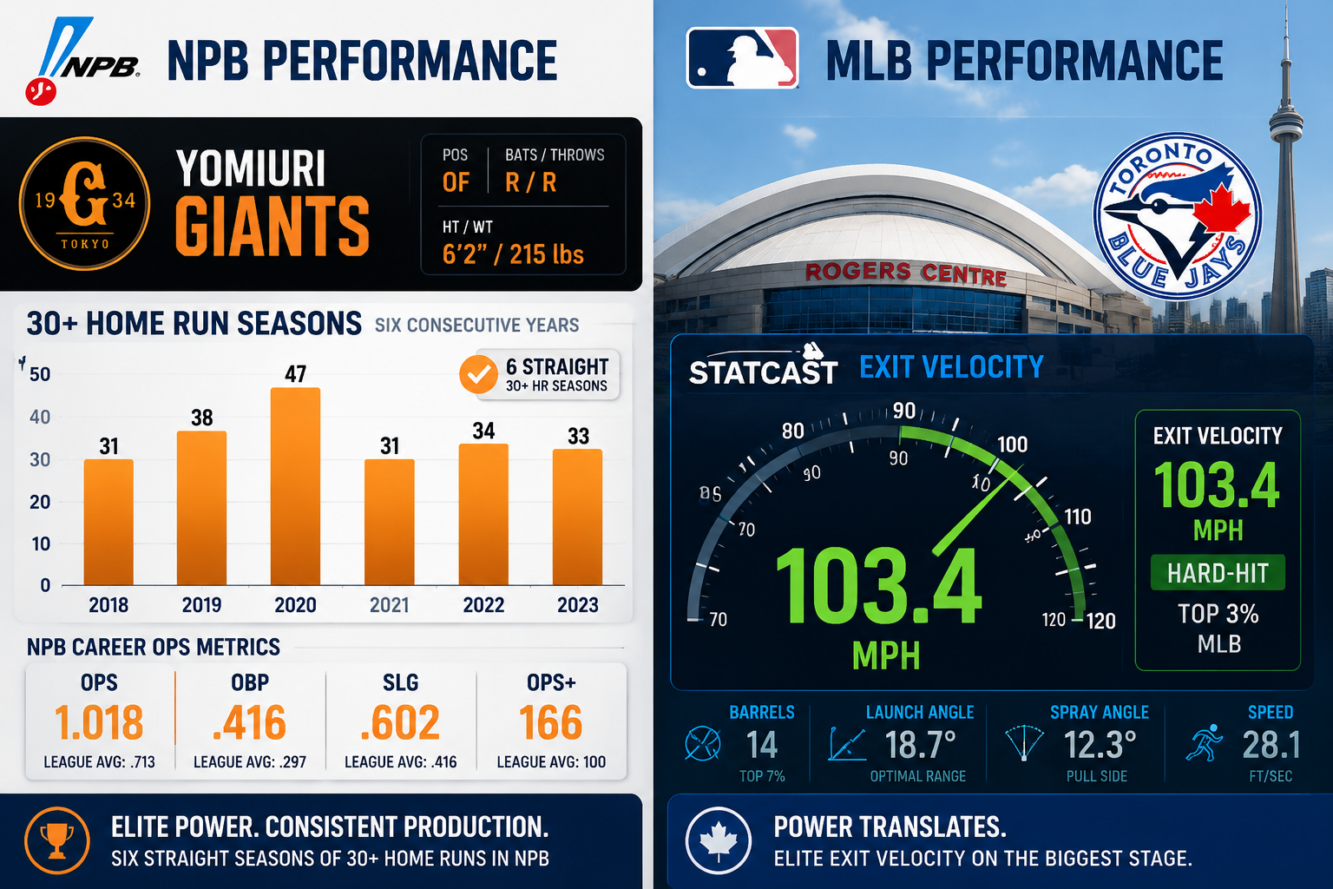
- ⚾ He averaged 30 home runs and an .898 OPS per season over his last five NPB years, with six straight 30+ homer campaigns for the Yomiuri Giants [9]
- 💥 In spring training, five of his first seven batted balls were hard-hit (95+ mph exit velocity), including a 431-foot homer at 103.4 mph off a low-and-away curveball [5][10]
- 📊 The Blue Jays moved him into the cleanup spot after just one MLB game — a strong organizational signal about his projected role [4]
- 🧠 His swing mechanics drew praise from teammates and MLB analysts alike, with contact quality metrics that organizations track closely [6][10]
- ⚠️ The real question isn’t whether his power is genuine — it’s how quickly he adapts to MLB breaking balls and pitcher sequencing
- 📅 His 2025 NPB finish (.327 average, 1.014 OPS in 69 games) showed both power and refined contact, not a one-year outlier [9]
- 🏟️ Rogers Centre’s dimensions and turf could affect his numbers, but his raw power profile projects well for any park
What Is Kazuma Okamoto’s Early Impact With the Blue Jays, and Why Does It Matter?
Kazuma Okamoto’s early impact with the Blue Jays matters because Toronto has been searching for a reliable middle-of-the-order right-handed power bat for years. His arrival, paired with Dylan Cease on the pitching side, signals a genuine win-now push from a front office that committed serious money.
The question driving most fan and analyst conversation — Is the Blue Jays’ new power bat the real deal or a hot start mirage? — has a data-supported answer that leans heavily toward “real deal.” Here’s why.
Toronto signed Okamoto in January 2026 to a four-year, $60 million contract, a larger guarantee than NPB-to-MLB position-player imports like Seiya Suzuki and Masataka Yoshida received [9]. That kind of commitment doesn’t happen without extensive scouting, video review, and Statcast-style analysis of his NPB production. The front office isn’t betting on a hot streak — they’re betting on a sustained track record.
What Does Okamoto’s NPB Track Record Actually Tell Us?
His NPB numbers are not a one-year sample. Over his last five seasons with the Yomiuri Giants, Okamoto averaged a .275 batting average, 30 home runs, 84 RBI, 29 doubles, and an .898 OPS [9]. Six consecutive 30+ homer seasons against quality NPB pitching is the kind of consistency that translates into organizational confidence.
Key NPB production highlights:
| Season Metric | Average (Last 5 NPB Seasons) |
|---|---|
| Home Runs | 30 |
| RBI | 84 |
| Doubles | 29 |
| OPS | .898 |
| Batting Average | .275 |
His final NPB half-season in 2025 before the move was arguably his best stretch: .327 average, 1.014 OPS, and 15 home runs in just 69 games [9]. That’s not a player declining into a career-ending deal — that’s a player peaking at the right moment.
Common mistake to avoid: Dismissing NPB production as irrelevant to MLB. While the leagues differ in velocity and pitch mix, elite NPB power hitters with strong plate discipline have historically made reasonable transitions. Okamoto’s profile — patient approach, plus raw power, consistent contact — fits the mold of a hitter who can adjust.
How Did Okamoto Perform in Spring Training, and What Do the Metrics Show?
Spring training results are often noise, but Okamoto’s underlying contact quality in Grapefruit League play was not [5]. Five of his first seven batted balls registered as hard-hit at 95+ mph exit velocity — a rate that would rank among MLB’s elite if sustained across a full season [5].
The signature moment came off Yankees reliever Clay Holmes: a 431-foot home run to dead center field, measured at 103.4 mph exit velocity on a low-and-away curveball [5][10]. Analysts noted that Holmes’ pitch wasn’t a mistake — it was a well-located breaking ball. Okamoto simply had the plate coverage and bat speed to punish it anyway [10].
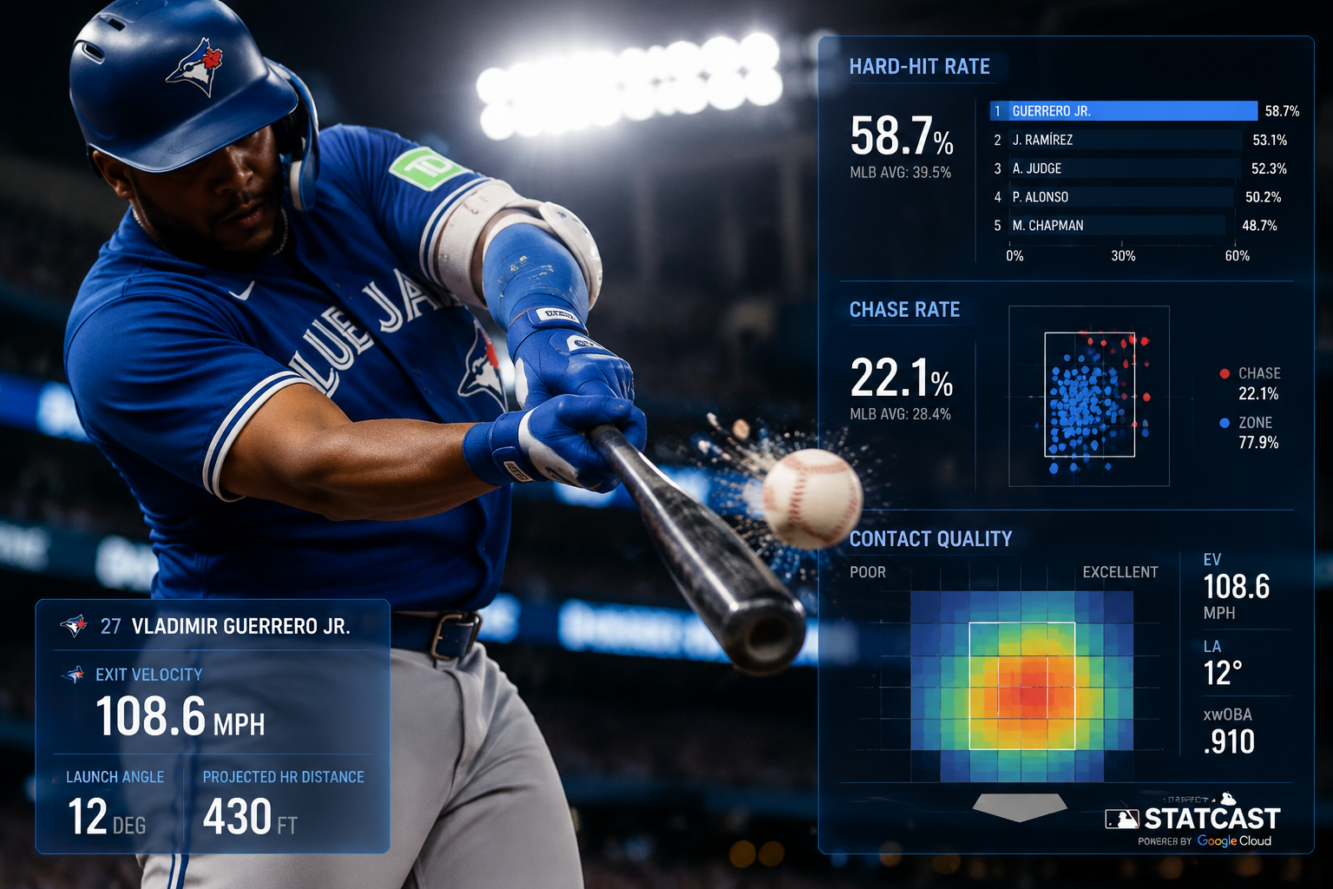
What MLB’s own breakdown highlighted [10]:
- Exceptional hip rotation and weight transfer through contact
- Bat path that stays in the hitting zone longer than average
- Ability to drive pitches on the outer third with authority
Teammate Ernie Clement described Okamoto as having “one of the smoothest right-handed swings you’re ever going to see” [6]. That kind of peer recognition, from a player who sees him daily in batting practice, carries real weight.
Pull quote: “Five of his first seven batted balls were hard-hit at 95+ mph — a spring training rate that would rank among MLB’s elite if sustained.” [5]
Why Did Toronto Move Okamoto to Cleanup After Just One MLB Game?
The Blue Jays moved Okamoto into the cleanup spot after a single MLB game, which is an aggressive organizational statement [4]. Cleanup hitters are expected to drive in runs, protect the lineup’s best on-base threats, and handle high-leverage at-bats against a team’s top relievers.
Moving a new import into that role that quickly tells you two things:
- The front office saw enough in spring training to trust his approach against MLB-quality stuff
- The lineup needed his bat immediately — Toronto’s run-production issues in recent seasons made waiting impractical
Decision rule: If Okamoto were simply a bench piece or platoon option, he’d ease into the lineup gradually. The cleanup designation is a direct signal that the organization views him as a core contributor, not an experiment [4][8].
For context on how the Blue Jays are building around this kind of commitment, the front office also added Dylan Cease and Tyler Rogers in the same offseason — a clear pattern of investing in impact players rather than depth pieces [9].
What Are the Realistic Risks and Adjustment Challenges?
No NPB-to-MLB transition is automatic. The risks are real, even for a hitter with Okamoto’s profile.
Potential adjustment challenges:
- Breaking ball sequencing: MLB pitchers are more likely to attack with high-spin breaking balls early in counts once they identify a hitter’s tendencies. Okamoto’s chase rate against offspeed pitches will be a key early indicator.
- Velocity at the top of the zone: MLB fastballs average higher velocity than NPB, and pitchers will test his ability to catch up to elite heaters up and in.
- Sample size volatility: Even a legitimate .280/30 HR hitter can look like a mirage through 30-40 games if the BABIP doesn’t cooperate.
- Park factors: Rogers Centre’s artificial turf and dimensions affect batted ball outcomes differently than NPB stadiums.
Edge case to watch: If Okamoto shows an elevated strikeout rate (above 28%) in his first 60 MLB games, that’s a flag worth monitoring — not a death sentence, but a sign that pitchers have found an exploitable pattern. Conversely, a chase rate below 30% would strongly suggest his plate discipline is translating intact.
How Does Okamoto’s Contract Compare to Other NPB Power Hitter Imports?
Toronto’s four-year, $60 million commitment is notably larger in both total guarantee and contract length than what comparable NPB position-player imports received [9]. For reference, Seiya Suzuki and Masataka Yoshida both signed shorter or lower-value deals when they crossed over.
What this contract signals:
- The Blue Jays view Okamoto as a franchise-level middle-of-the-order bat, not a one-year rental
- The investment reflects confidence in his durability and sustained production
- At $15 million per year, he needs to produce at roughly a 3-4 WAR level annually to justify the deal
For fans following the broader Blue Jays rebuild, this contract fits alongside the team’s other major moves as part of a coordinated effort to compete in the AL East in 2026 and through the late 2020s [8][9].
What Should Blue Jays Fans Expect From Okamoto Across a Full 2026 Season?
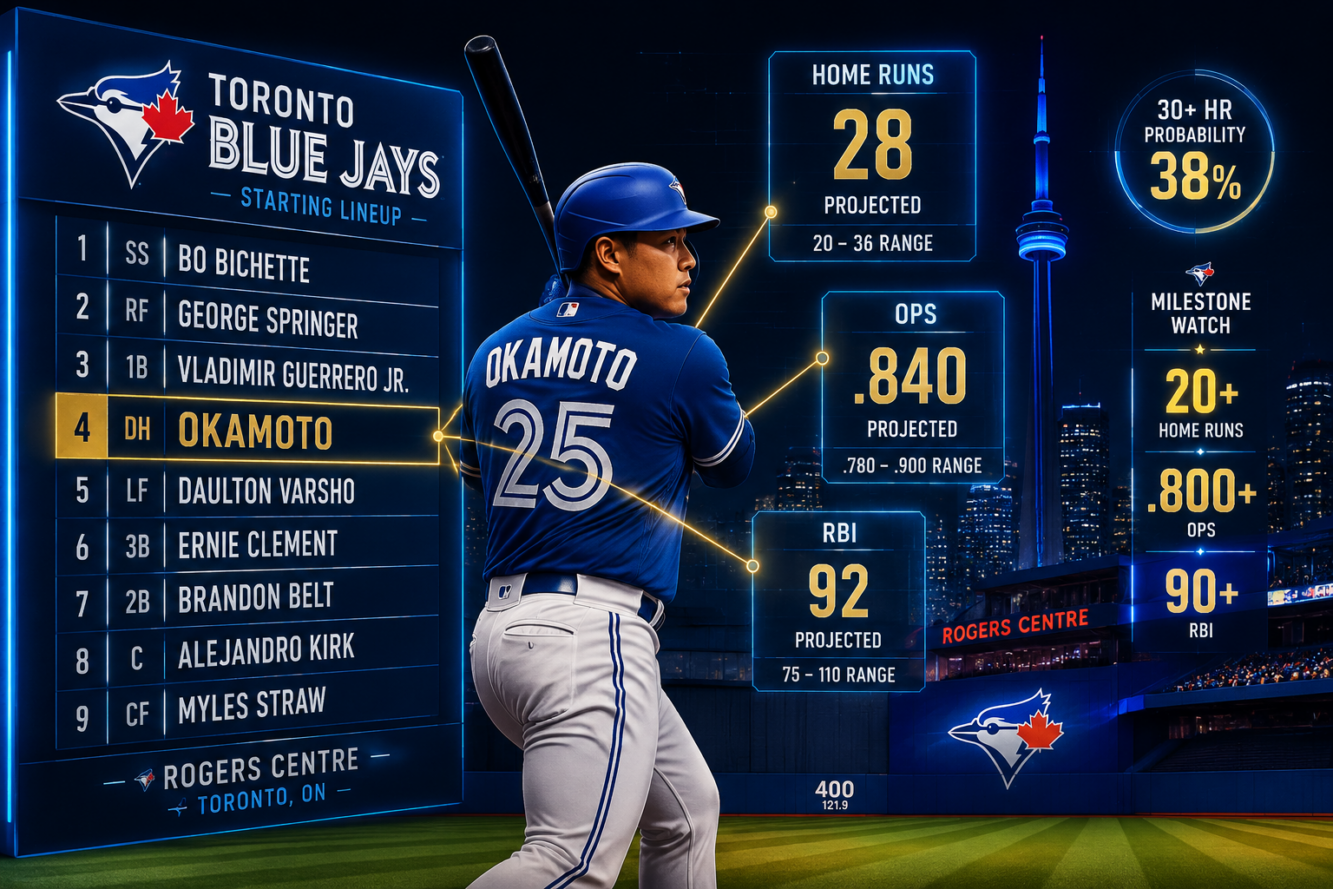
Realistic full-season projections for Okamoto in 2026 fall in a reasonable range, given his NPB track record and early MLB indicators [8].
Projected 2026 range (estimate based on NPB comps and spring data):
- Conservative: .255/.330/.470, 25 HR, 80 RBI
- Moderate: .270/.345/.500, 30 HR, 95 RBI
- Optimistic: .285/.360/.530, 35 HR, 105 RBI
The moderate projection aligns with what comparable NPB power hitters have produced in their MLB debut seasons when they carried strong plate discipline and contact profiles [8]. A full season of hard-hit rate data will be the clearest indicator of which range he’s tracking toward by mid-July.
Actionable watch list for fans and fantasy players:
- Track his chase rate monthly — ideally stays below 30%
- Monitor hard-hit rate (target: above 40% for elite power production)
- Watch his performance against left-handed starters specifically
- Note how pitchers sequence him in the second and third time through the order
FAQ: Kazuma Okamoto and the Blue Jays’ Power Outlook
Q: Is Kazuma Okamoto’s early impact with the Blue Jays sustainable? A: Based on six consecutive 30-homer NPB seasons and spring training exit velocities above 103 mph, the underlying indicators support sustainability rather than a hot start mirage [5][9].
Q: How does Okamoto’s contract compare to other NPB imports? A: His four-year, $60 million deal is one of the richest ever given to a direct NPB position-player import, larger than the deals Seiya Suzuki and Masataka Yoshida received [9].
Q: What position does Okamoto play for Toronto? A: He profiles as a corner infielder or designated hitter, fitting naturally into the cleanup spot in Toronto’s lineup [4][8].
Q: What was Okamoto’s most impressive spring training moment? A: A 431-foot home run to dead center off Clay Holmes at 103.4 mph exit velocity on a low-and-away curveball — off a well-located pitch, not a mistake [5][10].
Q: What are the biggest risks to Okamoto’s MLB transition? A: Adapting to MLB breaking ball sequencing and high-velocity fastballs up in the zone are the primary adjustment challenges for any NPB import.
Q: How quickly did Toronto commit to Okamoto as a starter? A: The Blue Jays moved him into the cleanup spot after just one MLB game, a clear signal of organizational confidence [4].
Q: What was Okamoto’s final NPB season like before joining Toronto? A: In 2025, he hit .327 with a 1.014 OPS and 15 home runs in 69 games — arguably his best stretch of production [9].
Q: Should fantasy baseball players roster Okamoto? A: Yes, if available. His power profile, lineup position, and underlying contact metrics make him a high-upside target, with the caveat that early-season adjustment variance is real.
Conclusion: The Verdict on Okamoto’s Early Impact
The evidence strongly favors “real deal” over “hot start mirage” when evaluating Kazuma Okamoto’s early impact with the Blue Jays. Six consecutive 30-homer NPB seasons, a $60 million organizational commitment, and spring training contact quality that impressed both analysts and teammates all point in the same direction [5][9][10].
The transition risks are real — every NPB import faces an adjustment period — but Okamoto’s profile (patient approach, elite raw power, refined contact mechanics) gives him the tools to work through early struggles if they come.
Actionable next steps for fans and analysts:
- Watch his chase rate through June as the primary early-adjustment indicator
- Track hard-hit rate monthly; anything above 40% sustained confirms the power is translating
- Reassess at the All-Star break with a meaningful sample of 300+ plate appearances
- Monitor his lineup protection — who bats around him affects his pitch diet significantly
Toronto’s front office made a high-conviction bet. The early returns suggest they got it right.
References
[1] Kazuma Okamoto Making Early Impact – https://sports.yahoo.com/articles/kazuma-okamoto-making-early-impact-221504203.html
[4] Blue Jays Kazuma Okamoto Decision – https://sports.yahoo.com/articles/blue-jays-kazuma-okamoto-decision-183328424.html
[5] 2 Blue Jays Offseason Acquisitions Producing Eye-Opening Numbers This Spring – https://www.si.com/mlb/bluejays/onsi/news/2-blue-jays-offseason-acquisitions-producing-eye-opening-numbers-this-spring
[6] Kazuma Okamoto Blue Jays Spring Training Options – https://www.mlb.com/news/kazuma-okamoto-blue-jays-spring-training-options
[7] Kazuma Okamoto Set To Make Blue Jays Debut Saturday In Exhibition Vs Phillies – https://www.cp24.com/news/sports/2026/02/20/kazuma-okamoto-set-to-make-blue-jays-debut-saturday-in-exhibition-vs-phillies/
[8] Blue Jays What To Expect From Kazuma Okamoto Across A Full Season – https://bluejaysnation.com/news/blue-jays-what-to-expect-from-kazuma-okamoto-across-a-full-season
[9] How Kazuma Okamoto Best Fits On Blue Jays – https://www.justbaseball.com/mlb/how-kazuma-okamoto-best-fits-on-blue-jays/
[10] A Deep Dive Into Kazuma Okamoto’s Home Run – https://www.mlb.com/bluejays/video/a-deep-dive-into-kazuma-okamoto-s-home-run-x8230
Content, illustrations, and third-party video appearing on GEORGIANBAYNEWS.COM may be generated or curated with AI assistance or reproduced pursuant to the fair dealing provisions of the Copyright Act, R.S.C. 1985, c. C-42. Attribution and hyperlinks to original sources are provided in acknowledgment of applicable intellectual property rights. Such referencing is intended to direct traffic to and support the original rights holders’ platforms.
Much Appreciate You Sharing This Post - It Helps MUCH!!!









![Toronto, Canada 1920s in color, Streetcar [60fps, Remastered] w/sound design added](https://georgianbaynews.com/wp-content/uploads/2025/08/maxresdefault-2025-08-14T111212.242.webp)