













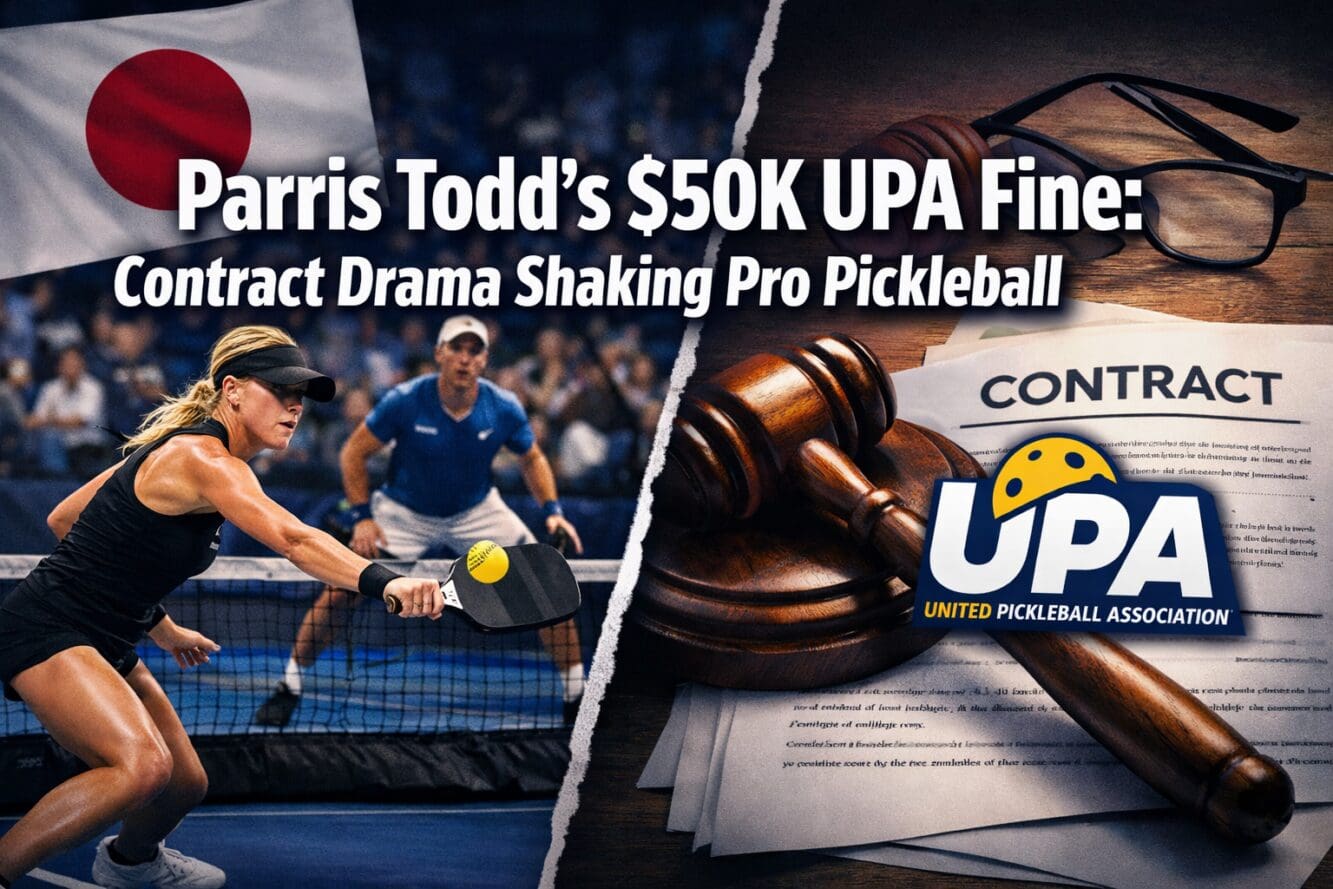
Parris Todd’s $50K UPA Fine and Japan Event Suspensions: Contract Drama Shaking Pro Pickleball

Last updated: February 20, 2026
Key Takeaways
- Parris Todd received a $50,000 fine and two-event suspension from the UPA for participating in unauthorized Pickleball Japan Federation events in December 2025
- Three other players—James Ignatowich, Ryan Fu, and Vivian Glozman—had their contracts terminated for the same Japan events, creating controversy over unequal treatment
- Todd requested advance permission but provided incomplete event details, distinguishing her case from players who didn’t seek approval at all
- The terminated players’ appeal was denied in January 2026, leaving them as free agents outside the UPA system
- Contract exclusivity clauses are at the center of the dispute, raising questions about player rights and league control in professional pickleball
Quick Answer

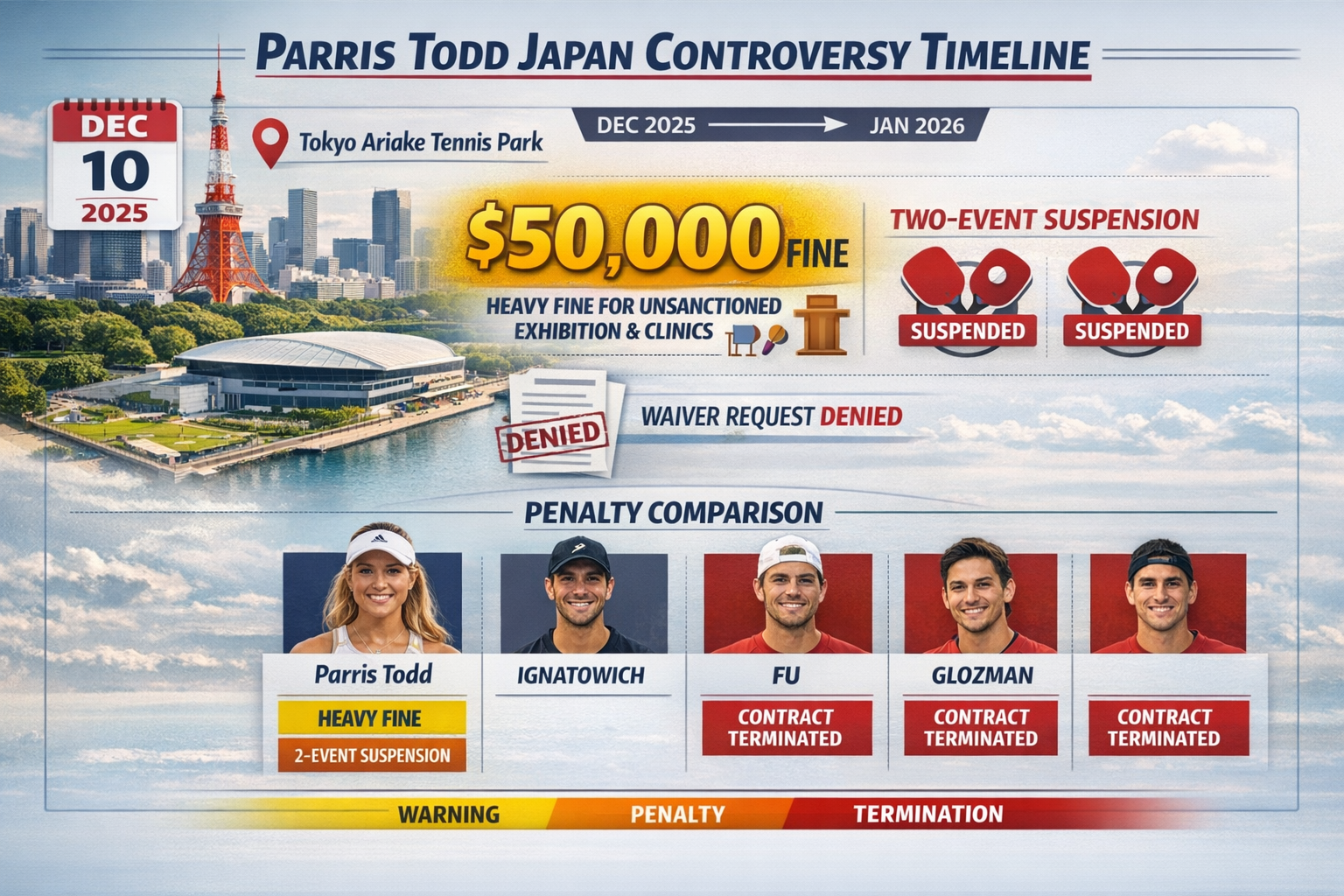
Parris Todd’s $50K UPA fine and Japan event suspensions stem from her December 2025 participation in Pickleball Japan Federation clinics and exhibitions that exceeded the scope of her approved waiver. Unlike James Ignatowich, Ryan Fu, and Vivian Glozman—whose contracts were terminated for the same events—Todd proactively requested permission and disclosed the discrepancy when discovered, resulting in a lighter penalty of $50,000 and suspension from two 2026 events rather than outright termination[1][2].

What Led to Parris Todd’s $50K UPA Fine and Japan Event Suspensions?
The controversy began when Parris Todd and three other top-ranked pros participated in a series of pickleball events organized by the Pickleball Japan Federation at Tokyo’s Ariake Tennis Park around December 10, 2025. Todd requested advance permission from the UPA to conduct “a single camp in Asia” and received a limited written waiver for that specific activity[1].

However, the actual events were materially different from what Todd disclosed:
- Multiple clinics and exhibition matches rather than a single camp
- Tournament component with over 1,000 registered players attached
- Promotional activities using player status and likeness to market the events
- RPM paddle sponsorship creating potential conflict of interest (Ignatowich co-founded RPM, Fu is on their roster)[2]
When Todd realized the scope exceeded her waiver, she immediately ceased involvement and proactively contacted the UPA to report the discrepancy[1]. This transparency became the key factor differentiating her penalty from the contract terminations issued to the other three players.
PPA Tour CEO Connor Pardoe explained: “Unlike the other three players, Parris did follow protocol by asking first and did not deliberately hide her plans. She at least attempted to do the right thing, even though the final scope far exceeded the waiver she was given”[1].
The $50,000 Fine Details
The $50,000 financial penalty matches the highest amount the UPA has ever fined a player for a single contract infraction[1]. This substantial sum sends a clear message about the seriousness of exclusivity violations, even when players make good-faith efforts to comply.
Two-Event Suspension Breakdown
Todd’s suspension covers:
- Carvana PPA Masters powered by Invited (January 2026) – the season’s opening PPA Tour event
- First Major League Pickleball event of 2026 (scheduled for May)[1][2]
This means Todd will miss critical early-season opportunities to earn ranking points, prize money, and maintain competitive momentum.
How Does Parris Todd’s Penalty Compare to the Contract Terminations?
The stark difference between Todd’s sanctions and the outright terminations of Ignatowich, Fu, and Glozman has sparked intense debate about fairness and consistency in UPA enforcement.
| Player | Advance Permission? | Penalty | Current Status |
|---|---|---|---|
| Parris Todd | Yes (incomplete disclosure) | $50,000 fine + 2-event suspension | Remains under UPA contract |
| James Ignatowich | No | Contract termination | Free agent (appeal denied) |
| Ryan Fu | No | Contract termination | Free agent (appeal denied) |
| Vivian Glozman | No | Contract termination | Free agent (appeal denied) |
Why the Different Treatment?
According to the UPA, the key distinction lies in procedural compliance and intent:
Todd’s mitigating factors:
- Proactively requested permission before traveling
- Received written waiver for limited activities
- Self-reported when scope expanded beyond approval
- Demonstrated attempt to follow proper channels[1]
Ignatowich/Fu/Glozman’s aggravating factors:
- No advance permission request
- No disclosure of plans to UPA
- Promotional materials prominently featured their PPA/MLP status
- Appeared to deliberately circumvent contract requirements[1][2]
The UPA stated that participating in competitor events constitutes a “black-and-white violation” of player agreements, but applied different consequences based on whether players attempted to follow proper procedures[2].

What Was the Pickleball Japan Federation Event That Triggered the Controversy?
The December 2025 events in Tokyo represented a significant international pickleball promotion effort that ran afoul of UPA exclusivity requirements.
Event Components
The Pickleball Japan Federation organized multiple activities:
- Professional clinics teaching techniques to Japanese players
- Exhibition matches showcasing high-level play
- Play-with-a-pro sessions allowing recreational players to compete alongside tour professionals
- Tournament with 1,000+ registered players creating a competitive component[2][3]
Marketing and Promotion
The events were heavily promoted using the players’ professional credentials:
- Advertising prominently featured their status as “top MLP and PPA players and champions”
- Social media campaigns highlighted their tour accomplishments
- Player likenesses were used to attract participants and spectators[1]
This promotional use of UPA-affiliated status to market non-UPA events became a central issue in the contract dispute.
The RPM Sponsorship Angle
Adding complexity to the situation, RPM (a paddle company co-founded by Ignatowich with Fu on its roster) sponsored the Japan events[2]. This created potential conflict-of-interest questions about whether players were using their UPA platform to promote competing commercial interests.
What Happened with the Appeal Filed by Ignatowich, Fu, and Glozman?
The three terminated players filed a formal appeal on December 22, 2025, challenging the UPA’s decision and arguing their participation didn’t violate contract terms.
Appeal Arguments
In their appeal statement, the players claimed:
“Nothing in our contracts prohibited this activity. We did not compete in another league, promote a rival tour, or receive compensation of any kind”[2][3]
They argued the Japan events were:
- Educational clinics rather than competitive tour events
- Exhibition play without league affiliation
- Promotional activities for pickleball growth, not competitor tours
- Uncompensated participation (though this claim remains disputed)[2]
UPA’s Response and Denial
Jeff Watson, VP of Communications and Marketing for the UPA, confirmed the organization received the appeal and would “take the appropriate next steps to evaluate”[3]. However, by early January 2026, the appeal was formally denied, leaving all three players as free agents outside the UPA system[2].
The denial suggests the UPA maintained that:
- Exclusivity clauses cover promotional activities, not just competitive play
- Using player status to market non-UPA events violates agreements
- Prior approval requirements are mandatory regardless of event type
Understanding UPA Contract Exclusivity Clauses in Professional Pickleball
The controversy highlights the extensive control UPA contracts give the organization over player activities, raising questions about athlete rights in professional pickleball.
What Do Exclusivity Clauses Cover?
Based on the Japan event fallout, UPA contracts appear to restrict:
Prohibited without approval:
- Participating in competitor tour events
- Conducting clinics at non-UPA tournaments
- Exhibition matches tied to other organizations
- Play-with-a-pro sessions at unsanctioned events
- Promotional activities using UPA-affiliated status
- Any pickleball-related activities that could benefit competitors[1]
Required procedures:
- Written advance permission requests
- Complete disclosure of all event components
- Additional approval if plans change or expand
- Ongoing communication about international activities[1]
The Waiver Request Process
Todd’s case illustrates how the approval system is supposed to work:
- Player submits written request describing planned activity in detail
- UPA reviews for potential conflicts with tour interests
- Limited waiver granted for specific approved activities only
- Player must return for additional approval if scope changes
- Proactive disclosure required if actual events differ from approval[1]
The system depends on complete transparency and good-faith communication from both parties.
Common Mistakes Players Make
Based on this controversy, players should avoid:
- Vague permission requests that don’t fully describe all planned activities
- Assuming approval covers related events not explicitly mentioned
- Failing to update the UPA when plans evolve or expand
- Participating in promotional activities beyond approved scope
- Allowing event organizers to use UPA credentials without explicit permission
What Are the Broader Implications for Professional Pickleball?
Parris Todd’s $50K UPA fine and Japan event suspensions, along with the contract terminations, expose tensions in professional pickleball’s governance structure.
Player Rights vs. League Control
The controversy raises fundamental questions:
League perspective:
- Exclusivity protects investment in player development
- Prevents competitors from free-riding on UPA-built reputations
- Maintains tour integrity and sponsor relationships
- Ensures players focus on UPA events
Player perspective:
- Restrictions limit earning opportunities outside tour schedule
- International growth activities benefit the sport overall
- Educational clinics shouldn’t require league permission
- Contracts may be overly restrictive compared to other professional sports
International Expansion Challenges
The Japan events occurred as the PPA Tour and MLP actively negotiate to bring events to Japan[1]. This creates awkward situations where:
- Players want to grow pickleball in emerging markets
- Independent organizations (like Pickleball Japan Federation) seek top talent
- UPA wants to control how its players participate in international markets
- Timing conflicts arise between grassroots growth and official expansion
Precedent for Future Enforcement
The different penalties for Todd versus the other three players establish important precedents:
Good-faith compliance matters: Players who attempt to follow procedures receive lighter sanctions than those who ignore them entirely.
Transparency is rewarded: Self-reporting violations can reduce penalties compared to hiding activities.
Intent factors into punishment: Deliberate circumvention draws harsher consequences than honest mistakes about scope.
But violations still carry serious penalties: Even with mitigating factors, Todd’s $50,000 fine and two-event suspension represent severe sanctions.
What’s Next for Parris Todd and Professional Pickleball Contracts?
As the 2026 season progresses, several developments will shape how this controversy affects the sport.
Todd’s Path Forward
After serving her suspension, Todd will return to UPA competition with:
Immediate challenges:
- Lost ranking points from missed January and May events
- Reduced prize money earnings in early 2026
- Competitive rust from extended time away
- Potential sponsor relationship impacts
Long-term considerations:
- Heightened scrutiny of all future activity requests
- Need for extremely detailed waiver applications
- Caution about international opportunities
- Reputation impact from high-profile penalty
The Terminated Players’ Options
Ignatowich, Fu, and Glozman now face decisions as free agents:
Possible paths:
- Negotiate new UPA contracts (if the organization allows)
- Participate in alternative pickleball tours or leagues
- Focus on international exhibition and clinic opportunities
- Pursue legal action challenging contract terms
- Create independent competitive platforms
Contract Reform Possibilities
The controversy may prompt changes to UPA agreements:
Potential reforms:
- Clearer definitions of prohibited activities
- More transparent waiver request processes
- Graduated penalty structures for different violation types
- Player representation in contract negotiation
- Independent arbitration for disputes
Industry-Wide Impact
Other professional pickleball organizations will likely:
- Review their own exclusivity clause language
- Establish clearer approval procedures
- Create player handbooks explaining restrictions
- Develop international participation frameworks
- Balance player freedom with league interests
Frequently Asked Questions
Why did Parris Todd receive a lighter penalty than the other players?
Todd proactively requested permission before participating and self-reported when the event scope exceeded her approval, demonstrating good-faith compliance efforts. Ignatowich, Fu, and Glozman didn’t seek advance permission at all, which the UPA viewed as deliberate contract circumvention[1].
Can the terminated players ever return to the UPA?
Potentially, but they would need to negotiate entirely new contracts. The UPA hasn’t publicly stated whether they’re open to re-signing Ignatowich, Fu, or Glozman after the appeal denial[2].
What exactly was the Pickleball Japan Federation event?
A series of clinics, exhibitions, and play-with-a-pro sessions at Tokyo’s Ariake Tennis Park in December 2025, with a tournament component involving over 1,000 players. The events aimed to promote pickleball growth in Japan[2][3].
Are pickleball players allowed to teach clinics at all?
Yes, but UPA-contracted players must receive advance written approval for clinics, especially those tied to non-UPA events or held internationally. The approval must cover the specific scope of all planned activities[1].
How does this compare to other professional sports?
Most major professional sports leagues have exclusivity clauses, but enforcement varies. The UPA’s approach appears stricter than some sports regarding educational and promotional activities outside official tour events.
What happens to Todd’s ranking during her suspension?
She’ll lose opportunities to earn ranking points at the two suspended events, potentially affecting her seeding and qualification for future tournaments. However, she retains her existing ranking points from prior competitions.
Can players participate in international pickleball events at all?
Yes, with proper advance approval. Players must submit detailed requests describing all activities, receive written waivers, and return for additional approval if plans change. Complete transparency is essential[1].
What was RPM’s role in the controversy?
RPM, a paddle company co-founded by Ignatowich with Fu on its roster, sponsored the Japan events. This created potential conflict-of-interest concerns about players using UPA platforms to promote competing commercial interests[2].
Will this affect pickleball’s international growth?
Potentially. The controversy highlights tensions between grassroots international promotion and official tour expansion. It may make top players more cautious about participating in international growth activities.
What should players do before participating in international events?
Submit detailed written requests well in advance, describe all planned activities completely, get explicit written approval, communicate immediately if plans change, and maintain ongoing dialogue with the UPA throughout the process[1].
Is the $50,000 fine the largest in UPA history?
Yes, it matches the highest amount the UPA has ever fined a player for a single contract infraction, demonstrating the severity with which the organization views exclusivity violations[1].
Can players appeal UPA decisions?
Yes, players can file formal appeals as Ignatowich, Fu, and Glozman did. However, the UPA maintains final authority over contract enforcement, and appeals may be denied as theirs was in January 2026[2][3].
Key Takeaways
- Parris Todd’s $50,000 fine and two-event suspension resulted from participating in Japan events that exceeded her approved waiver scope, but her proactive permission request and self-reporting led to lighter sanctions than contract termination
- Procedural compliance matters significantly in UPA enforcement—players who attempt to follow proper channels receive more lenient treatment than those who ignore requirements entirely
- Contract exclusivity clauses extend beyond competitive play to cover clinics, exhibitions, promotional activities, and any use of player status to benefit non-UPA events
- The waiver approval process requires complete disclosure of all planned activities, with mandatory additional requests if scope changes or expands
- Three players received contract terminations for the same Japan events, with their appeal denied in January 2026, leaving them as free agents
- International expansion creates complex challenges as players balance opportunities to grow pickleball globally with restrictive UPA contract requirements
- The controversy establishes important precedents about good-faith compliance, transparency rewards, and graduated penalties based on intent
- Future contract reforms may emerge as the industry grapples with balancing player freedom and league control
- Players must exercise extreme caution with international opportunities, submitting detailed requests and maintaining ongoing communication with the UPA
- The $50,000 fine represents the UPA’s largest single-infraction penalty, signaling serious consequences even for violations with mitigating circumstances
Conclusion
Parris Todd’s $50K UPA fine and Japan event suspensions represent a watershed moment for professional pickleball, exposing the delicate balance between player autonomy and league control. While Todd’s proactive approach to seeking permission earned her a lighter penalty than outright contract termination, the substantial $50,000 fine and two-event suspension demonstrate that even good-faith compliance efforts don’t eliminate consequences for scope violations.
The stark contrast between Todd’s sanctions and the contract terminations of Ignatowich, Fu, and Glozman establishes clear precedents: transparency matters, procedural compliance reduces penalties, and deliberate circumvention draws the harshest responses. Yet questions remain about whether UPA contracts strike the right balance between protecting league interests and allowing players to participate in pickleball’s international growth.
For players: Document every detail in waiver requests, communicate immediately when plans evolve, and recognize that educational clinics and exhibitions still require explicit approval when tied to non-UPA events.
For the UPA: Consider whether current exclusivity clauses appropriately balance legitimate business interests with player rights, and whether clearer guidelines could prevent future controversies.
For the sport: This controversy highlights growing pains as professional pickleball matures. How the industry resolves tensions between centralized control and player freedom will shape the sport’s trajectory for years to come.
As Todd serves her suspension and the terminated players navigate free agency, the pickleball community will be watching closely to see whether this controversy prompts meaningful contract reforms or simply reinforces existing power structures. The outcome will determine whether professional pickleball evolves toward greater player autonomy or maintains tight league control over all athlete activities.
References
[1] Upa Hands Parris Todd Two Event Suspension 50 000 Fine – https://pickleball.com/news/upa-hands-parris-todd-two-event-suspension-50-000-fine
[2] Parris Todd Fined Suspended Upa Ppa Tour Major League Pickleball – https://thekitchenpickle.com/blogs/news/parris-todd-fined-suspended-upa-ppa-tour-major-league-pickleball
[3] Parris Todd Fined 50 000 Suspended Two Events – https://www.thedinkpickleball.com/parris-todd-fined-50-000-suspended-two-events/
Some content and illustrations on GEORGIANBAYNEWS.COM are created with the assistance of AI tools.
GEORGIANBAYNEWS.COM shares video content from YouTube creators under fair use principles. We respect creators’ intellectual property and include direct links to their original videos, channels, and social media platforms whenever we feature their content. This practice supports creators by driving traffic to their platforms.
Much Appreciate You Sharing This Post - It Helps MUCH!!!