


















TBM’s Debt Crisis: The Bill Is Coming Due | The South Georgian Bay Project

UPDATED: Wednesday, May 20, 2026
Note on population figures: All calculations in this paper use 13,900 as TBM’s population base — rounded from 13,903, the number of registered electors on the 2022 municipal voters’ list. This is the most accurate available measure of the resident and property-owning population that will bear the financial consequences described here.
Executive Summary | Ron Shulman | The South Georgian Bay Project
An Executive Summary
This paper has one purpose. It documents, in precise and unsparing terms, the financial trajectory The Town of The Blue Mountains is on. It does not editorialize. It does not exaggerate. The numbers do that on their own.
What follows is the doomsday scenario. It is the path TBM is on today, absent structural intervention. It is cold. It is brutal. It is the consequence of a decade of decisions made by a council elected by fewer than 30 percent of the people who could have voted.
Thanks for reading Two Towns, One Failure! Subscribe for free to receive new posts and support my work.
It also presents a scenario where we don’t circle the drain, where our taxes don’t go up more than 100% and all it takes is a level of mature, competent management to get us there.
The Problem
TBM has authorized $78 million in capital debt — council-approved borrowing commitments that will fully land on the books by end of 2028. Two components:
- $57.31M — Water and wastewater infrastructure. The Craigleith, Mill Street, and Bay-Grey bundle, estimated at $34.79 million, escalated to $53.56 million with no council oversight. Annual debt service: $4.41 million.
- $21M+ — Fire hall ($15.84M) and pre-existing long-term debt ($5.24M).On top of that, two annual obligations compound the pressure every year:
- $5M/year — Roads capital obligation. Deferred, underfunded, and compounding.
- $10.28M/year by 2028 — Structural operating deficit, driven by a staff complement that grew from 118 to 192 — a 63 percent increase. That is one employee for every 72 residents and a revenue model built on development charges that collapsed. This compounds the capital debt problem every year without intervention.
The Implications of Not Acting
The consequences of inaction are not abstract. People have already reached out to me — concerned about losing their homes if taxes continue to climb unchecked. That is not hyperbole. That is where this trajectory leads.
When tax bills rise, landlords pass the cost through to tenants. Rental vacancies increase as renters can no longer afford to stay. When vacancies rise and carrying costs climb, sellers outnumber buyers. When sellers outnumber buyers, property values fall. The tax crisis does not stay on the municipal balance sheet. It moves directly into the real estate market — and into your life.
In the last municipal election, fewer than 30 percent of eligible voters cast a ballot. The council now sitting on a $78 million capital debt crisis was elected by 4,073 people out of 13,903 who could have voted.
I believe the Craigleith community bears a particular responsibility here. Weekend residency, rental units, a sense that someone else will sort it out — that detachment has a price. It has been paid in the form of the council we have.
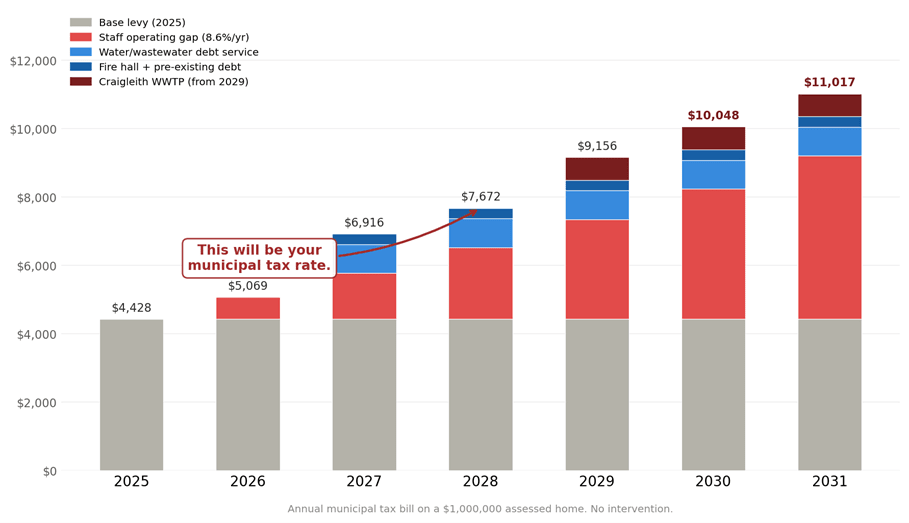
Without intervention, the municipal tax bill on a $1,000,000 home rises from $4,620 in 2026 to an estimated $7,519 by 2029 — an increase of more than 62 percent in three years. Monthly rent rises from $3,200 to approximately $3,580 by 2029.
The doomsday scenario for your municipal tax rate.
Annual municipal tax bill on a $1,000,000 assessed home. No intervention.
The Solution
This paper proposes that TBM take two actions that will fundamentally change its financial trajectory.
The first
- Join the Municipal Services Corporation that is being proposed by our MPP Brian Saunderson. An MSC removes the $57.31 million in wastewater debt from TBM’s books entirely, replacing a 20-year municipal debenture with a 40-year regional financing structure that substantially reduces annual debt service — from $4.41 million to approximately $3.1 million per year.
- It brings professional engineering talent to manage infrastructure that a municipality of 13,900 people was never equipped to handle alone.
- It creates the scalability to solve the region’s wastewater crisis as one — six plants at various stages of their life expectancy and replaces them with a single purpose-built facility on TBM’s north shore, the only site with the deep water access the next fifty years require.
- It generates the possibility that with a regional solution the town will not continue on with a Craigleith short-term wastewater treatment plant — eliminating an additional $45 million capital commitment before it lands on the levy.
The second
· Recognize and address a cost structure that has overwhelmed the towns financial capability.
- Municipal staff has grown by 63 percent in the past decade. Payroll and operating expenses have matched dollar for dollar.
- And somewhere in that decade, council approved a $15.84 million fire hall — on a balance sheet already heading toward insolvency.
These were not acts of necessity. They were acts of a council that had lost sight of what the town could actually afford.
We cannot continue in this fashion. Unless you are prepared to see your tax bill rise by more than 62 percent by 2029 — and your rent follow suit — something has to change.
What Does An Effective Intervention Look Like?
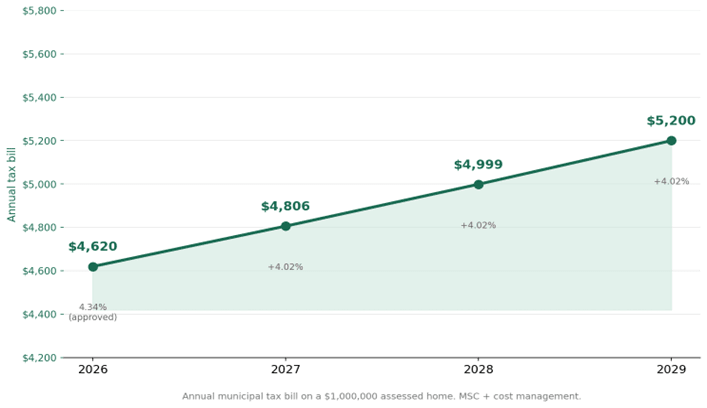
The impact of joining the MSC and addressing the out of control operating expenses brings the town back into a normal growth pattern. Taxes stabilize, real estate values hold and rental rates remain stable
Why you need to vote
The October 2026 election is the reset. One council. One chance to elect people who understand what an MSC is, what this town can actually afford, and what the consequences of another four years of inaction look like on your tax bill.
If you are a permanent resident — you are already on the voters’ list.
- If you are a renter — you are eligible. Register at RegisterToVoteOn.ca by August 12, 2026. Vote.
- If you own a property in TBM but live elsewhere — you are eligible as a non-resident elector. Register. Vote.
- If you rent from a landlord — tell them. They have more at stake than anyone.
You have two options. Stay home in October — and pay for it on your tax bill, in your rent, and in the value of your property. Or show up and be part of the solution.
The choice is yours. The bill is not.
Please subscribe to be kept informed.
The full report
TBM’s Debt Crisis: The Bill Is Coming Due
Ron Shulman | The South Georgian Bay Project | shulmanr.substack.com
In our first article we documented how The Blue Mountains built its financial model on a wave of development charge revenues that has since collapsed. Between 2015 and 2021, DC collections grew from $3.45 million to $9.38 million.
The organization grew to match them. At our last count — 192 staff at P60, the highest compensation grid in the region, one employee for every 72 residents worked for the town. When development froze in 2022, the structure did not shrink. When the Ontario Land Tribunal ratified a 40 percent cut to DC rates in March 2026, the last line of defence went with it.
The result is a structural operating deficit that turns negative for the first time in 2026 and reaches $10.28 million annually by 2028. Three forces drive it: a staff complement that grew 63 percent over the past decade, broader cost inflation amplified by an oversized organization, and a revenue model that assumed development would continue indefinitely. It did not.
For a detailed analysis see our previous Substack report… https://shulmanr.substack.com/p/tbms-operating-crisis-you-and-i-are
If nothing is done to address the operating cost structure, the consequences are direct and personal. On a home assessed at $1,000,000, your municipal tax bill rises from $4,620 in 2026 to approximately $6,543 by 2029. If you are renting a property currently at $3,200 per month, your landlord’s carrying costs rise with the tax bill — and that increase lands on your rent. By 2029, expect to be paying closer to $3,480/month. That is the operating problem alone.
But that is only half the problem.
TBM is not just running a deficit. It is accumulating debt — fast, and on top of an operating shortfall it has yet to address. The two compound each other. And the combined impact on what you pay — in taxes, in rent, and in the value of your property — is the subject of this article.
The Debt Problem
By end of 2028, TBM will have accumulated $57.31 million in capital debt — the product of three years of approved infrastructure borrowing, anchored by a single water and wastewater bundle that went badly wrong. The Craigleith Main Sewage Lift Station, Mill Street Sewage Pumping Station, and Bay Street–Grey Street Linear Works was estimated at $34.79 million. It escalated to $53.56 million. The balance of the $57.31 million reflects earlier water and wastewater infrastructure debentures already on TBM’s books prior to this project.
It will carry an annual debt service charge — at 4.5 percent over 20 years — of $4.41 million per year. That charge does not fluctuate. It sits on the books every year, regardless of what else is happening to the operating budget.
If your home is assessed at $1,000,000, that is an additional $841 per year in municipal taxes, bringing your total municipal bill to $5,461. If you are renting, that is an additional $70 per month, bringing your rent from $3,200 to $3,270.
That is the capital debt just for the wastewater debt alone. There is more to come.
The Rest of the Debt
The $57.31 million is not the whole story.
TBM carries an additional $21 million in capital debt. It stays on TBM’s books until a remediation process takes place.
$15.84 million is the fire hall. Approved by council — on a balance sheet already heading toward insolvency — with no apparent reckoning of what that commitment would cost a municipality of 13,900 people. At 4.5 percent over 20 years, it adds another $1.22 million per year in debt service to a budget already under severe strain.
$5.24 million is pre-existing long-term debt — obligations already on the books before the wastewater crisis arrived.
TBM’s roads capital obligation runs approximately $5 million per year — deferred, underfunded, and compounding quietly in the background. This is an annual obligation, not a fixed debenture, and sits entirely separate from the $21 million in capital debt above.
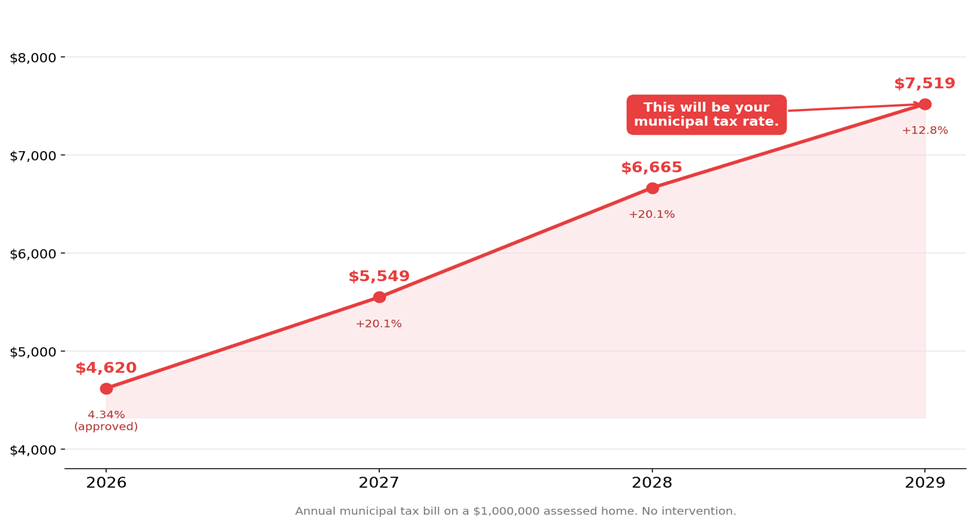
The full picture is this. TBM is carrying $78 million in capital debt. The two major new debentures — water/wastewater and fire hall — generate $5.63 million per year in debt service. The pre-existing $5.24 million in long-term debt carries additional annual service costs, bringing total debt service above $6 million. Add the structural operating deficit — reaching $10.28 million by 2028 — and the town is running toward a combined annual shortfall of more than $16 million on a permanent tax base of 13,900 people.
On a home assessed at $1,000,000, the fire hall and pre-existing debt add another $310 per year. Combined with the wastewater debt, total capital debt service now adds $1,151 per year to your tax bill — before a dollar of operating deficit is counted.”
The Mess
There is a mechanism that can address the majority of this debt — but not all of it. It is called a Municipal Services Corporation.
What an MSC Does — and Why TBM Needs It
Under the direction of The Honourable Rob Flack, Minister of Municipal Affairs and Housing, MPP Brian Saunderson is leading the charge on legislation that will create a Municipal Services Corporation. A bill is currently before Queen’s Park and our assumption is that it will proceed to third and final reading prior to the House rising for the summer. Our assumption is that the first MSC as an outcome of this legislation will be in Simcoe County, which is Mr. Saunderson’s riding.
An MSC is a regional solution — built around where systems exist, not where political boundaries run. This paper will clearly present the rationale as to why TBM belongs in the Simcoe County MSC.
Thus, while TBM is in Grey County, the legislation will allow municipalities to cross county boundaries to participate. However town council must initiate and pass a vote for TBM to join the MSC.
Brian Saunderson is sending TBM’s sinking ship a life raft.
An MSC is Built to Provide Regional Solutions
1. Long-Term Capital Financing.
Under the proposed MSC, TBM’s water and wastewater assets will transfer and the debt transfers with them.
All $57.31 million. Off TBM’s books. Gone.
TBM’s annual debt service charge of $4.41 million disappears from the municipal budget entirely.
Ontario law limits municipal debentures to a maximum of 20 years. An MSC can issue infrastructure debentures over 40 years, recovering the cost through regional user rates — not TBM’s tax levy. At the same 4.5 percent rate, a 40-year debenture on $57.31 million carries an annual cost of approximately $3.1 million — $1.3 million less per year than TBM’s current 20-year obligation. That saving flows directly to TBM’s fiscal position.
It is important to understand that while the MSC is a powerful tool. It is not a complete solution, the remaining $21 million — the fire hall and the pre-existing debt — stays with TBM. The separate $5 million annual roads capital obligation also remains. This debt has to be managed separately.
2. Professional Talent, Quality and Focus.
What an MSC brings to the table is professional engineering management. A municipality of 13,900 people cannot attract, afford, or retain the calibre of engineering and project management talent that water and wastewater infrastructure demands. What it gets instead is a young engineer learning on the job — practicing, on a $50 million capital project, skills they have never applied before. The overruns are not surprising. They are inevitable.
An MSC changes that equation entirely. A regional utility of scale recruits differently. It attracts the 50-year-old project manager who has built treatment plants, managed contractors, and delivered complex infrastructure a dozen times over. It creates the conditions for mentorship — where junior engineers learn from seasoned professionals rather than from their own expensive mistakes. Talent follows the mandate. And the mandate of an MSC is singular: run the infrastructure competently, nothing else.
To understand what that means in practice, we need only look at TBM’s catastrophic failure to deliver three critical sewage infrastructure projects — the Craigleith Main Sewage Lift Station, the Mill Street Sewage Pumping Station, and the Bay Street–Grey Street Linear Works. A $34.79 million contract, a $53.56 million outcome.
There were three levels of failure that require discussion
Failure Level 1 — The Contractor
A project of this magnitude runs on a professional project plan — milestones, deliverables, cost checkpoints at every stage. That is not optional. That is the minimum standard of a competent engineering firm. The total budget for all three parts was $34.79 million.
Based on the public documentation, at $32 million, the engineering firm reported that they had completed the Craigleith lift station and the Bay Street work. That left $2–3 million for Mill Street — which was now projected to cost another $19–20 million.
In my experience, the incompetence that this demonstrates — or something more malicious — is scary.
I have been involved in projects of this size and it is unheard of in any properly managed major infrastructure project that a competent contractor would not be raising alarms early in the work.
Serious questions must be asked. Where did they find this company? Who hired them? Who checked their references?
And one further question demands an answer: we have incredibly competent and professional local engineering companies. Why weren’t they hired?
Failure Level 2 — Internal Project Management.
In any major infrastructure project, the internal staff are the town’s eyes for oversight. That was their job. Monitor the contractor. Track the budget. Report to council. It didn’t happen.
We don’t know why. And that is perhaps the most damning part. The most charitable explanation is that no one was responsible. Not formally. Not in practice. No project manager with their name on the line. No one whose job it was to walk onto that site, look at the numbers, and ask the hard questions.
What we see is the hallmark of an immature, inexperienced organization. No one thought they needed to do this. The contractor was building. The money was being spent. Someone assumed someone else was watching.
Then the bill arrived.
Failure Level 3 — Council.
This is literally where the buck stops. These are the people responsible for your money.
Ultimately, every dollar spent on every project in this town is authorized by the men and women sitting around that council table. They approved the budget. They approved the contract. And then they fell asleep.
No milestone reporting was ever required. No financial checkpoints were ever established. No contract compliance structure was ever put in place. The project started in May 2022 and council didn’t learn of the overrun until November 2025 That’s approximately 3.5 years and council received no updates — and never asked for any.
A competent, engaged council — one that understood its fiduciary responsibility to the taxpayers who elected it — would have demanded progress reports from day one. Would have required staff to appear before them at every major milestone. Would have asked, at minimum, one simple question: are we on budget?
They didn’t ask. They didn’t require. They didn’t know.
And when the bill arrived, they expressed outrage.
That is not where the outrage should be… the outrage should be with you and I. This incompetence is going to cost us.
3. Scalability and a Plan.
Municipal councils don’t think regionally. They think municipally. Each town solves its own problem, builds its own plant, manages its own crisis — and sends the bill to its own taxpayers. It is the most expensive, least effective way to run infrastructure. Water doesn’t care where Collingwood ends and The Blue Mountains begins. Georgian Bay doesn’t care which municipality is bypassing into it. The infrastructure crisis in this region is regional. The solution must be regional.
What an MSC does is look at the entire system — across municipal boundaries, across county lines, across political jurisdictions — and ask a different question. Not “what does Collingwood need?” or “what does TBM need?” but “what does this region need, where should it be built, and what is the most intelligent and cost-effective way to build it?”
Integrating TBM into the MSC is not based on providing the Town with a handout. TBM is not a supplicant. It is not a basket case throwing itself on Simcoe County for help.
TBM is a vital partner in the only regional strategy that over time can actually solve the wastewater treatment problem.
Between Clearview, Wasaga Beach, Collingwood, and TBM there are six wastewater treatment plants serving the South Georgian Bay region. They range from plants on life support to plants that may reach 2035 before they have reached an end-of-life position and a crisis becomes unavoidable. None of them has a credible fifty-year solution.
The financial reality is stark. One example is now prescient. The Craigleith plant was built in 1984. It represents a perfect example of a massive investment without a long-term vision. The problem is simple. Population growth has overwhelmed the capability of the plant. Staff have identified seven sewage infrastructure projects required to keep it functional — with a combined budget of $45 million. The first of those projects has barely reached the 30 percent design stage, and the cost estimate has already increased.
The pattern should be familiar. Given the town’s track record, we are talking about $50 million or more to sustain this system. Not fix it. Sustain it.
The Town’s own Wastewater Master Plan Environmental Assessment — three years in the making, completed in June 2025 — lists every preferred alternative for the Craigleith system. New lift station. Pumping station upgrades. Linear works. And then, on the question of what actually happens to the treatment plant itself, the document says this: future expansions or upgrades will be subject to a subsequent environmental assessment.
Not planned. Not funded. Not studied. Deferred.
Craigleith is not an outlier. It is the regional norm. Clearview Stayner water supply hit full capacity in March 2023 — building permits halted, growth stopped. The Stayner WWTP, also built in 1984, has not breached capacity — but with water permits frozen and growth pressure building, it is a plant living on borrowed time. Wasaga Beach exceeded rated capacity in October 2021 and is managing, for now — but carries a formal obligation to absorb Clearview’s additional flows when development targets are reached, with no expansion funded and no plan in place.
Replacing these six plants individually — municipally, in isolation, on constrained sites — carries a combined price tag of $1.2 to $1.8 billion. While you can’t just merge systems that already exist. What can be done is to bring all the systems under single ownership so any future expansions or retrofits become accountable on a regional scale to find efficiencies and connect the system over time.
Three problems are fundamental when with dealing with these systems on an individual basis…
The first is land. Modern wastewater treatment requires space for overflow management, retention ponds, and buffer zones that simply do not exist on the footprints of the current plants. You cannot build a fifty-year facility on a site designed for 1970s technology in a 1970s community.
The second is outflow. Treated effluent requires deep water access for proper discharge. Of all the towns in this region, only one has that access — the north shore of The Blue Mountains. Every other municipality in this region is building toward a solution that only TBM’s geography can solve.
The third is money. No single municipality in this region has the balance sheet to finance a next-generation treatment facility. TBM certainly does not — it is already carrying $57.31 million in debt on the last generation of infrastructure.
Six plants. One regional problem. One regional plan — and only an MSC has the mandate, the credit capacity, and the forty-year financing horizon to build it.
Your Choice: Where Do We Go From Here
TBM is not without options. The goal of these articles is to create awareness of the mess we are in; hopefully drive some new people who have the capacity to address these problems into the political arena; and then make you so uncomfortable with the current status quo that you will come out and vote for change.
The numbers are damning but the path out exists. It requires two decisions — and it starts with you. After reading this, I hope you agree we must act on both.
1. The Council of TBM must vote to join the MSC. In doing so, $57.31 million in water and wastewater debt leaves TBM’s books entirely. $4.41 million in annual debt service disappears from the municipal budget. The infrastructure that nearly bankrupted this town becomes a regional asset, professionally managed, financed over forty years through user rates.
2. Address the cost structure. Bringing TBM’s staffing ratio down to a rational point such that it eliminates the operating deficit entirely — and generates savings that give a new council room to govern. The transition is manageable. The alternative is not.
These are not radical measures. They are the standard of competent managerial governance that every comparable community in this region should meet.
Your Tax Problem — With and Without Intervention
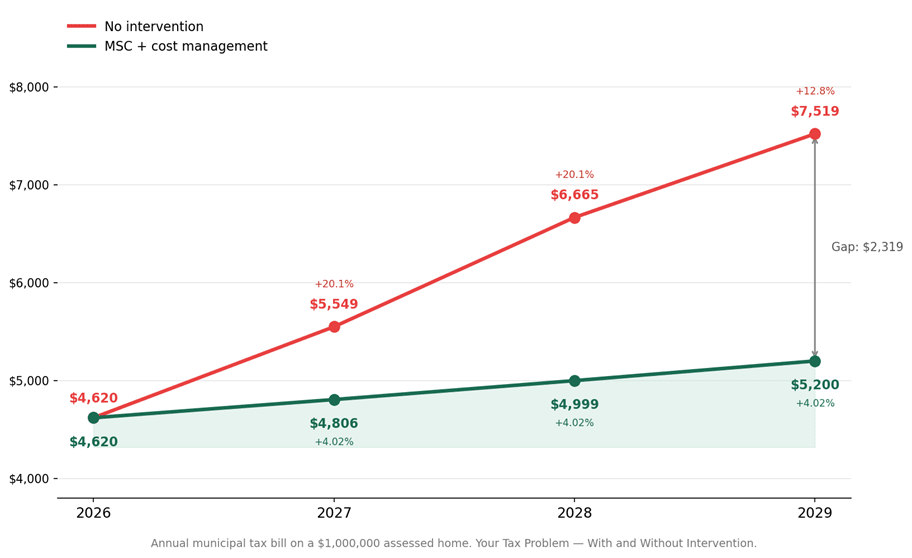
We are at a tipping point. Less than 30 percent of the eligible population voted for this council. They were elected by 4,073 people out of 13,903 who could have cast a ballot. We have elected a council with a staggering lack of financial and fiduciary capability.
The bottom line…they have left us with a mess that will take years to clean up.
The work of fixing it is already underway. Capable people are stepping forward. The organization is underway. The candidates are coming forward.
But none of it matters if you don’t show up. If you stay home in October, you have made your choice — and you will live with the consequences on your tax bill, in your rent, and in the value of your property. This is not someone else’s problem. It is yours. Vote.
The South Georgian Bay Project is independent civic journalism covering municipal governance in The Blue Mountains and Collingwood. Read more at shulmanr.substack.com.
Thanks for reading TBM’s Debt Crisis! Subscribe for free to receive new posts and support my work.
TBM’s Debt Crisis: Addendum…The Rate Story
A question was raised after publication: doesn’t TBM recover water and wastewater costs through rates, not the tax levy? The answer is yes. Here is the full picture.
You are correct. The $57.31 million in water and wastewater infrastructure debt will be recovered through utility rates, not the property tax levy.
Two Towns, One Failure is a reader-supported publication. To receive new posts and support my work, consider becoming a free or paid subscriber.
Here is how it breaks down.
The current average annual water and wastewater bill for a TBM home connected to municipal services is $1,045. The $57.31 million in debt carries $4.41 million in annual debt service. Spread across approximately 5,000 connected properties, that adds $882 per household per year — an 84 percent increase on the current bill. That increase hits in 2027.
This is not the end of the rate story. The Craigleith wastewater treatment plant requires seven additional infrastructure projects with a combined budget of $45 million just to remain functional. At the same financing terms — 20 years at 4.5 percent — that adds another $3.46 million annually in debt service. Spread across 5,000 connected properties, that is an additional $692 per household per year on the utility bill.
For renters, most pay their own water and wastewater charges directly. The $882 annual increase lands on the utility statement — not the landlord’s tax bill.


A utility bill that increases 151 percent in three years.
Please subscribe to be kept informed.
shulmanr.substack.com
Two Towns, One Failure is a reader-supported publication. To receive new posts and support my work, consider becoming a free or paid subscriber.
Much Appreciate You Sharing This Post - It Helps MUCH!!!