
























Trump Is Trying to Destroy the Manufacturing Base of Canada with Tariffs, What It Means for Workers, Businesses, and the Future

Last updated: August 23, 2026
Quick Answer
U.S. President Donald Trump has imposed sweeping tariffs on Canadian goods, and many Canadian officials and economists argue these measures are designed to destroy the manufacturing base of Canada with tariffs rather than address any genuine trade imbalance. The tariffs target steel, aluminum, automobiles, lumber, and other core Canadian exports, threatening hundreds of thousands of jobs and decades of integrated cross-border supply chains. Canada has responded with counter-tariffs and a firm refusal to back down, with Canadians like John Malloy declaring that Canada will not stand down in the face of what many are calling economic aggression.
Key Takeaways
- Trump’s tariffs on Canadian goods range from 10% to 25% across sectors including steel, aluminum, autos, and lumber.
- Canada’s manufacturing sector contributes roughly 10% of national GDP and directly employs over 1.7 million Canadians, according to Statistics Canada.
- The auto industry faces the most severe disruption, given that parts cross the Canada-U.S. border multiple times before a finished vehicle rolls off the line.
- John Malloy and other Canadians have stated publicly that Canada will not stand down and will respond with retaliatory counter-tariffs.
- Economists broadly agree that tariffs of this scale would raise consumer prices on both sides of the border, not just in Canada.
- Trump has used tariffs as a negotiation tactic in previous terms, but the scale and duration of the 2025-2026 measures are historically unprecedented for a close ally.
- Canadian manufacturers are exploring supply chain diversification, but shifting production is costly and takes years, not months.
- The tariff dispute is widely described as a trade war, with both governments escalating in rounds of counter-measures.
- Canada’s counter-tariffs target politically sensitive U.S. goods including orange juice, bourbon, and household appliances.
- The broader concern, shared by business leaders and policy analysts, is that prolonged tariffs could permanently hollow out Canadian industrial capacity.
What Tariffs Is Trump Proposing on Canadian Goods
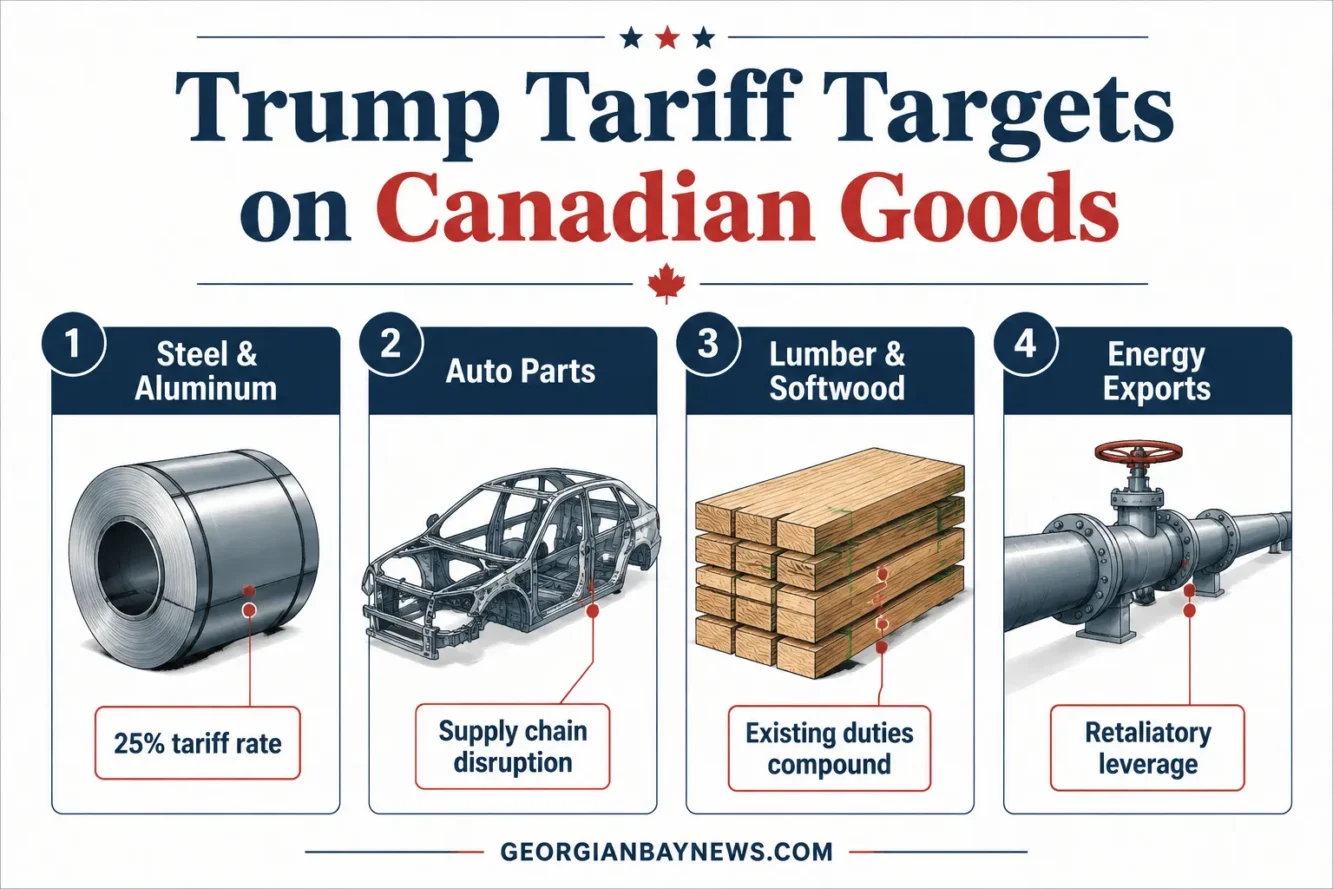
Trump’s tariff agenda against Canada involves broad, layered duties that go well beyond previous trade disputes. The core measures include a 25% tariff on most Canadian goods and a 10% tariff on Canadian energy exports. Steel and aluminum face 25% duties under Section 232 national security provisions. Automobiles and auto parts assembled in Canada are subject to a 25% tariff that directly threatens the Ontario manufacturing corridor.
These tariffs were announced in stages beginning in early 2025 and have been expanded and modified multiple times since. The stated justifications have shifted between border security concerns, fentanyl trafficking claims, and broader demands for trade concessions. Critics, including Canadian federal and municipal officials, argue the real goal is to destroy the manufacturing base of Canada with tariffs and force economic capitulation.
Key tariff rates by sector (as of mid-2026):
| Sector | Tariff Rate | Primary Impact Region |
|---|---|---|
| Steel and aluminum | 25% | Ontario, Quebec, Alberta |
| Automobiles and parts | 25% | Ontario (Windsor, Oshawa) |
| Softwood lumber | 25% (stacked on existing duties) | British Columbia, Ontario |
| Energy (oil, gas) | 10% | Alberta, Saskatchewan |
| General goods | 25% | National |
How Would Tariffs Affect Canada’s Manufacturing Sector
Tariffs at this scale would fundamentally restructure, and in some cases eliminate, Canadian manufacturing in several key industries. The damage is not abstract. When a 25% cost is added to a product that already operates on thin margins, factories close, workers are laid off, and supply chains collapse.

Canada’s manufacturing sector is deeply integrated with the U.S. economy. Roughly 75% of Canadian exports go to the United States, according to Statistics Canada. For manufacturers, the U.S. is not just a customer, it is the market. There is no quick replacement.
The specific mechanisms of damage include:
- Price uncompetitiveness: Canadian-made goods become more expensive for U.S. buyers overnight, pushing buyers toward domestic U.S. suppliers or third-country alternatives.
- Supply chain fracture: Integrated North American supply chains, particularly in auto manufacturing, cannot function efficiently when parts are taxed each time they cross the border.
- Investment flight: Uncertainty drives capital away. Manufacturers delay or cancel expansion plans when tariff policy is unpredictable.
- Currency pressure: A weakened Canadian dollar partially offsets tariffs but also raises the cost of imported inputs, squeezing margins further.
The concern among policymakers is not just short-term disruption. The deeper fear is that if the tariffs persist long enough, they will destroy the manufacturing base of Canada with tariffs in a way that cannot be reversed even if the tariffs are eventually lifted.
What Is Canada’s Manufacturing Industry Worth
Canada’s manufacturing sector is a cornerstone of the national economy, worth approximately $200 billion in GDP contribution annually, based on Statistics Canada data. It directly employs over 1.7 million Canadians and supports millions more in related industries such as logistics, engineering, and skilled trades.
The sector is concentrated in Ontario and Quebec, which together account for roughly two-thirds of Canadian manufacturing output. Key sub-sectors include:
- Motor vehicles and parts (Ontario’s Golden Horseshoe region)
- Food and beverage processing (national)
- Aerospace components (Quebec, Ontario)
- Steel and metal fabrication (Hamilton, Sault Ste. Marie)
- Chemicals and plastics (Sarnia, Ontario)
- Lumber and wood products (British Columbia, Ontario)
For communities in the Georgian Bay region and across rural Ontario, manufacturing is not just an economic statistic. It is the backbone of local employment, municipal tax revenue, and community identity. The Standing Up For Canada sentiment resonating across the country reflects exactly this reality: ordinary Canadians understand that an attack on manufacturing is an attack on their towns.
Which Canadian Manufacturers Would Be Hit Hardest by Tariffs
The auto sector faces the most immediate and severe damage. Ontario’s automotive corridor, stretching from Windsor through Oshawa, is home to assembly plants operated by Ford, General Motors, Stellantis, and Honda, along with hundreds of parts suppliers. A 25% tariff on vehicles and parts would make Canadian-assembled cars significantly more expensive in the U.S. market, which is their primary destination.
Industries facing the most severe tariff exposure:
- Automotive assembly and parts, Ontario accounts for roughly 20% of North American vehicle production. Tariffs threaten this directly.
- Steel production, Hamilton’s Stelco and Algoma Steel in Sault Ste. Marie export heavily to U.S. markets.
- Aluminum smelting, Quebec’s aluminum industry, powered by hydroelectricity, is a world-class producer now facing punishing duties.
- Softwood lumber, B.C. and Ontario mills already faced U.S. duties before the new tariff rounds compounded the pressure.
- Aerospace components, Bombardier and its supplier network in Quebec depend on cross-border trade for components and final sales.
Small and mid-sized manufacturers face an even harder path than large corporations. A global automaker can, over time, shift production. A 50-person precision parts shop in Barrie or Midland cannot.
What Products Does Canada Manufacture and Export to the U.S.
Canada exports a wide range of manufactured goods to the United States, making it one of America’s largest and most important trading partners. The trade relationship is not one-sided, it is deeply mutual, which is why tariffs cause damage on both sides of the border.
Top Canadian manufactured exports to the U.S.:
- Motor vehicles and passenger cars
- Auto parts and components
- Aluminum and aluminum products
- Steel and iron products
- Aerospace parts and equipment
- Lumber and wood products
- Chemicals and plastics
- Machinery and equipment
- Paper and pulp products
- Food and agricultural products
According to Global Affairs Canada, the Canada-U.S. trade relationship is the largest bilateral trading relationship in the world, with goods and services trade exceeding $1 trillion annually. Disrupting it does not just harm Canada, it harms U.S. businesses and consumers who depend on Canadian inputs and competitive pricing.
How Would Tariffs Impact Canadian Jobs and Employment
Tariffs of this scale would cost Canada hundreds of thousands of jobs, with the auto sector alone potentially shedding tens of thousands of positions in Ontario. The Canadian Centre for Policy Alternatives and other research bodies have modeled scenarios where sustained 25% tariffs could push Canada into a recession.
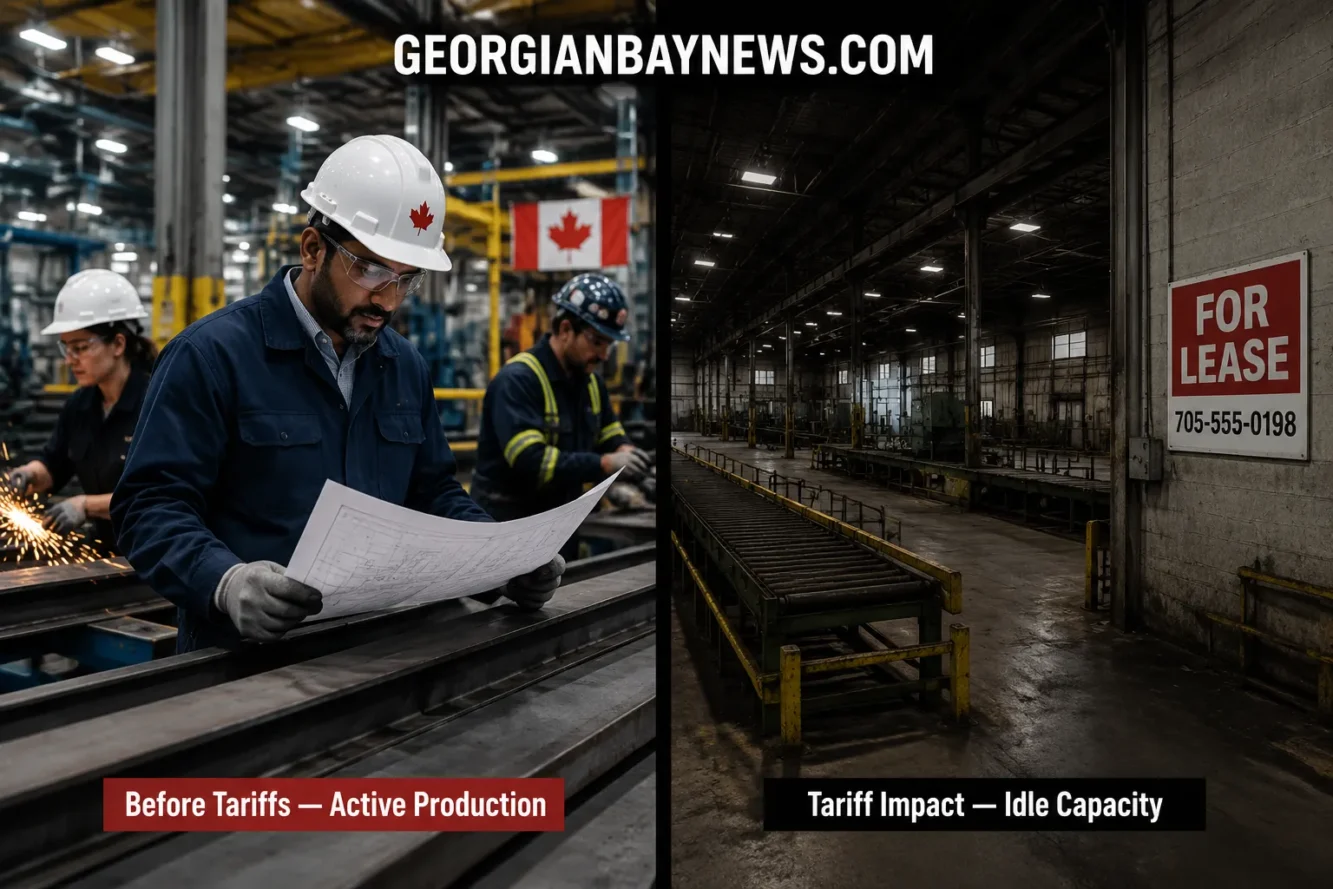
The job losses would not be limited to factory floors. Consider the ripple effects:
- A closed auto assembly plant eliminates direct manufacturing jobs, but also eliminates demand for local suppliers, restaurants, retail, and housing.
- Reduced corporate tax revenue weakens municipal budgets, cutting social programs and public services.
- Skilled tradespeople who lose manufacturing jobs face limited alternatives in regions where manufacturing is the primary employer.
- Young workers entering the labour market in manufacturing-heavy communities face a permanently diminished job market.
John Malloy, publisher of Georgianbaynews.com, has been direct: Canada will not stand down. His position reflects a broader national consensus that accepting the economic damage without fighting back would set a dangerous precedent and accelerate the very destruction these tariffs are designed to cause.
What Is Canada’s Response to Trump’s Tariff Threats
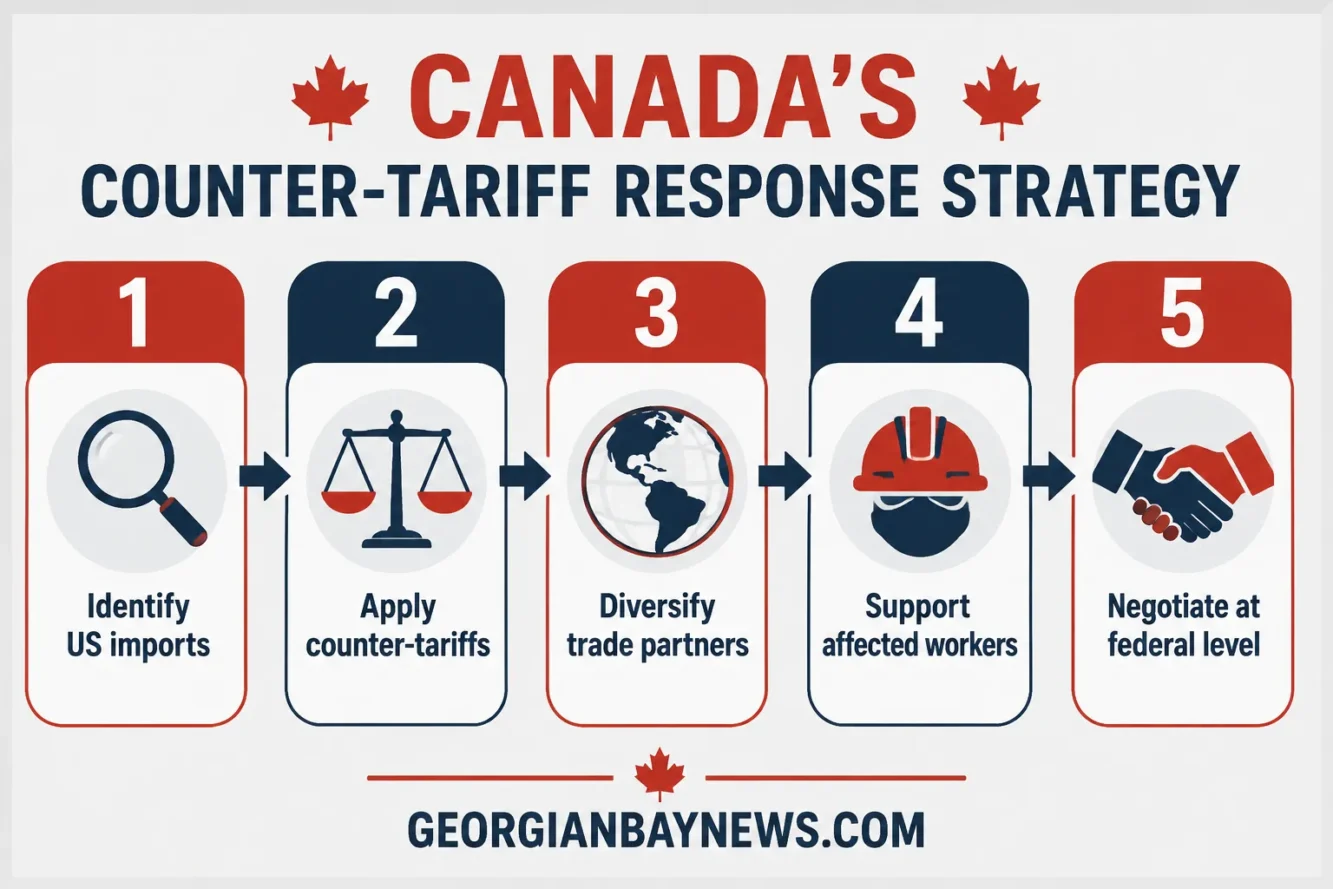
Canada has responded with a combination of counter-tariffs, diplomatic pressure, legal challenges under trade agreements, and efforts to diversify trade relationships. The response has been firm and coordinated across federal and provincial levels.
Canada’s multi-track response strategy:
- Counter-tariffs: Canada applied retaliatory tariffs on U.S. goods including steel, aluminum, orange juice, bourbon, peanut butter, and household appliances. These are targeted at politically sensitive U.S. states to maximize negotiating pressure.
- WTO and trade agreement challenges: Canada has filed formal challenges under World Trade Organization rules and under the Canada-United States-Mexico Agreement (CUSMA).
- Trade diversification: The federal government has accelerated efforts to deepen trade ties with the European Union under CETA, and with Indo-Pacific partners.
- Provincial coordination: Ontario, Quebec, and Alberta have coordinated with Ottawa to present a unified front and protect provincial industries.
- Public messaging: Canadian officials have been consistent and public in stating that Canada will not stand down, framing the tariffs as economic bullying by a larger neighbour.
The Conservative Party of Canada and other federal parties have largely aligned on the need for a firm response, making this a rare area of cross-partisan consensus in Canadian politics.
Can Canada Retaliate with Counter-Tariffs on U.S. Goods
Yes, and Canada has already done so. Canada’s retaliatory tariff strategy is designed to inflict economic pain on U.S. industries and states that have political influence in Washington, making the tariff war costly for the Trump administration domestically.
Canada’s counter-tariff list has been carefully constructed to target:
- Swing-state products: Florida orange juice, Kentucky bourbon, and Wisconsin dairy products hit politically important U.S. states.
- Steel and aluminum imports from the U.S.: Matching tariffs on U.S. steel and aluminum products.
- Consumer goods: Household appliances, cosmetics, and processed foods that U.S. manufacturers rely on Canadian consumers to purchase.
The legal basis for Canada’s retaliation rests on CUSMA provisions and WTO rules that permit countermeasures in response to unjustified tariff actions. Canada has used this playbook before, during the 2018 steel and aluminum tariff dispute, and it worked. The 2018 tariffs were eventually lifted after Canada’s retaliation created pressure on U.S. industries.
The key difference in 2026 is the scale and the apparent intent. Many analysts believe the current tariff regime is not a negotiating tactic but a structural attempt to destroy the manufacturing base of Canada with tariffs and force a fundamental restructuring of the trade relationship.
Has Trump Used Tariffs as a Negotiation Tactic Before
Trump has a well-documented history of using tariffs as leverage in trade negotiations, and Canada has been a target before. In 2018, Trump imposed 25% tariffs on Canadian steel and aluminum, citing national security under Section 232 of the Trade Expansion Act of 1962, a justification that Canada and most trade experts considered legally dubious given the two countries’ deep alliance.
Those 2018 tariffs were lifted in May 2019 after Canada and the U.S. reached an agreement in the context of the USMCA (now CUSMA) negotiations. The pattern established then was: impose tariffs, create pressure, negotiate a deal, lift tariffs.
The 2025-2026 tariff escalation follows a similar pattern in form but differs in magnitude and in the stated justifications. The current measures are broader, higher, and have been accompanied by rhetoric, including suggestions that Canada could become the “51st state”, that goes beyond typical trade negotiation language.
Whether this is negotiation or something more structural is a question that divides analysts. What is clear is that Canada is treating it as a genuine threat to its economic sovereignty, not merely a bargaining chip to be waited out.
How Have Tariffs Affected Manufacturing in Other Countries
History provides clear evidence that broad tariffs damage manufacturing in targeted countries, but they also generate unintended consequences for the country imposing them. The 1930 Smoot-Hawley Tariff Act in the United States, which raised tariffs on over 20,000 imported goods, is the most cited historical example. It triggered retaliatory tariffs from trading partners, contributed to a collapse in global trade, and deepened the Great Depression.
More recent examples include:
- U.S.-China trade war (2018-present): U.S. tariffs on Chinese goods did shift some manufacturing out of China, but much of it moved to Vietnam, Mexico, and other low-cost countries rather than returning to the U.S. American consumers paid higher prices on electronics, appliances, and clothing.
- EU steel tariffs: When the EU imposed safeguard tariffs on steel imports in 2018, downstream manufacturers in the EU who used steel as an input faced higher costs and reduced competitiveness.
- U.S. washing machine tariffs (2018): A study published in the American Economic Review found that the tariffs raised washing machine prices by roughly 12% for U.S. consumers, costing American households an estimated $1.5 billion annually.
The consistent finding across these cases is that tariffs rarely achieve their stated goal of rebuilding domestic manufacturing in the short term, while reliably raising consumer prices and disrupting supply chains.
What Would Happen to U.S. Prices If Canada Tariffs Go Into Effect
U.S. consumers would face higher prices on a wide range of goods if Canadian tariffs remain in place long-term. Canada is a major supplier of inputs that U.S. manufacturers depend on, and tariffs on those inputs raise production costs that are ultimately passed to consumers.
Categories where U.S. consumers would feel the impact:
- Lumber and housing: Canadian softwood lumber is a critical input for U.S. homebuilding. Higher lumber costs raise new home prices, worsening an already difficult housing affordability situation.
- Automobiles: Vehicles assembled in Canada or containing Canadian parts would cost more in U.S. showrooms. The integrated nature of the North American auto supply chain means even “American-made” vehicles contain Canadian components.
- Aluminum products: From beer cans to aircraft components, aluminum price increases flow through to consumer goods and industrial products.
- Energy: A 10% tariff on Canadian oil and gas raises input costs for U.S. refineries, which can translate to higher gasoline prices in border states.
The Peterson Institute for International Economics and other research bodies have consistently found that the costs of tariffs are borne primarily by the importing country’s consumers and businesses, not by the exporting country’s government. In other words, American families pay for tariffs on Canadian goods.
Could Canadian Manufacturers Move Production to Avoid Tariffs
Some Canadian manufacturers are exploring production shifts, but the practical barriers are enormous. Moving manufacturing capacity is expensive, slow, and often impossible for smaller firms.
Options manufacturers are considering:
- Relocating final assembly to the U.S.: Some larger manufacturers are examining whether to shift final assembly steps across the border to avoid the tariff trigger. This is expensive and requires significant capital investment.
- Shifting to non-U.S. markets: Canadian manufacturers are accelerating efforts to sell into European, Asian, and other markets. Canada’s free trade agreements with the EU (CETA) and with Indo-Pacific nations provide some alternative market access.
- Increasing domestic Canadian content: Some manufacturers are looking to source more inputs domestically to reduce cross-border exposure, though this is not always technically or economically feasible.
- Investing in automation: To offset higher costs, some manufacturers are accelerating automation investments, which may protect competitiveness but reduces employment.
The hard reality is that for manufacturers in sectors like auto parts, steel, or aerospace, the U.S. market is not easily replaced. The infrastructure, the customer relationships, and the supply chain integration built over decades cannot be recreated quickly. This is precisely why the tariffs are so damaging, and why some analysts believe the intent is genuinely to destroy the manufacturing base of Canada with tariffs rather than to negotiate a better deal.
Canada’s investment in energy independence, including projects covered in coverage of Small Nuclear Reactors Why Canada Is Investing Billions, reflects a broader strategic shift toward reducing economic vulnerability to U.S. policy decisions.
What Is the Difference Between Tariffs and Trade Wars
A tariff is a tax imposed by a government on imported goods. A trade war occurs when two or more countries escalate tariffs against each other in a cycle of retaliation. The Canada-U.S. tariff dispute in 2025-2026 meets the definition of a trade war by most economic and political science standards.
Key distinctions:
- A single tariff is a policy tool. It raises the price of a specific imported good to protect a domestic industry or generate revenue.
- A trade war is a cycle. Country A imposes tariffs. Country B retaliates. Country A escalates. The cycle continues, damaging both economies.
- Economic warfare is a term some analysts now use for the current situation, because the tariffs are broad enough and the rhetoric hostile enough to suggest the goal is economic damage rather than trade adjustment.
The Canada-U.S. situation is particularly unusual because the two countries share the longest undefended border in the world, are members of the same trade agreement (CUSMA), and have been close military and intelligence allies for generations. Using tariffs of this scale against Canada is without modern precedent in the relationship.
What Do Economists Say About Tariffs on Canadian Manufacturing
Economists across the political spectrum are broadly critical of the tariffs on Canadian manufacturing. The consensus view is that the tariffs will harm both economies, raise consumer prices, disrupt supply chains, and produce few of the promised benefits.
Key findings from economic analysis:
- The Bank of Canada has warned that sustained 25% tariffs on Canadian exports could reduce Canadian GDP growth by 2 to 3 percentage points, potentially triggering a recession.
- The Canadian Chamber of Commerce has estimated that the auto tariffs alone could cost Ontario more than 150,000 direct and indirect jobs.
- The Peterson Institute for International Economics has documented that tariff costs are primarily borne by consumers and downstream businesses in the importing country, not by the exporting country’s government.
- Economists at the University of Toronto’s Rotman School of Management have noted that the integrated nature of the North American auto supply chain means that tariffs effectively tax U.S. manufacturers as well as Canadian ones.
The dissenting view, held by some protectionist economists and Trump administration advisors, is that tariffs will force a rebalancing of trade and bring manufacturing jobs back to the U.S. The historical evidence for this outcome is weak, particularly over short to medium timeframes.
What nearly all economists agree on is that the attempt to destroy the manufacturing base of Canada with tariffs would be a self-defeating strategy for the United States as well, given how deeply the two economies are intertwined.
Conclusion
The tariff war between the United States and Canada is not a routine trade dispute. It is a direct challenge to the economic foundation of a close ally, and by the assessment of many Canadian officials, business leaders, and economists, it represents a deliberate attempt to destroy the manufacturing base of Canada with tariffs and force a fundamental shift in the bilateral relationship.
Canada’s response has been clear: the country will not stand down. Counter-tariffs are in place. Legal challenges are active. Trade diversification is accelerating. And from municipal leaders like John Malloy to federal officials across party lines, the message is unified.
What Canadians and businesses can do right now:
- Support Canadian-made products wherever possible. Consumer choices matter in a trade war.
- Contact elected representatives at the federal and provincial level to demand sustained, coordinated trade policy responses.
- Stay informed through credible sources. Misinformation about trade policy is widespread, and understanding the real stakes matters.
- Businesses should review supply chain exposure to U.S. tariff risk and begin diversification planning now, not after further escalation.
- Workers in affected industries should connect with provincial employment and retraining programs proactively, rather than waiting for layoffs to occur.
The road ahead is difficult. But Canada has navigated trade pressures before, and the country’s economic resilience, its skilled workforce, its natural resources, and its trade agreements with partners beyond the United States give it real tools to fight back. The manufacturing base of Canada is worth defending, and Canadians, by all available evidence, intend to defend it.
Frequently Asked Questions
What are Trump’s tariffs on Canada in 2026?
As of mid-2026, Trump’s tariffs on Canadian goods include a 25% duty on most manufactured goods, a 25% tariff on steel and aluminum, a 25% tariff on automobiles and auto parts, and a 10% tariff on Canadian energy exports including oil and natural gas.
Why does Trump say he is imposing tariffs on Canada?
Trump has cited border security, fentanyl trafficking, and trade imbalances as justifications. Canadian officials and many trade experts argue these justifications are pretextual and that the real goal is to pressure Canada into economic concessions or to destroy the manufacturing base of Canada with tariffs.
How many Canadian jobs are at risk from U.S. tariffs?
Estimates vary, but the Canadian Chamber of Commerce has suggested the auto sector alone could lose more than 150,000 direct and indirect jobs in Ontario. Broader tariff impacts across all sectors could threaten several hundred thousand positions nationally.
Has Canada retaliated against U.S. tariffs?
Yes. Canada has imposed counter-tariffs on U.S. goods including steel, aluminum, orange juice, bourbon, and household appliances. These are targeted at politically sensitive U.S. states to create domestic pressure on the Trump administration.
What is CUSMA and how does it relate to the tariff dispute?
CUSMA (the Canada-United States-Mexico Agreement, also known as USMCA in the U.S.) is the trade agreement that replaced NAFTA in 2020. Canada has filed formal challenges under CUSMA arguing that Trump’s tariffs violate the agreement’s terms.
Will U.S. consumers pay more because of Canada tariffs?
Yes. Economic research consistently shows that tariff costs are largely passed on to consumers and businesses in the importing country. Higher lumber, aluminum, and auto parts costs from Canada will raise prices for U.S. homebuyers, car buyers, and consumers of many everyday goods.
Can Canadian manufacturers just move to the U.S. to avoid tariffs?
Some larger manufacturers are exploring this option, but it is expensive, slow, and not feasible for most small and mid-sized firms. Moving manufacturing capacity requires years of capital investment and cannot be done quickly in response to tariff policy changes.
What is John Malloy’s position on the tariffs?
John Malloy has stated publicly that Canada will not stand down in the face of Trump’s tariff measures. His position reflects a broad Canadian consensus that the tariffs represent economic aggression and must be met with firm, coordinated resistance.
Are tariffs the same as a trade war?
A tariff is a single policy measure. A trade war occurs when tariffs trigger retaliatory cycles between two or more countries. The current Canada-U.S. situation, with both sides imposing and escalating tariffs, meets the standard definition of a trade war.
What sectors of Canadian manufacturing are most at risk?
The auto industry is the most immediately at risk, followed by steel and aluminum production, softwood lumber, aerospace components, and chemicals. Ontario and Quebec bear the greatest exposure given their concentration of manufacturing activity.
Could the tariffs permanently damage Canadian manufacturing?
This is the central concern of Canadian policymakers. If tariffs persist long enough, manufacturers may permanently shift investment, customers may find alternative suppliers, and skilled workers may leave the sector. The damage from a prolonged tariff war could outlast the tariffs themselves.
What is Canada doing to reduce dependence on the U.S. market?
Canada is accelerating trade diversification through CETA with the European Union, Indo-Pacific trade agreements, and increased domestic investment in strategic industries. Long-term energy and industrial projects, including investments in Small Modular Reactors and clean energy, are part of a broader strategy to build economic resilience independent of U.S. policy decisions.
Sources
- Statistics Canada. (2023). Manufacturing sector: Key indicators. Government of Canada. https://www.statcan.gc.ca
- Global Affairs Canada. (2024). Canada-United States trade and investment. Government of Canada. https://www.international.gc.ca
- Bank of Canada. (2025). Monetary Policy Report: Tariff scenarios and Canadian GDP. https://www.bankofcanada.ca
- Canadian Chamber of Commerce. (2025). Auto sector tariff impact assessment. https://www.chamber.ca
- Peterson Institute for International Economics. (2019). Who pays for tariffs? Evidence from U.S. trade policy. https://www.piie.com
- Amiti, M., Redding, S.J., & Weinstein, D.E. (2019). The impact of the 2018 tariffs on prices and welfare. Journal of Economic Perspectives, 33(4), 187-210.
- Office of the United States Trade Representative. (2025). Section 232 and Section 301 tariff actions. https://ustr.gov
- Canadian Centre for Policy Alternatives. (2025). Tariff war scenarios: Employment and GDP projections. https://www.policyalternatives.ca
Content, illustrations, and third-party video appearing on GEORGIANBAYNEWS.COM may be generated or curated with AI assistance or reproduced pursuant to the fair dealing provisions of the Copyright Act, R.S.C. 1985, c. C-42. Attribution and hyperlinks to original sources are provided in acknowledgment of applicable intellectual property rights. Such referencing is intended to direct traffic to and support the original rights holders’ platforms.
Much Appreciate You Sharing This Post - It Helps MUCH!!!