


















✅ Lyme Disease Prevention in Georgian Bay: 2026 Guide for Cottage Owners, Hikers, and Families


Ontario recorded an estimated 3,614 human Lyme disease cases in 2025, roughly 30 times more than in 2010, and provincial analysts project that number will surpass 4,000 in 2026 if current trends continue [9][14]. For anyone spending time along Georgian Bay’s shorelines, trails, and cottage lots this season, that trajectory is not an abstract statistic. It is a direct call to action.
This Lyme Disease Prevention in Georgian Bay: 2026 Guide for Cottage Owners, Hikers, and Families pulls together the latest Ontario tick surveillance data, field-tested habitat management advice, and simple daily routines so every family can enjoy the bay without unnecessary risk.

Key Takeaways
- Blacklegged ticks carrying the Lyme disease bacterium are now confirmed across Simcoe Muskoka and adjacent Southern Georgian Bay communities, and no part of southern Ontario should be considered low risk.
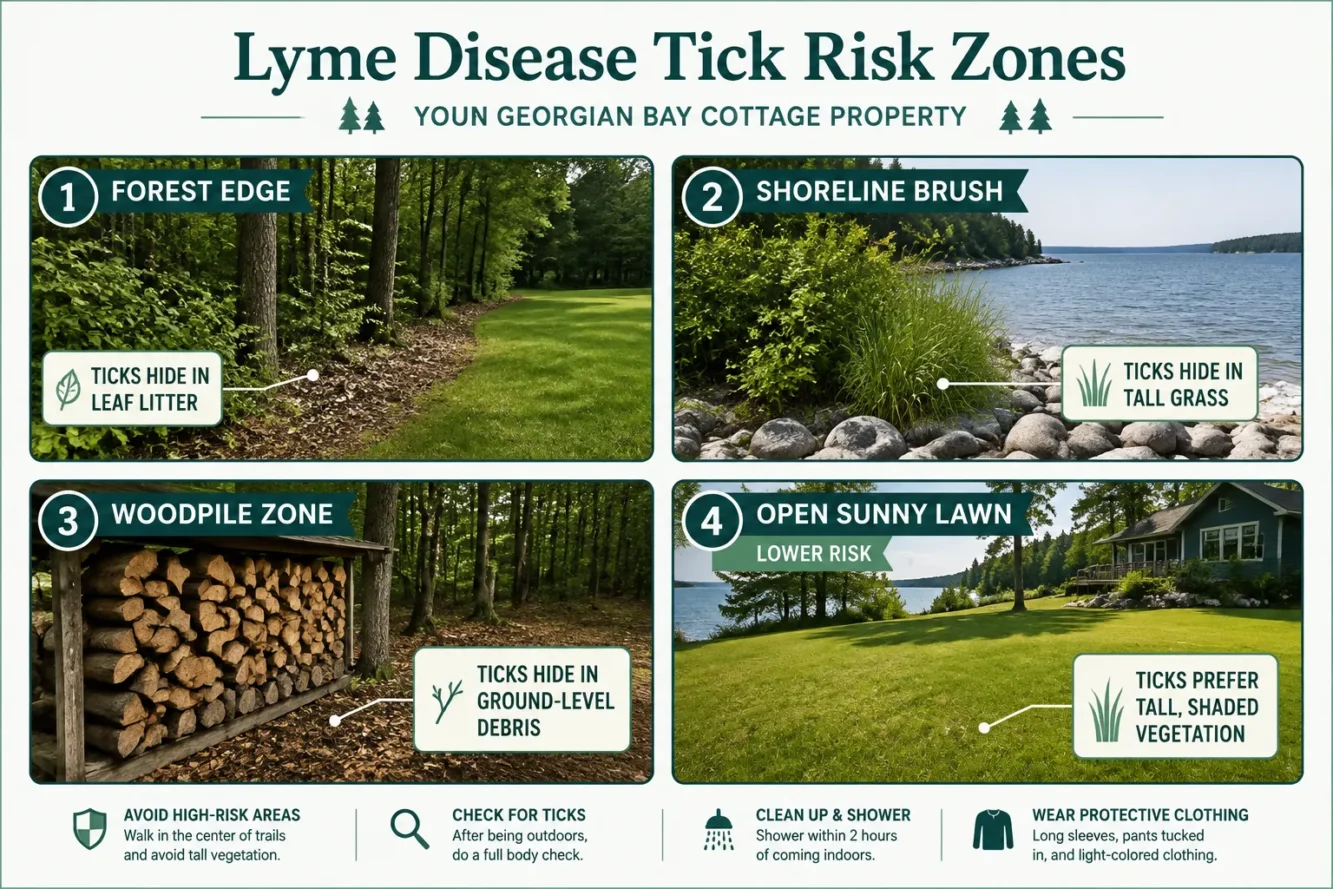
- The highest-risk zones on cottage properties are forest edges, shoreline brush, rocky outcrops, and woodpile areas, not open, sunny lawns.
- DEET- or icaridin-based repellents, light-coloured long clothing, and daily full-body tick checks are the most effective personal protection tools.
- Removing an attached tick within 24 hours dramatically reduces the chance of infection.
- Habitat management, clearing leaf litter, creating gravel borders, and relocating play equipment into open sun, is as important as personal protection.
Why Georgian Bay Cottage Country Is Now High-Risk Territory
Public Health Ontario’s vector-borne disease surveillance tool confirms widespread established and emerging risk areas for blacklegged ticks across southern and central Ontario [1]. Local health guidance for Simcoe Muskoka, the region that borders Georgian Bay, confirms that ticks have tested positive for the Lyme disease bacterium on Muskoka-area properties, conditions that mirror those found on nearby Georgian Bay cottage lots [4].
Migratory birds complicate the picture further. They can carry infected ticks far beyond mapped risk zones, meaning an infective tick may turn up on a seemingly isolated Georgian Bay island or mainland cottage enclave [1][3]. The practical message from health authorities is clear: anyone spending time outdoors in southern and central Ontario during tick season should follow prevention measures, regardless of whether their specific property appears on a risk map [1][7].
The Georgian Bay Association has echoed this concern directly, noting that ticks capable of carrying Lyme disease are “getting closer” to Georgian Bay and urging members to stay informed about evolving risk [11].

Understanding Where Ticks Hide on Your Property
Knowing where blacklegged ticks concentrate is the foundation of the Lyme Disease Prevention in Georgian Bay: 2026 Guide for Cottage Owners, Hikers, and Families.
Highest-risk zones on cottage lots:
| Zone | Why It Is Risky |
|---|---|
| Forest-to-lawn edge | Transition habitat ticks prefer for questing |
| Shoreline brush and tall grass | Shaded, humid conditions ideal for tick survival |
| Rocky outcrops with ground cover | Common on Canadian Shield properties |
| Woodpiles and leaf litter | Ground-level debris retains moisture and shelters ticks |
| Shaded paths to docks | Brushy edges on both sides create tick corridors |
Open, sunny, well-mowed lawn areas carry significantly lower risk [12]. The key insight: ticks do not jump or fly. They wait on vegetation at body height and attach when a person or pet brushes past.
Personal Protection for Hikers and Families: 2026 Best Practices
Provincial and local health units are consistent in their recommendations for anyone active on Georgian Bay trails, shorelines, and cottage properties [3][4][6].
Before heading out:
- Wear light-coloured, long-sleeved shirts and long pants so ticks are easier to spot
- Tuck pants into socks when walking through brush or tall grass
- Apply insect repellent containing DEET or icaridin to exposed skin and clothing
- Stay on marked trails and avoid bushwhacking through dense vegetation
After coming indoors:
- Shower within two hours of outdoor activity
- Perform a full-body tick check on every family member, paying close attention to the scalp, behind the ears, armpits, and groin [4][6]
- Check pets thoroughly before they re-enter the cottage
- Place outdoor clothing in a dryer on high heat for at least ten minutes
“Transmission of the Lyme disease bacterium typically requires the tick to be attached for more than 24 hours, which is why same-day checks and rapid removal are the single most effective habit a family can build.” [3][10]
For children specifically, keep play areas away from wooded edges and tall grass, and make tick checks a non-negotiable part of the end-of-day routine [4][6].
Cottage-Lot Habitat Management: Practical 2026 Steps
Reducing tick habitat on your property is a long-term investment in family safety. Ontario guidance now recommends the following for forest-adjacent Georgian Bay lots [3][12]:
- Create a gravel or wood-chip border at least one metre wide between your lawn and any wooded or brushy area to reduce tick migration into living spaces.
- Keep grass short and remove leaf litter, brush piles, and ground-level firewood regularly.
- Relocate children’s play equipment and outdoor seating away from treed edges and into sunnier, open areas.
- Consider professional perimeter treatments along forest and shoreline edges, particularly on larger, heavily forested properties. Spring and fall applications align with peak blacklegged tick activity, with possible summer top-ups where young children or dogs regularly use the yard [12][14].
These habitat steps complement, but do not replace, personal protection measures [3][12]. For more on community-level environmental health solutions, see Georgian Bay News coverage of solutions shaping the region.
How to Remove a Tick and When to See a Doctor
If a tick is found attached, act quickly and calmly [3][4][15]:
- Use fine-tipped tweezers to grasp the tick as close to the skin surface as possible
- Pull upward with steady, gentle pressure, do not twist, squeeze, burn, or apply substances to the tick
- Clean the bite site with soap and water or rubbing alcohol
- Save the tick in a sealed container or plastic bag
Residents can submit ticks through the national eTick identification service or their local health unit to support surveillance of risk areas, including Georgian Bay cottage zones [4][6].
Seek medical attention promptly if any of these symptoms appear within days to weeks of a tick bite:
- Fever or chills
- Fatigue and muscle aches
- Headache
- An expanding rash, particularly a bull’s-eye pattern
Early antibiotic treatment is highly effective, so do not wait to see if symptoms resolve on their own [3][4].
The Season Is Longer Than Most People Expect
Blacklegged ticks can be active from early spring, as soon as temperatures are consistently above freezing, through late fall [10][14]. Milder winters across the Georgian Bay region have extended the practical tick season at both ends, meaning the window for exposure now covers most of the cottage calendar, not just midsummer.
This extended season is one reason the Lyme Disease Prevention in Georgian Bay: 2026 Guide for Cottage Owners, Hikers, and Families treats tick awareness as a season-long habit rather than a one-time precaution. Families opening cottages in April or May and closing them in October are exposed throughout that entire period.
Independent analyses of Ontario surveillance data suggest Lyme disease will remain on an upward trajectory through at least the late 2020s, driven by climate trends, expanding tick habitat, and increased outdoor recreation [10][14]. Health units now advise that any household or cottage in southern Ontario with forest, shoreline, or conservation area adjacency should assume elevated annual tick exposure and treat routine yard management and daily tick checks as normal, not exceptional, parts of cottage life [1][7][12][14].
For broader context on how regional development and environmental change are shaping health conditions across the area, Georgian Bay News readers can explore ongoing coverage under Building Up Simcoe County.
Conclusion
The data is clear and the trend is upward. Lyme disease is no longer a fringe concern for Georgian Bay cottage owners, hikers, and families, it is a mainstream seasonal health risk that demands straightforward, consistent action.
Start with these steps this season:
- Apply DEET or icaridin repellent every time you head into brush, trails, or shoreline vegetation
- Build a daily full-body tick check into the end-of-day routine for every family member and pet
- Clear leaf litter, trim the forest edge, and create a gravel border on your cottage lot
- Know how to remove a tick correctly and keep tweezers in your first-aid kit
- Contact a health-care provider promptly if any symptoms develop after a tick bite
The bay is worth protecting, and so is the health of everyone who loves spending time there. Stay informed, stay proactive, and make Lyme prevention a core part of your 2026 cottage season.
References
[1] Vbd Tool – https://www.publichealthontario.ca/en/Data-and-Analysis/Infectious-Disease/VBD-Tool
[2] Bh.01.apr0126.r07 Vbd – https://wdgpublichealth.ca/sites/default/files/2026-03/BH.01.APR0126.R07_VBD.pdf
[3] Lyme Disease – https://www.publichealthontario.ca/en/Diseases-and-Conditions/Infectious-Diseases/Vector-Borne-Zoonotic-Diseases/Lyme-disease
[4] Lymedisease – https://www.simcoemuskokahealth.org/topics/infectiousdiseases/diseaseinformation/factsheetsil/lymedisease.aspx
[6] Article F821a98b 6a77 5190 813c 964634bb9f96 – https://www.northbaynipissing.com/life/stay-tick-free-this-summer-with-tips-from-the-simcoe-muskoka-health-unit/article_f821a98b-6a77-5190-813c-964634bb9f96.html
[7] Ticks Lyme Disease Information Healthcare Providers – https://wdgpublichealth.ca/professionals/healthcare-providers/ticks-lyme-disease-information-healthcare-providers
[9] Theres Tick Population Boom Happening 080016514 – https://ca.news.yahoo.com/theres-tick-population-boom-happening-080016514.html
[10] Ontario Tick Borne Disease Public Health Update – https://www.publichealthontario.ca/-/media/Event-Presentations/24/08/ontario-tick-borne-disease-public-health-update.pdf
Much Appreciate You Sharing This Post - It Helps MUCH!!!