














Last updated: October 18, 2026
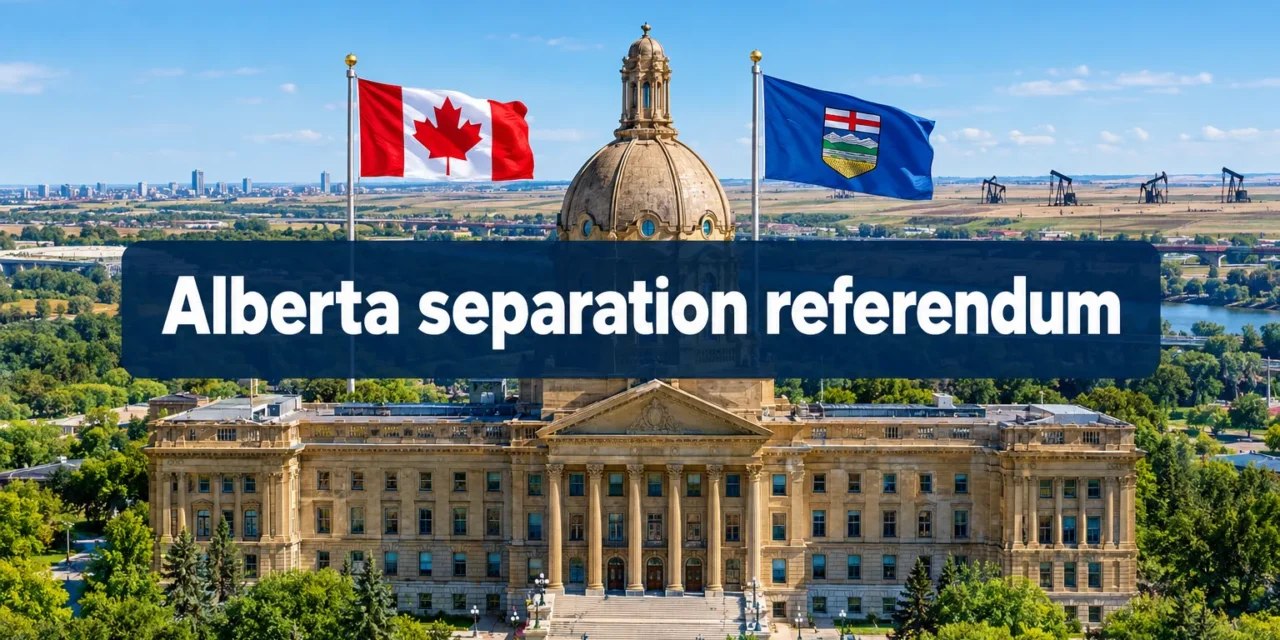
Alberta held a province-wide referendum on October 19, 2026, asking voters ten questions, including whether Alberta should remain a province of Canada or direct the provincial government to start the legal process toward a binding separation vote.[1][6] Polling through mid-October showed roughly 70 percent of Albertans intended to vote to stay in Canada, while about 23 percent backed starting the separation process.[10][7] The result matters far beyond Alberta’s borders because the Alberta separation referendum and its impact on Canadian unity now serve as a real-time stress test of how far a province can legally push toward secession.
The Alberta separation movement is a political push by a vocal minority of Albertans who believe the province would be better off economically and politically outside Confederation. It grew inside the governing United Conservative Party and through citizen campaigns pressing for a formal vote.[9]
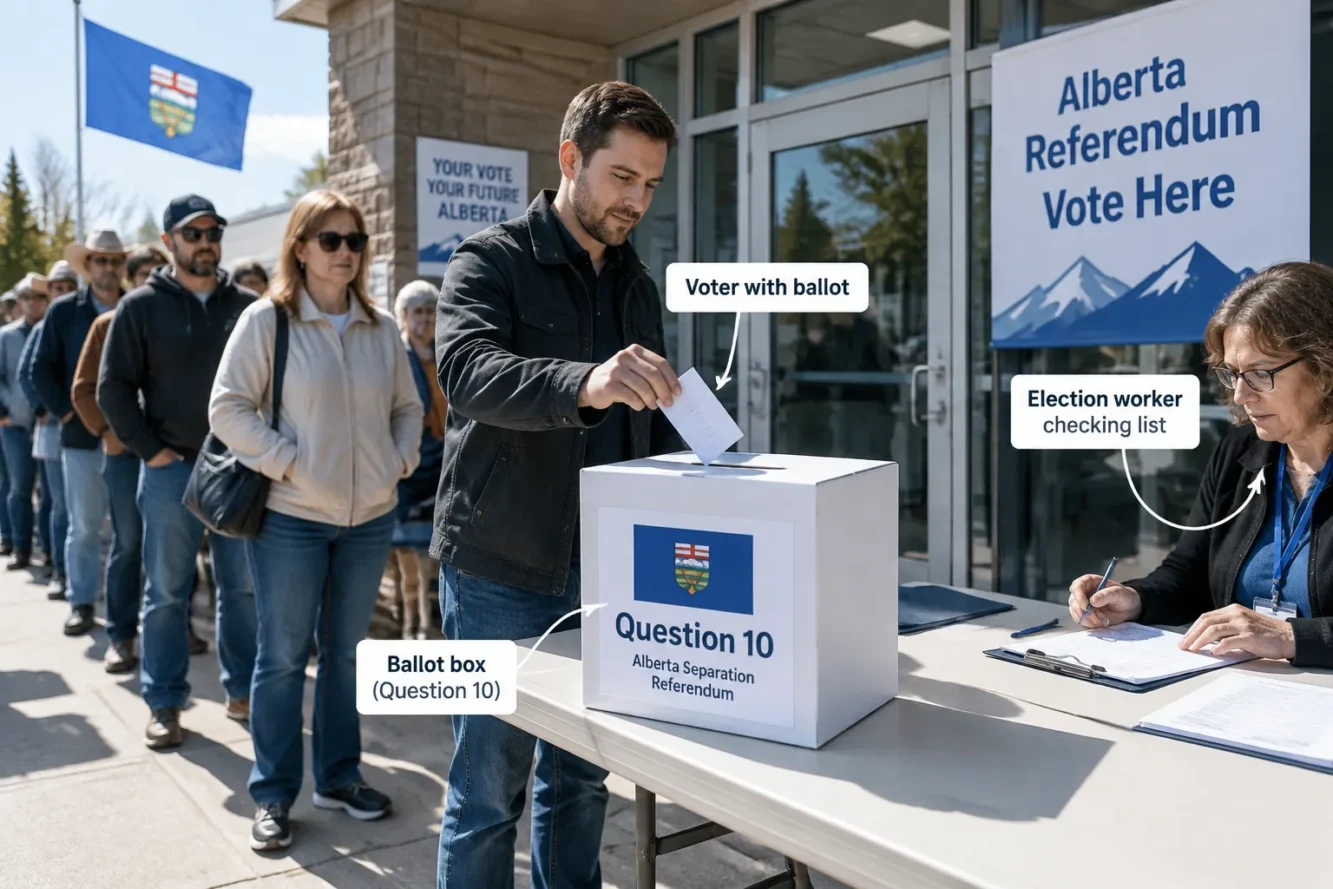
Supporters point to frustration over federal energy and immigration policy, a sense that Alberta’s oil and gas wealth subsidizes other provinces, and resentment toward national climate rules seen as hostile to the province’s economy. Premier Danielle Smith announced on May 21, 2026, that a tenth question on staying in Canada versus pursuing separation would be added to the referendum ballot after sustained pressure from separatist voices inside her own coalition.[9] Even so, many Albertans who feel disconnected from Ottawa still want more autonomy within Canada rather than a full break, which is why Smith personally urged voters to reject the separation path while supporting the other nine referendum questions as leverage in talks with the federal government.[10]
Common grievances driving the movement include:
Choose to read this section as background if you want the “why” before the “how.” For the legal mechanics, the next section covers that directly.
A binding Alberta separation referendum cannot happen overnight. Question 10 only asked whether to start the legal process; it did not itself trigger secession.[6][7] A real separation vote would still need enabling legislation, a defined question meeting legal clarity standards, and negotiation with Ottawa before any split could proceed.[9]
The Canadian Constitution contains no explicit clause letting a province unilaterally secede. Legal precedent, set largely through the Quebec secession framework, requires a clear question and a clear majority before any negotiation toward leaving can begin, and any actual departure would likely require a constitutional amendment involving the federal government and other provinces.[6][7][9]
Ottawa cannot block a provincial referendum question outright, since provinces control their own referendum processes, but the federal government can refuse to negotiate secession terms unless the vote meets constitutional clarity standards. Prime Minister Mark Carney made this point directly during campaign stops in Alberta, warning that pursuing independence carried serious risk for both Alberta and the country as a whole.[8][7]
A common mistake is assuming a “yes” vote on Question 10 equals independence. In fact, it would only authorize the Alberta government to begin a legislative and negotiation process that could take years and still fail at multiple constitutional checkpoints.[9][6]
Support for starting the separation process sat at roughly 23 percent heading into the October 19, 2026 vote, well below the roughly 70 percent favoring staying in Canada.[10][7] Multiple independent pollsters reached similar numbers within days of each other.
| Poll (date) | Remain in Canada | Start separation process | Undecided/won’t vote |
|---|---|---|---|
| Ipsos for Global News (mid-Oct 2026) | ~70% | ~23% | ~7%[10] |
| Leger (late Sept, mid Oct 2026) | ~70-72% | ~23-25% | remainder |
| CBC/Janet Brown (mid-Oct 2026) | ~70-72% | ~23-25% | remainder |
Pollsters and political scientists describe this backing as “soft,” meaning it tracks closely with oil prices, equalization disputes, and federal-provincial fights rather than a fixed national identity choice.[10] Support for independence had also cooled compared to earlier in 2026, suggesting the movement’s intensity fluctuates with the political news cycle.
Separation would force Alberta to negotiate its share of federal debt, build new financial institutions, and establish independent trade terms almost from scratch. No settled public framework currently exists for dividing shared federal assets and liabilities between Alberta and the rest of Canada.
Trade would likely continue in some form, since Alberta’s oil, gas, and agricultural exports depend heavily on pipelines, rail lines, and highways that cross provincial borders. But a separated Alberta would need new trade agreements, possibly new tariffs or customs arrangements, and separate regulatory bodies for energy exports, a process international observers compare to Scotland’s and Catalonia’s independence debates, where economic integration complicated full separation.[2][5]
Edge case: if talks stalled, Alberta could face years of trade uncertainty while still physically relying on cross-border infrastructure it does not fully control.
Separation would raise immediate questions about which health system and pension plan Albertans would use, and what citizenship status they would hold. None of these have settled answers because no Canadian province has ever formally separated.
Key open questions include:
These unresolved details around healthcare, pensions, and broader social security protections fuel much of the public anxiety visible in current polling, even among voters who sympathize with grievances against Ottawa.[10]
Indigenous peoples in Alberta hold treaty rights with the Crown that predate the province itself, meaning separation would not simply transfer automatically to a new Alberta government. Treaty obligations are tied to the federal Crown, so any secession process would need to address how those legal relationships, land rights, and funding arrangements carry forward.
This is a major edge case separatist leaders have not fully resolved publicly. First Nations and Métis leaders in Alberta have historically expressed concern that independence talk ignores treaty obligations negotiated directly with the federal government, not the province, creating legal uncertainty that could outlast any referendum result.
Alberta’s separation push and Quebec’s historic referendums share a legal roadmap but differ sharply in cultural motivation and political structure. Quebec’s movement centered on language and cultural identity; Alberta’s centers on energy policy and economic grievance.
| Factor | Alberta separation movement | Quebec separation referendums |
|---|---|---|
| Core motivation | Energy policy, equalization, federal regulation | Language, cultural identity, sovereignty |
| Legal framework used | Same constitutional clarity standard[6][9] | Set the original clarity precedent[9] |
| Recent support level | ~23% (Oct 2026 polling)[10] | Near 50% in 1995 referendum |
| Governing party stance | Premier opposes separation[10] | Governing party led the push |
Choose to think of Alberta’s version as economically driven and currently a minority position, versus Quebec’s historically closer and culturally rooted campaigns.
No other Canadian province currently has an active, government-backed separation referendum underway. The Alberta separation referendum and its impact on Canadian unity are being watched closely in Saskatchewan, where some similar energy-policy frustrations exist, but no formal referendum process has been launched there.
If Alberta had voted to begin the legal separation process, experts and international coverage suggest it would have:
Because polling pointed toward a “remain” outcome, most analysts expected the vote to function as a release valve for grievance rather than a fracture point, reaffirming the federation while leaving a vocal minority dissatisfied.[10] Reuters, the Associated Press, and other outlets framed the vote as a stress test of unity, not an immediate breakup.[7][2][5]
Did Alberta vote to separate from Canada on October 19, 2026?
No. The referendum asked whether to remain in Canada or start the legal process toward a binding separation vote; polling pointed to a strong “remain” result, not immediate separation.[10][6]
What was Question 10 on the Alberta referendum ballot?
Question 10 asked voters to choose between Alberta remaining a province of Canada or directing the government to begin the constitutional process for a future binding separation referendum.[6][1]
Does Premier Danielle Smith support Alberta separation?
No. Smith publicly opposed separation while asking voters to approve the other nine referendum questions to strengthen Alberta’s negotiating position with Ottawa.[10]
How did Prime Minister Mark Carney respond to the referendum?
Carney campaigned in Alberta before the vote, calling the push toward separation a “dangerous gamble” given global and domestic pressures on Canadian sovereignty.[8][7]
Can Alberta legally separate from Canada right away?
No. Any real separation would require enabling legislation, a constitutionally clear question and majority, federal negotiation, and likely a constitutional amendment, a process with no fixed timeline.[9][6]
What percentage of Albertans supported separation in 2026 polling?
Independent polls from Ipsos, Leger, and CBC/Janet Brown found roughly 23 to 25 percent support for starting the separation process, versus about 70 to 72 percent favoring remaining in Canada.[10]
Would Indigenous treaty rights survive an Alberta separation?
Treaty rights are held with the federal Crown, not the province, so separation would create significant unresolved legal questions about how those obligations would carry forward.[9]
How does Alberta’s movement compare to Quebec’s past referendums?
Alberta’s push is driven mainly by energy and economic grievance, while Quebec’s was rooted in language and cultural identity, though both followed the same constitutional clarity framework.[9][6]
The October 19, 2026 vote tested whether grievance politics in Alberta could translate into a formal push to leave Canada, and polling heading into the vote pointed toward a clear “remain” result.[10] Even so, separatist organizers made clear they consider the referendum itself a victory, which means the Alberta separation referendum and its impact on Canadian unity will keep shaping federal-provincial politics well beyond election night.[4]
For readers trying to follow what comes next: watch for the official results from Elections Alberta, track whether Ottawa adjusts energy or equalization policy in response, and pay attention to any copycat separation talk in other resource-dependent provinces. None of that requires alarm, but it does require paying attention, since the underlying grievances behind this vote did not disappear with a single ballot question.
[1] albertareferendum2026.ca – https://albertareferendum2026.ca/
[2] How Alberta Separatism Went From Fringe Cause To Referendum In Canada – https://www.latimes.com/world-nation/story/2026-10-18/how-alberta-separatism-went-from-fringe-cause-to-referendum-in-canada
[4] Alberta Separation Vote Canada Carney Pandemic – https://apnews.com/article/alberta-separation-vote-canada-carney-pandemic-7434ebceab64a704ffdaa4c07351dd79?__vfz=medium=standalone_top_pages
[5] Alberta Independence Vote Canada – https://www.wsj.com/world/americas/alberta-independence-vote-canada-22b8208b
[6] Referendum – https://www.elections.ab.ca/elections/referendum/
[7] What Does Alberta’s Referendum Separation Canada Mean – https://www.reuters.com/world/americas/what-does-albertas-referendum-separation-canada-mean-2026-10-15/
[8] Mark Carney Makes Final Appeal Alberta Separation Referendum – https://www.nbcnews.com/world/canada/mark-carney-makes-final-appeal-alberta-separation-referendum-rcna604003
[9] Alberta Is to Vote on Holding a Separation Referendum: A Timeline – https://www.thecanadianpressnews.ca/politics/alberta-is-to-vote-on-holding-a-separation-referendum-a-timeline-on-how-we-got/article_21911afc-edba-567e-8345-f271101c6eae.html
[10] Alberta Separation Referendum Not Likely: Poll – https://globalnews.ca/news/12106419/alberta-separation-referendum-not-likely-poll/
Content, illustrations, and third-party video appearing on GEORGIANBAYNEWS.COM may be generated or curated with AI assistance or reproduced pursuant to the fair dealing provisions of the Copyright Act, R.S.C. 1985, c. C-42. Attribution and hyperlinks to original sources are provided in acknowledgment of applicable intellectual property rights. Such referencing is intended to direct traffic to and support the original rights holders’ platforms.