

















🇨🇦 How China Is Building an Army of Hackers: What Bloomberg’s Investigation Means for Canadian Businesses and Residents
Last updated: September 3, 2026
Quick Answer
Bloomberg’s investigation found that Beijing redirected its top cybersecurity talent away from international hacking contests and into state-supervised domestic tournaments, turning individual skill into a coordinated offensive capability [4]. For Canadians, this matters because Canada’s own cyber authority already calls China’s program “the most sophisticated and active state cyber threat to Canada today,” with confirmed breaches of at least 20 federal networks and attacks on telecom infrastructure, research institutions, and businesses [2][11][14].
Key Takeaways
- Bloomberg’s June 2025 investigation shows China converted hacking competitions into a pipeline for state-directed cyber talent [4].
- Canada’s Communications Security Establishment (CSE) names China the top state cyber threat to the country [2][11].
- At least 20 Government of Canada networks have been compromised by PRC-linked actors over five years [14].
- Chinese state-sponsored group Salt Typhoon has hit Canadian telecom infrastructure directly [12].
- Group APT31 has targeted Canadian entities alongside lawmakers and journalists abroad [8].
- Chinese-linked hackers spent over a year stealing data from Canadian research institutions in 2023-2025 [5].
- Canadian critical infrastructure, defence contractors, and research bodies face the highest risk [2][10][11].
- Basic cyber hygiene (patching, multi-factor authentication, monitoring) remains the best defence available to businesses and residents.
What Is China’s Hacking Program and How Does It Work
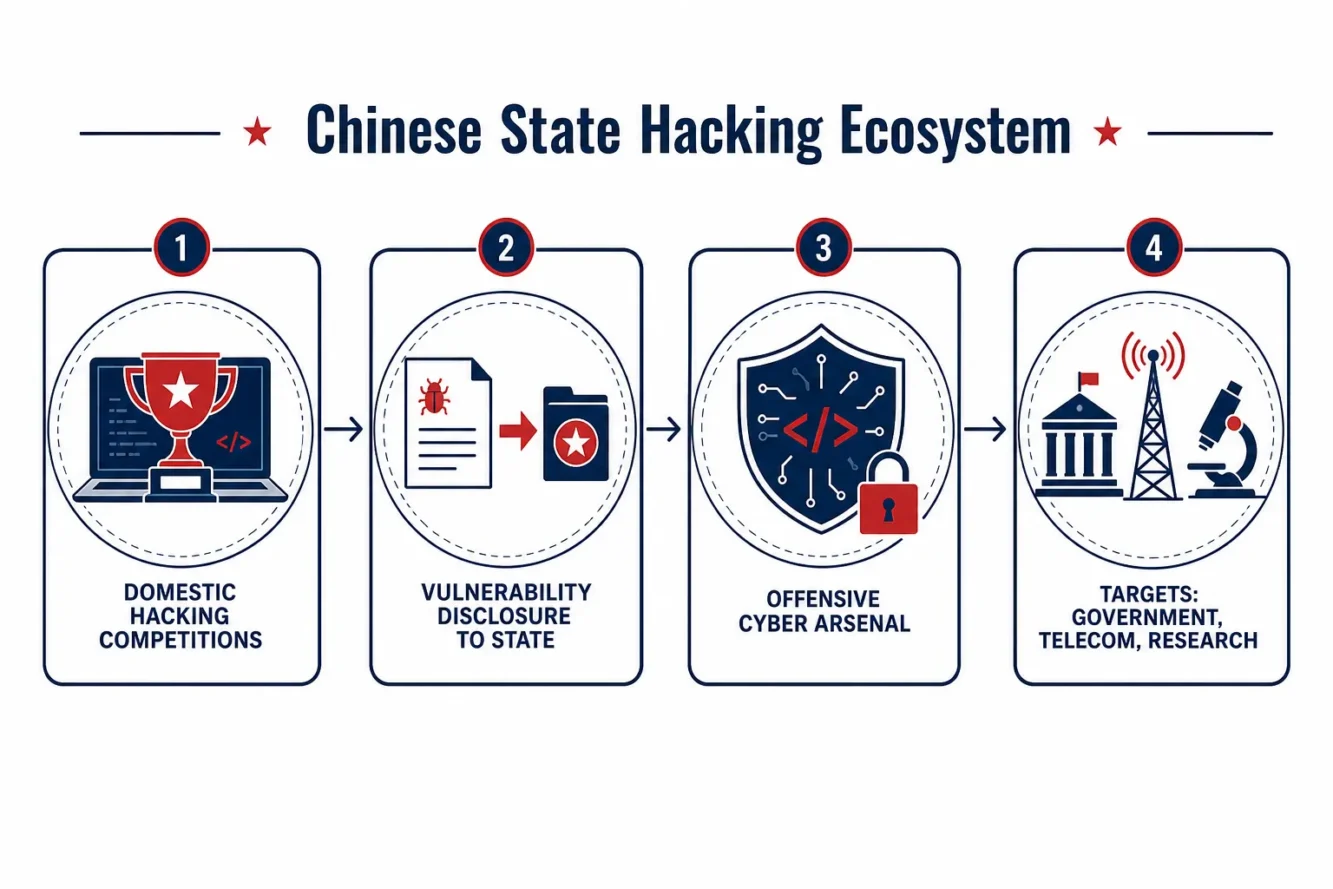
China’s hacking program functions as a state-managed pipeline that channels private technical talent into government-aligned cyber operations. Bloomberg’s investigation describes how Beijing ordered domestic teams to stop competing in global hacking events and instead compete in tournaments held on Chinese soil, where discovered software vulnerabilities are reported to state authorities before they ever reach the public [4].
This structure gives Beijing three advantages:
- Centralized intelligence on unpatched software flaws before vendors can fix them.
- A trained talent bench of exploit developers and penetration specialists.
- Direct integration of civilian skill into offensive military and intelligence programs [4].
Bloomberg’s reporting argues this is a deliberate policy shift, not an accident of culture, and it has produced a disciplined, large-scale hacking workforce whose output feeds directly into national security operations [4].
Why Is China Recruiting Hackers
China recruits hackers to strengthen espionage, economic advantage, and long-term strategic positioning against rivals, according to Bloomberg’s reporting and Canadian government assessments [4][11]. Recruitment is not random; it targets students, competition winners, and researchers with proven technical ability.
The motivations documented in official sources include:
- Stealing intellectual property tied to defence, AI, and advanced manufacturing [5].
- Gathering diplomatic and economic intelligence from government systems [2][14].
- Building pre-positioned access inside critical infrastructure for possible future use [10].
Choose to take this seriously if your organization holds proprietary research, government contracts, or infrastructure access. That describes a wide slice of Canadian business, not just Ottawa.
How Many Hackers Does China Have and How Are They Trained
There is no single verified public count of China’s hacker workforce, and Georgian Bay News will not invent a figure. What is documented is the training pathway: competitive hacking events, university cybersecurity programs, and state-linked research institutes feed talent into intelligence and military units [4].
Training typically follows this path:
- Students compete in domestic capture-the-flag and exploit-development contests.
- Winning techniques and vulnerabilities are reported to state overseers rather than published openly [4].
- Top performers are recruited into units linked to China’s military and intelligence services.
- Skills are refined on real operations, including attacks documented against Canadian and U.S. networks [5][8][12].
What Targets Has China’s Hacking Army Attacked
China’s hacking teams have attacked government networks, telecom carriers, research institutions, and critical infrastructure across North America. Canadian-specific incidents include compromised federal networks, telecom equipment, and academic research systems [5][12][14].
Documented targets include:
- Canadian federal, provincial, and municipal government systems [2][11][14].
- A Canadian telecommunications company hit by the Salt Typhoon group [12].
- U.S. and Canadian research institutions studying defence, AI, and unmanned vehicles [5].
- Critical infrastructure probed by the group known as Volt Typhoon [10].
How Does China’s Hacking Program Compare to Other Countries
China’s program stands out for its scale, state coordination, and persistence, according to Canada’s national threat assessment, which ranks it above other state actors as the most comprehensive cyber threat facing the country [2][11]. Unlike smaller, opportunistic criminal groups, PRC-linked units maintain long-term access inside networks rather than striking once and leaving [11][14].
Other nation-state actors run cyber programs too, but Canadian officials specifically single out China’s breadth: espionage, IP theft, infrastructure probing, and telecom intrusion all under one coordinated umbrella [2][11].
What Canadian Businesses Have Been Hacked by China
Confirmed cases include a Canadian telecom company breached by Salt Typhoon and Canadian research facilities targeted for over a year by a group Google tracks as UNC6508 [5][12]. CSE has also confirmed APT31 activity against Canadian entities, a group the U.S. and U.K. link to widespread espionage affecting millions of people globally [8].
If your business operates in telecom, cloud infrastructure, defence supply chains, or applied research, treat these cases as a warning, not background noise. For growth-focused companies exploring resources locally, the Business Development Centre Open House is a reasonable place to ask about cybersecurity supports available to small and mid-sized firms.
How Can Canadian Companies Protect Against Chinese Hackers
Canadian companies reduce risk most effectively by patching known vulnerabilities quickly, enforcing multi-factor authentication, and segmenting sensitive data from general networks. These steps directly counter the tactics documented in CSE and Bloomberg reporting [2][3][11].
A practical checklist:
- Patch internet-facing systems within days, not months.
- Require multi-factor authentication on all remote access and email accounts.
- Audit vendor and data-center connections, since shared infrastructure has already exposed telecom carriers to Chinese-linked breaches [3].
- Monitor for AI-assisted phishing, since PRC-linked actors are now using open-source AI models like DeepSeek to speed up attacks [13].
- Restrict access to research and IP based on need, not convenience.
Common mistake: treating cybersecurity as an IT-only issue. It is a business continuity issue that belongs on the leadership agenda.
What Industries in Canada Are Most at Risk
Telecommunications, government, defence, research, and critical infrastructure sectors face the highest risk from Chinese state cyber operations, based on CSE’s own risk categorization [2][11]. Financial services and energy are also named as high-value targets due to their role in critical infrastructure [2][10].
Businesses in these sectors should treat physical and digital access control as connected problems. Organizations evaluating building-level protections may find relevant context in research on the smart door access system study, since physical security gaps often compound digital ones.
Is Canada’s Government Doing Anything About Chinese Hacking
Yes. CSE publishes annual threat assessments naming China as the top state cyber threat and works with the FBI on joint advisories, including the 2025 bulletin on Salt Typhoon’s telecom intrusion [2][11][12]. Canadian officials frame this as a matter of national sovereignty as much as technical defence.
Municipal and provincial bodies are also paying attention. Local governments reviewing IT security policy sometimes surface these discussions inside routine planning documents, similar in spirit to items found in a Special Council Meeting Agenda Package, where infrastructure and security spending gets debated publicly. Broader national security policy remains tied to questions of sovereignty that go beyond any single department.
What Personal Data Are Canadians at Risk of Losing
Canadian residents risk exposure of communications, location history, employment details, and professional records, particularly if they work in government, academia, journalism, or defence-adjacent industries. CBC’s reporting on APT31 confirms Chinese state-linked campaigns have harvested this type of personal data at scale, affecting millions of people internationally [8].
Even Canadians outside these fields can be swept up indirectly when their data sits inside a breached corporate or telecom system [8][12].
What Should Canadian Residents Do to Stay Safe from Chinese Hackers
Canadian residents should use multi-factor authentication everywhere, avoid clicking links in unexpected texts or emails, and keep software updated on every device. These basics block the majority of everyday intrusion attempts, even sophisticated state-linked ones.
Practical steps:
- Turn on multi-factor authentication for email, banking, and social accounts.
- Be skeptical of unexpected text messages asking for personal details, a tactic covered under smishing fraud reporting.
- Update phones and computers as soon as patches are available.
- Report suspicious activity to local authorities, including through channels like the Southern Georgian Bay OPP, if fraud or identity theft is suspected.
How Can I Tell if My Business Has Been Hacked by Chinese Actors
Warning signs include unexplained outbound data transfers, unfamiliar admin accounts, and unusual login times from foreign IP ranges. These indicators match tactics documented in Salt Typhoon and APT31 investigations [8][12].
Edge case: sophisticated state-linked intrusions often avoid obvious disruption, staying quiet for months to preserve access. If your logs show dormant accounts suddenly active, or data-center connections behaving unpredictably, treat it as a serious incident and bring in a forensic specialist immediately, not weeks later.
Frequently Asked Questions
Is China actually building a hacker army, or is this exaggerated?
Bloomberg’s investigation documents a real policy shift: China moved domestic hacking talent away from international contests into state-supervised programs that feed offensive cyber capability [4].
Has Canada been directly hacked by China?
Yes. CSE confirms at least 20 Government of Canada networks have been compromised by PRC-linked actors, along with telecom and research-sector breaches [12][14].
Which Chinese hacking groups have targeted Canada?
Documented groups include Salt Typhoon, APT31, and Volt Typhoon, plus a research-focused group tracked as UNC6508 [5][8][10][12].
Are small Canadian businesses at risk, or only large companies?
Smaller firms tied to defence supply chains, research, or telecom vendor networks can be exposed even without being the primary target [3][5].
What is Salt Typhoon?
Salt Typhoon is a Chinese state-linked group identified by Canadian and U.S. authorities as compromising network devices at a Canadian telecom company [12].
Should residents worry about their personal data specifically?
Residents in government, academic, journalism, or defence-related roles face elevated risk, but data can be exposed indirectly through breached third-party systems too [8].
What is the single most useful defence step for a business?
Fast patching combined with mandatory multi-factor authentication blocks most of the access techniques documented in these cases [2][3].
Conclusion
Bloomberg’s investigation into China’s hacker ecosystem is not a distant story about faraway competitions. It connects directly to breached federal networks, a compromised Canadian telecom carrier, and research institutions targeted for over a year [5][12][14]. Canadian businesses in telecom, research, defence, and infrastructure sectors carry the highest exposure, but ordinary residents are not exempt once personal data lands in a breached system [8].
Next steps worth taking this week: enable multi-factor authentication everywhere, confirm your organization’s patching cycle is measured in days rather than months, and review vendor and data-center connections for hidden exposure. None of these steps are complicated, and all of them are backed by the same threat patterns documented across Bloomberg’s reporting and Canada’s own cyber authority [2][3][4][11].
References
[2] National Cyber Threat Assessment 2025 2026 – https://www.cyber.gc.ca/en/guidance/national-cyber-threat-assessment-2025-2026
[3] Chinese Telecom Hack Exposed Data Centers House Report To Say – https://www.bloomberg.com/news/articles/2026-08-04/chinese-telecom-hack-exposed-data-centers-house-report-to-say
[4] How China Is Using Hackathons Competitions To Build An Army Of Hackers – https://www.bloomberg.com/news/articles/2025-06-17/how-china-is-using-hackathons-competitions-to-build-an-army-of-hackers
[5] Chinese Linked Hackers Targeted Uscanadian Research Facilities Year Google Says – https://www.reuters.com/legal/litigation/chinese-linked-hackers-targeted-uscanadian-research-facilities-year-google-says-2026-06-15/
[6] Justice Department And Fbi Seize Platforms Operated And Used China State Sponsored Hackers – https://www.justice.gov/opa/pr/justice-department-and-fbi-seize-platforms-operated-and-used-china-state-sponsored-hackers
[8] Cyberespionage China Hack Canada Targetted – https://www.cbc.ca/news/world/cyberespionage-china-hack-canada-targetted-1.7155482
[10] Cyberwarfare And China – https://en.wikipedia.org/wiki/Cyberwarfare_and_China
Content, illustrations, and third-party video appearing on GEORGIANBAYNEWS.COM may be generated or curated with AI assistance or reproduced pursuant to the fair dealing provisions of the Copyright Act, R.S.C. 1985, c. C-42. Attribution and hyperlinks to original sources are provided in acknowledgment of applicable intellectual property rights. Such referencing is intended to direct traffic to and support the original rights holders’ platforms.