


















🇨🇦 Most Inspirational Canadian Stories of All Time: Real People, Real Moments of Courage

Last updated: May 29, 2026
Quick Answer: The most inspirational Canadian stories of all time span sport, science, social justice, and everyday heroism — from Terry Fox running 5,373 km on one leg to raise cancer research funds [1], to Indigenous scholars reclaiming their stories against impossible odds [2]. These are not just feel-good tales; they are documented moments where real Canadians chose courage over comfort, and changed the country — and sometimes the world — because of it.
Key Takeaways
- Terry Fox ran 143 days and 5,373 km across Canada in 1980 before cancer stopped him; his legacy now raises tens of millions annually through global Terry Fox Runs [1]
- Jesse Thistle’s memoir From the Ashes became the bestselling Indigenous memoir in Canada over the last 20 years, rising from homelessness to academic acclaim [2]
- Christine Sinclair holds the world record for international soccer goals and led Canada to Olympic gold in 2021 [6]
- Brian and Robin McKeever won multiple Paralympic medals together, with Robin guiding his visually impaired brother across cross-country ski courses [5]
- Reginald Fessenden made the first wireless voice transmission in 1900, laying the foundation for modern radio [8]
- Anne Innis Dagg broke gender barriers in the 1950s to become the world’s first person to study giraffes in the wild [3]
- Gurdeep Pandher used Bhangra dance videos from the Yukon wilderness during the COVID-19 pandemic to lift national spirits [4]
- Indigenous stories of courage carry distinct cultural weight and are often underrepresented in mainstream Canadian history
- Ordinary Canadians — not just famous figures — regularly become national symbols of resilience
- Canada’s heroic narratives tend to emphasize community, humility, and perseverance over individual glory
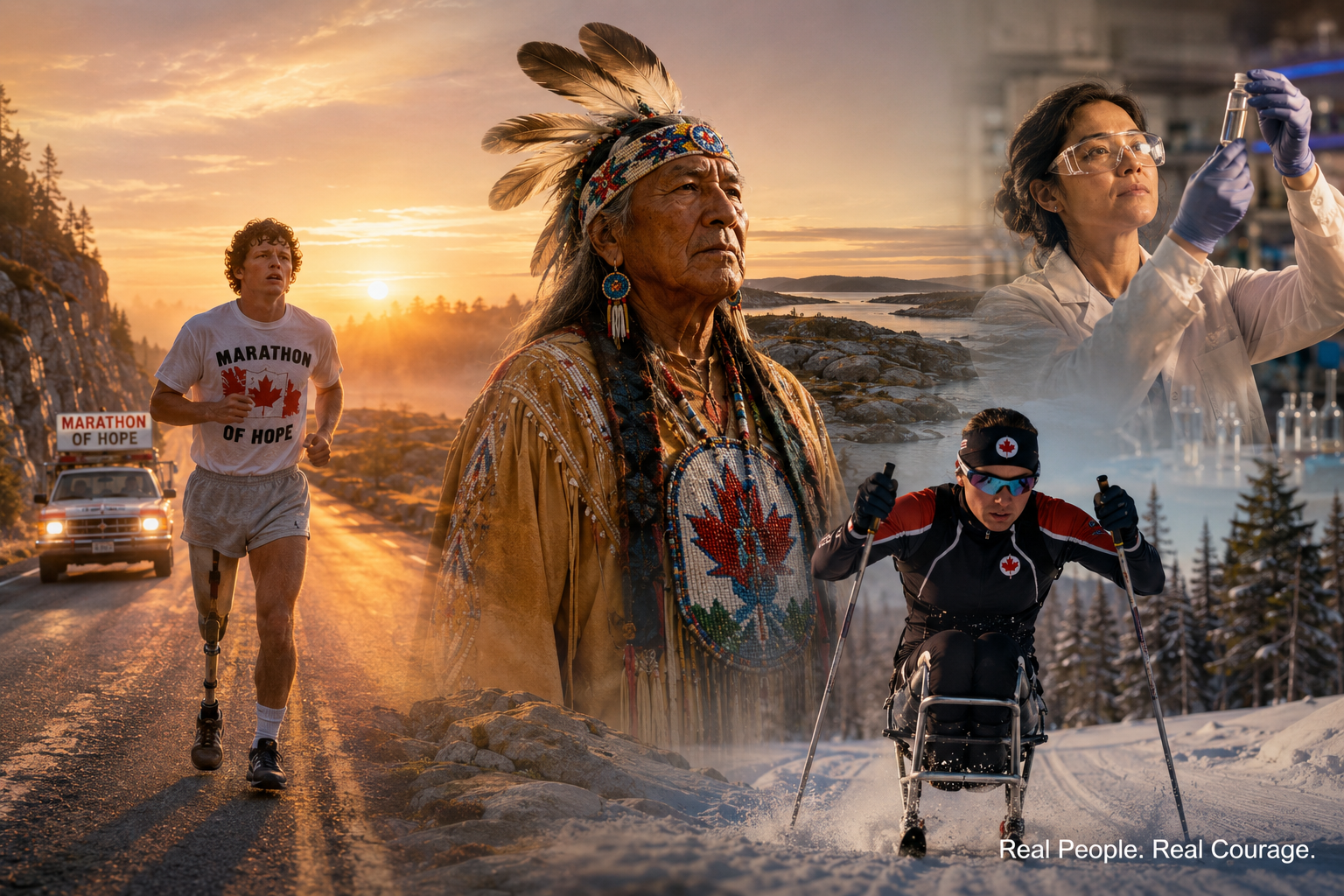
Who Are the Most Famous Canadian Heroes in History?
Canada’s most recognized heroes come from science, sport, and social activism. Names like Terry Fox, Frederick Banting (co-discoverer of insulin), and Christine Sinclair appear consistently in national surveys and school curricula.
A short list of widely recognized figures includes:
- Terry Fox — cancer fundraiser and marathon runner [1]
- Frederick Banting & Charles Best — co-discoverers of insulin, saving millions of lives worldwide [8]
- Donovan Bailey — set the 100m world record at the 1996 Atlanta Olympics [6]
- Christine Sinclair — all-time leading international goal scorer in soccer [6]
- Dr. Wilder Penfield — pioneered brain surgery techniques; once called “the greatest living Canadian” [8]
- Joseph-Armand Bombardier — invented the snowmobile in 1937, reshaping winter transportation [8]
- Reginald Fessenden — transmitted the first human voice over radio waves in 1900 [8]
These figures represent the most inspirational Canadian stories of all time because their actions had lasting, measurable impact — not just personal achievement.
What Makes a Canadian Story Truly Inspiring?
A truly inspiring Canadian story combines personal sacrifice with a benefit that extends beyond the individual. The most powerful examples involve overcoming systemic barriers, physical adversity, or social exclusion — and then using that experience to help others.
Key markers of a genuinely inspiring Canadian story:
- The person faced a real, documented obstacle (illness, poverty, discrimination)
- Their response was active, not passive
- The outcome benefited a community or changed a system
- The story is verifiable and grounded in fact, not mythology
“Inspiration without accountability is just entertainment. The stories that endure are the ones where the sacrifice was real and the result was tangible.”
Canada’s culture of humility also shapes these narratives. Unlike some national traditions that celebrate loud heroism, Canadian stories of courage often feature quiet determination — someone doing what needed to be done, without expecting applause.
How Did Terry Fox Change Canadian Culture?
Terry Fox did not just raise money — he redefined what ordinary Canadians believed was possible. In 1980, after losing his right leg to osteosarcoma, Fox began his Marathon of Hope, running an average of 42 km per day across Canada to fund cancer research [1].
He covered 5,373 km in 143 days before cancer spread to his lungs and forced him to stop near Thunder Bay, Ontario. He passed away in June 1981, but his goal of raising one dollar per Canadian was eventually surpassed many times over [1].
What changed after Terry Fox:
- Annual Terry Fox Runs now take place in over 60 countries
- The Terry Fox Foundation has raised hundreds of millions for cancer research
- His story became a permanent fixture in Canadian school curricula
- He shifted public perception of disability, illness, and athletic possibility
For readers in South Georgian Bay and across Ontario, local Terry Fox Run events remain one of the most widely participated community fundraisers each fall.
Are Indigenous Canadian Stories of Courage Different from Mainstream Narratives?
Yes — and the difference matters. Indigenous stories of courage in Canada are often rooted in cultural survival, language preservation, and resistance to systemic erasure, rather than individual achievement in Western institutions.
Jesse Thistle’s memoir From the Ashes (2019) is a landmark example [2]. Thistle, a Métis-Cree scholar, documented his path from homelessness and addiction to a university professorship. The book became the bestselling Indigenous memoir in Canada over the last 20 years [2]. It is a story of courage that operates on multiple levels: personal recovery, cultural reclamation, and academic persistence.
Other Indigenous stories of courage include:
- Elders who maintained oral traditions through the residential school era
- Activists like Cindy Blackstock, who fought for equitable child welfare funding for First Nations children
- Land and water defenders whose actions connect to broader sovereignty movements
These stories deserve separate recognition — not because they are lesser, but because the context of colonialism makes the courage required fundamentally different.
What Canadian Stories Are Taught in Schools — and Which Should Be Better Known?
Schools commonly teach Terry Fox, Frederick Banting, and Vimy Ridge. Less commonly taught but equally significant:
StoryWhy It MattersStatus in CurriculumAnne Innis Dagg’s giraffe researchFirst person to study giraffes in the wild; faced gender discrimination [3]Rarely taughtJesse Thistle’s From the AshesBestselling Indigenous memoir; recovery and identity [2]Growing inclusionReginald Fessenden’s radio transmissionFirst wireless voice broadcast in 1900 [8]Occasionally mentionedCanadarm developmentCanadian-built robotic arm for NASA Space Shuttle [8]Sometimes in science classGurdeep Pandher’s pandemic BhangraCultural bridge-building during COVID-19 [4]Almost never taught
The space and science contributions of Canadian engineers and inventors, including the Canadarm, represent a category of national pride that is consistently underrepresented in K–12 education [8].
How Much Money Have Canadian Heroes Raised for Charity?
The numbers are significant. The Terry Fox Foundation alone has raised over $850 million for cancer research since 1981 (Terry Fox Foundation, as cited in multiple Canadian news sources — exact current total varies by reporting date) [1].
Donovan Bailey and Christine Sinclair have both used their platforms for charitable causes, though precise fundraising totals are not centrally tracked [6]. The McKeever brothers’ Paralympic success helped raise the profile of adaptive sport funding in Canada [5].
Common mistake: People often assume Canadian charitable heroism is limited to big names. In fact, thousands of community-level Canadians — including volunteers in places like Springwater and Stayner — raise significant funds annually through local runs, auctions, and awareness campaigns inspired by these national figures.
What Challenges Do Canadian Heroes Typically Overcome?
The most inspirational Canadian stories of all time share common threads of adversity. The challenges vary, but patterns emerge:
- Physical illness or disability (Terry Fox, Brian McKeever)
- Systemic gender barriers (Anne Innis Dagg, Christine Sinclair)
- Racial and cultural discrimination (Donovan Bailey, Jesse Thistle, Gurdeep Pandher)
- Poverty and social exclusion (Jesse Thistle’s path from homelessness)
- Institutional resistance (Wilder Penfield’s early career challenges in neurosurgery)
What separates these figures from others who faced similar obstacles is not luck — it is documented persistence over years, often decades.
Which Canadian Moments of Courage Happened During World War II?
Canada’s Second World War contributions produced some of the country’s most enduring stories of collective courage. Canadian forces played a decisive role at D-Day’s Juno Beach on June 6, 1944, where approximately 14,000 Canadian soldiers landed — more than any other Allied nation’s forces advanced that day (Veterans Affairs Canada).
Notable WWII moments of Canadian courage:
- Juno Beach, D-Day (1944): Canadian soldiers advanced further than any other Allied force on June 6 [8]
- The Hong Kong garrison (1941): Nearly 2,000 Canadian soldiers defended Hong Kong against overwhelming Japanese forces
- Nursing Sisters: Over 4,000 Canadian women served as military nurses in active war zones
These stories connect directly to ongoing conversations about standing up for Canada and national identity.
Can Ordinary Canadians Become National Inspirations?
Absolutely — and some of the most powerful examples involve people who never sought fame. Gurdeep Pandher was a Sikh-Canadian Bhangra dancer living in the Yukon when he began posting videos of himself dancing in the snow during the COVID-19 pandemic [4]. Those videos went nationally viral, earning media coverage and a message from Prime Minister Justin Trudeau. Pandher’s story resonated because it was spontaneous, joyful, and genuinely community-minded.
The pattern repeats across Canadian history: ordinary people, facing extraordinary circumstances, choosing action. Terry Fox was a 21-year-old student. Jesse Thistle was a man living on the street before becoming a professor [2].
Choose this framing if: you want to inspire young Canadians — the most relatable heroes are often the ones who started with nothing extraordinary except determination.
Are There Any Recent Canadian Stories of Courage from the Last Decade?
Yes. Several stories from the 2010s and 2020s have entered the national conversation:
- Jesse Thistle (memoir published 2019): From homelessness to Métis-Cree academic and bestselling author [2]
- Gurdeep Pandher (2020–2021): Pandemic Bhangra videos from the Yukon that lifted national spirits [4]
- Christine Sinclair (2021): Led Canada’s women’s soccer team to Olympic gold at the Tokyo Games [6]
- Climate and land defenders: Indigenous youth activists, including those connected to movements like Standing Rock Sioux-inspired Canadian actions, who have drawn international attention
In 2026, these stories continue to be cited in discussions about Canadian identity, resilience, and what it means to lead by example.
How Do Canadian Stories of Courage Compare to American Heroic Narratives?
Canadian and American heroic narratives share some DNA but diverge in tone and emphasis. American stories tend to celebrate individual triumph, self-made success, and dramatic confrontation. Canadian stories more often emphasize community benefit, quiet endurance, and institutional change.
ElementCanadian Heroic NarrativeAmerican Heroic NarrativeToneHumble, community-focusedBold, individualisticCommon settingWilderness, adversity, institutionsBattlefield, business, politicsOutcome celebratedSystemic change, collective goodPersonal victory, fameCultural humilityHighLower
This is not a value judgment — both traditions produce genuine inspiration. But understanding the difference helps explain why Terry Fox never commercialized his run, and why that restraint made him more beloved, not less.
What Canadian Heroes Are Most Inspiring for Young People Today?
For young Canadians in 2026, the most relatable heroes tend to be recent, diverse, and connected to issues they care about — identity, sport, mental health, and climate.
Top picks for young audiences:
- Christine Sinclair — proof that sustained excellence in women’s sport earns global recognition [6]
- Jesse Thistle — a recovery story that speaks directly to youth facing addiction or homelessness [2]
- Gurdeep Pandher — cultural pride expressed joyfully, without apology [4]
- Brian McKeever — Paralympic champion who shows disability does not define limits [5]
- Terry Fox — still the most universally taught, and for good reason [1]
For educators and parents in communities like South Georgian Bay, pairing these stories with local examples of community courage makes the lessons land harder.
FAQ
Q: Who is the most famous Canadian hero of all time?
Terry Fox is consistently named Canada’s greatest hero in national polls. His 1980 Marathon of Hope raised cancer research funds and remains a defining moment in Canadian identity [1].
Q: What is the bestselling Indigenous Canadian memoir?
From the Ashes by Jesse Thistle (2019) is the bestselling Indigenous memoir in Canada over the last 20 years, according to Wikipedia’s sourcing [2].
Q: Did Terry Fox finish his run across Canada?
No. Fox ran 5,373 km over 143 days before cancer spread to his lungs and forced him to stop near Thunder Bay. He passed away in June 1981 [1].
Q: Who was the first person to study giraffes in the wild?
Anne Innis Dagg, a Canadian zoologist, became the first person to study giraffes in their natural habitat in the 1950s, overcoming significant gender barriers to do so [3].
Q: What did Canada contribute to the NASA Space Shuttle?
Canadian engineers developed the Canadarm, a robotic arm that became a critical component of NASA’s Space Shuttle program [8].
Q: Who made the first wireless voice transmission?
Canadian inventor Reginald Fessenden made the first wireless voice transmission in 1900, laying the groundwork for modern radio communication [8].
Q: Is Gurdeep Pandher a professional dancer?
Pandher is a Bhangra dancer and cultural ambassador based in the Yukon. His pandemic-era videos were not professionally produced — they were personal expressions that went nationally viral [4].
Q: How many countries hold Terry Fox Runs?
Terry Fox Runs take place in over 60 countries annually, making it one of the largest single-day cancer fundraising events in the world [1].
Q: What sport did the McKeever brothers compete in?
Robin and Brian McKeever competed in Paralympic cross-country skiing, with Robin serving as Brian’s sighted guide [5].
Q: What record does Christine Sinclair hold?
Sinclair holds the world record for international goals scored in soccer — surpassing the previous record held by Abby Wambach of the United States [6].
Conclusion
The most inspirational Canadian stories of all time are not confined to history books or bronze statues. They are living traditions, updated by each generation of Canadians who choose courage when it would be easier to stay quiet.
Actionable next steps:
- Share one story from this guide with a young person in your community — the McKeever brothers, Sinclair, or Thistle are strong starting points for youth
- Participate locally — Terry Fox Runs, Indigenous storytelling events, and community fundraisers keep these legacies active
- Read primary sources — Thistle’s From the Ashes and Sinclair’s Playing the Long Game are both widely available [2][6]
- Follow local courage — communities like those covered by Georgian Bay News produce their own stories of resilience worth documenting and sharing
- Revisit this guide annually — new stories of Canadian courage emerge every year, and this resource is updated to reflect them
Canada’s identity is built, story by story, on the choices of real people in real moments. The next chapter is still being written.
References
[1] Terry Fox Marathon Of Hope – https://runningmagazine.ca/special-feature/terry-fox-marathon-of-hope/?utm_source=openai
[2] From The Ashes (memoir) – https://en.wikipedia.org/wiki/From_the_Ashes_%28memoir%29?utm_source=openai
[3] Historica Canada Innovation Impact Insulin Canadarm – https://www.begiant.ca/stories/ideas/historica-canada-innovation-impact-insulin-canadarm?utm_source=openai
[4] Gurdeep Pandher – https://en.wikipedia.org/wiki/Gurdeep_Pandher?utm_source=openai
[5] Robin McKeever – https://en.wikipedia.org/wiki/Robin_McKeever?utm_source=openai
[6] Inspiring Memoirs Sports Superstars – https://www.penguinrandomhouse.ca/list/2898/inspiring-memoirs-sports-superstars?utm_source=openai
[7] Alistair MacLeod – https://en.wikipedia.org/wiki/Alistair_MacLeod?utm_source=openai
[8] Modern Canada – https://www.canada.ca/en/immigration-refugees-citizenship/corporate/publications-manuals/discover-canada/read-online/modern-canada.html?utm_source=openai