























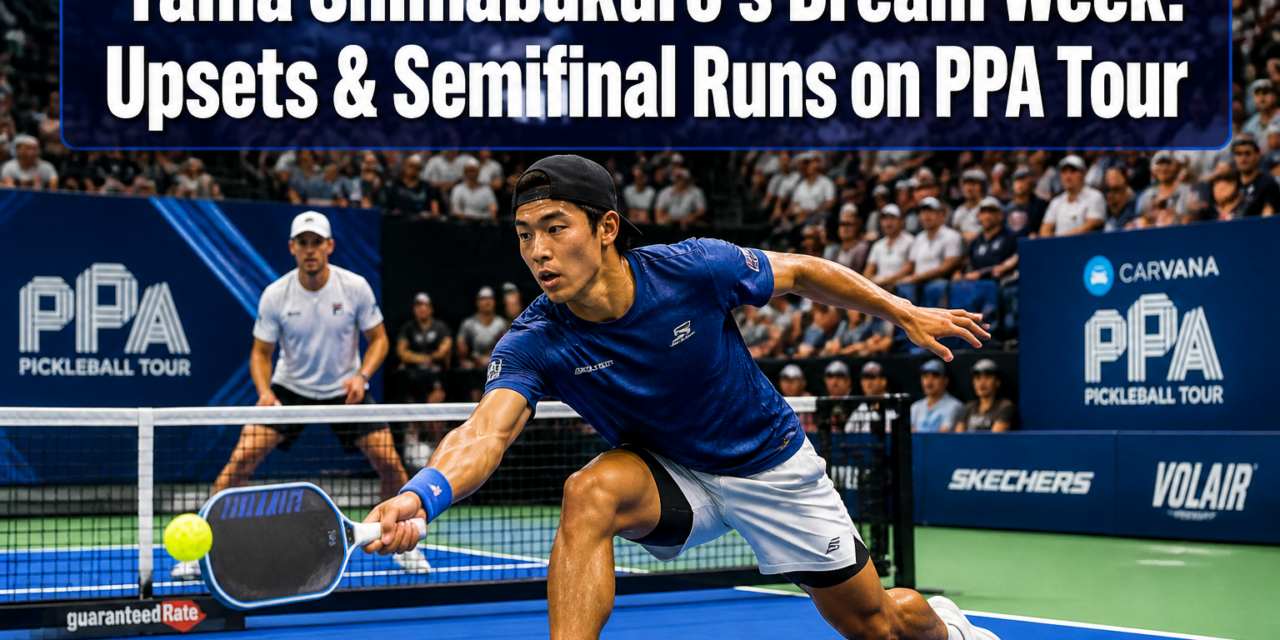
🏆 Tama Shimabukuro’s Dream Week on PPA Tour: Upsets, Semifinal Runs, and Emerging Women’s Singles Threat

Last updated: May 5, 2026
Quick Answer
Fifteen-year-old Tama Shimabukuro delivered a breakthrough performance at the Veolia Atlanta Pickleball Championships in early May 2026, reaching his first career PPA Tour final after defeating multiple top-seeded players including No. 3 seed Hunter Johnson.[1] The No. 22 seed upset Federico Staksrud, Jaume Martinez Vich, and Noe Khlif en route to the championship match, ultimately earning a silver medal after falling to top seed Chris Haworth in the final.[3] This performance established Shimabukuro as a rising threat in professional pickleball singles competition.

Key Takeaways
- Historic breakthrough: Shimabukuro reached his first PPA Tour final at age 15, defeating the No. 3 seed in the semifinals[1]
- Multiple upsets: The No. 22 seed took down several higher-ranked opponents throughout the tournament bracket
- Dominant semifinal: Shimabukuro defeated Hunter Johnson 11-7, 8-11, 11-1 on May 2, 2026[1]
- First career medal: Earned silver after falling to seven-time PPA Tour singles champion Chris Haworth 11-5, 11-1[3]
- Multi-discipline competitor: Competes in men’s singles, men’s doubles, and mixed doubles on the PPA Tour[2]
- Youth advantage: At 15, Shimabukuro represents the next generation challenging established professionals
- Tactical adaptability: Demonstrated ability to adjust strategy between matches and within three-game formats
What Made Tama Shimabukuro’s Atlanta Performance Historic?

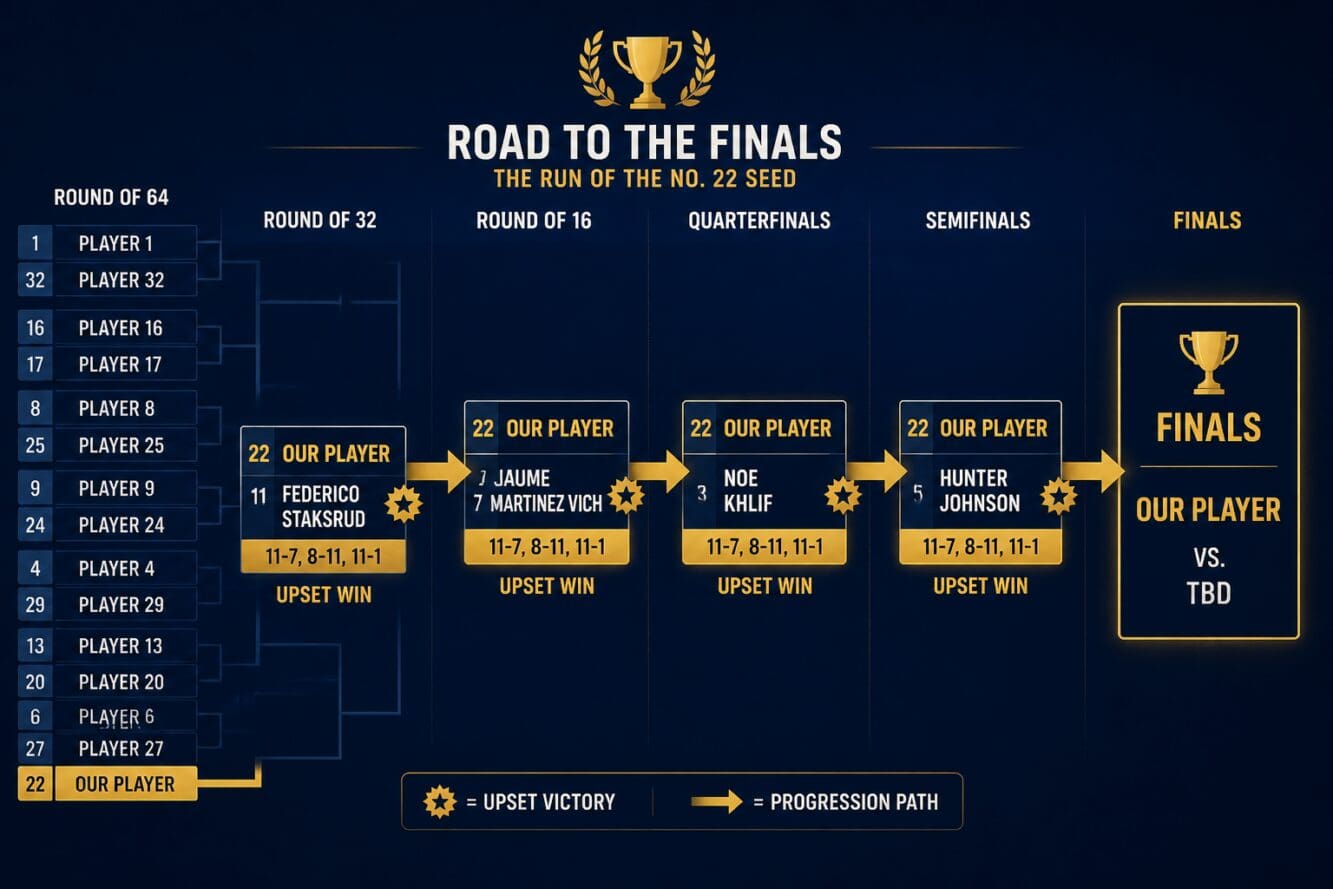
Shimabukuro’s run at the Veolia Atlanta Pickleball Championships marked a career-defining moment because he reached his first PPA Tour final as a 15-year-old No. 22 seed, defeating multiple top competitors along the way.[1][3]
The significance of this achievement includes:
- Age factor: Competing against seasoned professionals while still a teenager
- Seed differential: Overcoming a 21-position gap from his seeding to the final
- Quality of opponents: Defeating established names like Federico Staksrud, Jaume Martinez Vich, and Noe Khlif
- Consistency: Winning multiple consecutive matches against progressively tougher competition
- Mental fortitude: Handling pressure situations in elimination rounds
This performance signals a potential shift in professional pickleball, where younger players are increasingly challenging the established hierarchy. Choose to watch Shimabukuro if you want to see aggressive baseline play combined with youth athleticism.

How Did Shimabukuro Defeat Hunter Johnson in the Semifinals?
Shimabukuro secured his spot in the final by defeating No. 3 seed Hunter Johnson 11-7, 8-11, 11-1 on May 2, 2026, in a match that showcased his ability to dominate the decisive third game.[1]
Match breakdown:
- Game 1 (11-7): Shimabukuro established early control with consistent baseline play
- Game 2 (8-11): Johnson adjusted tactics and forced errors to even the match
- Game 3 (11-1): Shimabukuro dominated with only one point allowed, demonstrating superior conditioning and mental strength
The third-game performance was particularly noteworthy. After losing the second game, many young players might falter under pressure. Instead, Shimabukuro delivered his most dominant play when it mattered most.

Key tactical elements:
- Aggressive return of serve positioning
- Consistent third-shot drops to neutralize Johnson’s power
- Superior court coverage and retrieval ability
- Mental reset between games
Common mistake to avoid: Don’t assume youth equals inconsistency. Shimabukuro’s third-game dominance proves that younger players can maintain focus under championship pressure.
Who Did Shimabukuro Upset on His Path to the Final?
Beyond the semifinal victory over Johnson, Shimabukuro defeated several highly-ranked opponents including Federico Staksrud, Jaume Martinez Vich, and Noe Khlif in earlier rounds.[1]
Notable upset victories:
| Opponent | Significance | Round |
|---|---|---|
| Federico Staksrud | Established PPA Tour competitor | Early rounds |
| Jaume Martinez Vich | International player with tour experience | Mid-tournament |
| Noe Khlif | Ranked opponent with multiple tour appearances | Quarterfinals (likely) |
| Hunter Johnson | No. 3 seed, elite singles player | Semifinals |
Each victory required different tactical approaches. Staksrud, Vich, and Khlif all bring distinct playing styles, forcing Shimabukuro to adapt his game plan match by match.
The ability to prepare for and defeat multiple playing styles within a single tournament weekend demonstrates maturity beyond his 15 years. This adaptability will be crucial as he faces top players like Anna Leigh Waters in future mixed doubles and singles events.
What Happened in the Championship Final Against Chris Haworth?
Shimabukuro’s remarkable run ended in the final when top seed Chris Haworth defeated him 11-5, 11-1 on Championship Sunday, May 3, 2026.[3] Haworth’s experience proved decisive, as he captured his seventh career PPA Tour singles title.
Final match analysis:
- Experience gap: Haworth’s six previous singles titles provided championship composure
- Score differential: The 11-5, 11-1 result showed Haworth’s dominance
- Physical demands: Five matches in one weekend may have affected Shimabukuro’s performance
- Tactical mastery: Haworth neutralized the aggressive style that worked in earlier rounds
Despite the loss, Shimabukuro earned his first PPA Tour medal (silver) and acknowledged this achievement in his post-match press conference.[4] The final score doesn’t diminish the significance of reaching a championship match as a teenager.
What this means going forward: Facing elite competition like Haworth provides invaluable experience. The gap between semifinals and finals is often the hardest to close in professional sports.
What Playing Style Defines Shimabukuro’s Game?
Shimabukuro competes across multiple disciplines on the PPA Tour, including men’s singles, men’s doubles, and mixed doubles, which shapes his versatile playing approach.[2]
Core strengths:
- Baseline consistency: Ability to extend rallies and force opponent errors
- Court coverage: Youth and athleticism allow superior retrieval
- Aggressive positioning: Willingness to take balls early and control tempo
- Mental resilience: Demonstrated by the 11-1 third game against Johnson
- Adaptability: Success across singles and doubles formats
Multi-discipline advantage: Playing doubles develops net skills and quick exchanges, while singles builds endurance and strategic patience. This combination creates a well-rounded game.
Choose Shimabukuro’s approach if you value consistency over power. His game relies on making opponents beat themselves rather than forcing low-percentage winners.
How Does Shimabukuro Compare to Established Women’s Singles Players?
While Shimabukuro competes in men’s singles, his emergence parallels the rise of young talents in women’s singles who have challenged established dominators like Anna Leigh Waters.
Comparison factors:
- Age advantage: Youth provides recovery speed and fearlessness
- Ranking trajectory: Rapid improvement from lower seeds to championship contention
- Upset capability: Willingness to challenge higher-ranked opponents
- Tournament endurance: Ability to maintain performance across multiple matches
The women’s singles draw has seen similar breakthrough performances from teenagers who upset veteran players. Shimabukuro’s Atlanta run suggests the men’s side may experience comparable generational shifts.
Edge case: Direct comparisons between men’s and women’s singles are limited by different competitive fields, but the pattern of young disruptors challenging established champions appears consistent across both.
What Does This Performance Mean for Shimabukuro’s Future?
This breakthrough tournament establishes Shimabukuro as a legitimate contender in PPA Tour singles events and raises expectations for future performances.
Immediate implications:
- Ranking boost: First final appearance will significantly improve tour standings
- Seed improvement: Future tournaments will seed him higher, avoiding early-round giants
- Confidence building: Knowing he can defeat top-10 players changes his approach
- Target on his back: Opponents will now prepare specifically for his game
Long-term trajectory considerations:
- Physical development: At 15, continued growth may add power to his consistent game
- Experience accumulation: More championship situations will reduce final-round jitters
- Tactical refinement: Studying the Haworth loss will identify areas for improvement
- Multi-discipline balance: Managing singles, doubles, and mixed doubles workload
Decision rule: If Shimabukuro maintains this level while adding power as he matures physically, he could challenge for PPA Tour titles within 12-18 months.
What Tactical Lessons Can Players Learn from Shimabukuro’s Run?
Shimabukuro’s Atlanta performance offers several tactical insights for competitive players at all levels.
Key takeaways:
✅ Consistency beats power: His baseline game forced errors rather than hitting winners
✅ Mental reset ability: The 11-1 third game after losing game two showed championship mentality
✅ Adaptability matters: Different opponents required different tactical approaches
✅ Youth isn’t a weakness: Conditioning and fearlessness can offset experience gaps
✅ Tournament preparation: Success across multiple matches requires physical and mental stamina
Common mistakes Shimabukuro avoided:
- Trying to overpower stronger opponents
- Losing focus after dropping a game
- Playing tentatively against higher seeds
- Abandoning his game plan under pressure
Practical application: Recreational and competitive players should focus on consistency and mental resilience rather than attempting low-percentage shots. Shimabukuro’s success validates the “make them beat you” philosophy.
Conclusion
Tama Shimabukuro’s dream week at the Veolia Atlanta Pickleball Championships announced his arrival as a serious threat in professional singles competition. The 15-year-old’s journey from No. 22 seed to silver medalist, including upset victories over Federico Staksrud, Jaume Martinez Vich, Noe Khlif, and No. 3 seed Hunter Johnson, demonstrates that youth and consistency can challenge established power in professional pickleball.[1][3]
While Chris Haworth’s experience prevailed in the final, Shimabukuro’s first career PPA Tour medal establishes a foundation for future success.[3][4] His multi-discipline approach across singles and doubles formats, combined with tactical adaptability and mental fortitude, positions him as a player to watch in upcoming 2026 events.
Next steps for following Shimabukuro’s career:
- Track PPA Tour results: Monitor his performance at upcoming tournaments on the official tour website[5]
- Watch match footage: Study his tactical approach in available video coverage[4]
- Follow ranking progression: Observe how this breakthrough affects his tour seeding
- Compare to peers: Watch how other young players respond to his success
The question now isn’t whether Shimabukuro can compete with top professionals—Atlanta answered that definitively. The question is how quickly he’ll close the gap between semifinals and championships, and whether his generation will reshape professional pickleball’s competitive landscape in the coming years.
FAQ
How old is Tama Shimabukuro?
Shimabukuro is 15 years old as of his breakthrough performance at the Veolia Atlanta Pickleball Championships in May 2026.[1]
What was Shimabukuro’s seed at the Atlanta tournament?
He was seeded No. 22 entering the tournament, making his run to the final a significant upset performance.[3]
Who did Shimabukuro defeat in the semifinals?
He defeated No. 3 seed Hunter Johnson 11-7, 8-11, 11-1 on May 2, 2026, to reach his first career PPA Tour final.[1]
What was the final score against Chris Haworth?
Haworth defeated Shimabukuro 11-5, 11-1 in the men’s singles final on May 3, 2026.[3]
How many PPA Tour titles does Chris Haworth have?
Haworth captured his seventh career PPA Tour singles title by winning the Atlanta championship.[3]
What disciplines does Shimabukuro compete in?
He competes in men’s singles, men’s doubles, and mixed doubles on the PPA Tour.[2]
Was this Shimabukuro’s first PPA Tour medal?
Yes, the silver medal from Atlanta was his first career PPA Tour medal, which he acknowledged in his post-match press conference.[4]
What other players did Shimabukuro upset in Atlanta?
He defeated Federico Staksrud, Jaume Martinez Vich, and Noe Khlif in rounds leading to the final.[1]
What is Shimabukuro’s playing style?
His game emphasizes baseline consistency, superior court coverage, aggressive positioning, and mental resilience rather than pure power.
How does this performance affect his future seeding?
Reaching his first final will significantly improve his tour rankings and result in higher seeds at future tournaments, potentially avoiding early matches against top players.
Can Shimabukuro compete with players like Anna Leigh Waters?
While they compete in different divisions (men’s vs. women’s singles), Shimabukuro’s emergence as a young disruptor mirrors similar patterns in women’s singles, suggesting potential for mixed doubles competition.
What should players learn from Shimabukuro’s Atlanta run?
Focus on consistency over power, develop mental reset ability between games, adapt tactics to different opponents, and maintain physical conditioning for multi-match tournaments.
References
[1] Tama Town Shimabukuro Beats H Johnson To Make First Career Ppa Tour Final – https://pickleball.com/news/tama-town-shimabukuro-beats-h-johnson-to-make-first-career-ppa-tour-final
[2] Tama Shimabukuro – https://ppatour.com/athlete/tama-shimabukuro/
[3] Haworth Stops Shimabukuros Run In Mens Singles As Waters Johns Take Mixed Doubles Title – https://pickleball.com/news/haworth-stops-shimabukuros-run-in-mens-singles-as-waters-johns-take-mixed-doubles-title
[4] Watch – https://www.youtube.com/watch?v=xLGQ42hmtHc
[5] ppatour – https://ppatour.com
Content, illustrations, and third-party video appearing on GEORGIANBAYNEWS.COM may be generated or curated with AI assistance or reproduced pursuant to the fair dealing provisions of the Copyright Act, R.S.C. 1985, c. C-42. Attribution and hyperlinks to original sources are provided in acknowledgment of applicable intellectual property rights. Such referencing is intended to direct traffic to and support the original rights holders’ platforms.
Much Appreciate You Sharing This Post - It Helps MUCH!!!