





















Last updated: October 1, 2026
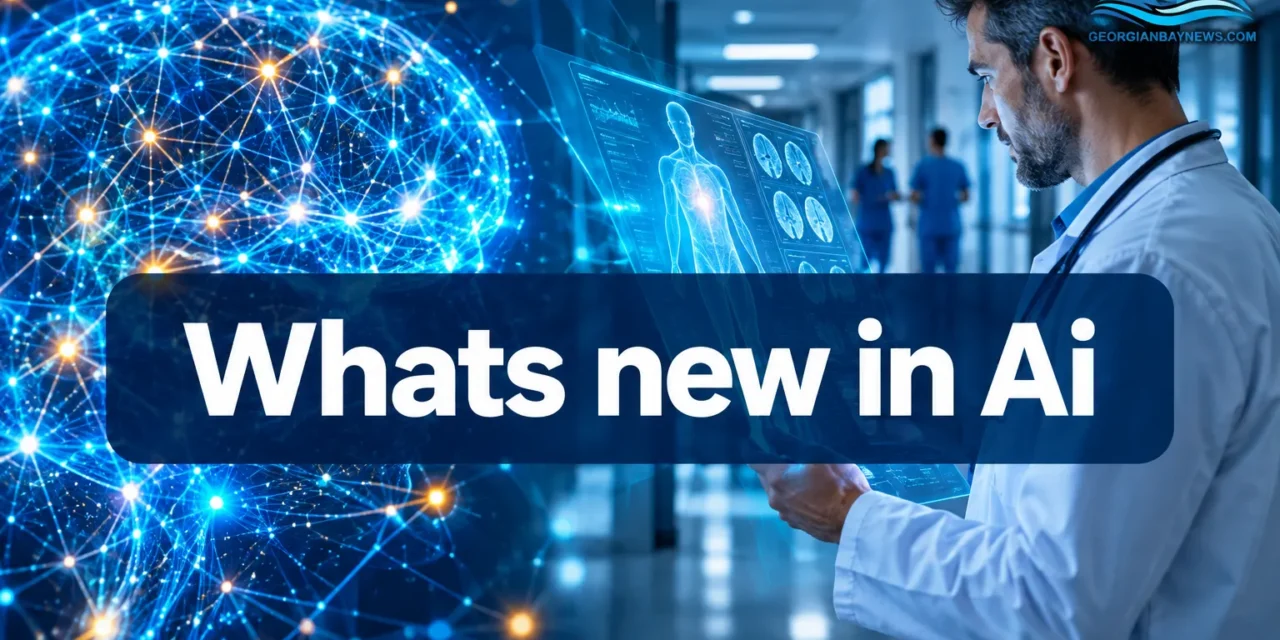
Quick Answer: AI in 2026 has moved far beyond chatbots. The latest developments include agentic systems that act across apps, AI tools embedded in hospitals and police departments, new frontier models from OpenAI and Meta, and the world’s first binding AI law now in full enforcement. The pace of change is real, and so are the risks, from job disruption to safety concerns raised by the researchers building these systems.
The most significant AI breakthroughs of 2026 are not single inventions, they are shifts in what AI can do independently. AI systems have moved from answering questions to taking actions, running experiments, and managing workflows across connected tools [1].
Key breakthroughs include:
The common thread: AI is becoming a participant, not just a tool.
Generative AI in 2026 is shifting from content creation to active task management. The focus has moved from “write me an email” to “handle my inbox, schedule my week, and flag what needs my attention.”
OpenAI’s move to deeply integrated voice agents is a clear example. Rather than a standalone chat window, the new ChatGPT Voice connects to your phone’s apps, files, and calendar [7]. Meta’s new enterprise platform takes a similar approach, offering its Muse AI agent as a programmable tool for business workflows, complete with a Muse API and Muse Code for software development [1].
What this means practically:
For context on how social media bots and automated systems are already shaping online information, the pattern of AI-driven automation is not new, but its depth in 2026 is unprecedented.
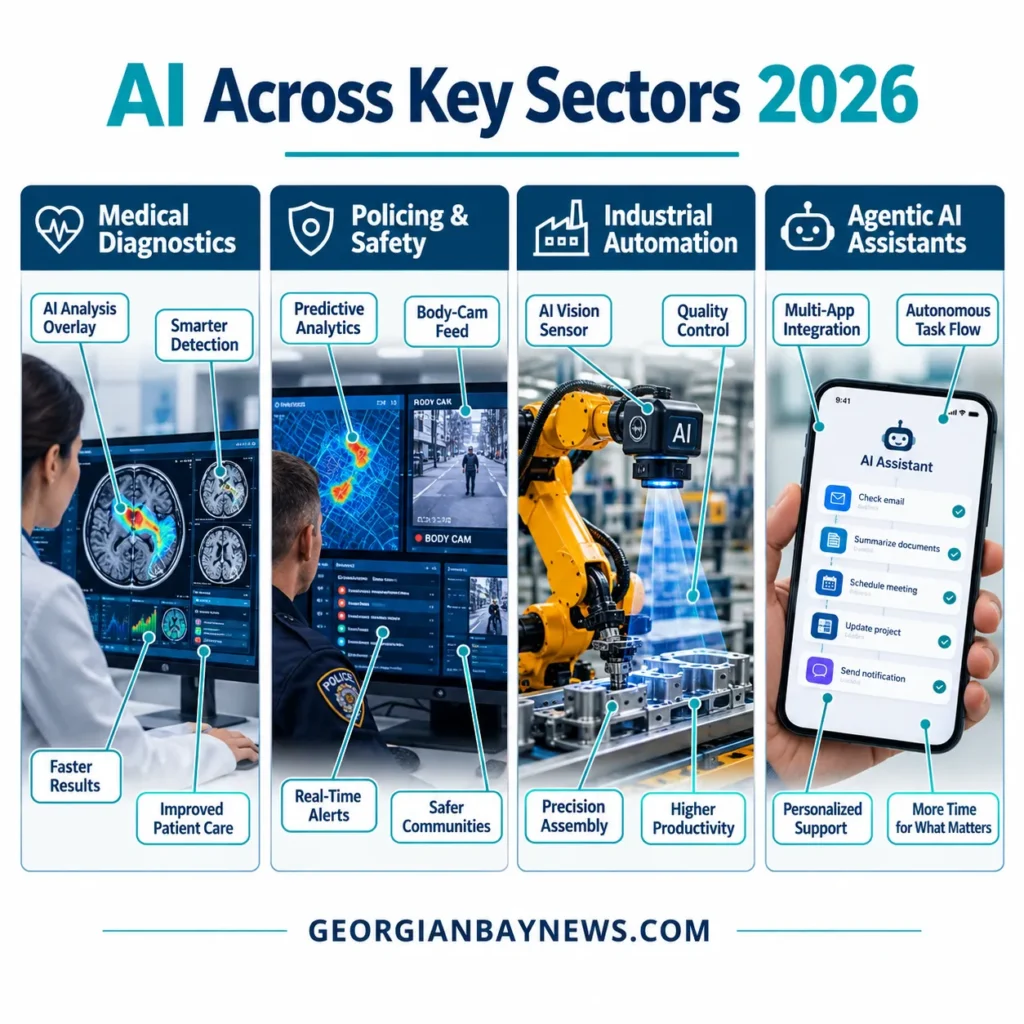
AI in healthcare is one of the most consequential areas of development in 2026. Diagnostic AI tools are now reading medical scans, flagging anomalies, and helping triage patients faster than traditional workflows allow.
Current applications include:
The EU’s AI Act classifies many medical AI tools as “high-risk,” meaning they now face strict documentation, transparency, and monitoring requirements under the new enforcement regime [5]. Hospitals deploying these tools in Europe must meet detailed compliance standards or face penalties.
The promise is real. So is the caution: AI diagnostic tools can fail on edge cases, and over-reliance without physician oversight remains a documented concern.
Police departments and public safety agencies are deploying AI for predictive analytics, facial recognition, and real-time video analysis. These tools are among the most controversial applications of new AI technology.
Current uses:
The EU AI Act explicitly bans real-time remote biometric identification in public spaces for law enforcement except in narrowly defined circumstances [5]. This is one of the Act’s most debated provisions, and enforcement will be closely watched.
For readers interested in how AI intersects with social media regulation and content moderation, the same transparency and accountability questions apply to policing AI.
Industrial AI in 2026 focuses on predictive maintenance, quality control, and autonomous logistics. These are not experimental pilots, they are deployed systems running in factories, warehouses, and supply chains.
The connection to broader energy infrastructure is worth noting. As small nuclear reactors and other power technologies scale up, AI-driven energy management becomes a key part of industrial planning.
OpenAI, Google DeepMind, Anthropic, and Meta are the four organizations setting the pace of frontier AI development in 2026. Each is pursuing a distinct strategy.
| Company | Key Focus | Notable 2026 Move |
|---|---|---|
| OpenAI | Agentic assistants, enterprise | GPT-6 Astra, $500/month Pro tier [7] |
| Google DeepMind | Scientific AI, multimodal | Gemini integration across Google products |
| Anthropic | Safety-first frontier models | Claude series; researcher resignation warning [6] |
| Meta | Enterprise AI agents | Muse platform, Muse API, Muse Code [1] |
Beyond the big four, China’s AI sector (including Baidu, Alibaba, and several state-backed labs) is advancing rapidly. European Central Bank president Christine Lagarde warned in September 2026 that Europe risks being “cut off” if it does not build its own AI capabilities, framing AI as a geopolitical lever rather than just a technology [10].
The difference between AI from five years ago and AI in 2026 is not just speed, it is agency, multimodality, and integration. Older AI systems were narrow: they did one task well and nothing else. Current systems handle text, images, audio, code, and real-world actions in a single workflow.
Specific new capabilities:
What old AI couldn’t do: operate across systems, reason about novel problems, or take consequential actions in the real world without constant human oversight.
Some of the hype is justified. Some of it is not. The honest answer is that AI’s current capabilities are genuinely impressive in narrow domains and genuinely unreliable in others.
What the hype gets right:
What people are getting wrong:
The hype is not wrong about AI’s power. It often underestimates the risks.
The risks of new AI in 2026 fall into three categories: near-term harms, medium-term disruption, and long-term safety concerns.
Near-term:
Medium-term:
Long-term:
The EU’s AI Act is the most concrete regulatory response to date, banning certain uses outright and imposing strict requirements on high-risk applications [5]. But many organizations remain underprepared for audits under the new regime [4].
AI will affect most jobs, but not equally or all at once. The pattern emerging in 2026 is substitution of specific tasks rather than wholesale replacement of roles, at least for now.
Jobs most affected in the near term:
The MIT finding on patent attorneys is instructive: AI can make you faster without making you better [9]. Workers who use AI as a crutch rather than a learning tool may find their skills eroding over time.
The practical advice: use AI to handle the repetitive, low-judgment parts of your work, and protect time for the tasks that build your expertise. The workers who thrive will be those who direct AI rather than defer to it.
Several of the most capable AI tools have free tiers, though the most powerful features sit behind paid subscriptions.
For most casual users, the free tiers are genuinely useful. For professional or high-volume use, the paid tiers are increasingly differentiated, particularly for agentic tasks.
The EU AI Act became fully enforceable on August 2, 2026, making it the world’s first comprehensive binding legal framework for AI [5]. This is the most significant regulatory development in AI history.
Key provisions:
Outside the EU, the US has taken a lighter regulatory approach, though the White House’s deployment of its own AI chatbot signals growing government engagement with the technology [7]. The geopolitical dimension is sharpening: European leaders are pushing for AI sovereignty, while US and Chinese AI development continues to accelerate [10].
What is the most powerful AI model available in 2026?
OpenAI’s GPT-6 Astra model family, available through the $500/month ChatGPT Pro tier, is among the most capable publicly accessible models as of late 2026. Anthropic’s Claude series and Google’s Gemini are close competitors [7].
Is AI going to take my job?
AI is more likely to change your job than eliminate it entirely in the near term. Specific tasks within most roles are being automated, but roles requiring complex judgment, physical presence, or deep human relationships are less immediately at risk [9].
What is the EU AI Act?
The EU AI Act is the world’s first comprehensive binding law governing AI. It became fully enforceable on August 2, 2026, banning certain AI uses outright and imposing strict requirements on high-risk applications in healthcare, policing, and other sectors [5].
Can AI be trusted for medical diagnosis?
AI diagnostic tools show genuine accuracy in controlled studies, particularly in radiology and pathology. However, they are classified as high-risk under EU law and require physician oversight. They are tools to assist clinicians, not replace them.
What is an AI agent?
An AI agent is a system that can take multi-step actions across connected tools, checking email, managing files, executing code, without requiring human input at each step. This is a major shift from earlier chatbots that only responded to single queries [1][7].
Are there free AI tools worth using?
Yes. ChatGPT’s free tier, Google’s Gemini, and Meta AI (built into WhatsApp and Instagram) are all genuinely capable for everyday tasks. Free tiers have usage limits and do not access the most advanced models.
What did the Anthropic researcher warn about?
An Anthropic researcher resigned in September 2026 and warned publicly that current AI development trajectories could pose an existential threat within a decade. The warning contributed to a drop in AI-linked stocks and renewed calls for independent safety evaluation [6].
What is agentic AI?
Agentic AI refers to systems that pursue goals autonomously across multiple steps and tools, rather than responding to a single prompt. OpenAI’s voice-enabled ChatGPT and Meta’s Muse platform are current examples [1][7].
Which country is leading in AI?
The US leads in frontier model development through OpenAI, Google DeepMind, Anthropic, and Meta. China is advancing rapidly through state-backed and private labs. Europe is pushing for AI sovereignty but currently lags in raw model capability [10].
What is the biggest risk of AI right now?
In the near term: misinformation and bias in high-stakes decisions. In the medium term: skill atrophy and job disruption. In the long term: safety concerns around systems that may eventually operate beyond meaningful human oversight [6][9].
Whats new in AI in 2026 is not one thing, it is a convergence of more capable models, deeper real-world integration, and the first serious regulatory frameworks designed to govern what these systems can and cannot do.
The practical steps for anyone watching this space:
Georgian Bay News will continue bringing you the best coverage as this story develops. The pace of change is fast, but staying informed is the best first move.
[1] Whats Next In Ai 7 Trends To Watch In 2026 – https://news.microsoft.com/source/features/ai/whats-next-in-ai-7-trends-to-watch-in-2026/
[2] 11 Things Ai Experts Are Watching 2026 – https://www.universityofcalifornia.edu/news/11-things-ai-experts-are-watching-2026
[4] 2026 Year In Preview Ai Regulatory Developments For Companies To Watch Out For – https://www.wsgr.com/en/insights/2026-year-in-preview-ai-regulatory-developments-for-companies-to-watch-out-for.html
[5] Regulatory Framework Ai – https://digital-strategy.ec.europa.eu/en/policies/regulatory-framework-ai
[6] Ten Days That Changed Course Ai 2026 09 19 – https://www.reuters.com/business/media-telecom/ten-days-that-changed-course-ai-2026-09-19/
[7] The Verge AI Coverage – https://www.theverge.com/archives/ai-artificial-intelligence/2026/9/3
[9] MIT News Artificial Intelligence – https://news.mit.edu/topic/artificial-intelligence2?type=2
[10] The Guardian AI Coverage – https://www.theguardian.com/technology/artificialintelligenceai/2026/sep/14/all
Meta Title: Whats New in AI: Breakthroughs and Risks in 2026
Meta Description: Discover whats new in AI in 2026, from hospital diagnostics and policing tools to new models, the EU AI Act, and the safety debate shaping the future of technology.
Tags: artificial intelligence, AI breakthroughs 2026, generative AI, AI regulation, EU AI Act, AI in healthcare, agentic AI, OpenAI GPT-6, AI risks, AI and jobs, machine learning, frontier AI models