






















Last updated: June 17, 2026
Quick Answer: Dizziness and vertigo after 65 are among the most common reasons older adults visit their doctor, affecting roughly 30% of people over 60 and nearly 50% of those over 85 [1]. Most episodes trace back to inner ear problems, medication side effects, or low blood pressure — all treatable. But some causes, including stroke and heart rhythm problems, require immediate emergency care. Knowing the difference can be life-saving.
Dizziness in older adults most often stems from inner ear disorders, medication side effects, cardiovascular changes, or neurological conditions. Because the body’s balance system depends on the inner ear, vision, and sensory nerves working together, any disruption to one component can trigger symptoms [2].
Common causes include:
Vertigo is not the same as general dizziness. Vertigo is a false sense of spinning or movement — either the person feels they are moving, or the room seems to spin around them. Regular dizziness is a broader term that includes lightheadedness, faintness, or a floating sensation [5].
TermWhat It Feels LikeCommon CauseVertigoRoom spinning, tilting, rotatingBPPV, Meniere’s, vestibular neuritisLightheadednessFaint, woozy, about to pass outLow blood pressure, dehydrationDisequilibriumUnsteady, off-balance while walkingNerve damage, muscle weakness, medication
Choose the right description when talking to a doctor. Saying “I feel like the room is spinning” points toward inner ear causes. Saying “I feel faint when I stand up” points toward blood pressure or heart issues. The distinction shapes the diagnostic path.
Yes, and this is one of the most underrecognized causes of dizziness after 65. Many common medications lower blood pressure, affect fluid balance, or sedate the nervous system — all of which can impair balance [3].
Medication classes most likely to cause dizziness:
Common mistake: Seniors often assume dizziness is “just aging” and don’t report it to their pharmacist or doctor. A medication review — sometimes called a “brown bag review” where all pill bottles are brought to an appointment — can identify problematic combinations quickly.
Inner ear disorders are very common in older adults and are a leading cause of dizziness and vertigo after 65. The vestibular system naturally degenerates with age, making older adults more vulnerable to conditions like BPPV, vestibular neuritis, and Meniere’s disease [2].
BPPV alone accounts for roughly 17% of all dizziness complaints in older patients seen in primary care. The good news: BPPV responds well to a simple in-office maneuver called the Epley maneuver, which repositions the displaced crystals [6].
Dizziness combined with any of the following symptoms is a medical emergency and may indicate a stroke or TIA. Call 911 immediately — do not drive to the hospital [4].
FAST stroke warning signs alongside dizziness:
Additional red flags:
Stroke-related dizziness tends to come on suddenly and is often accompanied by other neurological symptoms. BPPV-related vertigo, by contrast, is triggered by head position changes and resolves within seconds to a minute.
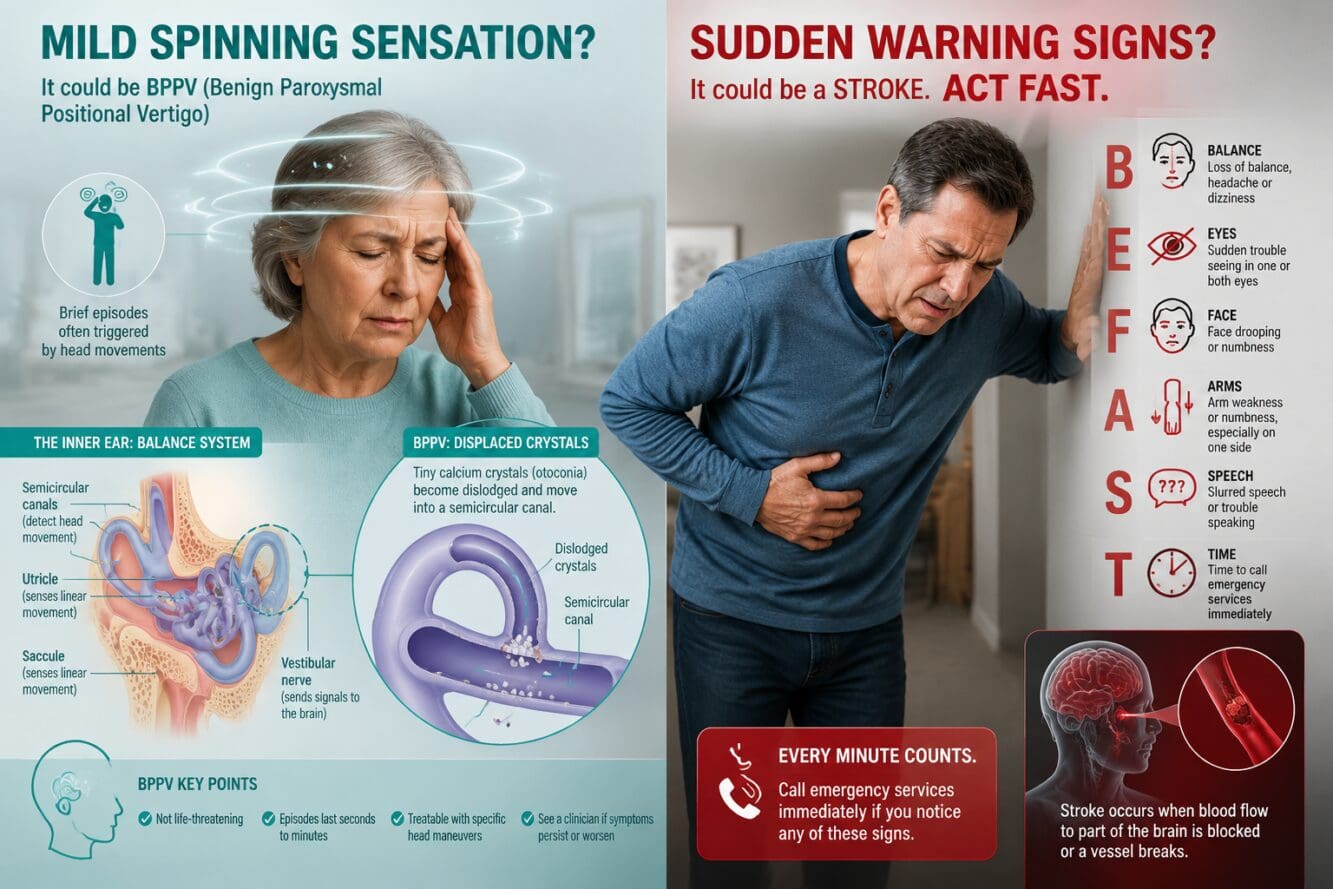
Go to the emergency room immediately if dizziness is sudden, severe, or accompanied by any neurological or cardiac symptoms listed above [4]. For milder, recurring episodes without other symptoms, a same-day or next-day call to a primary care doctor is appropriate.
Go to the ER if dizziness comes with:
Call your doctor (non-emergency) if:
Yes. Certain factors significantly increase the likelihood of dizziness and falls after 65. Older adults with multiple chronic conditions, those taking four or more medications (polypharmacy), and those with a history of falls are at the highest risk [2].
Higher-risk groups include:
Local health resources, such as those available through community health clinics, can connect high-risk seniors with fall-prevention programs and balance assessments. For residents in the Georgian Bay region, the South Georgian Bay Community Health Clinic is one resource worth exploring.
Fall prevention starts with addressing the underlying cause of dizziness, but immediate home safety measures matter just as much. According to Harvard Health, staying hydrated, moving slowly when changing positions, and modifying the home environment are the most practical first steps [3].
Immediate safety habits:
Targeted home changes reduce fall risk significantly for seniors managing dizziness and vertigo. The most effective modifications address lighting, floor surfaces, and bathroom safety [3].
Priority home modifications:
For those considering broader home adjustments or even a move to a more accessible living situation, reviewing home-buying resources may be useful for caregivers planning ahead.
Balance exercises, particularly those used in vestibular rehabilitation therapy, are proven to reduce dizziness frequency and improve stability in older adults [6]. A physiotherapist or occupational therapist can design a program tailored to the specific cause of dizziness.
Beginner-friendly balance exercises:
Start slowly and always have a stable surface nearby. Vestibular rehabilitation exercises for BPPV should only be done under professional guidance initially.
Vestibular rehabilitation and balance-focused physical therapy typically costs between $100 and $300 CAD per session in Canada, depending on the province and clinic type. Many provincial health plans cover physiotherapy sessions partially or fully for seniors, and some community health programs offer subsidized services.
In the United States, costs range from $75 to $350 USD per session, with Medicare Part B covering outpatient physical therapy when medically necessary.
Cost-reduction options:
Community programs focused on small business and health services sometimes partner with local physiotherapy providers to offer discounted group balance classes.
Several systemic medical conditions beyond inner ear disorders can cause or worsen vertigo in older adults [5].
ConditionHow It Causes DizzinessDiabetesNerve damage (neuropathy) disrupts balance signalsHypertensionBlood pressure fluctuations affect brain blood flowHypothyroidismSlows metabolism, causing fatigue and balance issuesAnemiaReduced oxygen to the brain triggers lightheadednessCardiac arrhythmiaIrregular heartbeat reduces cerebral blood flowCervical spondylosisNeck arthritis compresses nerves affecting balance
Managing these underlying conditions is often the most effective long-term strategy for reducing dizziness episodes. Regular check-ins with a primary care provider are essential, and staying informed through credible health resources — including those covered in local health and community news — supports better self-advocacy.
Most dizzy spells in older adults are not life-threatening, but specific patterns warrant urgent evaluation. Dizziness that is new, sudden, severe, or accompanied by other symptoms is more likely to signal a serious cause [4].
Signs dizziness is probably benign:
Signs dizziness needs prompt medical attention:
When in doubt, call a healthcare provider. Describing when the dizziness starts, how long it lasts, what makes it better or worse, and any accompanying symptoms gives the clinician the clearest picture.
Q: Is vertigo dangerous for seniors?
Vertigo itself is not always dangerous, but the fall risk it creates is serious. Falls are a leading cause of injury in adults over 65. The underlying cause of vertigo determines the actual medical risk.
Q: Can BPPV go away on its own?
Yes, BPPV often resolves on its own within weeks, but the Epley maneuver performed by a clinician can resolve it in one or two sessions. Waiting without treatment increases fall risk.
Q: Should seniors avoid driving if they have vertigo?
Yes, during active vertigo episodes, driving is unsafe. Seniors should discuss driving safety with their doctor if episodes are frequent or unpredictable.
Q: Does dehydration really cause dizziness?
Yes. Dehydration lowers blood volume and blood pressure, which can cause lightheadedness, especially when standing. Older adults have a reduced sense of thirst and are particularly vulnerable [3].
Q: Can anxiety cause dizziness in older adults?
Yes. Anxiety and panic can cause hyperventilation and lightheadedness. However, anxiety-related dizziness should only be diagnosed after ruling out physical causes.
Q: How long does a vertigo episode typically last?
BPPV episodes last seconds to under a minute. Vestibular neuritis can cause continuous vertigo for days. Meniere’s attacks typically last 20 minutes to several hours [2].
Q: Is dizziness after 65 always related to the inner ear?
No. While inner ear causes are common, dizziness in older adults can also stem from medications, cardiovascular conditions, neurological disorders, or metabolic issues like low blood sugar or anemia.
Q: What is vestibular rehabilitation?
Vestibular rehabilitation is a specialized form of physical therapy that uses exercises to retrain the brain to compensate for inner ear dysfunction. It is effective for BPPV, vestibular neuritis, and other balance disorders [6].
Q: Can high blood pressure medication cause dizziness?
Yes. Blood pressure medications, especially if the dose is too high, can cause orthostatic hypotension — a drop in blood pressure when standing — leading to lightheadedness [3].
Q: When is dizziness in a senior considered a psychiatric symptom?
Rarely and only after thorough physical evaluation. Dizziness should never be attributed to anxiety or depression without first ruling out inner ear, cardiovascular, and neurological causes.
Dizziness and vertigo after 65 are common but not something to dismiss or simply accept as part of aging. The most important step is distinguishing between causes that are benign and manageable — like BPPV or dehydration — and those that demand immediate emergency care, such as stroke or cardiac arrhythmia.
Actionable next steps:
Dizziness and vertigo after 65 are manageable with the right information, the right home environment, and the right medical support. The goal is not to live in fear of the next episode, but to reduce risk, stay active, and know exactly when to act fast.
[1] What Causes Dizziness And How To Fix It – https://www.consumerreports.org/health/medical-conditions/what-causes-dizziness-and-how-to-fix-it-a8503737836/?utm_source=openai
[2] Balance Problems: Symptoms and Causes – https://www.mayoclinic.org/diseases-conditions/balance-problems/symptoms-causes/syc-20350474?utm_source=openai
[3] Dealing With Dizziness – https://www.health.harvard.edu/diseases-and-conditions/dealing-with-dizziness?utm_source=openai
[4] Dizziness: When to See a Doctor – https://www.mayoclinic.org/symptoms/dizziness/basics/when-to-see-doctor/sym-20050886?p=1&reDate=01082024&utm_source=openai
[5] Dizziness and Vertigo – https://www.webmd.com/brain/dizziness-vertigo?utm_source=openai
[6] Vertigo – https://www.healthline.com/health/vertigo?utm_source=openai
Content, illustrations, and third-party video appearing on GEORGIANBAYNEWS.COM may be generated or curated with AI assistance or reproduced pursuant to the fair dealing provisions of the Copyright Act, R.S.C. 1985, c. C-42. Attribution and hyperlinks to original sources are provided in acknowledgment of applicable intellectual property rights. Such referencing is intended to direct traffic to and support the original rights holders’ platforms.