





















🔋 New E-bike Rules in Ontario: What Every Rider Needs to Know in 2026

Last updated: August 28, 2026
Quick Answer: Ontario classifies most e-bikes as “power-assisted bicycles,” meaning riders do not need a driver’s licence, vehicle registration, or insurance, provided the bike meets specific provincial standards. However, municipalities across Ontario, including those in the Southern Georgian Bay region, can and do set their own trail and path restrictions that override provincial defaults. Always check local bylaws before you ride.
Key Takeaways
- Ontario’s new e-bike rules define a legal power-assisted bicycle as having a motor of 500 watts or less, a maximum assisted speed of 32 km/h, and functional pedals.
- No driver’s licence, vehicle registration, or insurance is required for a qualifying e-bike in Ontario.
- Riders must be at least 16 years old and wear an approved bicycle helmet.
- E-bikes are permitted on most Ontario roads where regular bicycles are allowed, but are banned from 400-series highways and most expressways.
- Municipalities can restrict or ban e-bikes from local trails, paths, and parks, rules vary significantly between Collingwood, Wasaga Beach, the Town of The Blue Mountains, and Meaford.
- Electric scooters and high-powered e-bikes that exceed provincial specs are classified as motor vehicles and require a licence, registration, and insurance.
- Fines for violating e-bike rules in Ontario can range from roughly $85 to several hundred dollars depending on the infraction.
- Always verify current local bylaws directly with your municipality, as trail policies continue to evolve.
What Are the New E-bike Rules in Ontario?
Ontario’s framework for e-bikes has been in place since 2009, but the province has refined its definitions and enforcement over the years. As of 2026, the core rules remain anchored in the Highway Traffic Act (HTA), which classifies a legal e-bike as a “power-assisted bicycle.”
To qualify as a power-assisted bicycle under Ontario law, a bike must meet all of the following criteria:
- Electric motor output of 500 watts or less
- Maximum assisted speed of 32 km/h on level ground
- Functional pedals that allow the rider to propel the bike manually
- Weight of 120 kg or less (including the battery)
- Manufacturer’s label confirming it meets federal standards (either the old CAN/CSA-E500 standard or the newer federal Motor Vehicle Safety Regulations)
Bikes that exceed any of these specifications are no longer classified as bicycles under Ontario law, they become motor vehicles, with all the licensing and registration requirements that entails.
For more coverage of cycling topics in the region, visit the Bikes section at Georgian Bay News.
Do I Need a Licence to Ride an E-bike in Ontario?
No licence is required to ride a qualifying power-assisted bicycle in Ontario. Riders also do not need to register the vehicle or carry insurance.
This is one of the most significant distinctions between a legal e-bike and a motor scooter or moped. As long as your e-bike meets the provincial specs listed above, you can ride it with the same legal standing as a conventional bicycle. However, if your e-bike exceeds those thresholds, for example, if it has a 750-watt motor or no pedals, it is classified as a motor vehicle, and you will need a valid driver’s licence, vehicle registration, and insurance.
Common mistake: Many riders assume that any bike sold as an “e-bike” at a retail store automatically qualifies under Ontario law. That is not always true. Always check the motor wattage and whether the bike has functional pedals before assuming no licence is needed.
What Is the Speed Limit for E-bikes in Ontario?
The motor on a legal Ontario e-bike must stop providing assistance once the bike reaches 32 km/h. Riders can pedal faster than that under their own power, but the motor cannot push the bike beyond that threshold.
On public roads, e-bikes are subject to the same posted speed limits as motor vehicles. Riding an e-bike at 50 km/h in a 50 km/h zone is legal if you are pedalling, but the motor must cut out at 32 km/h. Riders should also be aware that some municipalities set lower speed limits on shared paths and trails where e-bikes are permitted at all.
Do I Need to Wear a Helmet on an E-bike in Ontario?
Yes. Ontario law requires all e-bike riders, and any passengers, to wear an approved bicycle helmet. This applies regardless of age.
The helmet must meet one of the following standards: CSA (Canadian Standards Association), CPSC (U.S. Consumer Product Safety Commission), ASTM (American Society for Testing and Materials), or Snell Memorial Foundation. A standard bicycle helmet is acceptable; a motorcycle helmet is not required.
Riding without a helmet can result in a fine. Staying safe on two wheels is a priority the province takes seriously, and for good reason given the speeds involved.
For related safety content, see Staying Safe on Georgian Bay News.
What Age Do You Have to Be to Ride an E-bike in Ontario?
Riders must be at least 16 years old to operate an e-bike on Ontario roads and paths. There is no upper age limit.
Riders under 16 are not permitted to ride e-bikes on public roads, even if they hold a bicycle licence or are accompanied by an adult. This age restriction applies province-wide and cannot be waived by municipal bylaw.
Are E-bikes Legal on Bike Paths and Trails in Ontario?
Provincially, e-bikes are treated like bicycles and are generally permitted wherever bicycles are allowed. But, and this is the critical point, municipalities have the authority to restrict or ban e-bikes from local trails, paths, and parks.
That means a trail that welcomes e-bikes in one town might have a completely different policy just one jurisdiction over. Provincial permission is the floor, not the ceiling.
Navigating the Maze of Local Bylaws: Collingwood, Wasaga Beach, Blue Mountains, and Meaford
The freedom for municipalities to set their own rules is the single most important thing to keep in mind when riding in the Southern Georgian Bay area. Here is a summary of current policies for the key communities in the region. Note: bylaws change, always confirm directly with the municipality before riding.

Collingwood
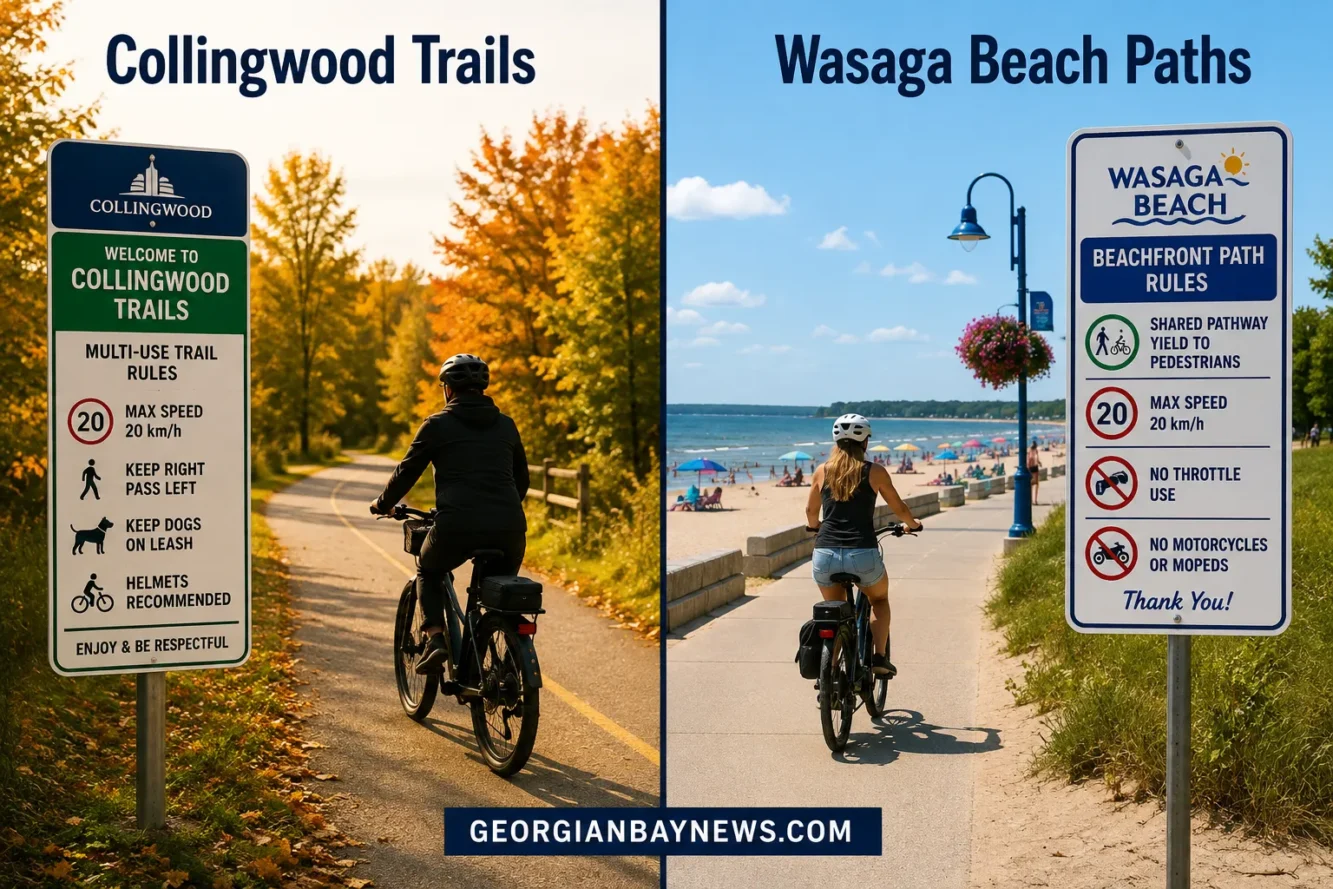
The Town of Collingwood permits e-bikes on its road network in line with provincial rules. However, the town’s trail system, including portions of the Georgian Trail, has seen ongoing discussion about e-bike access. As of 2026, Class 1 pedal-assist e-bikes (where the motor assists only while pedalling) have generally been more accepted on multi-use trails than throttle-operated models. Riders should check with the Town of Collingwood’s Parks and Recreation department for the most current trail-specific rules, as policies on specific trail segments can differ.
During Bike Month events in Collingwood, local cycling groups often post updated trail access information worth reviewing.
Wasaga Beach
Wasaga Beach has historically restricted motorized vehicles, including e-bikes, from its beachfront recreational areas and many of its designated pedestrian paths. E-bikes are permitted on town roads per provincial rules, but riders should avoid the beach corridor and signed pedestrian-only zones. The town’s bylaw enforcement has been active in this area, so the risk of a fine is real.
Town of The Blue Mountains
The Town of The Blue Mountains contains a mix of road networks and recreational trail systems, some of which are managed by the Niagara Escarpment Commission or private operators. E-bikes are generally permitted on roads. Trail access is more restricted: many of the area’s most popular recreational trails are designated for non-motorized use, which includes e-bikes under local interpretation. Riders heading to the Southern Georgian Bay area should contact the Town directly and check with trail operators before assuming access.
Meaford
The Municipality of Meaford follows provincial rules for road use. Its trail network, including sections of the Georgian Trail that pass through the municipality, has generally been more permissive toward e-bikes than some neighbouring communities, but this can vary by specific trail segment. Meaford’s municipal office is the best source for current trail access rules.
Bottom line for all four communities: Road use follows provincial rules. Trail use is a local decision. When in doubt, call the municipal office or check the town’s website before you ride.
Can You Ride an E-bike on the Road in Ontario?
Yes. E-bikes that meet provincial specs are permitted on most Ontario roads where bicycles are allowed. They are not permitted on:
- 400-series highways (e.g., Highway 400, 401, 404)
- Most expressways and controlled-access highways
- Roads where bicycles are specifically prohibited by signage
E-bikes must follow the same rules of the road as bicycles: ride on the right side, obey traffic signals, use lights at night, and yield appropriately.
Are Electric Scooters Covered Under Ontario E-bike Rules?
No. Electric scooters, devices with a platform for standing, no pedals, and a throttle, are not classified as power-assisted bicycles under Ontario law. They fall under motor vehicle regulations, which means they require a licence, registration, and insurance to operate legally on public roads.
Ontario has run limited pilot programs for e-scooters in select municipalities, but outside of those designated pilots, riding an electric scooter on public roads or paths is not permitted under standard provincial rules.
What Happens If You Break E-bike Rules in Ontario?
Fines vary depending on the specific infraction. Under the Highway Traffic Act, common penalties include:
- No helmet: approximately $85 fine
- Riding on a prohibited road (e.g., a 400-series highway): fines starting around $85
- Operating an e-bike that does not meet provincial specs: the bike may be treated as an unregistered motor vehicle, with significantly higher fines and potential vehicle impoundment
- Violating a municipal bylaw (e.g., riding on a prohibited trail): fines set by the municipality, typically in the $100,$300 range
Repeat violations or serious infractions can result in higher penalties. Enforcement has increased in popular recreational areas, particularly during summer months.
Which E-bikes Are Not Legal in Ontario?
An e-bike is not legal as a power-assisted bicycle in Ontario if it:
- Has a motor exceeding 500 watts
- Reaches assisted speeds above 32 km/h
- Has no functional pedals (throttle-only operation without pedals)
- Exceeds 120 kg in total weight
- Lacks the required manufacturer’s compliance label
Bikes in these categories are classified as motor vehicles. Riding them without a licence, registration, and insurance is illegal and can result in serious fines.
How Do the New Ontario E-bike Rules Compare to Other Provinces?
Ontario’s rules are broadly similar to federal guidelines but differ from some other provinces in key ways.
| Province | Max Motor Power | Min Age | Helmet Required | Licence Required |
|---|---|---|---|---|
| Ontario | 500W | 16 | Yes | No (if compliant) |
| British Columbia | 500W | No minimum set provincially | Yes (under 19) | No (if compliant) |
| Quebec | 500W | 18 | Yes | No (if compliant) |
| Alberta | 500W | No minimum set provincially | Recommended | No (if compliant) |
Sources: Provincial highway traffic acts and transportation ministry guidelines. Always verify current rules with the relevant provincial authority.
Ontario’s 16-year age minimum is one of the stricter provincial rules in Canada. Quebec’s 18-year minimum is the highest. British Columbia and Alberta have fewer age restrictions but their own local bylaw complexities.
Do I Need Insurance for an E-bike in Ontario?
No insurance is required for a qualifying power-assisted bicycle in Ontario. This is one of the key advantages of riding a compliant e-bike compared to a moped or scooter.
That said, personal liability coverage through a home or tenant insurance policy may extend to e-bike incidents in some cases. Riders who use their e-bikes frequently, especially for commuting, may want to confirm coverage with their insurer and consider dedicated e-bike insurance for theft and damage protection.
FAQ
Q: Can I ride my e-bike on the Georgian Trail?
A: Sections of the Georgian Trail pass through multiple municipalities, each with its own rules. Some sections permit e-bikes; others do not. Check with the specific municipality (Collingwood, Meaford, etc.) that manages the section you plan to ride.
Q: Does my e-bike need to be registered in Ontario?
A: No, if it meets the provincial power-assisted bicycle specs (500W or less, 32 km/h max assisted speed, functional pedals, under 120 kg). If it exceeds those specs, registration is required.
Q: Can I ride an e-bike on a sidewalk in Ontario?
A: Generally no. E-bikes are treated as bicycles, and most Ontario municipalities prohibit cycling on sidewalks. Check local bylaws.
Q: Is a throttle-only e-bike legal in Ontario?
A: Only if it also has functional pedals. A bike with a throttle but no pedals does not qualify as a power-assisted bicycle and is classified as a motor vehicle.
Q: What is the fine for riding an e-bike on a 400-series highway?
A: Fines start at approximately $85 under the Highway Traffic Act, but can be higher depending on the specific charge.
Q: Can a 15-year-old ride an e-bike in Ontario?
A: No. The minimum age is 16 province-wide.
Q: Do I need lights on my e-bike at night?
A: Yes. Ontario law requires a white front light and a red rear light or reflector when riding after dark.
Q: Are fat-tire e-bikes legal in Ontario?
A: Yes, provided they meet all the standard provincial specs (motor, speed, weight, pedals, and compliance label).
Q: Can municipalities make e-bikes more permissive than provincial rules allow?
A: No. Municipalities can restrict e-bike access beyond provincial rules, but they cannot grant more access than the province allows.
Q: Is a speed pedelec (45 km/h e-bike) legal in Ontario?
A: Speed pedelecs exceed the 32 km/h provincial threshold and are classified as motor vehicles in Ontario, requiring a licence, registration, and insurance.
Conclusion
The new e-bike rules in Ontario create a reasonably clear framework at the provincial level: no licence, no registration, no insurance, as long as your bike stays within the 500W and 32 km/h limits, has pedals, and carries the right compliance label. The real complexity kicks in the moment you leave the road and head for a trail.
Actionable next steps for riders in the Southern Georgian Bay region:
- Verify your e-bike’s specs against Ontario’s power-assisted bicycle criteria before your first ride.
- Call or check the website of the specific municipality (Collingwood, Wasaga Beach, Town of The Blue Mountains, or Meaford) for current trail access rules, bylaws change, and online sources can be outdated.
- Wear your helmet every ride, no exceptions.
- Carry your e-bike’s compliance documentation (manufacturer’s label or spec sheet) in case you are questioned by enforcement.
- Check for seasonal updates, many trail access decisions are reviewed annually, and summer 2026 may bring policy changes in several communities.
For ongoing local coverage of cycling, trails, and outdoor recreation in the region, keep checking Southern Georgian Bay news at Georgian Bay News.
References
- Government of Ontario. Electric Bikes (E-bikes). ontario.ca/page/electric-bikes-e-bikes. (2023)
- Government of Ontario. Highway Traffic Act, R.S.O. 1990, c. H.8. ontario.ca. (1990, as amended)
- Transport Canada. Motor Vehicle Safety Regulations, Power-Assisted Bicycles. tc.gc.ca. (2001, as amended)
- Town of Collingwood. Parks and Recreation, Trail Use Policies. collingwood.ca. (2024)
- Municipality of Meaford. Parks and Trails. meaford.ca. (2024)
- Town of The Blue Mountains. Trails and Outdoor Recreation. thebluemountains.ca. (2024)
- Town of Wasaga Beach. Bylaw Enforcement and Beach Access. wasagabeach.com. (2024)
Content, illustrations, and third-party video appearing on GEORGIANBAYNEWS.COM may be generated or curated with AI assistance or reproduced pursuant to the fair dealing provisions of the Copyright Act, R.S.C. 1985, c. C-42. Attribution and hyperlinks to original sources are provided in acknowledgment of applicable intellectual property rights. Such referencing is intended to direct traffic to and support the original rights holders’ platforms.
Much Appreciate You Sharing This Post - It Helps MUCH!!!