















🔥 How to Prepare for Wildfire Smoke Events in Ontario
Last updated: July 15, 2026
Quick Answer: Wildfire smoke events in Ontario are becoming more frequent and more intense, and knowing how to prepare for wildfire smoke events in Ontario can protect your lungs, your family, and your pets. The core steps are: monitor the Air Quality Health Index (AQHI) daily, seal your home, stock an emergency kit, and wear a properly fitted N95 respirator when going outdoors during smoke events.
Key Takeaways
- Ontario’s wildfire smoke season runs roughly from May through September, with the highest risk in June and July.
- The Air Quality Health Index (AQHI) measures real-time air quality; a reading above 7 signals high risk and above 10 signals very high risk.
- Fine particulate matter (PM2.5) in wildfire smoke is the primary health hazard, particles small enough to penetrate deep into the lungs.
- People with asthma, heart disease, the elderly, children, and pregnant women face the greatest health risks.
- N95 respirators offer meaningful protection outdoors; surgical masks and cloth masks do not filter fine particles effectively.
- Sealing gaps around windows and doors and running a HEPA air purifier indoors significantly reduces indoor smoke exposure.
- Download the WeatherCan app and enable AQHI notifications so you receive alerts automatically.
- Pets are also vulnerable, keep them indoors and watch for signs of respiratory distress during smoke events.
- A basic smoke preparedness kit costs very little and can be assembled well before fire season begins.
What Is Wildfire Smoke and Why Is It Dangerous
Wildfire smoke is a complex mixture of gases, water vapour, and fine particles produced when forests, brush, and other organic material burn. The most dangerous component is PM2.5, particulate matter smaller than 2.5 micrometres in diameter, which is fine enough to bypass the nose and throat and lodge deep in the lungs or enter the bloodstream.
Short-term exposure causes eye and throat irritation, coughing, and shortness of breath. Longer or repeated exposure is linked to worsened asthma, heart attacks, stroke, and reduced lung function. Because smoke can travel hundreds of kilometres from its source, communities nowhere near an active fire can still experience dangerous air quality.
When Is Wildfire Smoke Season in Ontario
Ontario’s wildfire smoke season typically runs from May through September, with peak risk in June and July when fire weather conditions, low humidity, high temperatures, and dry vegetation, are most common across Northern Ontario and neighbouring provinces.
In recent years, smoke from fires in British Columbia, Alberta, Quebec, and even the United States has drifted into Southern Ontario and the Georgian Bay region, affecting communities far from any active fire. Residents of Sudbury and surrounding Northern Ontario communities tend to experience the earliest and most direct impacts each season.
How Do I Know If Wildfire Smoke Is Affecting My Area
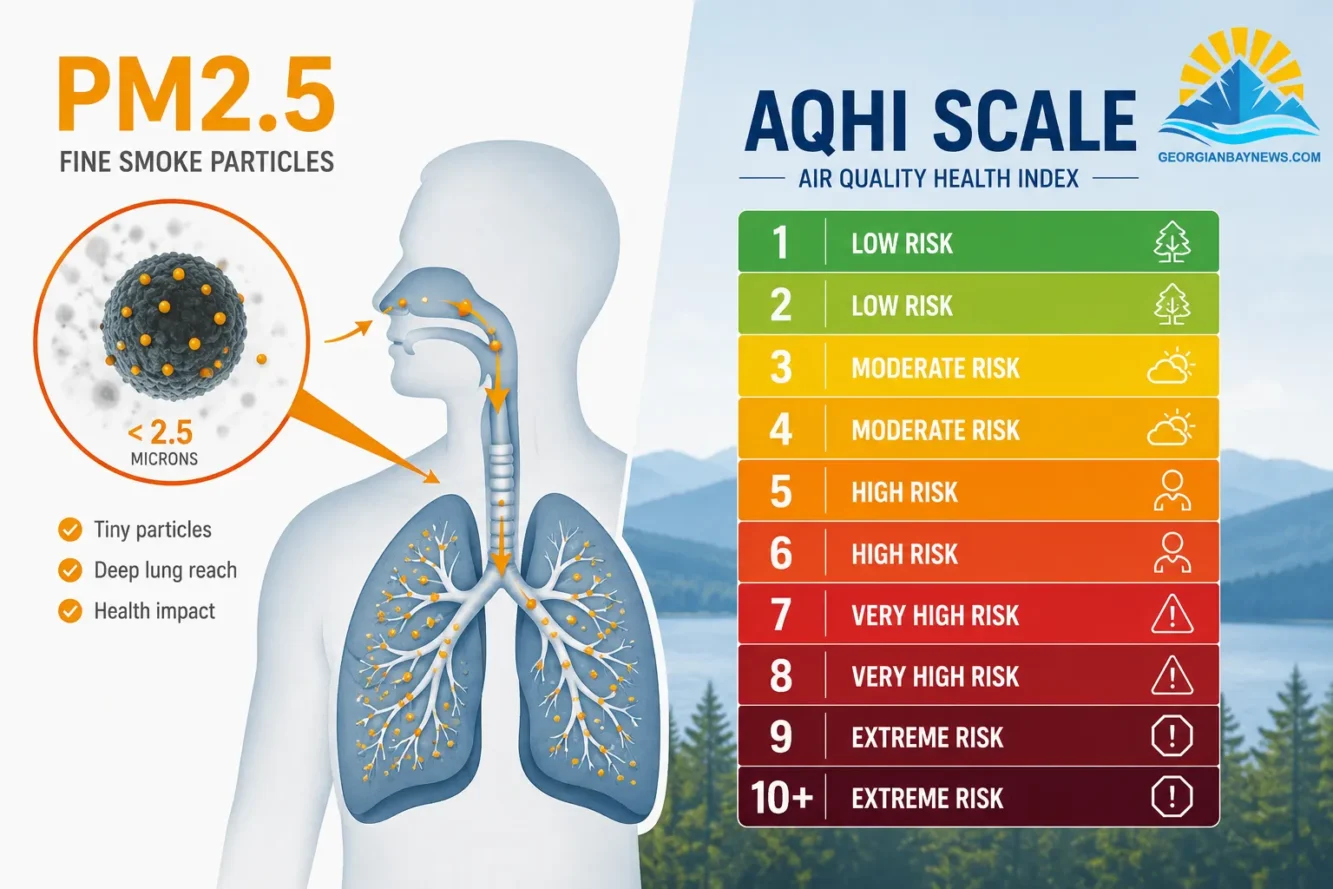
The fastest way to check is the Air Quality Health Index (AQHI), which Environment and Climate Change Canada updates hourly for communities across Ontario. A reading of 1-3 is low risk; 4-6 is moderate; 7-10 is high risk; anything above 10 is very high risk and warrants staying indoors.
Ways to monitor air quality in your community:
- AQHI forecasts at weather.gc.ca, updated hourly for Ontario communities
- Air quality alerts issued by Environment and Climate Change Canada and the Ontario Ministry of the Environment
- Wildfire smoke forecast maps available through the Canadian Wildland Fire Information System (CWFIS)
- InfoSmog forecasts for Quebec (relevant when smoke drifts east)
- WeatherCan app (free, iOS and Android), set AQHI push notifications so you are alerted automatically when air quality worsens in your area
If the sky looks hazy, the sun appears orange or red, and you can smell smoke, treat the air as unhealthy even before checking an official reading.
Air Quality Index Scale: What the Numbers Mean for Ontario
The AQHI scale runs from 1 to 10+. Here is a plain-language breakdown:
| AQHI Reading | Risk Level | Recommended Action |
|---|---|---|
| 1-3 | Low | Normal outdoor activity |
| 4-6 | Moderate | Reduce prolonged outdoor exertion if sensitive |
| 7-10 | High | Limit outdoor activity; wear N95 outdoors |
| 10+ | Very High | Stay indoors; run air purifier; avoid all outdoor exertion |
At readings of 7 or above, vulnerable groups should stay indoors entirely. At 10+, everyone should treat it as a health emergency.
Who Is Most at Risk from Wildfire Smoke Exposure
Certain groups face significantly higher health risks from wildfire smoke and should take extra precautions well before an event begins:
- Children and infants, lungs are still developing; they breathe more air relative to body weight
- Adults over 65, more likely to have underlying heart or lung conditions
- Pregnant women, smoke exposure is linked to preterm birth and low birth weight
- People with asthma, COPD, or other respiratory conditions
- People with heart disease or diabetes
- Outdoor workers, construction, agriculture, landscaping
- People experiencing homelessness, limited ability to shelter indoors
For those managing ongoing health concerns, resources on healthy aging strategies can also provide useful context for building personal resilience before smoke season arrives.
Signs, Symptoms, and Health Effects of Wildfire Smoke Exposure
Mild to moderate symptoms (often appear within hours of exposure):
- Burning or watery eyes
- Runny nose and sneezing
- Sore throat and dry cough
- Headache and mild fatigue
- Shortness of breath during exertion
Severe symptoms requiring medical attention:
- Chest tightness or chest pain
- Difficulty breathing at rest
- Rapid or irregular heartbeat
- Dizziness or confusion
- Worsening asthma attack unresponsive to a reliever inhaler
Wildfire smoke can also worsen symptoms for people dealing with substance use or stress-related conditions, as poor air quality compounds physical and mental strain.
Can Wildfire Smoke Cause Long-Term Health Problems
Yes. Repeated or prolonged exposure to wildfire smoke is associated with long-term health consequences, including reduced lung function, increased risk of cardiovascular disease, and accelerated cognitive decline in older adults. Research published by Health Canada notes that PM2.5 is classified as a Group 1 carcinogen by the International Agency for Research on Cancer (IARC, 2013).
Children exposed during developmental years may experience permanently reduced lung capacity. This is why building a household preparedness plan, not just reacting during events, matters for long-term health.
How to Prepare Your Home and Vehicle for Wildfire Smoke Events
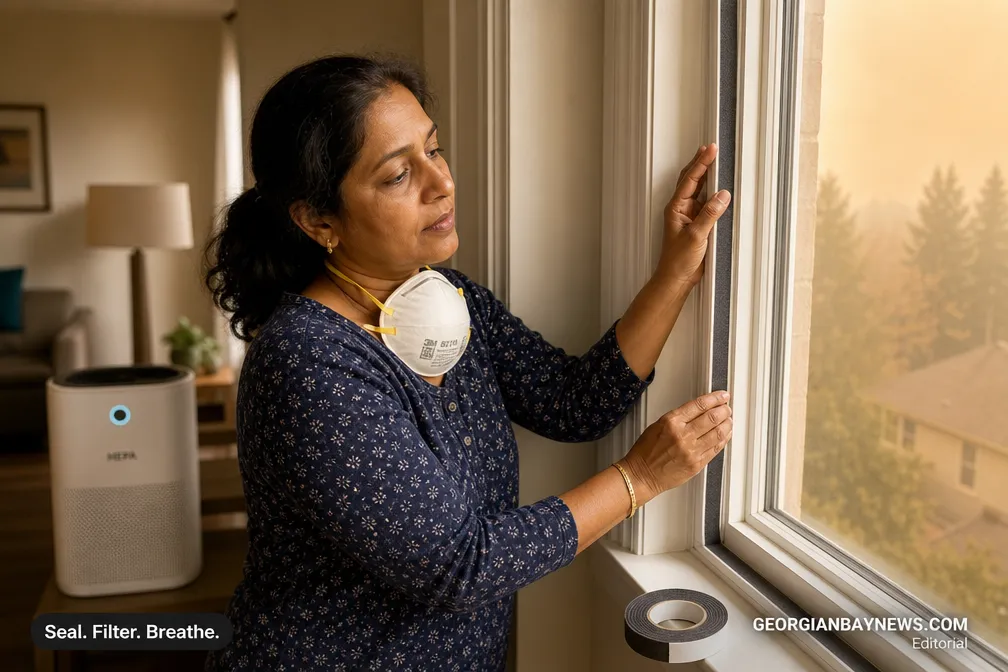
Preparing your home before smoke arrives is far more effective than scrambling once an alert is issued.
Sealing windows and doors:
- Apply foam weatherstripping tape around window frames and door edges
- Use door draft stoppers at the base of exterior doors
- Close fireplace dampers fully
- Turn off whole-house ventilation systems that draw in outdoor air (HRV/ERV units) during high-risk periods
Running a HEPA air purifier:
- Choose a purifier rated for your room size; look for a MERV 13 or higher filter, or a true HEPA filter
- Run it in the room where your family spends the most time
- Keep interior doors closed to concentrate filtered air
In your vehicle:
- Set the HVAC to recirculate mode (do not draw in outside air)
- Replace the cabin air filter before smoke season if it has not been changed in the past year
A basic home preparation kit, weatherstripping tape, a quality air purifier, and N95 masks, typically costs between $100 and $300 depending on the size of your home and the purifier model chosen.
N95 Mask vs. P100 Mask for Wildfire Smoke: Which Is Better
For most Ontario residents, a properly fitted N95 respirator is the practical choice for outdoor use during smoke events. N95 masks filter at least 95% of airborne particles when sealed correctly against the face. They are widely available at hardware stores and pharmacies.
P100 respirators (half-face or full-face models) filter 99.97% of particles and offer superior protection, but they are bulkier, more expensive, and better suited to outdoor workers or people with serious respiratory conditions who must spend extended time outdoors.
Surgical masks and cloth masks do not protect against PM2.5. Their loose fit allows smoke particles to bypass the filter entirely.
Choose an N95 if: you need occasional outdoor protection and want an affordable, portable option.
Choose a P100 if: you work outdoors during smoke events or have a high-risk medical condition.
What Should I Keep in My Emergency Kit for Smoke Events
A smoke event kit does not need to be elaborate. Stock these items before fire season:
- N95 respirators (at least 2 per household member)
- Portable HEPA air purifier with spare filters
- Foam weatherstripping tape and door draft stoppers
- A 72-hour supply of prescription medications (especially inhalers and heart medications)
- Bottled water (smoke can affect outdoor water sources in some rural areas)
- Battery-powered or hand-crank radio for emergency alerts
- Copies of important documents in a waterproof bag
For broader emergency planning, reviewing resources on states of emergency preparedness can help households build a more complete plan that covers multiple hazard types.
What to Do If You Have Asthma During a Wildfire Smoke Event
People with asthma should treat a high AQHI reading as a trigger event and act before symptoms appear:
- Stay indoors with windows and doors closed and a HEPA purifier running.
- Keep your reliever inhaler (e.g., salbutamol/Ventolin) accessible at all times.
- Follow your written asthma action plan, if you do not have one, ask your doctor to create one before smoke season.
- Avoid all outdoor exercise until the AQHI drops to 3 or below.
- Call 911 or go to an emergency room if your reliever inhaler is not controlling symptoms within 15 minutes.
Do not rely on symptoms alone to judge air quality. Smoke can worsen lung inflammation for hours before breathing difficulty becomes obvious.
How to Protect Pets from Wildfire Smoke
Pets are vulnerable to the same PM2.5 particles that harm humans. Dogs and cats show respiratory distress through coughing, wheezing, nasal discharge, lethargy, and reduced appetite.
- Keep pets indoors during high AQHI readings
- Shorten outdoor walks to bathroom breaks only during smoke events
- Do not leave pets in vehicles, which heat up quickly and trap smoke
- Watch for laboured breathing, blue-tinged gums, or extreme lethargy, these are emergencies requiring a veterinarian
Birds are especially sensitive to airborne pollutants and should be kept well away from any source of smoke, including indoor cooking smoke during fire season.
Common Mistakes People Make Preparing for Smoke Events
Avoiding these errors can make a real difference to your health outcomes:
- Waiting for symptoms before acting. PM2.5 damage begins before you feel it. Start precautions when the AQHI hits 7.
- Using a surgical mask and thinking it is enough. Only a fitted N95 or better provides meaningful particle filtration.
- Opening windows “just for a few minutes.” Even brief exposure to heavy smoke can spike indoor particle levels for hours.
- Ignoring vehicle air quality. Driving with windows down or HVAC on fresh-air mode during a smoke event exposes occupants to outdoor concentrations.
- Not checking the AQHI regularly. Air quality can shift dramatically within a few hours. The WeatherCan app makes this automatic.
- Forgetting medications. Running out of an inhaler or heart medication during a multi-day smoke event is a preventable crisis.
Conclusion: Take Action Before Smoke Season Peaks
Knowing how to prepare for wildfire smoke events in Ontario is not a one-time task, it is an annual routine that pays off every time a smoke plume drifts south. The steps are straightforward: download the WeatherCan app and turn on AQHI alerts, seal your home with weatherstripping, stock N95 masks and a HEPA air purifier, and build a 72-hour medication and supply kit before June arrives.
Vulnerable residents, children, seniors, people with asthma or heart conditions, and outdoor workers, should have a written action plan in place and share it with caregivers and family members. Pets need protection too.
Ontario’s fire seasons are not getting shorter. The best time to prepare is now, while the air is still clear.
Frequently Asked Questions
Q: At what AQHI level should I stay indoors?
A reading of 7 or above is considered high risk. Vulnerable groups should stay indoors at 7+; everyone should limit outdoor activity. At 10+, staying indoors is recommended for all residents.
Q: Does a regular dust mask protect against wildfire smoke?
No. Standard dust masks and surgical masks do not filter fine particles (PM2.5). Only a properly fitted N95 respirator or better provides meaningful protection.
Q: Can I run my air conditioner during a smoke event?
Yes, if it recirculates indoor air and does not draw in outside air. Check your unit’s settings. If it has a fresh-air intake, close it or switch to recirculate mode.
Q: How long does wildfire smoke typically last in Ontario?
Smoke events can last anywhere from a few hours to several weeks, depending on fire activity and wind patterns. Multi-day events of 3-7 days are common during active fire seasons.
Q: Is it safe to exercise outdoors when the AQHI is 4-6?
Healthy adults can do light activity at moderate AQHI levels, but should reduce intensity and duration. Vulnerable groups should avoid outdoor exercise at any reading above 3.
Q: Where can I get free N95 masks in Ontario?
During declared air quality emergencies, some public health units and community centres distribute masks. Check your local public health unit’s website for distribution locations.
Q: Does wildfire smoke affect indoor air even with windows closed?
Yes, but significantly less so. Sealing gaps and running a HEPA purifier can reduce indoor PM2.5 concentrations by 50-80% compared to outdoor levels, according to Health Canada guidance.
Q: How do I know if my air purifier is effective against smoke?
Look for a true HEPA filter (captures 99.97% of particles 0.3 microns and larger) and a Clean Air Delivery Rate (CADR) appropriate for your room size. Activated carbon filters also help with smoke odour.
References
- Health Canada. Wildfire Smoke and Your Health. Government of Canada, 2023. https://www.canada.ca/en/health-canada/services/publications/healthy-living/wildfire-smoke-your-health.html
- Environment and Climate Change Canada. Air Quality Health Index (AQHI). Government of Canada, 2022. https://www.canada.ca/en/environment-climate-change/services/air-quality-health-index.html
- International Agency for Research on Cancer (IARC). Outdoor Air Pollution, IARC Monographs Volume 109. World Health Organization, 2013. https://www.iarc.who.int/
- Ontario Ministry of the Environment, Conservation and Parks. Air Quality in Ontario. Government of Ontario, 2023. https://www.ontario.ca/page/air-quality-ontario
- Canadian Wildland Fire Information System (CWFIS). Smoke Forecast Maps. Natural Resources Canada, 2024. https://cwfis.cfs.nrcan.gc.ca/
Content, illustrations, and third-party video appearing on GEORGIANBAYNEWS.COM may be generated or curated with AI assistance or reproduced pursuant to the fair dealing provisions of the Copyright Act, R.S.C. 1985, c. C-42. Attribution and hyperlinks to original sources are provided in acknowledgment of applicable intellectual property rights. Such referencing is intended to direct traffic to and support the original rights holders’ platforms.