
















Alberta’s US Separatist Push: Treason Accusations Fly Over Secret Trump Meetings
When provincial leaders in Canada use the word “treason” to describe the actions of their fellow citizens, the political stakes have clearly escalated beyond ordinary partisan squabbles.
Alberta’s US Separatist Push: Treason Accusations Fly Over Secret Trump Meetings represents an unprecedented chapter in Canadian politics, where covert diplomatic engagement between a separatist movement and a foreign government has triggered accusations of betrayal from coast to coast. 🍁
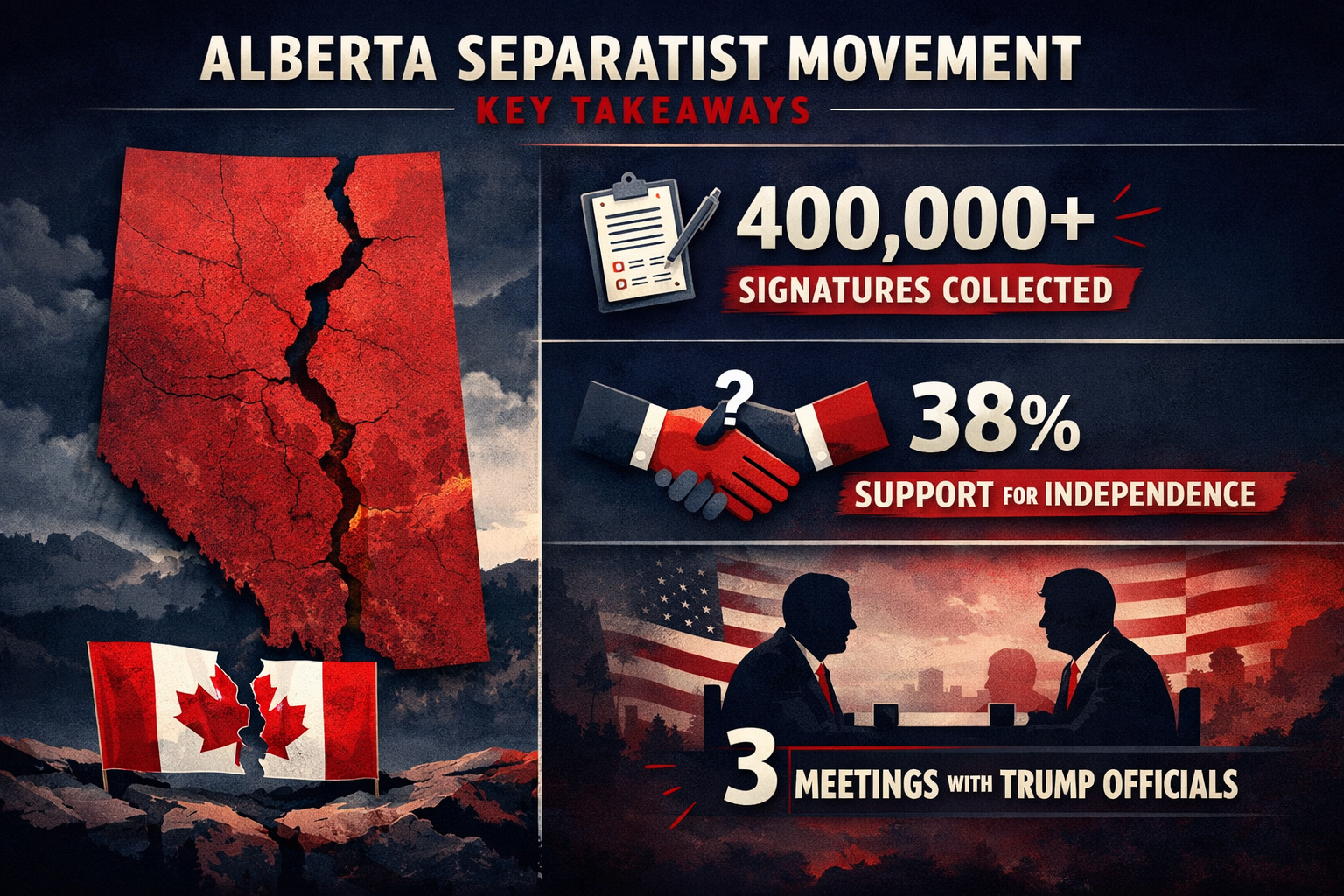
The controversy centers on the Alberta Prosperity Project (APP), a far-right separatist organization that conducted at least three formal meetings with U.S. State Department officials throughout 2025, seeking support for Alberta’s potential independence from Canada.[1] These secret meetings, held on April 22, September 29, and December 16, 2025, have sparked outrage among Canadian premiers who view the engagement as nothing short of treasonous collaboration with a foreign power.[1]
Key Takeaways
- Three confirmed meetings between Alberta separatists and U.S. State Department officials occurred in 2025, with APP seeking a $500 billion credit line from the U.S. Treasury[1]
- British Columbia Premier David Eby labeled the meetings “treason,” while Ontario Premier Doug Ford called them “unethical” and “unacceptable”[1]
- The Alberta Prosperity Project is collecting 177,000 signatures by May 2, 2026, to trigger an independence referendum[2]
- Despite Trump’s “51st state” rhetoric, APP explicitly seeks independent nationhood, not U.S. statehood[1]
- Majority of Albertans still support remaining part of Canada, limiting the movement’s practical viability[3]
The Secret Meetings: What Happened Behind Closed Doors
The revelation of formal diplomatic engagement between the Alberta separatist movement and the Trump administration sent shockwaves through Canadian political circles. According to APP co-founder Dennis Modry, U.S. State Department officials welcomed separatist representatives for substantive discussions about Alberta’s potential independence.[1]
Timeline of Diplomatic Engagement
The documented meetings occurred on:
| Date | Location | Significance |
|---|---|---|
| April 22, 2025 | Washington, DC | Initial formal contact established |
| September 29, 2025 | Washington, DC | Discussion of economic arrangements |
| December 16, 2025 | Washington, DC | Credit facility negotiations discussed |
A fourth meeting was tentatively planned but subsequently canceled after the State Department announced no future meetings would occur.[1] This abrupt halt suggests the diplomatic engagement became politically untenable as news of the meetings leaked to Canadian media.
What the Separatists Were Seeking
The APP representatives weren’t merely seeking moral support. According to reports, the organization pursued a $500 billion line of credit from the U.S. Treasury to finance the formation of an independent Alberta government following a successful referendum.[1] This extraordinary financial request underscores the ambitious scope of the separatist vision.
Jeffrey Rath, the group’s legal counsel, clarified that despite President Trump’s repeated suggestions about making Canada the “51st state,” APP’s objective is categorically different. “We are seeking a free and independent Alberta, not statehood,” Rath stated, emphasizing that an independent Alberta would establish zero tariffs with the United States and create a single market arrangement.[2]
The separatists also floated the idea of constructing a new oil pipeline from Alberta directly to the United States, a proposal that reportedly received positive responses from U.S. officials.[3] This infrastructure project would fundamentally reshape North American energy flows and reduce Alberta’s dependence on Canadian federal approval for resource development.
Treason Accusations: Canadian Leaders React
The political fallout from Alberta’s US Separatist Push: Treason Accusations Fly Over Secret Trump Meetings has been swift and severe. Provincial premiers across Canada responded with unprecedented harshness, using language rarely deployed in Canadian political discourse.
British Columbia’s Strong Stand
British Columbia Premier David Eby delivered the most forceful condemnation, explicitly invoking the concept of treason. “If you are crossing a border to seek the support of a foreign government to break up our country because you don’t have the support and the resources and the ability within our own country to advance that conversation…that is treason,” Eby declared.[1]
“To go to a foreign country and to ask for assistance in breaking up Canada, there’s an old-fashioned word for that, and that word is treason.” – David Eby, Premier of British Columbia
Eby’s characterization represents a dramatic escalation in how Canadian officials view foreign engagement by separatist movements. Unlike Quebec’s sovereignty movement, which historically sought international recognition after democratic referendums, the APP actively solicited foreign government assistance before achieving any democratic mandate.
Ontario Joins the Criticism
Ontario Premier Doug Ford echoed Eby’s concerns, calling the meetings “unethical” and “unacceptable.”[2] Ford’s criticism carries particular weight given Ontario’s status as Canada’s most populous province and economic powerhouse. His condemnation signals that opposition to the separatist engagement crosses partisan lines and regional boundaries.
Prime Minister Carney Demands Respect for Sovereignty
Canadian Prime Minister Mark Carney, himself an Albertan, found himself in the awkward position of defending Canadian sovereignty against a separatist movement from his home province. At a news conference, Carney stated firmly: “I expect the U.S. administration to respect Canadian sovereignty.”[1]
This direct rebuke to the Trump administration represents a significant diplomatic moment, as Carney essentially accused the U.S. government of undermining Canadian territorial integrity by entertaining discussions with separatists. The statement contrasts sharply with the typically cordial relationship between the two nations.
The Referendum Campaign: Racing Against the Clock
While political leaders trade accusations of treason, APP activists are conducting an intensive grassroots campaign to collect signatures for their independence referendum. Understanding Alberta’s US Separatist Push: Treason Accusations Fly Over Secret Trump Meetings requires examining the practical mechanics of how this separatist movement operates.
Signature Collection Requirements
Under Alberta’s citizen initiative legislation, APP must collect approximately 177,000 signatures representing 10% of the province’s registered voters by May 2, 2026.[2][3] This represents a formidable organizational challenge, requiring sustained mobilization across Alberta’s diverse urban and rural communities.
The petition drive has been traveling across the province, with activists setting up tables at community events, farmers’ markets, and public gatherings. Once the signatures are collected and verified, they will be submitted to Alberta’s premier, who must then decide whether to proceed with a referendum.
Public Opinion Challenges
Despite the organizational efforts and international intrigue surrounding the movement, polling data consistently shows that the majority of Albertans want to remain part of Canada.[3] This fundamental democratic reality limits the practical viability of the independence movement, regardless of whatever support it might receive from Washington.
The disconnect between activist enthusiasm and public sentiment mirrors challenges faced by other separatist movements worldwide. Even with foreign backing and sophisticated organization, democratic movements ultimately require majority support to succeed.
Economic Grievances Fueling Separatist Sentiment
To understand why some Albertans are receptive to separatist messaging despite majority opposition, one must examine the economic grievances that form the movement’s foundation. Alberta’s separatist sentiment is rooted in long-standing resentment over how the province’s oil and gas wealth is managed within Canadian confederation.[1][3]
The Oil and Gas Industry Conflict
Alberta produces the vast majority of Canada’s oil and gas, yet activists argue that federal environmental regulations have systematically hamstrung industry profitability.[1][3] From their perspective, Ottawa-based politicians who don’t depend on resource extraction for their livelihoods impose restrictions that damage Alberta’s economic interests.
Key grievances include:
- 🛢️ Pipeline approval delays that limit market access for Alberta crude
- 🌍 Carbon pricing policies that increase production costs
- 📜 Environmental assessments that slow project development
- 💰 Equalization payments that transfer Alberta wealth to other provinces
These economic frustrations have created fertile ground for separatist messaging, even among Albertans who don’t necessarily support independence. The APP skillfully frames independence as an economic liberation narrative rather than merely a political project.
The China Factor
Both the Trump administration and APP have expressed shared concerns about Canada’s deepening relationship with China as bilateral U.S.-Canada trade relations deteriorate.[1] This geopolitical alignment creates a natural basis for cooperation between American officials and Alberta separatists who view themselves as more aligned with U.S. economic interests than with Ottawa’s foreign policy.
The convergence of energy policy, trade concerns, and China skepticism creates a powerful ideological cocktail that transcends simple left-right political divisions. For those interested in how American politics intersects with Canadian regional tensions, this dynamic offers fascinating insights.
Contrasting Quebec’s Separatist History
Alberta’s US Separatist Push: Treason Accusations Fly Over Secret Trump Meetings stands in stark contrast to Quebec’s well-established sovereignty movement, which operated under very different principles regarding foreign engagement.
Quebec’s Democratic Approach
Quebec separatists consistently emphasized that international recognition would be sought after achieving democratic legitimacy through referendums, not before. The Parti Québécois held two major referendums (1980 and 1995) based on democratic principles, seeking a mandate from Quebecers before pursuing international relationships as a sovereign state.
Interestingly, Parti Québécois leader Paul St-Pierre Plamondon expressed support for Alberta separatism in September 2025, met with APP leaders that month, and stated willingness to assist in a referendum campaign as of January 2026.[2] This Quebec-Alberta separatist alliance represents an unusual coalition between movements with very different cultural and economic foundations.
Different Motivations, Different Methods
Quebec separatism emerged from:
- Linguistic and cultural preservation concerns
- Historical grievances dating to British conquest
- Desire to protect French-Canadian identity
- Democratic nationalism rooted in self-determination
Alberta separatism stems from:
- Economic frustrations with federal resource policy
- Western alienation from central Canadian power
- Right-wing political ideology
- Resource nationalism and free-market economics
The methodological difference—seeking foreign support before democratic legitimacy—explains why Alberta’s approach has triggered treason accusations while Quebec separatism, despite its challenges to national unity, generally avoided such extreme characterizations.
The Trump Administration’s Official Position
Despite the explosive nature of these revelations about Alberta’s US Separatist Push: Treason Accusations Fly Over Secret Trump Meetings, the White House and State Department have attempted to downplay the significance of the engagement.
“Staff-Level Meetings” Defense
U.S. officials characterized the encounters as standard “staff-level meetings” with civic society groups, claiming that no senior officials participated and no commitments were made.[1][3] This framing attempts to minimize the diplomatic significance of the engagement, suggesting these were routine courtesy meetings rather than substantive policy discussions.
However, APP representatives painted a very different picture, claiming the U.S. administration expressed genuine support for Alberta independence. This discrepancy between official U.S. statements and separatist accounts creates ambiguity about the true nature of the discussions.
Trump’s “51st State” Rhetoric
President Trump’s repeated public statements about making Canada the “51st state” provide important context for understanding why Alberta separatists might have believed they would receive a sympathetic hearing in Washington. While Trump’s comments are often dismissed as provocative political theater, they create an environment where Canadian separatists might reasonably expect American support.
The tension between Trump’s public rhetoric and the State Department’s official position reflects broader patterns in how the Trump administration operates—with the president making bold statements that official channels then attempt to moderate or reinterpret.
Far-Right Ideology and Political Positioning
The APP is consistently characterized as a “far-right” or “ultra-right” organization,[1] though its policy positions reveal interesting complexities that don’t fit neatly into American political categories.
Ideological Characteristics
The movement combines:
- Economic libertarianism emphasizing free markets and resource development
- Western alienation narratives about central Canadian political dominance
- Anti-regulatory positions opposing federal environmental oversight
- Pro-American orientation favoring closer U.S. economic integration
Interestingly, APP supports birthright citizenship rather than opposing it,[1] which actually places them at odds with Trump’s MAGA coalition on this specific issue. This demonstrates that Canadian right-wing movements don’t simply mirror American conservative positions but reflect distinct regional and national contexts.
Implications for Canadian Unity and Sovereignty
The broader implications of Alberta’s US Separatist Push: Treason Accusations Fly Over Secret Trump Meetings extend far beyond the immediate controversy, raising fundamental questions about Canadian sovereignty and national unity in the 21st century.
Precedent-Setting Concerns
If foreign governments can openly engage with regional separatist movements without diplomatic consequences, it establishes a dangerous precedent that could:
- Encourage other regional grievances to seek foreign backing
- Undermine federal authority to speak for Canada internationally
- Create competing centers of diplomatic engagement
- Weaken Canada’s ability to present unified positions on trade and security
The Sovereignty Question
Prime Minister Carney’s demand that the U.S. respect Canadian sovereignty highlights the core issue: can a foreign government legitimately engage with separatist movements in a democratic ally? International norms generally discourage such engagement, viewing it as interference in domestic affairs.
However, the APP argues they have a democratic right to seek support wherever they can find it, and that foreign governments have a right to meet with civic organizations. This clash between sovereignty principles and democratic rights creates genuine legal and ethical ambiguity.
What Happens Next?
As the May 2, 2026 signature deadline approaches, several scenarios could unfold:
Scenario 1: Signature Threshold Not Met
If APP fails to collect sufficient signatures, the immediate referendum threat dissipates, though the underlying grievances remain. The treason accusations would likely fade from headlines, but the episode would leave lasting damage to U.S.-Canada relations.
Scenario 2: Referendum Proceeds
If signatures are collected and Alberta’s premier calls a referendum, Canada would face its most serious unity crisis since the 1995 Quebec referendum. The international community would watch closely to see whether the U.S. maintains its engagement with separatists.
Scenario 3: Federal Intervention
The Canadian government could potentially take legal action to prevent foreign interference in the referendum process, though this would raise complex constitutional questions about provincial rights and democratic expression.
Conclusion: Democracy, Sovereignty, and the Future of Canadian Unity
Alberta’s US Separatist Push: Treason Accusations Fly Over Secret Trump Meetings represents more than a regional political controversy—it illuminates fundamental tensions between democratic rights, national sovereignty, and foreign policy in the modern era. While Albertans have every right to debate their place in Canadian confederation, the covert engagement with a foreign government crosses lines that even Quebec separatists historically respected.
The treason accusations from premiers Eby and Ford reflect genuine concern that foreign interference could tip the scales in what should be a purely domestic democratic process. Whether these meetings actually constitute treason in a legal sense remains debatable, but they undeniably violate the norms that have historically governed Canadian separatist movements.
Actionable Next Steps
For Canadians concerned about national unity:
- ✅ Stay informed about the signature collection campaign and its progress
- ✅ Engage in constructive dialogue about Alberta’s legitimate economic grievances
- ✅ Support democratic processes while opposing foreign interference
- ✅ Contact elected representatives to express views on sovereignty issues
- ✅ Monitor U.S.-Canada relations for further diplomatic developments
For Albertans specifically:
- ✅ Research the economic implications of independence beyond separatist rhetoric
- ✅ Examine how other resource-rich regions have navigated similar tensions
- ✅ Consider whether constitutional reform might address grievances within confederation
- ✅ Evaluate whether foreign support genuinely serves Alberta’s long-term interests
The coming months will determine whether this separatist push gains democratic legitimacy or remains a fringe movement amplified by international intrigue. Regardless of the outcome, the episode has already damaged trust between Canada and its most important ally, raised questions about the boundaries of democratic expression, and reminded Canadians that national unity cannot be taken for granted in an era of populist nationalism and great power competition. 🇨🇦
References
[1] Trump Canada Separatists Alberta Carney B2914169 – https://www.the-independent.com/news/world/americas/us-politics/trump-canada-separatists-alberta-carney-b2914169.html
[2] Alberta Separatism – https://en.wikipedia.org/wiki/Alberta_separatism
[3] Watch – https://www.youtube.com/watch?v=ey9V-s8uLDI
Content, illustrations, and third-party video appearing on GEORGIANBAYNEWS.COM may be generated or curated with AI assistance or reproduced pursuant to the fair dealing provisions of the Copyright Act, R.S.C. 1985, c. C-42. Attribution and hyperlinks to original sources are provided in acknowledgment of applicable intellectual property rights. Such referencing is intended to direct traffic to and support the original rights holders’ platforms.