



















🇨🇦 Will high diesel prices drive up what Canadians pay for food?

Last updated: October 6, 2026
Quick Answer
With the price of diesel being so high, Canadians can expect continued upward pressure on groceries, vegetables, dairy, and meat, even as the most recent data shows a short-term cooling in food inflation. Fuel costs ripple through every stage of the food supply chain, from farm to truck to store shelf. Economists warn the full impact of elevated diesel prices typically takes 12 to 18 months to fully show up in grocery bills, meaning more increases are likely through 2027.
Key Takeaways
- Food prices at Canadian stores rose 2.8% year over year in August 2026, down from 3.9% in June, but grocery costs are still roughly 29% higher than in 2021 [1][6]
- Diesel fuel costs are a direct input for trucking, farm equipment, and refrigerated transport, all critical to the Canadian food supply chain [10]
- Gasoline prices were 22.8% higher in August 2026 than a year earlier, keeping energy costs elevated across the economy [2]
- A Scotiabank analysis estimates food prices typically peak about 18 months after a major fuel shock, pointing to continued grocery inflation into 2027 [10]
- Fresh produce and imported vegetables face the steepest exposure to diesel price hikes because of long trucking distances
- Meat is particularly vulnerable because it is heavy, refrigerated, and shipped over long distances
- Dairy saw only a 0.7% price increase year over year in August 2026, but refrigerated transport dependency means it remains at risk if fuel stays high [2]
- Rural and northern Canadians face disproportionate impacts because food travels farther and retailer competition is thinner [10]
- Grocery stores have limited ability to absorb sustained fuel cost increases without eventually raising shelf prices
- Supply chain disruptions compound the effect of diesel price hikes, amplifying cost pressures at every stage
How Does Diesel Price Affect Grocery Prices in Canada?
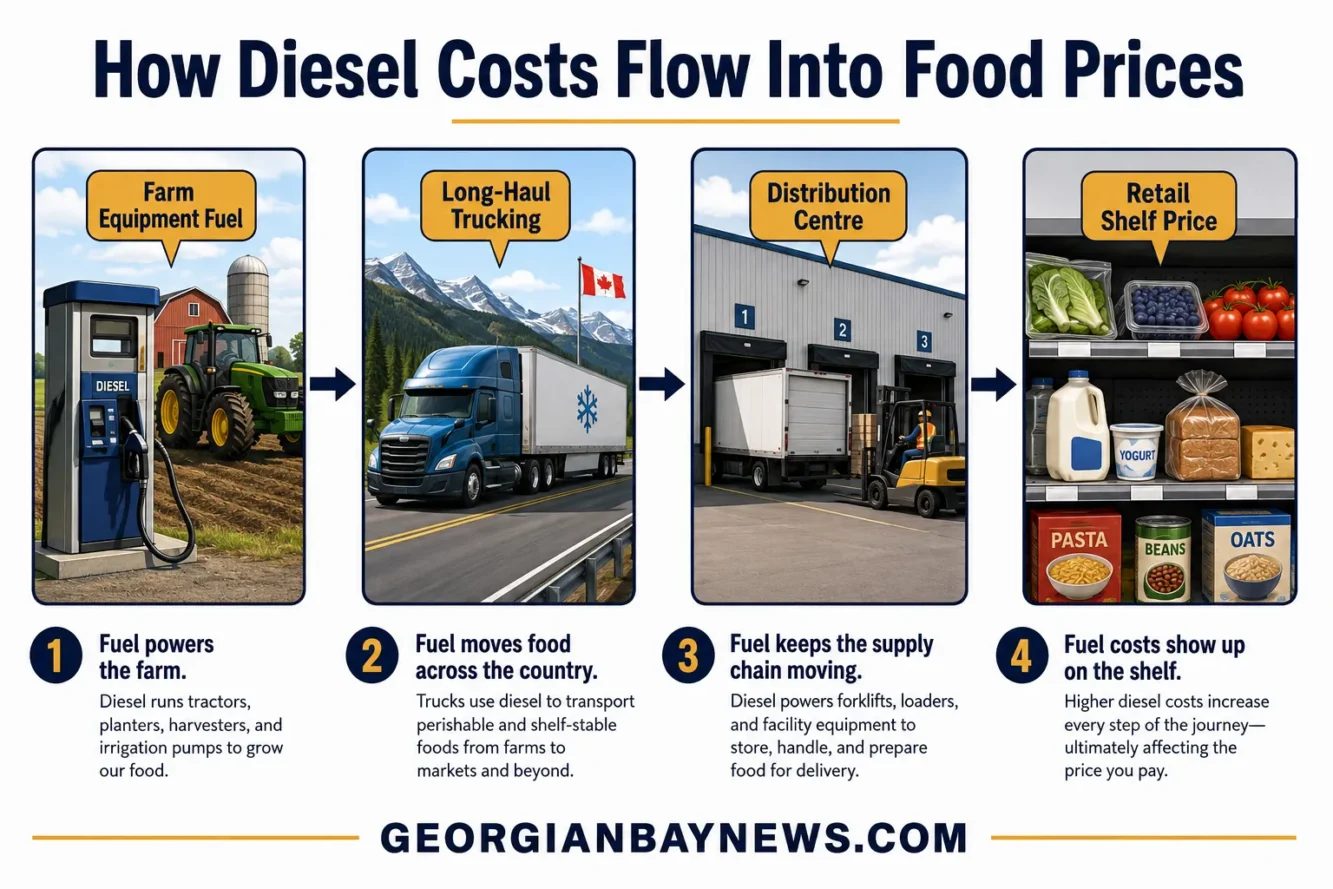
Diesel is the fuel that moves virtually all food in Canada. Every truck that hauls produce from a farm, every refrigerated trailer carrying meat across the country, and every delivery van stocking a grocery store runs on diesel. When diesel prices rise sharply, those costs flow directly into the price of moving food.
Agriculture and Agri-Food Canada explicitly identifies diesel price increases as a key driver of higher food transportation costs, noting that fuel prices directly impact the cost of trucking goods across Canada [10]. Because Canada relies on trucking far more than many other countries, given its vast geography and dispersed population, fuel costs represent a larger share of final food prices here than almost anywhere else.
The mechanism works in layers:
- Farm level: Diesel powers tractors, harvesters, and irrigation equipment. Higher fuel costs raise production costs before food even leaves the farm.
- Transport level: Long-haul truckers pass fuel surcharges to distributors, who pass them to retailers.
- Retail level: Grocery stores absorb some costs initially, but sustained increases eventually reach the shelf.
What Percentage of Food Costs Go to Transportation, and When Do Fuel Increases Show Up?
Transportation typically accounts for a meaningful but variable share of final food costs, and the lag before fuel increases hit grocery shelves is longer than most people expect.
A Scotiabank analysis found that food prices tend to peak roughly 18 months after a major fuel price shock, meaning Canadians who felt diesel prices surge in mid-2025 could see the full grocery impact running well into 2027 [10]. Shelter costs peak sooner, around 12 months after a fuel shock, while food takes longer because supply contracts, inventory buffers, and retailer pricing cycles all slow the pass-through.
Key timing points:
- Immediate (0-3 months): Fuel surcharges appear in distributor invoices
- Short-term (3-6 months): Retailers begin adjusting shelf prices on the most transport-intensive items
- Medium-term (6-18 months): Broad grocery inflation reflects the full supply chain adjustment
- Long-term (18+ months): Prices stabilize only if fuel costs also stabilize
This lag is why the August 2026 cooling in grocery inflation, food store prices up just 2.8% year over year, does not mean the diesel problem has passed [1][4]. The most acute price pressures from recent fuel spikes may still be ahead.
Which Foods Are Most Affected by Diesel Price Hikes?
Fresh produce, imported vegetables, meat, and dairy are the categories most exposed to high diesel prices, though for different reasons.
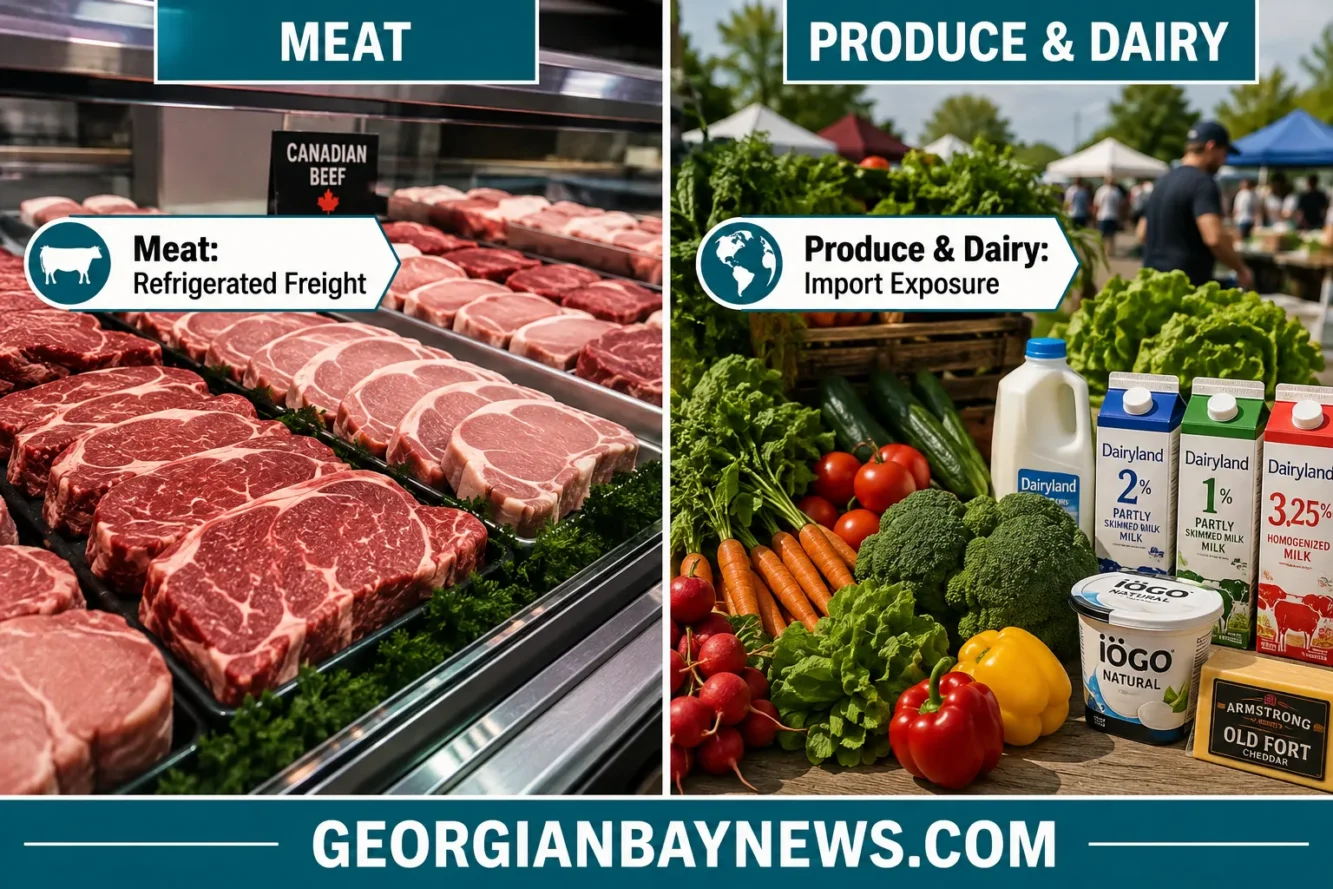
Fresh produce and imported vegetables top the list. Many fruits and vegetables sold in Canada during fall and winter are imported from the United States, Mexico, and beyond, trucked over thousands of kilometres. Agriculture Canada’s food security strategy flags rising global fuel prices as a direct driver of higher Canadian prices for imported consumer foods [10]. Off-season vegetables such as tomatoes, peppers, cucumbers, and leafy greens are especially vulnerable.
Meat is heavily affected because it is dense, perishable, and must be kept refrigerated throughout transport. Beef, pork, and poultry all travel long distances from processing facilities to distribution centres to stores. Higher diesel raises both the direct trucking cost and the energy cost of maintaining cold-chain integrity.
Dairy is somewhat insulated in the short term by Canada’s supply management system, which sets prices through a regulated formula. Dairy prices rose only 0.7% year over year in August 2026 [2]. However, dairy still depends on frequent refrigerated transport, and bank modelling suggests dairy costs could climb over the next 12 to 18 months if fuel remains elevated [10].
Dry and shelf-stable goods (pasta, canned goods, cereals) are less affected because they are less perishable, easier to stockpile, and less dependent on refrigerated transport.
How Much Will Meat Prices Go Up If Diesel Stays High?
Meat prices have shown modest increases in recent StatCan data, with smaller hikes for pork contributing to the overall August 2026 slowdown in food inflation [2]. But analysts caution that this relative calm may not last.
Because meat is heavy and refrigerated, it carries some of the highest per-unit transportation costs of any grocery category. Any sustained diesel price shock will eventually translate into higher beef, pork, and poultry prices, even if official meat inflation currently appears modest [10]. The Scotiabank model points to a 12-to-18-month lag, which means the full impact of 2025’s fuel surge on meat prices may not be fully visible until late 2026 or into 2027.
Factors that amplify meat price increases:
- Long distances between feedlots, processing plants, and urban grocery stores
- Mandatory refrigeration throughout transport and storage
- High weight per unit, increasing fuel consumption per item
- Limited substitution options for consumers who rely on protein
Are Canadian Dairy Prices Tied to Fuel Costs?
Canada’s supply management system for dairy provides a partial buffer, but it does not eliminate the connection between fuel costs and dairy prices.
Dairy prices rose only 0.7% year over year in August 2026, compared with a 3.1% rise in July, a notable deceleration [2]. Supply management sets regulated farmgate prices and import controls, which means retail dairy prices do not swing as freely as produce or meat prices in response to short-term fuel shocks.
That said, dairy products still require frequent refrigerated transport from farms to processing facilities to stores. If diesel costs remain elevated for an extended period, the cost pressure will eventually be factored into regulated price reviews. Bank modelling implies dairy could see higher increases over the next 12 to 18 months if fuel costs stay high [10].
Do Imported Vegetables Get More Expensive When Fuel Costs Rise?
Yes, imported vegetables are among the most exposed grocery items when diesel prices rise. Canada imports a large share of its fresh produce, particularly in fall and winter, from the United States and Mexico. That produce travels by refrigerated truck over distances that can exceed 3,000 kilometres.
Agriculture Canada’s food security analysis stresses that rising global fuel prices are driving up Canadian transportation costs and prices for imported consumer foods [10]. Fresh tomatoes, peppers, cucumbers, and leafy greens imported during off-season months carry significant diesel costs embedded in their final retail price.
Domestic vegetables grown in Ontario, Quebec, and British Columbia during summer months are less exposed, but the Canadian growing season is short. For most of the year, Canadians depend on imports, and those imports are directly tied to diesel economics.
Can Grocery Stores Absorb Fuel Costs Without Raising Prices?
Grocery retailers can absorb short-term fuel cost increases through margin compression, but they cannot sustain that indefinitely.
Canadian grocery chains operate on thin net profit margins, typically in the 2% to 4% range for food retail. When diesel costs spike, retailers initially absorb some of the increase to remain competitive and avoid customer backlash. However, when fuel costs stay high for months, the math stops working. Distributors raise their prices, and retailers have little choice but to follow.
TD Economics noted that, as of August 2026, price pressures at grocery stores had cooled below headline inflation for the first time in almost two years [2]. But with gasoline and diesel still far above year-ago levels, economists expect fuel-related costs to offset some of this relief, making a renewed pickup in grocery inflation likely if energy prices remain elevated [2][10].
When retailers are most likely to raise prices:
- When fuel surcharges from distributors exceed 5% of cost of goods
- When multiple product categories face simultaneous transport cost increases
- When competitor retailers also begin raising prices, reducing the competitive penalty
- When long-term supply contracts expire and are renegotiated at higher rates
Are Canadian Farmers Passing Fuel Costs to Consumers?
Canadian farmers are under significant pressure to pass diesel costs downstream, but their ability to do so depends on the commodity and the market structure.
Farmers who sell into regulated supply-managed systems (dairy, poultry, eggs) have some protection through price formulas that can account for input costs. Farmers selling into open commodity markets (grains, beef, pork) face more competitive pressure and may absorb costs in the short term, especially if global commodity prices are soft.
However, with diesel fuel costs running well above historical norms, StatCan’s Food Price Data Hub reports a diesel fuel indicator of 75.0 for August 2026, farm operating costs are genuinely elevated [10]. Fuel is a direct input for tractors, combines, irrigation pumps, and grain dryers. When those costs rise, farmers eventually need higher prices to stay viable, and that pressure works its way through the supply chain to consumers.
How Do Supply Chain Issues Make Fuel Price Impacts Worse on Food?
Supply chain disruptions act as a multiplier on fuel price impacts. When supply chains are already strained, by labour shortages, border delays, or extreme weather, the added cost of expensive diesel becomes harder to absorb and easier to pass on.
Canada’s food supply chain is particularly vulnerable because of:
- Geographic concentration: Many processing facilities serve large geographic areas, requiring long-haul transport
- Limited redundancy: Fewer alternative routes or suppliers mean less ability to shop for cheaper transport options
- Northern and remote communities: Food must travel even farther, and solutions for reducing costs are limited by infrastructure
A Scotiabank analysis warns that a major diesel and crude oil price shock will be inflationary for “just about everything,” including food, as higher fuel costs work through already-stressed supply chains [10]. The combination of elevated fuel costs and supply chain fragility is what makes the current environment particularly concerning for Canadian grocery prices.
What’s the Difference Between How Produce and Meat Respond to Fuel Costs?
Produce and meat both respond to diesel price increases, but the timing and mechanism differ in important ways.
Fresh produce responds quickly. Fruits and vegetables have short shelf lives, so supply chains turn over rapidly. A diesel price spike shows up in produce prices within weeks because distributors cannot delay purchasing or hold inventory. Imported produce is especially fast to reflect fuel costs.
Meat responds more slowly but more durably. Meat production involves longer supply chains, from feed grain to feedlot to processing plant to distribution centre to store. Each stage adds a buffer that slows the pass-through. But once meat prices rise due to fuel costs, they tend to stay elevated longer because the entire production cycle has been repriced.
Dairy is the most insulated short-term, due to supply management, but is not immune over a 12-to-18-month horizon [10].
The practical implication for Canadian shoppers: expect produce price increases to show up first, meat increases to follow over the next several months, and dairy to remain relatively stable until the next regulated price review cycle.
FAQ
How much have Canadian grocery prices risen overall since 2021?
Food prices at Canadian stores are approximately 29% higher than they were in August 2021, based on StatCan data summarized by national media [6]. Any new diesel-driven increases will be layered on top of this already elevated baseline.
What was the Canadian food inflation rate in August 2026?
Food purchased from stores was 2.8% more expensive in August 2026 than a year earlier, down from 3.1% in July and 3.9% in June, the first time since July 2024 that grocery inflation ran below the overall CPI [1][4].
How high were diesel and gasoline prices in August 2026?
Gasoline prices were 22.8% higher in August 2026 than a year earlier, following a 25.7% annual increase in July, with firm crude prices and Middle East conflict cited as key drivers [2]. StatCan’s diesel fuel indicator stood at 75.0 for August 2026 [10].
Which grocery items are most exposed to diesel price increases?
Fresh and imported produce (tomatoes, peppers, cucumbers, leafy greens), beef, pork, poultry, and dairy products all face meaningful exposure. Imported vegetables and meat carry the highest transport cost burden.
How long before diesel price increases fully show up in food prices?
Scotiabank modelling estimates food prices typically peak about 18 months after a major fuel price shock [10]. This means the full impact of mid-2025 diesel surges may not be fully reflected in grocery bills until late 2026 or 2027.
Are rural and northern Canadians hit harder by diesel price increases?
Yes. Food must travel longer distances to reach rural and northern communities, and limited retail competition makes it harder for stores to absorb higher transport costs without raising shelf prices [10].
Will supply management protect dairy prices from diesel increases?
Supply management provides a short-term buffer. Dairy prices rose only 0.7% year over year in August 2026 [2]. But if diesel stays high, the cost pressure will eventually be reflected in regulated price reviews.
Can Canadians expect grocery prices to fall if diesel prices drop?
Grocery prices tend to rise faster than they fall. Even if diesel costs ease, retailers and distributors are slow to reduce prices once costs have been repriced into supply contracts. A meaningful rollback in grocery bills is unlikely in the near term [10].
What is driving diesel prices so high in Canada in 2026?
Firm global crude oil prices and ongoing conflict in the Middle East are the primary drivers cited by Reuters and StatCan for elevated energy costs in Canada in 2026 [2][6].
Are there any grocery categories that are relatively safe from diesel price hikes?
Shelf-stable, non-perishable items (canned goods, dry pasta, cereals) are less exposed because they do not require refrigerated transport and can be stockpiled. However, they are not entirely immune, as trucking costs affect all goods.
Conclusion
With the price of diesel being so high, the pressure on Canadian grocery, vegetable, dairy, and meat prices is real, and, according to economists, not yet fully felt. Food store prices have shown a short-term cooling in mid-2026, but that relief sits on top of a 29% cumulative price increase since 2021 [6]. The 18-month lag in how fuel shocks translate into grocery bills means Canadians should prepare for continued upward pressure through 2027, particularly on fresh produce, imported vegetables, and meat.
Actionable steps for Canadian households:
- Buy seasonal and local produce when possible to reduce exposure to import-dependent, fuel-intensive supply chains
- Watch for unit price changes rather than package size changes, shrinkflation can mask effective price increases
- Stock non-perishables when prices are stable, particularly shelf-stable proteins and grains
- Compare store brands against name brands, as private-label products often carry lower transport cost markups
- Monitor fuel price trends as an early indicator of where grocery prices are heading in the months ahead
Staying informed is the best defence. Georgian Bay News will continue tracking how energy prices and supply chain developments affect the cost of living for Canadians across the region.
References
[1] Dq260914a Eng – https://www150.statcan.gc.ca/n1/daily-quotidien/260914/dq260914a-eng.htm
[2] Canadas August Inflation Holds Steady 3 Crude Stays Firm Food Prices Ease 2026 09 14 – https://www.reuters.com/world/americas/canadas-august-inflation-holds-steady-3-crude-stays-firm-food-prices-ease-2026-09-14/
[4] 9327 Weekly Review September 14 18 2026 – https://www.statcan.gc.ca/o1/en/plus/9327-weekly-review-september-14-18-2026
[6] Inflation August 2026 – https://globalnews.ca/news/12058045/inflation-august-2026/
[10] Food Prices Diesel Scotiabank – https://globalnews.ca/news/12088214/food-prices-diesel-scotiabank/
Content, illustrations, and third-party video appearing on GEORGIANBAYNEWS.COM may be generated or curated with AI assistance or reproduced pursuant to the fair dealing provisions of the Copyright Act, R.S.C. 1985, c. C-42. Attribution and hyperlinks to original sources are provided in acknowledgment of applicable intellectual property rights. Such referencing is intended to direct traffic to and support the original rights holders’ platforms.