




















Granny Pods as Economic Lifesavers: How 400 Sq Ft Backyard Tiny Homes Are Enabling Multigenerational Living and Childcare in 2026
Last updated: February 23, 2026
Key Takeaways
- Granny pods cost 61% less than the median U.S. home price, with prefabricated models starting under $160,000 and custom builds typically under $250,000[1][5]
- Childcare savings are massive: With childcare costs reaching $362,891 in high-cost areas over 18 years, live-in grandparents provide free care while maintaining independence[1]
- Assisted living alternative: At $5,190/month for assisted living, a $250,000 granny pod pays for itself in under four years while keeping families together[5]
- Build time is quick: Custom granny pods can be completed in less than three months with minimal permitting requirements in many jurisdictions[1]
- Operating costs stay low: Monthly utilities average around $35 for propane and basic services, far below traditional housing expenses[1]
- Accessibility features included: Purpose-built granny pods feature nonslip floors, wide doorways, emergency alert systems, and mobility assistance unlike standard ADUs[2][4][5]
- Real estate experts confirm: Industry leaders cite “economic necessity” driven by affordability issues, housing shortages, and multigenerational care demands as primary growth factors[1]
- Sandwich generation relief: Adults caring for both children and aging parents find granny pods solve dual care crises simultaneously
- Property value boost: Well-designed accessory dwelling units can increase main property values by 15-20% while generating rental income potential[7]
- Rapid adoption across U.S.: Reports from Maryland, Michigan, and Oregon document accelerating interest in early 2026[1]
Quick Answer
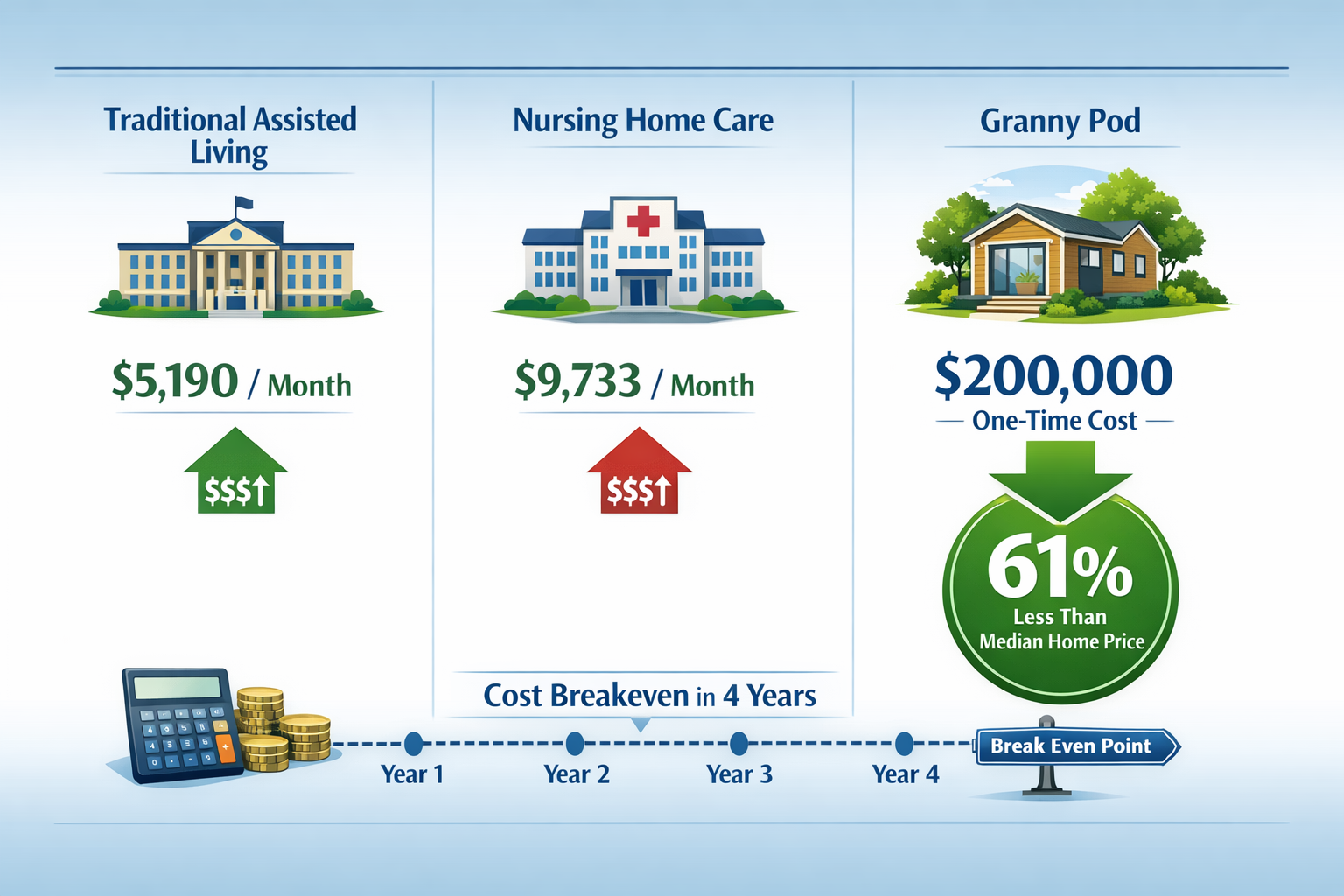
Granny pods—compact 300-440 square foot backyard homes—are solving America’s multigenerational care crisis in 2026 by providing affordable housing for grandparents who can then offer free childcare while maintaining independence. At under $200,000 to build versus $5,190/month for assisted living and childcare costs exceeding $360,000 over 18 years in expensive markets, these tiny homes deliver financial relief to sandwich-generation families. Real estate experts confirm the trend is driven by “economic necessity” amid housing shortages and unaffordable care options[1][5].
What Are Granny Pods and Why Are They Becoming Economic Necessities in 2026?
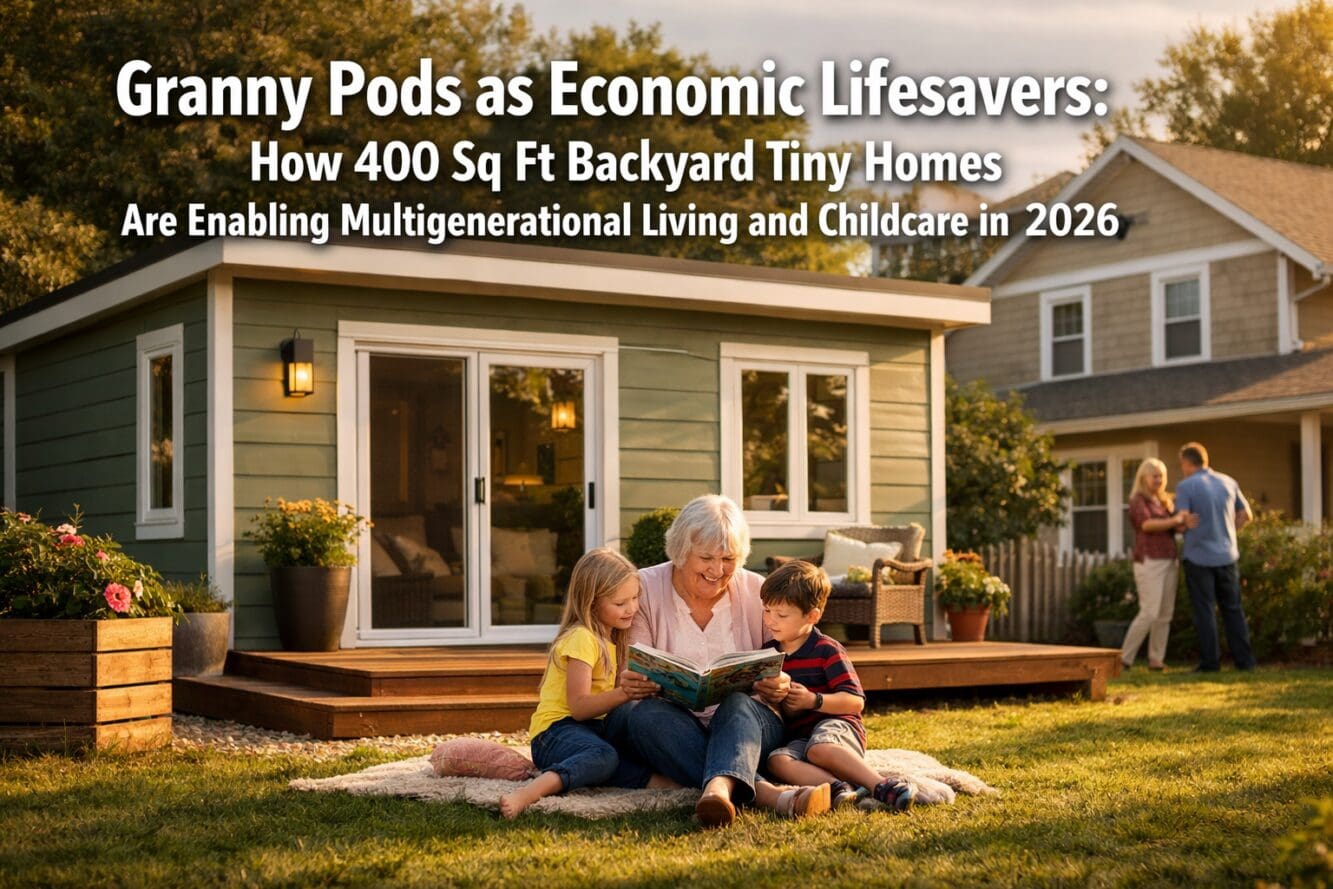
Granny pods are small, self-contained homes (typically 300-440 square feet) built in the backyards of family properties, specifically designed for aging relatives with accessibility features like wide doorways, nonslip flooring, and emergency alert systems[2][4][5]. Unlike standard accessory dwelling units (ADUs), granny pods prioritize senior safety and independence while keeping families physically close.
Jason Waugh, president of global real estate brokerage Coldwell Banker Affiliates, directly attributes the 2026 surge in granny pod requests to “affordability issues and economic uncertainty” over the past three years, citing high mortgage interest rates, poor economic conditions, and severe housing inventory shortages[1].
The economic case is compelling:
- Housing cost comparison: Granny pods cost approximately 61% less than the median U.S. home price of $410,800[1]
- Care cost avoidance: Assisted living averages $5,190 monthly, while skilled nursing ranges from $8,669-$9,733 monthly in 2025[5]
- Childcare crisis: Raising a child costs an average of $297,674 over 18 years, with childcare potentially reaching $362,891 in high-cost areas[1]
- Breakeven timeline: A $250,000 granny pod could pay for itself in fewer than four years compared to assisted living costs alone[5]
The arrangement creates a mutually beneficial exchange: grandparents gain affordable, independent living near family support, while working parents receive reliable childcare and eldercare under one roof. For families navigating what experts call the “sandwich generation” crisis—simultaneously caring for children and aging parents—granny pods offer a practical solution to an otherwise financially devastating situation.
Similar to the benefits found in thriving tiny house communities, granny pods provide simplified living that reduces financial stress while maintaining quality of life.
How Much Do Granny Pods Actually Cost in 2026?
Granny pods range from $100,000 to $250,000 depending on customization, with prefabricated options from manufacturers like Spindrift Tiny Homes starting under $160,000[1][2][5]. This represents a fraction of traditional housing costs and delivers faster financial returns than conventional real estate investments.
Real-world example: Denise Martin, a 65-year-old retired financial advisor, completed her custom 400-square-foot granny pod for under $200,000 in less than three months[1]. Her monthly operating costs total approximately $35 for propane utilities—dramatically lower than her previous Arizona housing expenses.
Cost Breakdown by Component
| Expense Category | Typical Range | Notes |
|---|---|---|
| Base prefab unit | $100,000-$160,000 | Standard models from manufacturers |
| Custom builds | $160,000-$250,000 | Tailored features, finishes, layouts |
| Site preparation | $5,000-$15,000 | Grading, foundation, access paths |
| Utility hookups | $3,000-$10,000 | Electric, water, sewer connections |
| Permits & fees | $500-$5,000 | Varies significantly by jurisdiction |
| Furnishings | $5,000-$15,000 | Appliances, furniture, fixtures |
| Monthly utilities | $30-$75 | Propane, electric, water, internet |
Key cost advantages over alternatives:
- Versus traditional home: 61% less than $410,800 median U.S. home price[1]
- Versus assisted living: $5,190/month = $62,280/year; granny pod pays for itself in 3-4 years[5]
- Versus childcare: Full-time daycare averages $1,200-$2,000/month per child; grandparent care is free
The financial math becomes even more compelling when considering that many granny pods can later serve as rental units, generating $800-$1,500 monthly income in most markets[7]. This flexibility provides long-term return on investment beyond the immediate multigenerational living benefits.
Communities exploring affordable housing solutions should consider granny pods as a viable option for addressing both senior housing and childcare challenges simultaneously.
What Makes Granny Pods Different From Regular Tiny Homes or ADUs?
Granny pods are purpose-built for senior safety and accessibility, featuring specialized equipment and design elements that standard tiny homes and ADUs typically lack. While all three provide compact living spaces, granny pods prioritize aging-in-place functionality over general housing flexibility[2][4][5].
Senior-specific features that differentiate granny pods:
- Nonslip flooring throughout to prevent dangerous falls
- Wide doorways (36+ inches) for wheelchair and walker accessibility
- Emergency alert systems with direct family/medical contact
- Mechanical lifts for mobility assistance between levels
- Video monitoring systems for safety without invasion of privacy
- Strategic hand railings along walkways and in bathrooms
- Defibrillators and first aid equipment readily accessible
- Lighted floorboards to minimize nighttime fall injuries
- Single-level layouts or gentle ramps instead of stairs
- Grab bars in showers and near toilets
Comparison to standard options:
| Feature | Granny Pod | Standard ADU | Tiny Home |
|---|---|---|---|
| Primary purpose | Senior housing + care | General housing/rental | Minimalist lifestyle |
| Accessibility focus | High (built-in) | Variable (optional) | Low (often lofts) |
| Medical equipment | Standard inclusion | Rare | None |
| Emergency systems | Required | Optional | None |
| Typical cost | $160,000-$250,000 | $100,000-$300,000 | $50,000-$150,000 |
| Mobility features | Comprehensive | Minimal | None |
Denise Martin’s granny pod includes a 10-by-10 foot loft sleeping area above a 300-square-foot main living space, complete with freestanding kitchen, bathroom, and laundry facilities[1]. However, unlike typical tiny homes with steep ladder access to lofts, her unit likely features safer access appropriate for a 65-year-old resident.
The design philosophy centers on independence with proximity—grandparents maintain full autonomy and privacy in their own home while remaining close enough to family for daily interaction and emergency assistance. This balance proves crucial for both senior dignity and family peace of mind.
How Does Denise Martin’s Story Illustrate the Granny Pod Movement?
Denise Martin’s experience provides a concrete case study of how granny pods solve multiple economic and family challenges simultaneously. The 65-year-old retired financial advisor relocated from Arizona to her daughter’s Bend, Oregon property in December 2024, moving into a custom Spindrift Tiny Homes granny pod built by her son-in-law, Bijan Taherkhan[1].
Martin’s primary motivations:
- Grandchild care: “The primary reason why I relocated here was because I had a granddaughter, and I now have a second granddaughter who’s four months old,” Martin explains[1]
- Cost savings: Monthly expenses dropped dramatically from her Arizona house to approximately $35 for propane utilities
- Family proximity: Daily participation in family activities while maintaining complete independence
- Simplified living: Radical downsizing taught her she doesn’t need everything she once thought necessary
Timeline and adjustment period:
- Construction: Less than 3 months from start to completion[1]
- No permitting hassles: No DMV registration or complex permits required
- Adjustment period: 6 months to fully adapt to 400 square feet[1]
- Current status: Over one year of successful multigenerational living
Martin’s story reflects broader trends documented across Maryland, Michigan, and Oregon in early 2026, where families are rapidly adopting granny pods as practical solutions to converging crises: unaffordable childcare, financially punishing eldercare, and sandwich-generation burnout[1].
“There was room to put one on the property for me, and that enabled me to be close to the grandchildren, help out the family when needed, [and] just participate in all the things that go on on this property, and live very comfortably at the same time.” — Denise Martin[1]
Her arrangement exemplifies the dual benefit: while Martin provides free childcare that would otherwise cost her daughter $1,500-$2,000 monthly, she simultaneously avoids assisted living expenses of $5,190 per month while living in a home that cost less than $200,000 to build[1][5].
The financial and emotional returns prove substantial for all generations involved, demonstrating why real estate experts now classify granny pods as “economic necessities” rather than lifestyle choices.
What Are the Biggest Benefits of Granny Pods for Multigenerational Families?
Granny pods deliver financial, practical, and emotional advantages that address multiple family challenges simultaneously. The arrangement creates value for grandparents, adult children, and grandchildren in ways that traditional housing or care facilities cannot match.
Financial benefits:
- Childcare savings: $1,200-$2,000/month per child avoided through grandparent care
- Eldercare savings: $5,190-$9,733/month in assisted living or nursing costs avoided[5]
- Housing cost reduction: 61% less than median home prices for senior housing[1]
- Utility efficiency: Monthly costs as low as $35 for basic services[1]
- Property value increase: Well-designed ADUs can boost main home values 15-20%[7]
- Future rental income: Potential $800-$1,500/month when family needs change
Practical advantages:
- Immediate emergency response: Family members seconds away during medical events
- Shared household duties: Grandparents help with cooking, cleaning, errands
- Transportation assistance: Reduced need for senior driving or ride services
- Medication management: Family oversight of health routines
- Social engagement: Daily interaction prevents senior isolation
- Childcare flexibility: Parents can work irregular hours with reliable backup
Emotional and relationship benefits:
- Grandchild bonding: Daily opportunities for intergenerational connection
- Senior independence: Complete autonomy and privacy in personal space
- Family peace of mind: Constant awareness of elderly parent’s wellbeing
- Cultural continuity: Grandparents actively participate in raising grandchildren
- Reduced guilt: Adult children avoid difficult assisted living placement decisions
Common mistake to avoid: Treating the granny pod as “guest quarters” rather than the grandparent’s primary home. Successful arrangements require clear boundaries about privacy, visiting hours, and household responsibilities to prevent resentment.
The arrangement works best when all parties view it as a mutually beneficial partnership rather than one generation doing a favor for another. Martin’s experience demonstrates this balance—she helps with grandchildren when needed but maintains her own independent life in her 400-square-foot sanctuary[1].
For families considering similar arrangements, exploring cohousing communities can provide additional insights into successful multigenerational living models.
What Should Families Know Before Building a Granny Pod?
Building a granny pod requires careful planning across zoning, utilities, design, and family dynamics. While the process can be completed in under three months, success depends on addressing key considerations upfront[1].
Critical planning steps:
1. Zoning and Legal Requirements
- Check local ADU regulations: Many jurisdictions now allow accessory dwelling units, but size, setback, and occupancy rules vary significantly
- Verify property zoning: Single-family residential zones typically permit granny pods, but confirm specific restrictions
- Understand permit requirements: Some areas require building permits; others (like Martin’s Oregon location) have minimal requirements[1]
- Review HOA rules: Homeowners associations may prohibit or restrict backyard structures
- Consider septic capacity: Properties on septic systems may need upgrades to handle additional dwelling
2. Site Assessment and Preparation
- Evaluate yard space: Minimum 400-600 square feet needed for pod plus clearances
- Check utility access: Proximity to electric, water, and sewer connections affects costs
- Assess terrain: Sloped lots may require expensive grading or foundation work
- Consider privacy: Position pod to maximize both independence and family connection
- Plan access paths: Safe, well-lit walkways between main house and pod essential for seniors
3. Budget and Financing
- Total project cost: $120,000-$280,000 including unit, site prep, utilities, permits
- Financing options: Home equity loans, construction loans, cash-out refinancing
- Hidden costs: Landscaping, fencing, outdoor lighting, furniture often overlooked
- Ongoing expenses: Property tax increases, insurance adjustments, utility costs
- ROI timeline: Calculate breakeven versus assisted living and childcare costs
4. Design and Customization
Choose between:
- Prefabricated models: $100,000-$160,000, faster delivery, limited customization[2][5]
- Custom builds: $160,000-$250,000, tailored features, longer timelines[1]
Essential features for seniors:
- Single-level layout or safe lift system
- Roll-in shower with grab bars
- Wide doorways (36+ inches minimum)
- Emergency alert system
- Adequate heating/cooling for medical needs
- Storage for medications and medical equipment
5. Family Agreements
Establish clear expectations before construction:
- Privacy boundaries: When can family enter the pod? Knock-first policies?
- Childcare expectations: How many hours weekly? What age children?
- Financial contributions: Does grandparent pay rent, utilities, or property tax share?
- Maintenance responsibilities: Who handles repairs, landscaping, cleaning?
- Exit strategy: What happens if health declines or relationships strain?
Common pitfall: Failing to discuss what happens if the grandparent needs skilled nursing care. The granny pod then becomes valuable rental income to help pay for advanced care—but only if zoning allows non-family rentals.
Martin’s son-in-law owned Spindrift Tiny Homes, which simplified her process considerably[1]. Families without construction connections should vet manufacturers carefully, checking references, warranties, and local building code compliance.
Communities interested in supporting multigenerational housing might explore economic development grants that could help fund granny pod initiatives as affordable housing solutions.
How Do Granny Pods Compare to Other Senior Housing Options in 2026?
Granny pods offer distinct advantages over traditional senior housing alternatives when families prioritize proximity, independence, and cost control. However, they’re not suitable for every situation—particularly when advanced medical care becomes necessary.
Detailed comparison:
| Housing Option | Monthly Cost | One-Time Cost | Pros | Cons |
|---|---|---|---|---|
| Granny Pod | $30-$75 utilities | $100,000-$250,000 | Family proximity, independence, childcare exchange, cost-effective long-term | Requires suitable property, limited medical support, family dynamics risk |
| Assisted Living | $5,190 average[5] | $0-$5,000 deposit | Professional care, social activities, no family burden | Expensive ($62,280/year), institutional setting, family separation |
| Skilled Nursing | $8,669-$9,733[5] | $0-$10,000 deposit | 24/7 medical care, rehabilitation services | Very expensive ($104,000-$117,000/year), hospital-like environment |
| In-Home Care | $4,000-$8,000 | $0 | Familiar environment, personalized care | Expensive, home modifications needed, caregiver turnover |
| Independent Senior Apartment | $2,500-$4,000 | $0-$3,000 deposit | Age-appropriate community, maintenance-free | Ongoing expense, family distance, limited care services |
| Living with Family (no pod) | $200-$500 contribution | $0 | Free/cheap, family support | Privacy loss, potential conflict, home modifications needed |
Choose granny pods when:
- Grandparent is relatively healthy and independent (can manage daily activities)
- Family property has adequate space and suitable zoning
- Childcare needs create mutual benefit exchange
- Long-term cost savings justify upfront investment
- Both generations value proximity but need separate living spaces
- Family relationships are strong and communication is clear
Choose alternatives when:
- Grandparent requires daily medical monitoring or skilled nursing
- Property lacks space or zoning prohibits ADUs
- Family dynamics are strained or conflict-prone
- Upfront capital ($100,000-$250,000) is unavailable
- Grandparent prefers age-segregated community with peer socialization
- Climate or geography makes backyard living impractical
Financial breakeven analysis:
A $200,000 granny pod versus $5,190/month assisted living:
- Year 1: Granny pod costs $200,000; assisted living costs $62,280
- Year 2: Granny pod costs $200,000 + $900 utilities; assisted living costs $124,560
- Year 3: Granny pod costs $200,000 + $1,800 utilities; assisted living costs $186,840
- Breakeven: Approximately 3.2 years
Add childcare savings of $1,500/month ($18,000/year), and the granny pod pays for itself in roughly 2.2 years. After that, families save $80,000+ annually compared to paying for both assisted living and childcare separately.
Martin’s experience confirms these economics: her under-$200,000 pod with $35 monthly utilities provides both her housing and enables her to care for two granddaughters, delivering combined savings that would otherwise exceed $100,000 annually[1].
What Are the Most Common Challenges and How Can Families Overcome Them?
While granny pods solve many problems, they also create new challenges that require proactive management. Successful multigenerational living depends on addressing potential conflicts before they escalate.
Challenge 1: Privacy and Boundary Issues
Problem: Family members entering pod without permission, grandparents feeling obligated to always be available, or grandchildren treating pod as playground.
Solutions:
- Install separate entrance with lock
- Establish “office hours” for childcare availability
- Create visual signal system (door sign, flag) indicating when grandparent is unavailable
- Schedule weekly family meetings to address concerns
- Design pod with curtains/blinds for complete visual privacy
Challenge 2: Zoning and Permit Obstacles
Problem: Local regulations prohibit ADUs, require expensive permits, or limit occupancy to family members only.
Solutions:
- Research zoning before purchasing property
- Attend planning commission meetings to request variances
- Join advocacy groups pushing for ADU-friendly zoning reforms
- Consider jurisdictions with favorable tiny home regulations (Oregon, California, Texas often more permissive)
- Hire local attorney familiar with ADU law if facing resistance
Edge case: Some jurisdictions classify granny pods as “temporary structures” or “medical hardship housing” with different (often easier) approval processes than permanent ADUs.
Challenge 3: Utility and Infrastructure Costs
Problem: Connecting electricity, water, and sewer to backyard location costs more than expected.
Solutions:
- Get multiple contractor quotes before committing
- Consider partial off-grid systems (solar panels, composting toilets) if utility hookups exceed $15,000
- Negotiate with utility companies about trenching costs
- Position pod closer to main house utility connections
- Budget 20% contingency for unexpected infrastructure issues
Challenge 4: Downsizing Resistance
Problem: Grandparent struggles to fit lifetime of possessions into 400 square feet, creating stress and delaying move-in.
Solutions:
- Start downsizing 6-12 months before construction
- Use storage unit temporarily for sentimental items
- Digitize photos, documents, and memorabilia
- Focus on quality over quantity (keep favorite items, donate duplicates)
- Remember Martin’s lesson: “She doesn’t need everything she once thought she needed”[1]
Challenge 5: Family Relationship Strain
Problem: Daily proximity exposes conflicts, different parenting philosophies clash, or financial arrangements feel unfair.
Solutions:
- Draft written agreement covering expectations, finances, and exit strategies
- Schedule regular check-ins to address small issues before they grow
- Maintain separate social lives and friend groups
- Consider family counseling if conflicts escalate
- Build in “escape valves” (grandparent visits other family members monthly)
Challenge 6: Health Decline and Care Escalation
Problem: Grandparent’s health deteriorates beyond what granny pod can accommodate.
Solutions:
- Plan exit strategy upfront (convert to rental? Sell? Leave empty?)
- Purchase long-term care insurance before building pod
- Research in-home care services available in area
- Design pod with future rental potential to fund nursing care
- Accept that granny pod may be temporary solution (5-10 years) before higher care level needed
Common mistake: Assuming granny pod will work indefinitely. Most successful arrangements last 5-15 years before health changes require different solutions. This is still long enough to achieve significant financial savings and family benefits.
Martin required six months to adjust to her 400-square-foot space, demonstrating that even enthusiastic grandparents need patience during transitions[1]. Families should expect a learning curve and remain flexible as everyone adapts to the new arrangement.
What Does the Future Hold for Granny Pods and Multigenerational Living?
The granny pod trend shows no signs of slowing in 2026, driven by converging economic pressures that make traditional housing and care models increasingly unsustainable for middle-class families. Industry experts predict continued growth as more jurisdictions update zoning laws and manufacturers expand production capacity.
Factors accelerating adoption:
- Housing affordability crisis: Median home prices remain elevated while interest rates fluctuate, making separate senior housing prohibitively expensive
- Childcare cost explosion: With costs potentially reaching $362,891 over 18 years in expensive markets, free grandparent care becomes economically essential[1]
- Aging population: 10,000 Americans turn 65 daily, creating massive demand for senior housing alternatives
- Zoning reforms: California, Oregon, Washington, and other states have passed laws requiring municipalities to allow ADUs
- Sandwich generation growth: More adults simultaneously caring for children and aging parents
- Remote work flexibility: Home-based workers can more easily coordinate with live-in grandparents
Emerging trends:
- Modular manufacturing scale-up: Companies like Spindrift Tiny Homes expanding production to meet demand[1]
- Smart home integration: Granny pods featuring health monitoring, fall detection, and telemedicine capabilities
- Community granny pod developments: Shared granny pod villages on family compounds or cooperative properties
- Financing innovation: Specialized loans and reverse mortgage products designed for ADU construction
- Intergenerational design: Pods built for flexibility—senior housing now, teen suite later, rental unit eventually
Policy developments to watch:
- Federal tax incentives for multigenerational housing construction
- Medicare/Medicaid programs recognizing granny pods as eligible care settings
- Building code standardization for manufactured granny pods
- Utility company programs offering reduced hookup fees for ADUs
- Property tax exemptions for family-occupied granny pods
Market projections:
While precise data remains limited, real estate professionals report substantial inquiry increases. Waugh’s observation about “economic necessity” driving demand suggests the market will continue expanding as long as housing costs, childcare expenses, and eldercare fees remain high relative to median incomes[1].
The movement aligns with broader shifts toward sustainable community living and simplified housing solutions that prioritize affordability and connection over square footage and status.
Potential obstacles:
- Neighborhood opposition to increased density
- Construction cost inflation reducing affordability advantage
- Supply chain disruptions delaying manufacturing
- Family conflict stories creating negative perception
- Economic recession reducing available capital for construction
Despite challenges, the fundamental economics remain compelling: families facing $80,000-$100,000 in combined annual childcare and eldercare costs will continue seeking alternatives. Granny pods offer a proven solution that delivers financial relief while strengthening family bonds—a combination that ensures continued relevance regardless of broader economic conditions.
Frequently Asked Questions About Granny Pods
How much does a granny pod cost to build in 2026?
Granny pods typically cost $100,000-$250,000 depending on customization, with prefabricated models starting under $160,000 and custom builds reaching the higher end of the range[1][2][5]. Additional costs include site preparation ($5,000-$15,000), utility hookups ($3,000-$10,000), and permits ($500-$5,000). Monthly operating costs average $30-$75 for utilities.
Are granny pods legal in all states?
No. Granny pod legality depends on local zoning ordinances, which vary by state, county, and municipality. Many jurisdictions now allow accessory dwelling units (ADUs), but size limits, setback requirements, and occupancy restrictions differ. Oregon, California, Washington, and Texas generally have favorable ADU laws, while some conservative zoning areas prohibit them entirely. Always check local regulations before purchasing.
How long does it take to build a granny pod?
Prefabricated granny pods can be delivered and installed in 4-12 weeks, while custom builds typically take 2-4 months from design to completion. Denise Martin’s custom Spindrift Tiny Homes unit was completed in less than three months[1]. Timeline factors include manufacturer backlog, site preparation complexity, utility hookup requirements, and permit approval speed.
Can granny pods be moved if we relocate?
Some granny pods are built on permanent foundations and cannot be moved, while others are constructed on trailers or skids for portability. If mobility is important, specify this requirement when ordering. However, moving a granny pod costs $5,000-$15,000 depending on distance and requires suitable zoning at the new location. Most families treat granny pods as permanent structures.
What happens to the granny pod when the grandparent no longer needs it?
Granny pods can be repurposed as rental units (generating $800-$1,500 monthly income), guest houses, home offices, teen suites, or sold separately in some jurisdictions[7]. Many families use rental income to help fund nursing home care if needed. Check local zoning to confirm non-family rental is permitted before building if this flexibility is important.
Do granny pods increase property taxes?
Yes, adding a granny pod typically increases property assessments and taxes because it adds square footage and value to the property. However, the increase is usually modest (5-15% of total tax bill) compared to the financial benefits. Some jurisdictions offer tax exemptions for family-occupied ADUs—check with your local assessor’s office.
How big are granny pods typically?
Granny pods range from 300-440 square feet of living space, often with additional loft sleeping
Content, illustrations, and third-party video appearing on GEORGIANBAYNEWS.COM may be generated or curated with AI assistance or reproduced pursuant to the fair dealing provisions of the Copyright Act, R.S.C. 1985, c. C-42. Attribution and hyperlinks to original sources are provided in acknowledgment of applicable intellectual property rights. Such referencing is intended to direct traffic to and support the original rights holders’ platforms.